

April 18, 2023
Multilateral financier World Bank has urged government to give incentives for private sector to invest in climate smart agriculture and renewable energy and to tap ESG bonds to finance climate actions countering disasters.
Presenting its Country Climate and Development Report (CCDR) 2022 in a forum of the Southeast Asian Regional Center for Graduate Study and Research in Agriculture (SEARCA), World Bank officials stressed government has to raise access of climate financing to private sector.
That along with making investment policies for climate action attractive and encouraging access particularly to ESG bonds.
“Public and private investments are needed to finance adaptation through climate-resilient infrastructure. Financing mitigation measures from private sector should be incentivized by new regulatory technology-push and demand-pull policies,” said Souleymane Coulibaly, World Bank project leader and lead economist, at the SEARCA forum.
“On the private side, issuing ESG bonds under the recently introduced Sustainability Financing Framework could leverage private financing for climate actions.”
ESG bonds (environmental, social, governance) are generally part of sustainability financing supported by the Bangko Sentral ng Pilipinas. Eligible green expenditures are clean transportation, climate change adaptation and disaster risk reduction projects, sustainable agriculture, and renewable energy (solar, wind, geothermal, biomass, hydropower).
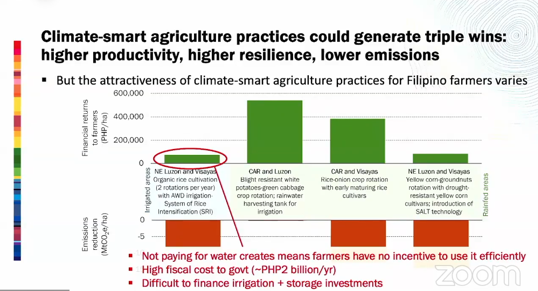
Dr. Stefano Pagiola, World Bank senior environmental economist, also said at the SEARCA forum that attractiveness to farmers of climate smart agriculture practices should be improved as these have triple wins.
These are higher productivity, higher resilience, and lower greenhouse gas emissions.
Some policies must be avoided. A policy for farmers not to pay for water does not give farmers incentives to use water efficiently.
In Luzon and Cordillera, a technology that may have higher financial return for farmers is the use of blight resistant white potatoes in crop rotation with green cabbage and rainwater harvesting.
Financial return is estimated at more than P500,000 per hectare.
In Visayas and Cordillera, another technology with good financial return is rice-onion crop rotation with the use of early maturing rice.
Dr. Glenn B. Gregorio, SEARCA director, said that talks on climate policies are now so critical. He himself has been immersed since 1986 in developing adaptation solutions to climate challenge.
“Sustainable Development Goal 13 for climate action is close to my heart. I have been a plant breeder for abiotic stresses, (developing rice) for drought tolerance, submergence tolerance, and salt tolerance,” said Gregorio.
Climate change adaptation techniques in agriculture enable crops to withstand increasing temperature from global warming and receding rainfall.
Gregorio stressed collaboration from the academe and industries are important to promote sustainable practices.
Focus on benefitting the poorest
The poorest population will be the most adversely affected by climate disasters– with consumption reducing by almost 9% compared to the richer population’s lower 6%.
As such, solutions should prioritize the poorest, along with women, for their target beneficiaries.
The Philippines is extremely vulnerable to erratic climate change, with temperature that has risen by two 0.68 degrees C (Centigrade), further rising by 1-3 degrees C, on various scenarios.
As financing the cost of climate solutions is extremely high, total gross domestic product (GDP) of the Philippines is foreseen by 2030 to shrink by 7.6% than what it should be in the absence of climate shocks, the World Bank experts said.
The good news is climate solutions are well-known as the Climate Change Act (RA9729) has been ratified 15 years ago.
For Philippines, these include no construction in flood-prone or coastal areas and prohibition of water facility built-up in areas where ground water is shallow—where land subsidence is high.
Other solutions are investing in irrigation and in farm technologies that emit less greenhouse gas (such as methane produced in rice farms).
“When you apply the solutions, you reduce the cost of climate change by two-thirds. (The other) one-third is inevitable,” said Coulibaly.
“You see a lot of opportunities for win-win solutions like scaling renewable energy to reinforce energy security and reduce the cost of electricity.”
Mitigation measures
With climate change mitigation measures, ominous predictions on GDP could be reversed.
Mitigation actions that reduce greenhouse gas emission such as from the use of renewable energy and electrifying transport GDP could increase by about 0.5 percent and generate about 80,000 jobs in 2040.
These measures have a positive impact on GDP if carbon tax revenues are used for investment, said Coulibaly.
To enhance budget procurement, government can also use green public procurement and “layered Disaster Risk Financing Strategy.”
“Setting a moderate price of $5 per ton of carbon dioxide could signal firms to adopt low carbon technologies while raising revenues of up to 0.4 percent of GDP per year.”
Renewable energy
Reducing power rates is a significant factor for Philippines’ competitiveness. Decarbonizing brings enormous savings in health costs as it reduces pollution.
The greatest reduction in emission of greenhouse gas is from converting transport to electricity. Reduction in GHG may reach 1,000 metric tons of carbon dioxide equivalent given renewable energy investments up to 2050. This entails electrifying 90% of public transport and 72% of private vehicles with $100 billion investment.
Other climate solutions are scaling up mass transit, additional bike lanes and non-motorized transport, promoting inter-regional passenger and freight rail, and promoting telecommunity through Internet access.
Local approach
Aside from the private sector, local government units (LGU) should be empowered and trained in capability for climate actions.
“It’s important to get down to the local level. You need numerous localized interventions to address local climate change realities,” said Coulibaly.
Forum participants asserted LGUs should invest too in climate actions as the Mandanas Ruling is enabling these to have increased budget.
International financing—concessional and grant– may be limited given many countries’ need for the climate actions.
“Financing should be concessional to sweeten investment that government wants to do.”
Urban development
Pagiola said another key sector that must be addressed and financed is urban development as 50% of Filipinos live in urban areas. Construction in floodplains vulnerable to storm surges must be avoided.
Water infrastructure should also be beefed up.
“Improving water storage is not only an infrastructure (solution) but also one of watershed management, along with forest cover improvement. Their benefits are resilience, diversifying biodiversity, and carbon sequestration,” said Pagiola.
There is increasing risk of hunger as food price rises. So, farm technologies and their financing should be attractive to farmers. The poor and women will be most vulnerable due to agriculture’s dependence on climate and rainfall.
Right incentives include using environmental taxes to discourage harmful activities, removing regulatory obstacles to private sector climate action, attracting foreign investors, and strengthening finance sector’s financing capability .
Training on green jobs should be made available, along with improving resilience of education system and introducing climate-sensitive health policies. (Melody Mendoza Aguiba)



 Growth Features