
July 11, 2023
Melody Mendoza Aguiba
“Bamboo Bill” Senate Bill 605 has been set on July 19 for Senate public hearing amid the Marcos Administration’s aim to speed up economic development, create livelihood, and cushion vulnerable poor population from climate disasters.
Authored by Senate President Juan Miguel F. Zubiri, SB 605 or an “Act Institutionalizing the Philippine Bamboo Industry Development Program,” will create among the biggest agriculture industries with up to 55,000 hectares of existing bamboo stands across the islands, Zubiri said.
Six other bamboo development-related bills will be deliberated in the Senate on July 19. All these bamboo bills, generally strengthening functions of the Philippine Bamboo Industry Development Council (PBIDC), are seen to be consolidated with SB 605.
The bills are SB 615 (Senator Cynthia Villar), SB 1044 (Sen. Joel Villanueva), SB 1145; and SB 1552 (Senator Lito Lapid), SB 1118 (Senator Loren Legarda), SB 1145 (Win Gatchalian), and SB 2172 (Senator Jinggoy Estrada).
Not only is bamboo a unique Filipino cultural symbol with the “bahay kubo” and the innovative industrial design works of Bobby Manosa and Kenneth Cobonpue.
Philippines also has the world’s fifth biggest bamboo industry. Yet it has to keep up with far distant huge bamboo industries of China and Vietnam, said Zubiri. Global market is estimated by the Department of Environment and Natural Resources at $17 billion.
SB 605 fortifies PBIDC’s policy-making role in creating community-based enterprises that will have sufficient supply of quality materials and produce new products from research and development-inspired technologies.
Manufacturers are mandated to use bamboo on at least 25% of their raw materials inputs for furniture, lumber (wood processed into uniform sizes such as beams and planks), and manufactured products that can use bamboo as an alternative to wood.
Plantations will be accepted as loan collateral in government-owned-and-controlled financial institutions. Plantation developers and bamboo processors will have priority access to credit and guarantee. Bamboo plantations will be exempted from security cutting, harvesting, and transporting permits.
Markets will be created through aggressive trade promotion. Supply of trained and skilled labor will be stabilized. There will be a comprehensive program on bamboo nursery expansion;
bamboo propagation, breeding, site-specific bamboo species development; and sustainable planting, harvesting, soil and water conservation protocols.
Bamboo advocate former House Deputy Speaker Deogracias Victor B. Savellano, currently vice chairman of PBIDC, said he hopes the Bamboo Bill will be ratified on or before the year ends.
“It is imperative that the industry that is so natural to us Filipinos can be developed sooner. It has been waiting for a long time now to help our poorest population. And you don’t need big budget for infrastructure to address our climate-related ills — soil erosion and environmental degradation that are causes of natural disasters,” Savellano said.
“Bamboo will substantially support our farmers and fisherfolks. It supplies their need for simple devices like banana tree’s support pole or the katig (outrigger) in boats,” he said.
PBIDC Executive Director Rene Madarang said the industry hopes government will cite SB 605 a priority bill in President Ferdinand R. Marcos Jr.’s State of the Nation (SONA) address as the bamboo industry will cement in the next five years the Administration’ contribution to economic growth.
Edgardo Manda, Philippine Bamboo Foundation president, said the strengthened PBIDC will provide a coherent direction in developing commercial, large scale bamboo plantation to support the manufacturing of bamboo products.
Without the passage of such bamboo law, PBIDC which is under the Office of the President lacks not only the budget but the powers to harmonize all government bamboo programs that has left the industry undeveloped.
At least 20% of planting materials needed for the National Greening Program of the Department of Environment and Natural Resources (DENR) will come from bamboo.
The industry will be supported by accurate and reliable data for decision-making aid of investors and entrepreneurs.
Among incentives to be granted to stakeholders of bamboo-based products are those under the Board of Investments and National Internal Revenue Code.
The Bamboo Industry Research and Development Center will be established under the bill. Local Bamboo Industry Development Councils (BIDC) will be put up in towns and provinces to localize planning and support for budget and policies for industry development.
The amount needed to implement the Bamboo Bill (Law) will initially come from unexpended contingency fund of the Office of the President and existing bamboo industry budget of the Department of Trade and Industry and DENR. “Thereafter, such amount … shall be included in the annual General Appropiations Act.”
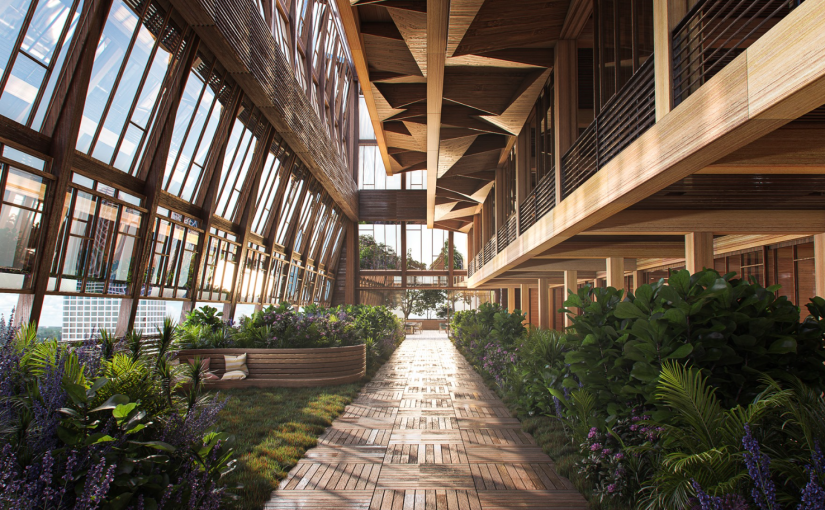
PHOTO Florida-based Rizome Philippines produces world-class engineered bamboo that make for sophisticated and beautiful building material.
 Growth Features