

September 21, 2023
By Melody Mendoza Aguiba
President Ferdinand R. Marcos Jr. has vowed to fight illicit tobacco trade that brings P30 billion in foregone revenue to government.
The Marcos Administration will also introduce a multiple cropping system that gives alternative income to farmers amid health concerns raised against tobacco.
In a speech delivered for him by Ilocos Norte Governor Matthew Joseph Manotoc during the First International Tobacco Agricultural Summit, Marcos said the government will not let up on tobacco smuggling which likewise to date this year P16 billion in foregone revenue to the government.
“We must seek ways to protect the livelihood of thousands of our tobacco farmers,” said the president
“I urge the Department of Agriculture (DA), and the NTA (National Tobacco administration) — together with the academe and the private sector — to explore other crops that can be grown alongside tobacco so as to contribute to our goal of food security.”
Marcos sees the need to introduce additional or alternative sources of income for tobacco farmers considering health concerns raised against tobacco.
“These past years, we had seen so much change in our health policies that affected the tobacco industry. As such, we must seek ways to protect the livelihood of thousands of our tobacco farmers.”
He recognized that the tobacco industry is a “vibrant catalyst for economic growth in the country” particularly in Mindanao and Northern Luzon.
In a separate farmers’ pre-tripartite conference in Vigan City, DA Undersecretary Deogracias Victor B. Savellano said DA and NTA will encourage farmers to adopt a multiple cropping system.
Savellano said technical assistance will be extended to farmers so they may also plant rice, corn, sugarcane, vegetables, garlic, onion, and bamboo along with other high value crops.
As part of the aim to raise farmers’ income, DA will carry out an intervention program for the industry.
There are six important things to take note of in improving the quality of tobacco, Savellano said. These are 1. Water 2. Fertilizers and pesticides as prescribed by agronomists 3. Good-quality fuel wood 4. Upgraded flue-curing barns 5. Greenhouses 6. A research and development program.
“Our main goal is to export our tobacco. That’s why we should produce high quality tobacco in order to be competitive in the world market and earn the dollar revenue we deserve,” said Savellano.
NTA Regulatory Head Robert Ambros said government’s revenue loss due to illicit tobacco trade is expected to exceed P30 billion by the end of the year.
The World Health Organization (WHO) reported that illegal tobacco trade involves products that are “untaxed and unregulated, with no health warnings, packaging or labeling requirements; which makes them cheaper, more readily available and accessible, especially to young and poor people.”
WHO said that eliminating illicit tobacco trade “will increase tobacco product prices, lower consumption, reduce premature deaths, and increase government revenues.”
DA-NTA has a coordinating mechanism with the Bureau of Internal Revenue and the Bureau of Customs in fighting illegal trade.
While critics hit tobacco’s role in the economy, Marcos noted that the tobacco industry
is a “significant source of tax revenues that are used to fund government programs.”
“It is an indispensable bedrock that generates income, livelihood, opportunities, and employment, particularly in areas where its cultivation spans generations and holds pivotal significance in the way of life of its communities,” said Marcos, also DA secretary.
The tobacco industry provides livelihood to 2.1 million people including more than 89,000 direct labor force in tobacco farming consisting of farmers, laborers, and helpers, according to Savellano.
These are the other significant contribution of the tobacco industry to the economy, Savellano said:
- Tobacco collections are reinvested into tobacco producing regions via beneficiary local government units (LGUs). A total of P19 billion was released in 2020 from tobacco excise tax which LGUs use for their priority programs.
- The tobacco industry is a key contributor to public sector revenues. Excise tax collection amounted to P 160 Billion in 2022. Tobacco comprises 54% of sin tax collection in 2022.
- The tobacco industry is a foreign exchange generator and finances the government’s health programs. Export values rose by 46.3 % from 2018 to 2022. The tax revenue from tobacco products is reinvested in government’s universal healthcare program (UHP). A total of P74.48 billion has been earmarked for (UHP) in 2022 out of the tobacco excise tax collections.
High quality tobacco for export
DA-NTA will increase the quality of tobacco for export to make products more competitive for the export market.”
“We will create more employment . We will lower cost of production to increase the income of our farmers. We will facilitate partnerships between farmers and their buyers or with manufacturers that use their produce as inputs.”
LGUs will play a vital role in helping tobacco farmers improve their tobacco to make it of high quality for export. LGUs should partner with DA-NTA’s in introducing interventions to tobacco farmers.
“LGUs receive excise tax from the production of tobacco, so they should be proactive in partnering with DA and NTA in helping farmers improve productivity. Our goal is to raise our production and raise the quality of our products so we can up the dollar value of our export,” said Savellano.
Developing alternative livelihood for farmers, such as the planting of the versatile bamboo will enable farmers to no longer depend just on tobacco farming for income especially as health concerns confront the tobacco industry.
“Don’t forget my advocacy of planting bamboo which supports the daily needs of our farmers and fisherfolks. Bamboo plants are versatile and are used as trellis for vegetables, ‘katig’ for fishing boats, brace for fishpens,” said Savellano.
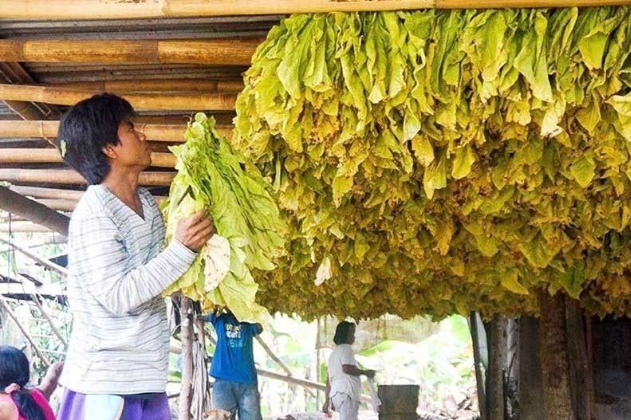
For one, bamboo is used as the device where cured tobacco leaves are hung.
Bamboo has 10,000 documented uses as wood, pulp and paper, and raw material in many industries.
DA-NTA will continue to engage in programs that will improve sustainability of the tobacco industry—both as a nature-friendly activity and as a constant source of livelihood for farm families.
“When I was a member of the House of Representatives, DA, NTA, and my office formulated the step (Sustainable Tobacco Enhancement Program),” said Savellano.
Engaging in other businesses, such as livestock farming, will add a significant income for tobacco farmers.
“When purchasing power of farmers is high, they are able to contribute more to economic growth They can increase consumption of goods,” said Savellano..
PHOTO DA Undersecretary Deogracias Victor B. Savellano (third from left) led a farmers’ consultative conference in Ilocos Sur
Tobacco leaves are hung for drying on bambo poles. Credit-Philstar
 Growth Features