Ilocos Region inaugurates first biosecure swine multiplier techno-demo farm as part of raising production, fighting ASF

October 29, 2023

By Aurelio Salvador

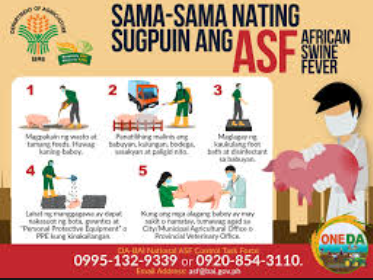
The first biosecure swine multiplier technology-demonstration farm has been launched in Ilocos Region as part of the Marcos Administration’s program to fight African swine fever (ASF), raise swine production, and give livelihood to small farmers.

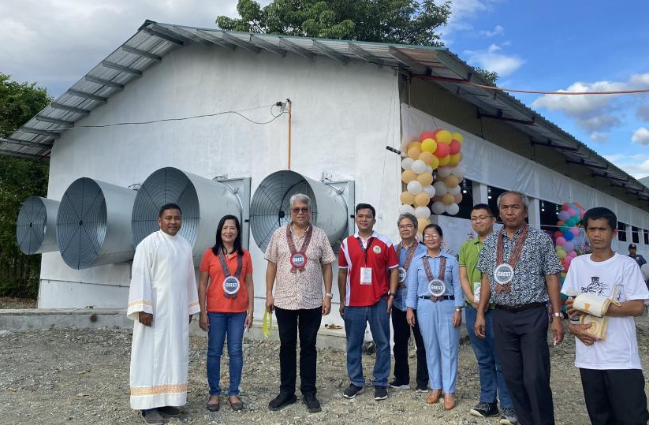
   Department of Agriculture (DA) Undersecretary Deogracias Victor B. Savellano graced last October 24 the Swine Multiplier and Technology Demonstration (SMTD) farm in Natividad, Pangasinan.

   “We will repopulate our hog sector through these swine technology centers. We have put in place biosecurity measures that use a standard shelter design for hogs to keep small farms away from ASF,” said Savellano.

   The technology centers will be sites through which good swine genetics will be disseminated to farflung provinces.  Through farmers’ trainings on biosecurity measures, Philippines will be able to raise hog inventory and pork supply, Savellano said.

      “The facility will provide support to local raisers by making available breeders and breeding materials and by producing adequate and quality stocks to supply DA and other agencies’ needs for sustainability in production,” he said.

   A budget of P40 million has been allocated for four SMTDs in Ilocos Region.  A budget of P10 million per SMTD includes provision for tunnel vent type facility and 30 breeder sows and feeds. 

   The Natividad facility is the first.  Three others will be launched within the year.  The sites are Manaoag, Pangasinan and Candon and Vigan in Ilocos Sur.

   Local government units (LGU) provide the land for the swine facility as its counterpart support. Farmers are trained on biosecure hog raising prior to receiving their swine.

   DA’s National Livestock Program (NLP) has partnered with the International Training Center on Pig Husbandry (ITCPH) based in Lipa City, Batangas for the house design for the hogs, according to Agricultural Training Institute livestock focal person Krizel Joy Natividad.

   The SMTD has been introduced under DA-NLP’s Integrated National Swine Production Initiatives for Recovery and Expansion (INSPIRE) Program.  It is a hog repopulation program aimed at raising hog inventory following heavy ASF infestation, reported Aurelio Salvador of DA-Livestock

   Biosecurity measures in the swine program includes disinfestation process under which farm workers are required to bathe for disinfection before and after entering the swine facilities.  They also go through a 24-hour quarantine after entry to the facilities.

   The swine facility itself is air-conditioned and has curtains that keep the facility off infection.

   Present also during the launch were OIC-Provincial Veterinarian Dr. Arcely G. Robeniol (representing Pangasinan Provincial Governor Ramon V. Guico III); LGU-Natividad Municipal Mayor Hon. Rosita G. Rafael; Municipal Agriculturist Engr. John Christian M. Sioco; and ATI-RTC 1 Center Director Dr. Rogelio C. Evangelista.

   The event was also witnessed by the members of the Pagrang-ayan ti San Pedro Farmers Association, Municipal Agriculture and Fisheries Council (MAFC) Chairman Mr. Loujay S. Pagal, Sangguniang Kabataan Federated President Ms. Angelica D. Malaca, Municipal Local Government Operations Officer Ms. Hope Ordonio, and staff of the Municipal Agriculture Office.

PHOTO DA Usec Deogracias Victor Savellano (third from leflt) leads launch of biosecure Swine Multiplier Techno-Demo Farm in Natividad, Pangasinan

DA-NTA negotiated higher floor price for Virginia tobacco; govt. to earn higher excise tax

October 27, 2023

The Department of Agriculture-National Tobacco Administration has negotiated a higher price for Virginia tobacco, up by an average of P9.90 per kilo for various grades, enabling farmers to enjoy higher income while raising for government excise tax that stands at P150 billion.

   DA-NTA has  successfully haggled for the higher tobacco price during the  tripartite conference last October 3 and 4 attended by farmers and tobacco buyers.

   DA Undersecretary Deogracias Victor B. Savellano expressed satisfaction over the NTA negotiation which is resulting in better income for farmers for trading years 2024 and 2025.

   “This is an unprecedented increase in the price of Virginia tobacco in at least 10 years of  trading history.  It  will surely benefit our farmers.  We also need to continue finding ways to help raise farmers’ income through intercropping and other alternative livelihood,” said Savellano.

   In the same forum, the increase in floor prices for a kilo of Burley tobacco and native-type tobacco are P5.90 and P3.90, respectively over the same trading years.

   DA-NTA reported earlier that for trading years 2022 and 2023, floor price per kilo for Virginia top grades was at P87.10 for Grade AA and P86.10 for Grade A.

   For Burley, the top grades A and B was at P75.10 and P72.10, respectively. The floor price for high grade of the native type was P77.10 per kilo. 

   The NTA Governing Board will release the full details of the 2024-2025 floor prices for various grades and their increases.

   NTA Administrator Belinda S. Sanchez initiated the successful negotiation.  The price increment is the second highest of such price difference brought about by NTA intervention.

   Records show the highest agreed increase on the floor price of Virginia tobacco was P10 a kilo.  It was also a result of a negotiation in a tripartite conference on December 10, 2007.

   “It was a time when the honorable DV (Deogracias Victor) Savellano also intervened when he was then governor of Ilocos Sur.  This is the second time Usec Savellano is intervening,” according to the NTA.

   The succeeding tripartite conferences after the 2007 forum brough an increase in floor prices of Virginia tobacco by a minimal P1 to P3 a kilo.

   The NTA convenes the tripartite conference every two years to review and fix reasonable tobacco floor prices.   Agreements on tobacco price consider factors including world market situations, production costs, and a reasonable margin of profit for farmers, dealers, manufacturers, and exporters.

   “The ultimate aim of our tripartite forum is to strengthen the tobacco industry as part of the directive of President (Ferdinand R.) Marcos for us to help raise income of farmers.  We will also increase our exports and reduce imports as we expand our production,” said Savellano.

   The tobacco industry generates huge tax revenue for government, reaching to P149.7 billion in excise tax in 2020.  It contributes at least P74 billion per year to the Universal Health Care program.

   “We aim to improve our industry while we help balance the tobacco industry’s contribution to the economy, being one of the highest contributors to the government coffer,” Savellano said.

   Tobacco-producing local government units (LGUs) got a P19 billion share from the national government’s 2020 excise tax revenue.  LGU share is being used for cities’ and municipalities’ implementation of priority programs.

   The industry provides livelihood to at least 2.1 million people, including more than 430,000 farmers, farm workers, and their family members.

PHOTO Agriculture Undersecretary Deogracias Victor B. Savellano leads a tripartite consultative conference in Ilocos Sur attended by farmers, traders

DA taps FAO for technical expertise on processing of seaweeds into feeds to lower costs of meat and poultry

October 26, 2023

Agriculture Undersecretary Deogracias Victor B. Savellano is eyeing the processing of seaweed through a technical cooperation with the Food and Agriculture Organization (FAO)  in order to produce nutrient-dense and cost-efficient feed to help lower costs of meat and poultry.    

   “We are tapping the expertise of Mr. Lionil Henri Valentin Dabbadie, country representative of the Food and Agriculture Organization (FAO) of the United Nations, to explore the processing of seaweeds as commercial feeds for farm animals and livestock,” said Savellano

   “This will relieve our local animal raisers from the high cost of commercial feeds in the market,” he said.

   Savellano, Department of Agriculture (DA)  undersecretary for livestock, said that the country has abundant seaweed resources that grow in its coastal waters whose length is one of world’s fifth longest. Seaweeds are relatively cheaper and are very rich sources of protein. 

   Savellano is also an oversight official for livestock and poultry feeds development and of the National Tobacco Administration (NTA) along with being alternate chairperson–designate to the NTA Governing Board.

   Seaweed is a sustainable source of macronutrients, particularly dietary fiber, and micronutrients for animal feeds.  It provides several antioxidants which can increase animals’ longevity and may lower the risk of infections.

   There are three main reasons to use seaweed in poultry feed.  These are improving animal immunity, decreasing microbial load in the digestive tract, and enhancing nutrient content of meat and eggs.

   Savellano said during the World Food Day celebration last October 17  that he is also looking at expanding the production of native pigs and native chicken which are easier to raise.  Native animals require commercial feeds at cheaper costs. 

   “We need to go back to the basics and the traditional way of raising our livestock so we can cut on our expenses for food for our family,” he said.

   Considering that corn accounts for  80% of feed formulation, DA is working on the planting of corn at the former sugarcane plantation in Batangas, he said.  This, after the closure of a Batangas sugar mill here.  As such, sugarcane farmers can take on a new livelihood and help supply requirements for animal feed ingredients of the livestock and poultry sector.

   According to Savellano, these ongoing initiatives are in in line with the three marching orders of President Ferdinand R. Marcos, Jr., also concurrent agriculture secretary.

 The orders are stated in an acronym VAM which means 1.  increasing Volume for export  of agricultural products; 2.  making price of food Affordable; and 3. increasing Margin or income of Filipino farmers.

   “These are some of our agency initiatives to achieve the ultimate goal of President Marcos Jr. of producing more foods at affordable for every Filipino consumer,” Savellano said.

PHOTO Feeding cattle with seaweeds lessens greenhouse gas emission. Credit- Steemit.com

DA asks LGUs to supplement DA’s effort to curb ASF, compels them to report State of Calamity to access disaster funds

October 19, 2023

The Department of Agriculture (DA) has asked local government units (LGU) to supplement DA’s effort to curb African swine fever (ASF) and compelled them to declare a State of Calamity in order to access disaster program budget.

   DA Undersecretary Deogracias Victor B. Savellano said DA and its attached Bureau of Animal Industry (BAI) is strengthening biosecurity measures amid a State of Calamity declaration in Nueva Vizcaya.

   Dr. Arlene Vytiaco, BAI deputy director, said that under the NDRRMC (National Disaster Risk Reduction and Management Council) guidelines, provincial LGUs  are compelled to declare a State of Calamity if more than two of their municipalities have an outbreak. 

   “This (declaring a State of Calamity) will allow them to access disaster funds to combat ASF,” said Vytiaco.

   DA-BAI has already sent investigators, trained personnel and supplies to Nueva Vizcaya as soon as it declared a State of Calamity after its infected areas reached to nine municipalities.

   Savellano urged LGUs to supplement DA’s limited budget for ASF control. As the deliberated budget of DA for vaccines for 2024 just amounts to P1.5 billion, LGU’s accessing its own funds will be a significant move to control the disease.

   “Malaking bagay ang pag access ng LGU funds sa pakikipaglaban ng ASF.  Sa amin sa DA, biosecurity war na ito. Ang laban namin ay sitio kada sitio, bara-barangay, muni- munisipyo at probi-probinsiya.’ Ngayong wala pang aprubadong bakuna, pag iingat na di kumalat ang ASF ang ating ginagawa,” said Savellano.

   He also urged vaccine manufacturers to apply for commercialization with government.

   “We call upon vaccines companies to register and undergo testing and trials for the local market with the proper authorities,” he said.

   Savellano believes that as there is no approved vaccine yet, the P1.5 billion budget should also be made available for biosecurity efforts.

  In coordination with enforcement authorities, it is putting in place checkpoints to monitor movement of diseased hogs.

   There is also a need for a huge indemnification fund which will encourage hog raisers to report ASF as they will be compensated for reporting it. 

Govt urged to raise biodiesel mix to 5% to take advantage of P23.4 billion forex savings

October 14, 2023

Melody Mendoza Aguiba

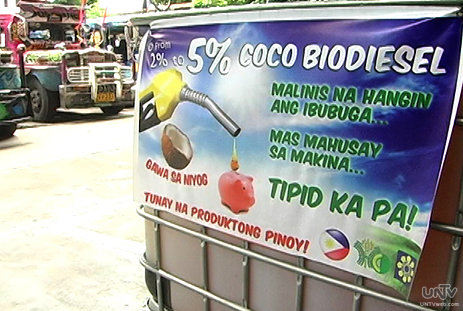
The government should take advantage of the lower price of nature-friendly biodiesel by raising coconut methyl ester’s (CME) mix to diesel to 5% so as to generate huge foreign exchange savings equivalent to P23.4 billion yearly.

   Aside from enhancing the fuels’ ability to cut pollutant greenhouse gas emission, the increase in the biofuel will enable Philippines to displace a big amount of imported diesel, according to United Coconut Association of the Philippines (UCAP) Chairman Dean Lao Jr.

   “We are importing 13 billion liters of diesel (yearly).  From B2 (2% biodiesel) to B5 (5% biodiesel), we can displace an additional 390 million liters equivalent to P23.4 billion,” Lao told a press briefing hosted by the Philippine Chamber of Agriculture and Food Inc. (PCAFI).

   The Philippines was a pioneer in 2006 in adopting the biodiesel technology through CME, being itself then the biggest exporter of coconut oil.

   Having ratified Republic Act 9367 or the Biofuels Act of 2006, government subsequently implemented biodiesel mix of 2%.  Despite its early adoption, the Philippines has been overtaken by other Southeast Asian countries in maximizing use of the environment-friendly technology.

   “When we started in 2006, we were the pioneer. Now, we’re the laggard,” said Lao.

   Indonesia is now the leader in biodiesel with its mix reaching to 30% and even announced early this year a 35% blend.

   The country’s commercialization of biodiesel has stagnated since 2009, the last time that the biodiesel mix was raised from 1% to 2%.

  Along with the cheaper price now of biodiesel compared to fossil fuel-based diesel, the Philippines is missing on the other advantages of a higher biodiesel mix. These are improved vehicle mileage and the reduced pollutant carbon dioxide emission to the environment.

   Due to the slow uptake on the technology, several companies are not operating at present, incurring opportunity loss.

   The Philippines, in fact, has excess production of CME.

   “Do we have enough coconut?  There is enough coconut oil to supply biodiesel.  The infractructure is ready to supply the  increase from 2% to 5%.  The capacity is ready.  And It’s the simplest to implement,” said Lao.

   PCAFI, led by its president Danilo V. Fausto, recommended the increase of CME blend to B3 by January 2024; B4 after six months thereafter; then B5 by 2025.  

   “The National Biofuels Board (NBB) has not championed B5 despite its merits. Misinformed politicians campaign against biofuels,” according to PCAFI in a position paper.

   Pollutant emission from 100% biodiesel has been proven to be 74% lower than those from petroleum diesel, according to a life cycle analysis conducted by the Argonne National Laboratory.

   As it uses generally vegetable oils compared to the depleting petroleum resource, biodiesel is deemed a renewable and biodegradable fuel. 

   “Biodiesel meets both the biomass-based diesel and overall advanced biofuel requirement of the Renewable Fuel Standard,” reported the Department of Energy (DOE).

  DOE cites other benefits of biodiesel including clean burning and use of domestic production.

   “Using biodiesel as a vehicle fuel increases energy security, improves air quality and the environment, and provides safety benefits,” according to DOE. “Biodiesel in its pure, unblended form causes far less damage than petroleum diesel if spilled or released to the environment. It is safer than petroleum diesel because it is less combustible.”

   Vehicle engine operation is improved as biodiesel improves fuel lubricity and “raises the cetane number of the fuel.”

PHOTO Nature friendlier biodiesel at 5% mix Credit- UNTV

Aquaculture exporter urged LGUS to adopt a Sustainable Aquaculture Program to generate jobs, beef up food supply

October 14, 2023

By Melody Mendoza Aguiba

An aquaculture exporter has urged local government units (LGUs) to pursue a Sustainable Aquaculture Program in their domestic water so as to generate jobs and help beef up food security and protein supply in the Filipino diet.

   In a press briefing of the Philippine Chamber of Agriculture and Food Inc (PCAFI), Norberto O. Chingcuanco, Feedmix Specialist Inc. (FSI) vice president, also asked LGUs to issue long term aquaculture permits. 

   This will ensure long term investments in the fishery sector.

  Adopting a Sustainable Aquaculture Program (SAP) can be a major livelihood program of LGUs aligned with national government’s call for sustainable food production.

   It should be an intentional policy program to attract private sector investments.

   “These policies should contain proper zoning and site exclusivity per company or group. 

 Long term permits encourage needed long term investments,” said Chingcuanco     

   Also integrated in the SAP should be priority employment for local or native communities within the LGU.  It should implement safety and labor standards.  Fees and rentals should be appropriate to cover costs of monitoring and regulations.

   Chingcuanco lamented that the Philippine government has made it easier to import raw fish.  That is rather than importing cooked raw materials in order to produce feeds and grow its own fish.

   PCAFI President Danilo V. Fausto government should also boost production of fish fries needed in fishery production.  It should put up more hatcheries where fish and shellfish are spawned and hatched until large enough to be transferred to an aquaculture farm.

   “BFAR (Bureau of Fisheries and Aquatic Resources) said tilapia fry and fingerling production was 208.35 million in 2020 while annual demand is 2.1 billion tilapia fingerlings,” said Fausto.

   Even local communities will be benefitted by an LGU-based SPA as they will have priority access over whatever food is produced.

   FSI with its affiliate firm Fisher Farms is an integrated aquaculture company with seafood processing facilities that enable export products to reach Europe and North America. 

   It boasts of full traceability enabling food safety, technological innovation even in feeds, sustainable farm management, and the largest of its kind in its processed fish production.

   All of Feedmix’s hatcheries and feeds manufacturing facilities are certified and regulated by BFAR.  Fisher Farms’ facilities are certified by Sanitation Standard Operating Procedure (SSOP), Hazard Analysis Critical Control Point (HACCP), Good Manufacturing Practice, and World Halal Council. 

   Calling aquaculture “fish farming” rather than fish hunting, Chingcuanco said aquaculture in the Philippines has exceeded fish hunting production with 2.349 million metric tons as of 2022.  Commercial fisheries only reached 868,408 MT and municipal fisheries, 1.122 million MT.

    In his “Sustainable Aquaculture as a Livelihood Option,” Chingcuanco said the fisheries sector is a major job employer in the Philippines. 

   “WE have over 2 million registered fisherfolks as of 2021,” he said.

   This consists of capture fisheries, 1.095 million fishers; gleaning, 253,825; aquaculture, 247,164; fish vending, 147,038, fish processing 4,524, and related jobs, 404,113.

   An aquaculture or marine culture site employs 10 people per hectare and produces 250 tons of fishery per year.

  The advantage of SAP is it can be done in remote coastal areas, can employ people in the farflung provinces, and is a source of local food supply and local revenue.  It is protective of the environment if only proper policies are in place.

   Fishes are a major source of protein for the Filipino diet.

   “Fish and fishery products constitute 11.68% of each person’s total food intake which is equivalent to 93.9 grams per day,” he said.  “Each Filipino consumes an average of 34.27 kilos of fish and fish products per year, 65% from aquaculture.”

   The Philippines should take advantage of its natural resource, having the second longest coastline among South East Asian countries and China.   It has a coastline of 36,289 kilometers, just second to Indonesia, 99,073 kilometers.

   Even if fishermen and fishing investors take huge risks in the sector with storms, volcanic eruptions, and climate change, he said the country remains lucky as fishery resources just stay in the waters and are not lost.  That makes it less risky compared to crops.

DA Usec Savellano holds a position paper asserting DA’s oversight over animal vaccine now needed to contain African swine fever, avian flu

October 11, 2023

Department of Agriculture Undersecretary Deogracias Victor B. Savellano files with Malacanang a position paper asserting that DA’s Bureau of Animal Industry (BAI) should have jurisdiction over animal vaccine (veterinary drugs, supplies) regulation. Food and Drug Administration (FDA) has jurisdiction over food safety regulation and even registration of veterinary drugs and vaccines.  However, evaluation of such veterinary supplies is under the realm of DA-BAI as it has the human resource expertise and laboratories. This policy has become crucial with the escalating pestilence of animal diseases (African swine fever, avian flu) in livestock and poultry—needing expansive vaccination.