
DA throws support for Anti-Agricultural Economic Sabotage Act

November 30, 2023

The Department of Agriculture (DA) has thrown its support for the Anti-Agricultural Economic Sabotage Act as it sought collaborators in the fight against illegal tobacco trade that brings P25 billion yearly in foregone revenue for government.

   DA Undersecretary Deogracias Victor B. Savellano said Senate Bill 2432 should be immediately approved to help eliminate illegal trade and smuggling of tobacco and other agricultural produce.

   Illegal tobacco trade even has serious impact against the health of minors.

   “It may worsen the country’s problem on smuggling. Illicit tobacco trade reduces the effectiveness of public health policies designed to discourage smoking, with unregulated, substandard quality and non-compliant products.  It makes it easier for minors to access tobacco products and undermines the legitimate industry’s business,” according to SB 2432.

   The livelihood of thousands of Filipino farmers is adversely affected by illegal agricultural trade. 

   Among these are farmers belonging to Philippine Tobacco Growers Association (PTGA) and the National Federation of Tobacco Farmers Association and Cooperatives (NAFTAC) which are lobbying for the bill’s passage.    PTGA and NAFTAC has membership base of around 50,000 farmers.

   Speaking at the “Anti-Illicit Trade Interagency Dialogue: Protecting National Economic Interests through Greater Synergy and Cooperation,” Savellano said DA needs collaborators in this seemingly unsurmountable task of fighting illegal trade. 

   “Combating such highly organized crime requires substantial resources, specialized skills, effective inter-agency cooperation which can be difficult to coordinate and sustain,” he said.    

   “Illicit tobacco trade often involves the movement of products across international borders, making border coordination and cooperation within the country’s jurisdiction  essential.”

   Adequate investment in training programs, modern technology, and sufficient staffing levels is crucial to enhance the capacity of these agencies to combat illicit trade effectively.

   Senator Cynthia Villar, in her sponsorship of the Senate bill, cited Samahang Industriya ng Agrikultura or SINAG. The farmers’ group indicated that government loses P200 billion yearly in revenue due to smuggling.

   The Senate bill amends the Anti-Agricultural Smuggling Act of 2016 or Republic Act No. 10845.

   “With no conviction made seven years after the Anti-Agricultural Smuggling Act the, law is a failure at the hands of the Bureau of Customs (BOC). It’s been seven years and there is not a single conviction,” she said.

   “Smuggling brings about unfair competition for locally produced goods because it floods the market of cheaper agricultural products.  It puts undue risk to our consumer’s health.  It encourages corruption and threatens the rule of law.”

   Aside from tobacco, illegal trade involves sugar, corn, pork, poultry, garlic, onion, carrots, fish, and cruciferous vegetables, according to the Southeast Asian Regional Center for Graduate Study and Research in Agriculture.

   The Euromonitor reports that 16.7 percent or about 9.52 billion sticks of the total cigarette volumes sold in the Philippines comes from illegal sources as of 2022.

   “Most illicit cigarettes are shipped from Cambodia, Vietnam, and China, and enter through Sulu and Tawi-Tawi,” said Villar’s sponsorship statement.

   Illegal trade destroys tobacco industries in in Ilocos Norte, Ilocos Sur, Abra, La Union, Pangasinan, Isabela, Cagayan, Nueva Vizcaya, Quirino, Tarlac and Occidental Mindoro.

   It competes with the produce of at least 2.1 million people, including more than 430,000 farmers, farm workers and their family members.  (Melody Mendoza Aguiba)
LGU veterinarians pressed govt to resolve conflict between FDA, BAI on approving authority for vaccines

November 28, 2023

By Melody Mendoza Aguiba

Local government veterinarians have sought for the immediate resolution of the conflict on approving authority for African swine fever (ASF) and avian influenza (AI) vaccines as the immediate supply of vaccines will arrest a “national emergency” in meat and food security.


The Provincial, City, Municipal Veterinarians League of the Philippines (PCM-VLP) has expressed disappointment over the conflict between the Food and Drug Administration (FDA) and the Bureau of Animal Industry (BAI) on the approving authority for vaccines.


The conflict has been dragging the worsening ASF and AI infestation on hog and poultry sectors.
“We have long been waiting for this resolution,” said PCM-VLP President Dr. Mary Grace M. Bustamante during the Animal Health Congress last week.


The Department of Agriculture’s (DA) Livestock Group led by DA Secretary Francisco Tiu-Laurel will coordinate with the Office of the President with which a petition for resolution on the conflict has been filed.


“The spread of ASF is now a national emergency concern. There are provinces that have shortages of pork for their citizens. Prices are soaring at wet markets. We need to ensure food security especially for pork,” said DA Undersecretary Deogracias Victor B. Savellano.


“The approval of ASF vaccines by the FDA is critical to our food security. We have been waiting. I do not know how long we can wait as ASF eats up LGUs who have now been declaring states of emergency.”


DA has not procured any vaccines for ASF since there are no FDA-approved vaccines for ASF, he said.

Local government veterians are concerned that FDA lacks the resources and capability to fully undertake the task of approving veterinary vaccines. This, although an earlier memorandum of agreement (MOA) ordered FDA and BAI to collaborate on regulating such veterinary products.


“FDA has limited people to look after this function. BAI used to do this task as it does have the capability to test and approve (the safety and efficacy) of vaccines. If this conflict is cleared, (then we can work toward ASF-free and avian flu-free status),” said Bustamante.


There is an apparent lack of alignment in the present setup where FDA approves commercial release of the vaccine while BAI is the one testing it.


It has been assumed that since some animal drugs are also being prescribed to human, even vaccines and animal biologics should be approved by FDA.


However, Bustamante asserted that veterinarians precisely know that animal vaccines are only for animals. Veterinarians nor medical practitioners will never prescribe animal vaccines to human. This should not then be a concern for regulators.


“We know that antibitiocs for animals are only for animals. We know that these vaccines should only be for animals. So why is there a need for FDA to approve it? she said.


FDA Advisory 2022-0591 indicated that marketing authorization of veterinary drugs, vaccines, medical devices will be regulated by FDA’s Center for Drug Regulation and Research (CDRF).
This advisory was issued apparently during the time of high Covid infections. It was in compliance with FDA Circular 2021-025 or the “Guidelines for Appplication for Authorization at FDA in light of Extended Stare of Public Health Emergency dated 9 December 2021.”


An earlier Joint DA and DOH Administrative Order (AO 0026) in 2013 indicated that FDA “shall continue to register veterinary drugs in pharmaceutical dosage forms except those intended for feeds and license establishments manufacturing, distributing , importing exporting, selling the same.”


The AO was effective for five years until sooner terminated. A periodic review of a Technical Working Group should also be in order to recommend appropriate actions.


Under the same AO, BAI will regulate veterinary drugs and products including “veterinary vaccines, diagnostic kits and reagents, veterinary medical devices, and other biological products.”


The limited number of veterinarians is also a major concern if the Philippines is seeking after ASF-free and AI-free status. However, Bustamante said that under present laws, only provincial governments and first class municipalities are required to hire veterinarians.


“If a local executive doesn’t find the importance of having veterinarians, we really can’t do much about this problem. How about second, third class municipalities– where hiring of veterinarians is dependent on who the local authority is?”


Dr. Loida M. Valenzuela, provincial veterianarian of Ilocos Norte, told the same Animal Health Congress that veterinarians should have an independent authority in local government units (LGU). They should not be under provincial agriculturists, considering that veterinary medicine is an entirely distinct professional discipline.


Entry level compensation for veterinarians should also be upgraded, according to Valenzuela. This will encourage fresh passers of Veterinary Medicine board examination to take on local government jobs.


The LGU veterinarians were regretful of the low passing rate for takers of Veterinary Medicine board examination. It has been limiting the number of animal experts in local governments. It worsens the already brain drain experienced as veterinarians choose to work in higher-paying private companies, worse abroad.


“Something has to be done about this. This is not favorable for us,” said a veterinarian at the Animal Health Congress.


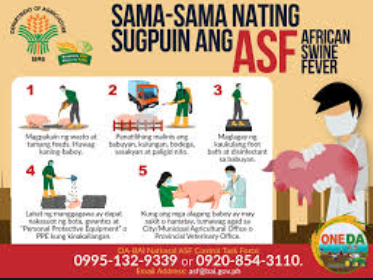
PHOTO Sama sama nating sugpuin ang ASF

DA warns against sale of “hazardous” frozen meat in the wet market, its adverse effect on local industry

Nov. 9, 2023

The Department of Agriculture (DA) has warned against the sale of frozen meat in the wet market as this can put human health at risk due to the absence of refrigeration facilities and a lack of know-how of vendors on handling frozen meat.

   DA Undersecretary Deogracias Victor B. Savellano said DA is collaborating with Department of Trade and Industry (DTI) so as to weed off public wet markets of health hazardous frozen products.

  DA also advised consumers to look for the seal of the National Meat Inspection Service (NMIS) to ensure food safety.

   “Delikado ito sa kalusugan ng tao. Hanapin ang papeles ng NMIS at katayan ng mga LGU (local government units). Walang problema ang imported na karne. Huwag lang ibenta na sariwa sa palengke.”

   (This is dangerous to health.  Look for the NMIS food safety seal and of LGU’s slaughterhouse documents.  Imported frozen meat is not the problem, but their handling as fresh food in wet markets.)

   DA Administrative Order 6-2012 prohibits frozen meat from being sold in the wet market.  Frozen meat should only be confined to hotels, restaurants, and supermarkets which have the refrigeration facilities and handling expertise. 

   Savellano said DA is also examining the price difference of poultry being sold in the market compared to farmgate prices.  While poultry’s price sold in the wet market has been increasing, farmgate price has actually been decreasing. 

   Ang mga nag-aalaga ng manok ay dumadaing sa mababang presyo na kuha sa kanila ng mga biyahero.

   (Poultry farmers have been complaining against the low price at which traders buy their produce.)

   DA believes the excessive dumping of frozen meat in the wet market may be the cause why farmgate price of poultry  has been decreasing to the detriment of farmers.

   Also, Savellano fears poultry farmers have been cutting maturity days for harvesting poultry—down to 27 or 28 days instead of 30 days.  This, as they try to meet poultry demand in time for the Christmas holidays.

   However, instead of increasing their income from increased production, they may be suffering from low farmgate price due to excessive frozen meat in the wet market.

   Savellano said DA’s objective is three-pronged, not just raise supply.  But it is to raise production, bring down price for consumers, and raise farmers’ income.

   DA’s strategy to meet these objectives is to increase feed production to lower price, reported Heaven Torres of DA Livestock.

   “Nagpapatanim na kami ng malalaking plantasyon ng mais para mapababa ang gastos ng mga nag aalaga at siya ding dapat ikababa sa merkado para sa lahat ng Pilipino.  Ang dapat na mababang presyo sa farm ay dapat maramdaman ng mga mamimili sa palengke.”.

   (DA is now expanding planting of corn so as to bring down feed costs of poultry farmers.  This should lead to lower price of chicken for Filipino consumers.  Filipinos should be able to feel the low price of chicken).

   DA has also asked Malacanang to grant it the authority to manage and administer African swine fever and avian flu vaccine. 

   As soon as it is granted this jurisdiction (with which it has conflict with Food and Drug Administration), it can then hasten processing of access of  vaccines to the industries. This is critical in preventing the fast spread of the diseases. Heaven Torres