
Bill strengthens commercialization of engineered bamboo as potential high-rise construction material

February 28. 2024

By Melody Mendoza Aguiba

A bill that will strengthen commercialization of engineered bamboo as a sustainable construction material potentially in high-rise buildings has been filed in Congress.


House Bill 9144 or an “Act Integrating Bamboo as a Sustainable Material for the Built Environment” has been filed by Rep. Jose Manuel F. Alba of Bukidnon.


HB 9144 will direct relevant agencies to develop a Bamboo Stuctural Code (BSC) which will provide the guidelines, standards, and best praactices for the safe and sustainable use of bamboo in building design and construction.


Department of Agriculture Undersecretary Deogracias Victor B. Savellano said the local manufacturing of engineered bamboo is seen to account for a significant chunk of potential revneue from bamboo for the Philippines. From import substitution alone, economic benefit from enginereed bamboo is placed at P400 billion ($8 billion) yearly.


Savellano, also vice chairman of Philippine Bamboo Industry Development Council (PBIDC), said the legislation on the Bamboo Structural Code is critical to implementing Executive Order 879 which created the PBIDC.


“We look forward to finally implementing EO 879 which envisioned industrialization through bamboo-based manufacturing,” Savellano said.


EO 879, issued in 2010, has not been implemented at all. Neither has PBIDC received any budget allocation.


But the bills now filed in Congress, particularly Senate Bill 2513 (Kawayan Act), will put teeth on existing policies. SB 2513, filed by Senator Mark A. Villar, is allocating a budget for PBIDC in order to spur private sector investment in the bamboo sector.


HB 9144 will promote bamboo as a sustainable building material, boosting Philippines’ compliance with United Nations Sustainable Development Goals (UN-SDG). It will call for integration of bamboo-related education into higher education curricula and continuing professional education for archictets, interior designers, and engineers.


Bamboo will be introduced as a construction material that is comparable to steel in tensile strength and as beautiful as hardwood.


Bamboo is traditionally used for housing in the rural areas, but only for one or two story houses. But to be used as alternative to steel or hardwood, especially in high-rise structures, guidelines should be put up in the National Building Code or Structural Code.


Luis P. Lorenzo Jr., chairman of egineered bamboo producer Rizome Philippines, said government should consider it urgent to come up with policies on the Bamboo Structural Code in order to seize a huge market.


“Our wood-based construction material is imported almost 94%. (To use bamboo) for import substitution, and earn billions of dollars, we need to move fast (in coming up with policies) that include bamboo in every instrument– into the structural building code,” he said.


Extensive research has shown that bamboo has the mechanical properties for use in construction.
Savellano has been pushing for the commercial use of bamboo both as an agricultural support material and as an industrial product.


“Bamboo can be our single biggest source of revenue that can enable many of our countrymen to rise above poverty especially our Indigenous People who are also the guardians of our environment,” Savellano said.


As an Ilocos Sur representative, Savellano had authored House Bill 9576 or the Philippine Industry Development Act.


DA is now strengthening its bamboo propagation program, having recognized that bamboo is a high value crop that has both food and consumer-industrial uses.


For one, DA has funded the bamboo nursery of University of the Philippines-Visayas which has a planned plantation expansion over 10 hectares.


Rene Madarang, executive director of PBIDC, said the Philippines should now catch up in bamboo commercialization.


“Total export trade value of bamboo commodities (in 2020) reached $2.969 billion with Asia accounting for a significant 80.2% share. However, the Philippines contributed to just $473,852,” he said.


Madarang said the local industry has to hurdle the challenges including low product quality and high production cost, inaccessible financing, and non-supportive policies.


With the now pending bills in Congress institutionalizing PBIDC, Philippines is establishing an agency that harmonizes all bamboo functions scattered in different government agencies, he said.
Even now, PBIDC is supporting establishment of a bamboo electronic database, policy incentives for private sector investments, and rural-based bamboo enterprises.
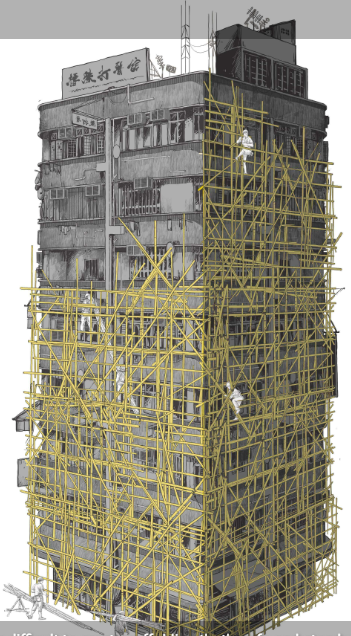
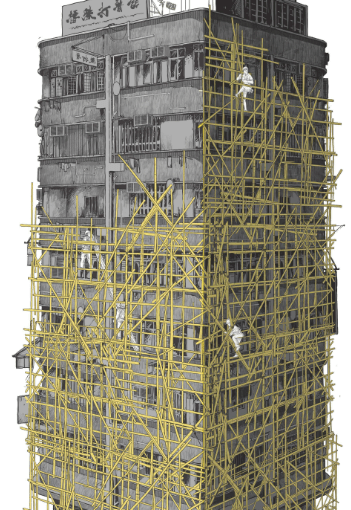
Bamboo’s internal cell-like structure allows it to withstand compression, making it an ideal material for scaffolding. Compared to steel, bamboo is much lighter, six times faster to erect and 12 times faster to dismantle. Credit- South China Morning Post


Engineered bamboo for construction can indeed be one of the sunlight bamboo industries.


According to the Advances in Science and Technology Journal (ASTJ), bamboo can be used as reinforcement in concrete as a replacement to steel.


“Bamboo culms are often used directly without any alteration as structural members such as beams and columns. The shear and flexural behavior of bamboo reinforced concrete (BRC) beams is significantly better than plain concrete beams,” reported the ASTJ.


“Bamboo fibers reinforced concrete (BFRC) is a good alternative to existing synthetic fibers reinforced concrete such as glass and steel fibers.”


Bamboo has been reported to have a tensile strength comparable to steel.


Interesting Engineering (IE) reported that “steel has a tensile strength of 23,000 pounds per square inch.”


“But bamboo surpasses steel with a noticeable lead at 28,000 pounds That is because when we consider the strength of a material, there are variables to keep in mind. The tensile strength can be defined as the resistance offered by an objecting to breaking or splitting under tension,” reported IE.


“And yes, bamboo is stronger than steel in this case, as it has a tightly packed molecular structure than steel.”

PHOTO Bamboo’s internal cell-like structure allows it to withstand compression, making it an ideal material for scaffolding. Compared to steel, bamboo is much lighter, six times faster to erect and 12 times faster to dismantle. Credit- South China Morning Post

Phl meat importation declined heftily to 95.979 million kilos, down 18.9%due to DA fight vs illicit trade


November 21, 2023

Philippines’s meat importation declined heftily in October this year to 95.979 million kilos, down by 18.9% in light of the Department of Agriculture’s (DA) aggressive fight against illegal trade along with a rigorous program for increased local production.


DA-Bureau of Animal Industry (BAI) also reported lower cumulative meat imports from January to October this year to 1.019 billion kilos, down by 9.7% from 1.128 billion kilos in the same period last year.


DA Undersecretary Deogracias Victor B. Savellano attributed the sustained downtrend in meat importation to the government’s thrust to raise local production. DA has also been collaborating with different government agencies in fighting illegal trade as this is the same marching order received by DA Secretary Francisco Tiu Laurel from President Ferdinand R. Marcos.


“Our mandate is to eliminate illegal meat importation, smuggling, hoarding, price manipulation, and anything that distorts prices in the market,” said Savellano. “We will raise production by five times (in five years). With enough volume we hope to make food affordable for Fiipinos. We want producers, especially small scale farmers, to make money.”


For beef, importation dropped 22.1% to 13.963 million kilos in October. Buffalo meat importation reached only 1.987 million kilos, down by 42.5% from 4.676 million kilos in the same period last year.


Pork which takes up the biggest share among meat import decreased by 26.35% to 45.604 million this ear from 61.927 million kilos in October 2022.


However, chicken importation in October this year rose slightly by 1.28% to 34.252 million kilos from 33.817 million kilos last year.


In the aim to raise local production, an immediate program of DA is to control infestation of African swine flu (ASF) and avian influenza (AI) while awaiting approval for vaccine commercialization.


“There are problems in the availability of vaccines for ASF and AI that are now being solved so that we can protect the population of hogs and chicken. We will also intensify research on vaccines so we can improve their availability,” said Savellano.


DA is raising its target on the use of artificial insemination in order to raise genetic quality of animals.


“We are raising our target on the use of artificial insemination by 50% from the previous 30%. We are improving availability of high quality semen to farmers under our breeding program in order to raise our animal and meat production,” he said.


DA is also embarking on long term programs to raise local animal and meat production. Investment are being done in infrastructure development including farm-to-market roads and transportation networks, cold storage facilities, and meat processing plants that can help reduce post harvest losses.

Food safety standards such as Good Agricultural Practice, Good Manufacturing Practice, and Hazard Anaysis Critical Control Point are being complied with.


DA will explore development of high-value meat products that have untapped markets. It will expand sources of meat importation that can offer good quality meat and competitive prices while curbing smuggling and illegal trade.


It is now setting up a Central Information Technology hub as part of a program to register all legitimate livestock farmers under a National Livestock Library. This will legitimatize contributors and beneficiaries of government’s livestock program.

PHOTO (L-R) Philippine Bamboo Industry Devt. Council Executive Director Rene Madarang, Deputy Speaker Antonio ‘Tonypet’ T. Albano of the 1st District of Isabela, DA Usec Deogracias Victor Savellano, and DA Secretary Francisco Tiu Laurel Jr. await flag ceremony at DA.

Kawayan Act strongly supported by Senate as bamboo is seen to contribute $3.5B to economy, pollution control aims


February 12, 2024

The Senate has strongly supported passage of the “Kawayan Act” as bamboo has the potential to contribute $3.5 billion to the economy and strengthen the country’s pollution control under its Sustainable Development Goal commitments.


Senate Bill or an “Act Institutionalizing the Bamboo Industry in the Philippines and Appropriating Funds Therefor” has been broadly supported in the Senate.


An official legislative statement indicated Senator Mark A. Villar’s speech has been “overwhelmingly supported by the Senate having been co-sponsored by multiple senators, including Senate President Migz Zubiri who is one of the co-authors and co-sponsors of the bill.


Villar, chairman of the Senate Committee for Trade, Commerce, and Entrepreneurship. led sponsorship of the bill.


Villar cited multiple economic potentials and environmental values of the bamboo industry including its global trade value that is expected to reach $88.43 billion by 2030 among others.


The bamboo industry is also expected to contribute $3.5 billion to the Philippine economy. He also emphasized the efficient pollution control capacity of bamboo as it releases 38% more oxygen than trees and sequesters 12 to 17 tons of carbon dioxide per hectare.


“The Institutionalization of the Bamboo Industry Development in the Philippines or the Kawayan Act aims to pursue further efforts that will develop the bamboo industry. At present, government agencies such as DTI, DOST, DENR and DA implement their own research and development programs, in an attempt to address the insufficiency of information and data resources, among others,” Villar said during a sponsorship speech last week.


“Yet, these initiatives are fragmented and this is worsened by the perception of the private sector for a lack of a functional governmental body overseeing the development of the industry which thus hinders its optimization.”


The Kawayan Act seeks to institutionalize the Philippine Bamboo Industry Development Council (PBIDC), which was created by Executive Order 879, to serve as the central body for overall policy and program direction for all bamboo stakeholders. The Council is also mandated to formulate and implement the Philippine Bamboo Industry Development Roadmap.


The Kawayan Act will further provide a comprehensive approach to the development of the bamboo industry as its provisions mandates DENR, DTI, DOT, DepEd, and DOST and their attached agencies to use bamboo in government programs and to scale up the use, investment promotions, research and development of bamboo.


“The Philippine Bamboo Industry Development Roadmap will be guided with actionable, time-bound, and realistic objectives that are aligned with the Philippine Development Plan, in which the former will include substantial and attractive incentives to encourage investments in the bamboo industry,” said Villar.


Department of Agriculture Secretary Deogracias Victor B. Savellano has expressed confidence that the legislative support to the institutionalization of the PBIDC will accelerate bamboo’s role in industrialization. It will lure private investors with the incentives granted by the law.


PBIDC Executive Director Rene Butch Madarang said the Kawayan Act will speed up and enhance efficiency of plantation, harvest, and bamboo transport permit approvals.


Savellano who is also PBIDC vice chairman said PBIDC, since the issuance of EO 879 in 2010, has been convening representatives of DENR, DA, DTI, DepEd, and other appointed public and private agencies as mandated, despite budget lack.


Villlar said “through the Kawayan Act, we can look forward to a Philippine economy that stands as mighty and grows as rapidly as bamboo does. Similarly, the development of our bamboo industry mirrors the persisting Filipino resilience amid various challenges. No matter what hinders us, no matter what sways and bends us, we will continue to push forward towards progress and development,” he said.


“It is high time we push for the development of the Philippine bamboo industry”
PHOTO Senator Mark A. Villar in a sponsorship speech on Kawayan Act. Credit- Senate