The
private sector has stood pat in its support for a “legal” regime in rice sector
via issuance of special safeguard duty (SSG) on imports despite import
suspension’s temporary relief from influx of imported rice.
The Philippine Chamber of Agriculture and
Food Inc (PCAFI) asserted the SSG measure, with the benefit of being sanctioned
by Republic Act 11203, the Rice Tarrification Act, still needs to be
implemented by January or February 2020.
This is to ensure imports will not coincide
with harvest by dry season in March to
April 2020, the peak harvest of the 2-season crop. It will help support farmgate price of palay
(unhusked rice) to at least P17 per kilo.
“It takes 30 to 60 days to implement the
law. So it should be issued January-February. A suspension is against the prevailing law on
‘no QR’ (quantative restriction),” said PCAFI President Danilo V. Fausto,” a
dairy entrepreneur who also plants rice.
As the SSG is ideally issued just for that
dry harvest window, the SSG may also be immediately lifted once harvest is
finished.
The benefit of SSG, aside from being
sanctioned by section 10 of RA 11203, is it automatically puts a cap on imports
as price of imported rice becomes at parity with local prices, making Filipino
farmers’ rice competitive.
PCAFI has maintained the needed duty on
imported rice is 70%. At rice’s world market price of $360 per metric ton,
imported rice’s landed cost stands at P17 per kilo which makes it hit a P32-P34
per kilo retail price, just matching domestic produce, when added with 70% duty
and traders’ margin.
With imported price just matching domestic
rice produce, traders will opt to rather defer importation as imports lose
price advantage of the locals.
While worried about its inflationary effect,
PCAFI brushed aside such fear of inflation amid SSG implementation.
Even if domestic rice price inches up a
little due to a little higher rice price for consumers, inflation may just hit just
1.3%. This is much within government’s
targeted 2-4% limit. Yet this will do a
huge help of rescue for Filipino farmers, said Fausto.
Section 10 of RA 11203 states “In order to protect the Philippine rice industry from sudden or extreme price fluctuations, a special safeguard duty on rice shall be imposed in accordance with R.A. No. 8800, otherwise known as the ‘Safeguard Measures Act’ and its implementing rules and regulations.” (Melody Mendoza Aguiba)
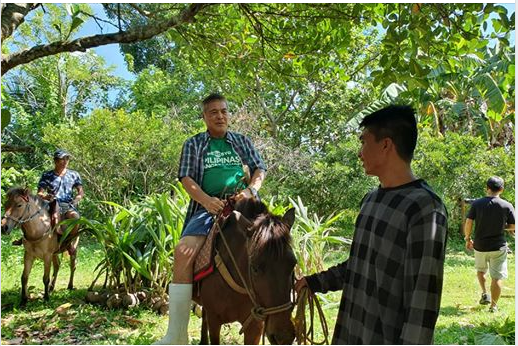
Vilegas OrganiKs founder Pabs Villegas in a horse-riding, agri-mentoring session at the VOHO Farm Complex, Malvar, Batangas
October
28, 2019
An organic agri-tourism farm village stretching over 8.8 hectares in Malvar, Batangas has been put up for aspiring farm entrepreneurs and hobbyists who may now run their small farms and be part of the bigger, more profitable agriculture value chain.
Agriculture Economist Pablito M. Villegas has
established four separate, non-contiguous farms that operate as one agro-ecological
and natural farming complex under the brand name Villegas OrganiKs.
The farm village maximizes productivity and
profit opportunities for small farmer-entrepreneurs or agripreneurs.
Four farms form part of the Villegas.
Organic & Hobby Farm Complex (VOHO) that are being sold to individual
entrepreneurs.
They receive a package of assistance in
organic inputs supplies, agriculture technology, and marketing from VOHO and
Malvar Organic Farmers Agriculture Cooperative (MOFAC).
The farm lots have been sold to
farmer-entrepreneurs who may be taking the risk for the first time in
agriculture business.
But fortunately, they face higher profit
opportunities and enjoy better risk management because of VOHO’s package of
aids and services even to newbies.
“We help amateur entrepreneurs to enjoy
hobby and wellness farming and achieve economies of scale through consolidation
of their produce together with other small farm lots owners,” said Villegas.
He is an agriculture economist who was a
retired vice-president of Landbank at the age of 40 and has been a Food and
Agriculture Organization (FAO) consultant on agricultural and rural development.
By operating as one the farm lots in the four
farms divided into units with 1,000 to 5,000 square meter (SQM) area, farm
investors can produce or buy cheaper inputs and have full access to natural
farming technology.
They are able to negotiate with local buyers
and direct consumers for a higher price for their produce with their combined
bigger volume that enables them to sell to consolidators and institutional
markets.
Likewise, they are also able to obtain first
and second party certification as organic producer or secure Good Agricultural
Practice (GAP) certification through VOHO’s assistance.
The farm complex consists of the following farms
that are all within Malvar township:
San
Pedro Uno Farm, 3.0 hectares with 12 farm lots duly sold out with remaining
0.583 ha of available lots for sale. It is located right adjacent to STAR
Expressway. A total of 12 farm lots are now owned by individual entrepreneurs
while 2 lots are run by VOHO itself. There is a whole block of 5,830 square
meters (SQM) that will be sub-divided into 4 to 8 eco-farmville lots.
Villegas
has also put up an 8,000 SQM amenities area and technology demonstration site for organic farming. The amenities area has air-conditioned
three-door inn with outdoor kitchen for lodging of agricultural tourists. There
is a sauna facility, swimming pool, and gazebo. A water pump is available for
irrigation and domestic waster use.
San
Pioquinto Farm, 3.2 hectares, with 4 farm lots now owned by individual
farm-entrepreneurs while 12 more lots cut into 2,000 m2 and 3,000 m2, are still
available for lot purchasers.
San Gregorio Agro-forest, located in the
watershed and protected area of Taal Volcano and its Lakes, is a 0.9 hectare property,
with 7 agro-forest farm lots still available.
With its sloping, hilly land area, it will be developed with a trekking pathway
and a Glamping (Glamorous Camping) area on the riverbed of Balete River that
drains to Taal Lakes. Continuous
planting is on-going in the agro-forest area (rambutan, Thai mango, Taiwan atis
and guyabano, Malaysian Langka, a dwarf productive breed).
Poblacion
Eco Tourism & Agro-industrial Farm, 1.73 hectares. It will be subdivided into 8 lots for
eco-tourism and multi-use purposes (as events place, pension or retirement
homes , warehouse and logistics, and trucking and storage). It is right within
the midst of the Metro Turf Racing Track in Malvar, and the nearby Summit Point
Golf Course in Lipa City.
Through Villegas OrganiKs, farmers are able
to access nearby markets in the booming economy of Batangas (Sto. Tomas, Tanauan
and Lipa Cities) where the Malvar town is at the center of the province.
At the same time, the farm lots have an easy access to Metro Manila as Malvar is
just 60 kilometers away from Magallanes, Makati.
That’s only a 40-minute travel (without
traffic) via the South Luzon Expressway (SLEX) and Southern Tagalog Arterial
Road (STAR).
Their markets include the Malvar Organic
Trading Post, the Lima Land Industrial Park, also in Malvar, the Lima Hotel,
SM-Lipa, and Robinson-Lipa, and Ayala Mall.
The farmer-entrepreneurs automatically get
aid on agriculture technology, organic farming in particular, through the
Malvar Organic Agriculture Cooperative once they hold membership.
Even before an aspiring farm-owner gets to
own a farm lot at VOHO, farm produce are already waiting for him to harvest as
the farms are already planted with different organically-maintained crops or
fruit-bearing trees that command high
value (higher price) in the market.
The San Pioquinto Farm is planted to
all-organic banana, dragonfruit, guyabano, malunggay, kalamansi, pomelo, cacao,
coffee, durian, mangoes, chico and pili.
There are also areas for organic vegetables (empalaya, okra, sitao), winged
and lima beans, yam, turmeric and ginger with non-sting bees as pollinators.
The San Pedro Uno Farm is also an orchard planted to varied fruit
trees coconut, mango, avocado, rambutan, chico, lanzones.
The San Gregorio Agroforest is planted to
more than 150 fruit bearing trees including lanzones, langka, mangoes, avocado,
coconuts and indigenous forest trees (bamboo and gmelina.)
Villegas said he has put up VOHO with a
concept he has carried all along since childhood in the farm and when he was
part of a think tank and execution group in the University of the Philippines,
Department of Agriculture and Land Bank
and as an agriculture economist (with FAO/UN, ADB, World Bank and his
consulting firm, Meganomics).
As an employee or consultant then, he
crafted value chain master plans programs and projects for agriculture and
fisheries development in Africa, Pacific Islands and Asian economies including Indonesia,
Thailand, Myanmar, Cambodia and Laos.
He has long conceptualized the Nucleus &
Satellite Organic Farm Cluster (NUSOFAC).
It was long ago just a concept that aims to optimize
farm productivity and give small farmers the benefit of being connected to the
bigger, even international supply chain.
But now he has made this concept into a reality
in his own VOHO Farm model.
In this case, the nucleus is the VOHO Farm
Complex, and it is the link that connects small farmers to the value chain. The
satellites are the small farms connected via membership with MOFAC.
The Villegas OrganiKs also has the SAGE, a
Learning Center in its Amenities Area that also makes it an accredited learning
site of DA/ATI for organic agriculture that has 3 training rooms and 28-people
bamboo dormitory. Now, it has transformed into an agri-tourism destination.
The Learning Center lodging has a 3-room Inn
that may accommodate 10-15 persons. The
Amenities Area also has a swimming pool, a spa within and gazebo in front of a
wide veranda.
As an agri-tourism site, the bonus it offers
is the barriotic, refreshing panoramic view of four mountains– Mt. Makiling,
Tagaytay Higlands, Malarayat Mountain ranges, and Mt.
Makulot. The town is also surrounded by three rivers–
Balete River, Alulod River, and San Juan River.
The San Pedro 1 Farm is powered by solar
panels, aside from power from the national grid, enjoying an
environment-friendly, stable and hybrid source of electricity.
Villegas encourages young and senior citizen
investors to try farming initially as a hobby for health and wellness and
eventually as a profitable and rewarding experience Villegas Organiks also
contributes to the country’s food security and poverty reduction with 3 farmer
laborers now transformed into farm family agripreneurs engaging on-farm,
off-farm and non-farm enterprises.
“While one is young, he should invest in
agriculture, so that he will see his investment’s opportunity grow through the
years,” he said.
After all, even if one does not engage in farming in the farm village but just enjoy its provincial surroundings just a little outside of Metro Manila, he gets to own a fast-appreciating value for money property just nearby the nearest expressways from Metro Manila. (Melody Mendoza Aguiba)
The private sector has warned government of possible lawsuits for “illegally” refusing to enforce the “mandated” safeguards against rice imports in Nazi-like reasoning that it is a choice between “105 million Filipinos versus 10 million farmers.”
The Philippine Chamber of Agriculture
& Food (PCAFI) said the Department of Agriculture (DA) and government’s
economic managers are committing an “illegal act” for deliberate abandonment of
its poorest sector despite claims of “inclusive” development.
It is explicitly indicated in Section 10 Republic Act 11203 (Rice
Tarrification Law ) Section 10 that “in order to protect the Philippine rice
industry from extreme price fluctuations, a special safeguard duty—SSG– on
rice shall be imposed.”
As such it is incumbent
upon government to enforce the safeguards legal mandate.
“Although it is not
their (DA and economic managers) intention, but the argument that we should
choose 105 million Filipinos as against 10 million farmers (psa.gov.ph, 2018) is like Hitler justifying the killing of six
million German Jews to save the German Aryan nation.
“They have yet to effectively implement the Rice Competitiveness
Enhancement Fund, but they led them to slaughter,” said Lawyer Elias Jose M.
Inciong, PCAFI director.
PCAFI President Danilo
V. Fausto said granting farmers an additional P3 billion cash assistance in
place of implementing SSG on rice imports is tantamount to “violating the law”
itself.
This may subject government authorities to court suits.
“That is a clear analogy that like
the German Nazi and Hitler, you are willing to slaughter 10 million farmers to
save 105 million consumers. But farmers are also consumers. That’s why
inflation is just at 0.9 percent because farmers don’t have the money to buy. Demand
is low,” said Fausto.
The DA and economic managers are misleading the public by claiming
implementing SSG is inflationary.
“This is a diversionary tactic to protect those who benefited from this
law which are importers. The ones favored by this law are not consumers, much
more not farmers, but importers. They’re trying to divert us from the
fact that so far the importers are the beneficiaries of the law,” said Inciong.
It is utterly unfair
that government is insulting its own farmers by giving a cash consolation of P3
billion (as earlier announced by DA) in place of the safeguards mandate.
“The government really looks down on farmers. It is in bad faith
to even argue that safeguards are inflationary. They’re in bad faith for
refusing to implement the law,” said Inciong.
“The law mandates Section 10 of RA 11203,
meaning the executive has no choice but to impose it. The meaning of
impose is to establish the mechanism,” said Inciong, a lawyer and also
president of the United Broiler Raisers Association some of whose
farmer-members are planting rice.
Government
should start having a new perspective on farmers.
“Farmers don’t plant to save the agriculture industry. They plant
to sustain their livelihood, to have income.
The government should now see farmers not as welfare beneficiaries, but
as a business sector that needs to profit,” Fausto said.
Inciong said government’s task under the law is simply to come up with a
mechanism implementing the SSG based on either price or volume triggers.
If, for instance, the trigger price is set at P35 per kilo and the
landed price of imported rice hits below P35, an SSG should automatically be
implemented. The lower it is from the trigger price, the bigger the duties to
be imposed.
“The only thing DA has to do is to issue an order requesting the
Commissioner of Customs through the Department of Finance. It is in bad faith
to say it is inflationary because they can suspend the SSG anytime. That claim has no credence,” said Inciong.
Unfortunately, DA is apparently refusing to even come up with this
mechanism.
“The way the law was crafted and in practice, when you say impose, you
establish the mechanism. The mechanism is to find out what is the trigger–
when to apply the special safeguard, either price or volume trigger”
So far, the indicative volume trigger of rice imports must have already been hit as “we only need 1.9 million tons of imports, but our importation has already hit 3 million tons according to (DA Secretary William) Dar himself,” said Fausto.(Melody Mendoza Aguiba)
Food and agriculture processors have asked for a sugar import allocation of an estimated 105,000 metric tons (MT) annually to stabilize their manufacturing input and raise their global competitiveness with heftily lower cost.
The Philippine Chamber of Agriculture &
Food Inc (PCAFI) and member Philippine
Food Processors & Exporters Organization
(Philfoodex) is asking Agriculture Secretary William D. Dar to grant a maximum
of 10% sugar import allocation.
This is out of the country’s annual sugar
production placed at 2.1 million MT.
However, even just half of this amount, or 105,000 MT will be good
enough to significantly raise food processors’ global competitiveness.
It will cut sugar cost for food
manufacturing from P55-P60 per kilo locally to P28-P30 per kilo in other South
East Asian countries, particularly Thailand.
PCAFI President Danilo V Fausto said this
petition of PCAFI and PHilfoodex for an import allocation will be accompanied
by an implementation mechanism to ensure it does not adversely affect local sugar
farmers’ plight.
“We’ll issue a petition to be submitted to
Secretary Dar and President (Rodrigo) Duterte. We will also propose an
implementation mechanism that will ensure this allocation will not go to the
retail market but rather help our food producers become competitive,” said
Fausto.
Philfoodex President Roberto C. Amores said
not even the entire 10% of production will be asked by processors.
Initially, only 50% of each company’s sugar
requirement based on its production program is proposed to be granted to the
company.
“We’re not talking about even 10% of the 2.1
million. We’re not requesting for
liberalization. We’re requesting for import allocation for stabilization for
the cause of processors,” Amores said.
“As a processor, you will submit your requirements
based on your production program and sales. And you will be given only 50% of
your requirement (not 100%).”
This
initial allocation per processor will establish credibility of the processor.
The processor should guarantee that the sugar import will be used solely
as input for its food manufacturing, not for retail to the domestic market
(adversely affecting sugar farmers’ income).
Dr. Rolandy Dy, Center for Food &
Agribusiness (University of Asia & the Pacific) chief and PCAFI member,
said the sugar import allocation for local food processors is necessary.
“We’re not competitive. Never mind (if we’re not competitive in) softdrinks
which is not exportable because softdrinks are heavy. The problem is we’re not
competitive in products like biscuits, candies,” said Dy.
Filipino food processors can hardly compete
with ASEAN biscuit manufacturers.
“I’m talking about those 4,500 food
processors who are paying P55 versus P28. When Apollo biscuits from Malaysia
(or Indonesia) arrive here, it’s only P10. Pero pag gumawa si Mang Pandoy ng
Apollo biscuits nya, P15 ang puhunan nya,” said Amores.
(If Filipino businessman Mang Pandoy
produces his own Apollo biscuit, his cost is at P15).
Some groups have opposed such allocation due
to past experiences when some imports for manufacturing input have been
diverted to the domestic market.
This concerns not only sugar, but other
imports such as carabeef (carabao meat from India).
But a proven effective mechanism to control
such diversion is to make the food manufacturers themselves to police their
ranks, PCAFI said.
Fausto said members of PCAFI, Philfoodex,
and the Philippine Chamber of Commerce and Industries (PCCI) may be tasked to
monitor if the import allocation is being diverted to the market.
Amores stressed food processors’ import need
is not for liberalization.
“I would like to correct the impression that
this is liberalization. The sugar industry in Negros has been writing all over
the news that the private sector led by me is espousing liberalization. It’s
not,” he said.
“We all know that since our sugar sector is
not competitive, we can’t be self-sufficient in sugar as sugar area is
declining. But we have to admit some
traders are riding on this issue in the guise of protecting farmers.”
Also, it is initially proposed that the
state-owned Philippine International Trading Corp (PITC) be the one to do the
importation.
Philfoodex lamented that while the Sugar
Regulatory Administration (SRA) had once approved sugar importation for 170,000
MT, this volume has not benefited food processors.
Since SRA issued a memorandum allowing this
volume to be designated as “reserve,” some of this sugar found their way into
the domestic market since reserve sugar is allowed to be released domestically.
“But we have not benefitted from this allocation,” said Amores. (Melody Mendoza Aguiba)
A rice tariff of at least 70%, as sanctioned by the Rice Tariffication Law’s (RTL) safeguards provision, was pressed to be urgently implemented by government to arrest further imports hitting beyond all-time high records, saving Filipino farmers.
The safeguards will also save government
from needing to spend huge funds for conditional cash transfer or farmers’
loan, now placed by Department of Agriculture (DA) at P15 billion, just to spare
Filipino farmers from serious economic damage.
The private sector, representing thousands
of Filipino farmers under its wings in the supply chain, has pegged desired
rice tariff to at least 70% in order to beef up global competitiveness of Filipino produce.
At the same time, the Philippine Chamber of
Agriculture& Food Inc. (PCAFI) asserted that it strongly supports the RTL,
contrary to what may be perceived by some groups.
“We are supporting the law. Therefore let’s
implement the law. We want the law, that’s why we want it implemented,” said
PCAFI President Danilo V. Fausto.
PCAFI warned the continuous influx of cheap
imported rice may threaten the country’s national security, prompting hungry farmers
in the rural areas to resort to joining communist rebels.
“We have to assess the situation because any
further damage may affect our national security.”
Unlike the position of some groups adversely
affected by the RTL, Fausto said PCAFI wants RTL upheld through immediate
implementation of its explicit provisions.
“We’re not asking for a repeal of the law or
an amendment of the law. And if the law
says, section 10 of Republic Act there are safeguards, let’s implement it.”
A tariff rate of at least 70 percent should
be reasonable enough to give the Filipino farmers at least the “temporary” yet
extra edge against imports.
“Our palay price is now at around P12 per
kilo. But NFA should buy it at P17 (to aid farmers). At that buying price, it will sell in the
retail market at P34 per kilo, when milled.
Then domestic rice will even out with the imported at P34,” said Fausto.
With price of both domestic and imported
rice at same level, “why would you bother importing?”
Ernesto Ordonez, PCAFI trustee and Agri
Fisheries Alliance (AFA) chairman, said the imposition of safeguards from the
current 35% level is urgent even as there are trade notification rules involved.
AFA is
composed of five sectors: farmers and fisherfolk, (Alyansa Agrikultura-AA),
agribusiness, PCAFI, science and technology (Coalition for Agriculture
Modernization in the Philippines – CAMP), rural women (Pambansang Kilusan ng
Kababaihan sa Kanayunan – PKKK), and multisectors (Agrifisheries 2025 –
AF2025).
“We do not want a repeat of the mistake
during the 1990’s when we agreed to the too rapid tariff reduction without
giving the farmers the necessary support services and the WTO-approved
safeguard measures,” said Ordonez.
Ordonez cited the Department of Agriculture
September 9 national survey where imported rice with the 35% tariff caused
farmgate wet palay prices in Regions 2, 3, 11 averaged P12.10 a kilo, barely
above the P12 production cost.
CAMP President Emil Javier favored measures
like cash transfers and assistance in credit, technology, and marketing.
AFA stated it rejects calls for a return to government
rice import monopoly and supports food security instead of food
self-sufficiency.
“In areas where rice production is not
competitive, the government must provide assistance for transition to higher
value crops,” said Ordonez.
The tariff protection under safeguards will
just be a temporary, a transitory, policy, PCAFI asserted.
“DA should immediately implement it as
promised it should be by October 1.
Anyway, that will just temporary,
while we’re trying to give our farmers time to upgrade their competitiveness.”
Now at 2.4 to 2.5 million MT (MT), imports
must immediately be curbed. The Foreign
Agricultural Service (USDA) placed
projected import for the year to hit 2.6 million MT.
Fausto
said even a P34 against P34 per kilo Filipino against import price will be
enough.
Imported rice is currently being traded at
around P17 per kilo. With trader’s
overhead, it rises to P20 per kilo, and finally to P27, P28 per kilo in the
retail market (with logistics costs).
“But imported rice should be at least equal
the local market price. That will make
them lose over domestic rice. Now, NFA
should ensure farmers dictate the buying price of palay at P17 per kilo for dry
and P13, P14 per kilo for wet.”
PCAFI Trustee Elias Inciong is questioned
why some groups may be opposing the safeguards implementation even if they are
representing sectors that are not rice-related as compared to suffering rice farmers.
“They don’t want higher tariff? Why?
Because it will affect consumers? (or their businesses?)”
But PCAFI, some of whose members themselves
plant rice in poverty stricken, rural areas, want more protection for precious
but few Filipino farmers that remain sustaining to raise the country’s food
security.
Under Republic Act 880, the Safeguard Measures
Act, safeguards may be imposed in the following conditions (Rule 2.2a-c) all of
which conditions are reported to have been happening after the RTL
implementation:
significant idling of productive facilities in the domestic industry including the closure of plants (rice mills) or underutilization of production capacity
inability of a significant number of firms to carry out domestic production at a profit
significant unemployment or underemployment within the domestic industry.
The Philippine Chamber of Agriculture and Food Inc. (PCAFI) supports the call of the Samahan ng Industriya sa Agrikultura (SIK) for government to suspend importation of pork until a genuine quarantine system is in place at Customs borders.
That policy will not only ensure animal
protection from infection of the dreaded African swine fever (ASF). It will also
ensure that proper tariffs and duties are paid.
The government—the Bureau of Customs (BOC)—currently
does not have the full capability to carry out strict biosecurity system that
will guarantee that no imported meat products infected with ASF will enter the
country.
These BOC deficiencies include the absence
of refrigerated facilities where the
meat products may be adequately inspected for quarantine systems by the Bureau
of Animal Industry (BAI) and the system for proper collection of tariffs and
duties.
These deficiencies derail implementation of
proper animal and food safety along with
proper revenue collection from meat imports.
“The current ‘make-do’ second border system
inside the cold storage facility of the importer is meaningless in terms of
proper collection of tariffs and duties, quarantine and food safety,” said
PCAFI President Danilo V. Fausto.
Such government practice of allowing meat
imports to be directly transported to warehouse of importers before these are
evaluated for quarantine procedures and charged with tariffs and duties have
long been questioned by agriculture stakeholders.
“The Bureau of Customs has no refrigerated
facilities within the Port of Manila
which has prevented the Bureau of Animal Industry (BAI) from implementing
quarantine protocols,” Fausto said.
Poultry and livestock industry stakeholders
have long recommended that all meat imports should just go through a single
port with the necessary facilities for a full quarantine process.
The agriculture stakeholders have asserted government’s
role in implementing biosecurity systems against ASF will be crucial.
Likewise, all local government units (LGUs)
should consistently impose on all backyard hog raisers to obtain business
permit for their operations even as some LGUs do not even know that hog
backyard raisers exist in their jurisdiction.
LGUs
will have a critical role in this biosecurity system considering that nearly 70
percent of all hog production in the Philippines comes from backyard
raisers.
“LGUs should be held liable on the control
of African swine fever within their area,” said Fausto.
At the same time, even sari-sari store operators should be monitored for keeping business permits through which a system may be implemented on controlling consumption of meat that may be affected by the disease.
Stricter biosecurity measure on pigs urged by PCAFI after hog disposal in Marikina river
September
13, 2019
The private sector has urged government to implement stricter biosecurity measures against the spread of Asian swine fever (ASF) on hogs but also assured consumers that humans cannot be infected by the disease.
The Philippine Chamber of Agriculture and
Food (PCAFI) urged the Department of Agriculture (DA) and local government
units (LGU) to intensify implementation of protocol in disposing of dead hogs. This as some of the dead hogs suspected of
having been infected by ASF have been found floating in the Marikina River.
“Offenders should be prosecuted as this is
apparently a violation of certain memorandum act of DA regarding the disposal
of dead hogs,” said PCAFI President Danilo V. Fausto. “Stricter implementation of biosecurity
procedures should be observed.”
At the same time, Fausto said there should
also be more information program declaring the scare against hog consumption
since ASF does not adversely affect human health.
“People should not be afraid of ASF,” said
Fausto.
Edwin Chen, president of PCAFI member Pork
Producers Federation of the Phils (Propork), said hog raisers, particularly
those from small backyards, should be advised to observe proper disposal of dead
hogs.
“If the farm is in the backyard, the hogs
(affected by the disease) should be culled first then buried immediately
outside the farm at a depth (that may not be disturbed by other animals.)
Depending on the number, it should be within a certain depth, maybe two meters
if there are only a few.”
“In
commercial farms or in a locality, DA people have a designated areas for
burying these. The site should not be near a waterway or a creek.”
DA spokesman Noel Reyes said government will
be prosecuting offenders on the handling of dead hogs based on the Animal
Welfare Act and the Solid Waste Management Law.
There are several other ways of controlling spread
of ASF, according to authorities. The Disease and Welfare guide of the Pigsite.com
advises the following:
Prevention of feeding of contaminated feed and contaminated food waste used to supplement hog feed
Control of the animals from the bites of soft bodied ticks, lies and flies
Prevention of inoculation of the pigs with contaminated syringes and use of contaminated surgical equipment
Prevention of introduction of infected pigs with uninfected ones. (Melody M. Aguiba)
Vince Roxas (right in black) presents the SKR Sustainable Development Model
Today, I feel fortunate to have attended a presentation on a Sustainable Development model conceived by people from the Development Academy of the Philippines. The idea of the model is to promote true poverty reduction from the really grassroots level, the poorest of the poor through agro-industrialization.
Vince Roxas, son of former Bancom Development Corp. (Bancom) president Sixto K. Roxas, explained the development in rural areas led by real estate developers is not a model that truly sustains Philippines’ economic development.
Real estate development makes Philippines a net importer of food, an exporter of raw materials or agricultural products, and and exporter of sadly, overseas Filipino workers (OFW).
As soon as a real estate developer constructs a mall, areas surrounding it gets to have land value appreciation. Then, even agricultural areas get sold out and are converted into residential/industrial area, leaving farmers and prospective agriculture entrepreneurs without land to till. Meanwhile, that community flourishes because farmers and their families go abroad, and that OFW money flows back to the once rural area and prompts a more intensified consumer consumption, thereby appearing to contribute to rural development. The cycles just goes on, and more OFWs go abroad, eventually becoming detached to their old community as even his own land is sold off. Farmers are left without jobs, and the farm sector dies in that area. The cycle goes on as real estate developers transfer to another rural area.
I and Bohol Governor Arthur C. Yap
The development model though proposed by SKR is one where Philippines taps its own natural resources, intellectual/human capital for its own use, produce goods that may be consumed here and in export markets–enabling a more sustainable development through agro-industrialization.
I was in this presentation as part of a team from the private sector, Philippine Chamber of Agriculture and Food Inc. (PCAFI) where I do PR work.
Bohol Governor Arthur C. Yap (a former Department of Agriculture secretary) was there not only to listen to the SKR model presentation, but to offer Bohol to PCAFI businessmen as an investment destination. He wants businessmen to take part in this sustainable development to be piloted in Bohol. One town I remember as a suggested area of investment is Ubay– ideal for dairy carabao business.
Bohol appears to be an auspicious investment area, according to DVF Dairy Inc. President Danilo V. Fausto, as other businessmen have already infused investments there– including Philip Ong (bangus).
Other sectors represented in the meeting to possibly look at investment opportunities are Lawyer Elias Jose Inciong of the United Raisers and Broilers Assn and Gregorio San Diego of the Egg Board.
I joined PCAFI and the DAP group with Bohol Governor Arthur C. Yap in this photo. I’m at the extreme right (in black)
Vince said Dr. William Dar, DA secretary, wants the SKR model to be piloted in if I recall it right, Alaminos, Pangasinan. However, as I recall, SKR has proposed it to be implemented in Cauayan, Isabela.
The idea of this SKR model really stands on findings based on empirical data carried out by SKR’s group. I hope to write a blog further on this development. (Melody M. Aguiba)
The government will impose sanitary and phytosanitary (SPS) measures against imported rice as imports have ballooned to 2.2 million metric tons (MT) for a quality found to be “bukbok-packed” (pests) to Filipino consumers’ health detriment.
Imported rice has been found in the past to
be needing heavy pesticide-spraying due to the bukbok.
Department of Agriculture (DA) Secretary William
D. Dar said Saturday DA at a forum with the Philippine Chamber of Agriculture and
Food Inc (PCAFI) said government will impose SPS measures.
This is sanctioned within its agreement with
the World Trade Organization (WTO) to curb poor quality rice imports.
“We have asked BPI (Bureau of Plant Industry) to
implement protocol in import regulations regarding pesticide residue, presence
of storage pests before the issuance of SPS (certificate) for imported rice,”
said Dar at the PCAFI meeting held at the Quezon City Sports Club.
Dar said DA will correct several policies
and impose new ones to ensure the benefit of both Filipino farmers and
consumers.
“Those that say DA should rather be called
Department of Importation, to some extent that’s true. And we will correct that eventually.” Dar said.
One of the policies being studied is the recommendation
of PCAFI for the imposition of special safeguard measures, similarly sanctioned
by the WTO, to ensure entry of dumped rice does not endanger the local
industry.
“We’re also now studying the possibility of
special and general safeguards measure.
If there’s excessive rice import, we will limit these. We will stop rice from coming from its origin
as it’s affected by bukbok,” said Dar.
PCAFI President Danilo V. Fausto said such special safeguard measure is a government right as part of protecting its own people.
Danilo V. Fausto, PCAFI President
Section 7 of Republic Act 11203 (Rice Tariffication
Act) indicates government may “increase, reduce, revise” import duty rates
(given certain conditions) consistent with “national interest” and the “objective
of protection Filipino farmers and consumers.”
These are possibly other immediate measures
of DA in protecting farmers and consumers from the adverse effect of RA 11203
implementation:
Imposition of a
Suggested Retail Price (SRP) “when figures don’t reflect true value of price” to
ensure traders do not take advantage of the situation by “managing” or stopping
inflow of supply to domestic market, thereby causing price to shoot up.
DA will study
the reason why rice price has not gone down considering huge imports since
March upon ratification of RA 11203.
Government will
legislate increase in rice buffer stock from 30 days to 90 days. This will provide higher government budget
for buying of palay of Filipino farmers’ produce, ensuring better income for
farmers. This may also raise National
Food Authority’s (NFA) ability to buy rice from Filipino farmers up to 5% of
total rice production, versus the current 1% or less.
Enjoining Local
Government Units (LGUs) to engage in the business of buying palay, milling,
storing, and distributing with the objective of immediately releasing rice
stocks so that “turnover” of the value of rice may be realized, bringing
multiple profits to Filipino farmers and other stakeholders. LGUs may also manage warehousing and
maintenance of farm machineries as part of a “tripartite agreement” with DA and
farmers.
National Food
Authority’s warehouses will be leased
out to LGUs who have the advantage of
strategically being located where farmers’ produce are, thereby becoming
efficient in managing this business.
However, Fausto warned DA should ensure that
this LGU business of rice buying and selling should be an “honest to goodness”
one and should not be used by LGU leaders just to benefit those that patronize
them.
“You have to be very careful because LGU
leaders are political people. You can legalize
vote buying through this system. We’re
not generalizing all political leaders.
But at the end of the day, some look for votes so that they or their
relatives will win again next term,” said Fausto.
“It should be an honest to goodness way of
buying of palay from all sectors, and selling to all. It should not only benefit the selected few
(voters),” Fausto said.
This new LGU rice buying and selling,
though, definitely has advantage in providing budget for maintenance of
warehouses and rice machineries.
“There’s no issue if government maintains machineries. There should be training of people on these skills and in marketing goods. If the machines break down, or the warehouses need repair, there will be a budget that may be lent to the LGU,” said Fausto. (Melody M. Aguiba-Growth Publishing)
Non-tariff measures, legislated Land Use Plan to be adopted by Duterte Admin as milestone policies for agri modernization
September
1, 2019
Non-tariff measures (NTM) and a legislated Land Use Plan will be adopted by the Duterte Administration as major milestone policies that are seen to catapult Philippines to agricultural modernization.
In a forum with the Philippine Chamber of Agriculture
and Food Inc. (PCAFI), Department of Agriculture Secretary William D. Dar declared
Saturday these two major policies as an official government stance for the
first time since Philippines joined the World Trade Organization (WTO) in 1995.
The NTMs will include subsidies for ensuring
Filipino farmers will be globally competitive and will have capability to
export goods.
NTMs will also support Filipino farmers in
the form of stricter sanitary and phytosanitary rules for imported goods and
other support– farm to market roads,
post harvest facilities, research fund, skills development upgrading.
“If we need to subsidize, we must subsidize. That’s a policy direction. There are many ways, not only subsidy, that may be used under the WTO (to help farmers). New equations, when you promote these in a big way, (will benefit farmers). We will take this route so we can become productive and competitive,” said Dar at a PCAFI meeting at the Quezon City Sports Club .
PILLARS OF AGRI MODERNIZATION. Agriculture Secretary William D. Dar (second from left) speaks on Agri Modernization before a PCAFI meeting at the Quezon City Sports Club together with (L to R) PCAFI Chairman Philip Ong, former DA Secretary Luis P. Lorenzo Jr., and Rolando Dy of the University of Asia and the Pacific.
Dar’s declared policy toward NTM was a
response to PCAFI’s position that the government has not supported the local
farm sector with NTMs openly practiced by developed countries (United States,
Japan, European countries).
PCAFI President Danilo V. Fausto said the US
government approved a Farm Bill providing for $850 billion budget including
subsidies for American farmers.
“That’s against our P70 billion budget that’s
all there is for our farmers for this year,” said Fausto.
Also PCAFI member, Lawyer Elias Jose Inciong
of the United Broilers and Raisers Association, said the National Economic
Development Authority and other economic team members in the country have all
along ignored the fact that foreign farmers are heavily subsidized.
The Doha Development Round of WTO that
commenced in 2001 in fact broke down because developed countries refused to
give in to removing subsidies, all other trade support, for their own farmers.
“What enables other farmers is subsidy. That’s
why the Doha development round of WTO, the development aspect, has been
abandoned. Its’ not there anymore. Yet, our policy making is very silent on the
issue of subsidy. The economic team will
rather blame the agriculture sector of not being competitive or of having
protectionist mindset,” said Inciong.
“But obviously our farmers don’t have subsidy. Ever since we got into the WTO, we’re
competing not only with foreign partners, foreign companies, but foreign
governments who subsidize their sector,” said Inciong.
Dar also took a position that a Land Use Act
(LUA) should be legislated, a major policy pushed by the private sector for
many years as it protects use for agriculture, but a policy that faced
opposition from some legislators.
“Our position is we don’t have a land use
system. That’s the issue of land conversion on one side. But bright agricultural lands, much more those
with irrigation system, must not be converted (for industrial or residential
use,” Dar said.
Fausto said the LUA will solicify the
presence of investors in agriculture.
“Our investors will have stability with Land
Use Act. They’re putting in millions and millions in investments. But at the end of the day, their land may be
converted because we don’t have a proper land use law. Lands that are perfectly productive should
remain producing food for our country,” said Fausto.
Dar said the LUA would have been ratified a
long time ago.
“The issue of land use is issue has been
there for the last 30 years. We hope
this time around, it has to be legislated.
There should be a comprehensive land use for every area. (Even without the law yet), Local Government
Units should now go forward and start
land use planning,” said Dar.
The PCAFI forum with Dar was attended by close to 200 agriculture sector leaders in the private sector coming from 23 different farm subsectors. (Melody M. Aguiba)




 Growth Features