Filipino-designed electric bike that uses climate-smart bamboo to pave way to Ph being globally known world class bamboo producer

April 3, 2023

A Filipino-designed electric bike (EB) brand-named “Banatti” that uses innovative, environmentally sustainable bamboo  is seen to pave the way to Philippines’ being a globally known producer of world class bamboo products.

   Speaking in an “Usapang Kawayan” bamboo forum, Christopher Paris Lacson, Banatti EB’s creator,  said the trendy motorcycle is just the beginning of a highly promising sector that has the potential to catapult Philippines to industrialization.

   “A bike like this can inspire the young, the leaders, the countrymen, and the industries to say ‘Kaya pala yan’ (It can be done!),” said Lacson.  “It’s not (just) about making money.  It’s about making us proud.  We can have our own. We’re creative.  We’re smart.  We’re intelligent.”

   The team that developed Banatti Green Falcon chose to use bamboo as “it is the mandate of the country.”

   “This God-given supergrass is one of our tickets out of poverty.   When people see a picture of Banatti Green Falcon, it brings an incredible feeling. Something goes on to their mind, something shifts,” said Lacson.

   The dream of using bamboo as a jump-off point for Philippines’ development of rural-based industries is  a much practical vision due to the abundance of bamboo in the Philippines, said Philippine Bamboo Industry Development Council (PBIDC) Vice Chairman Deogracias Victor B. Savellano.

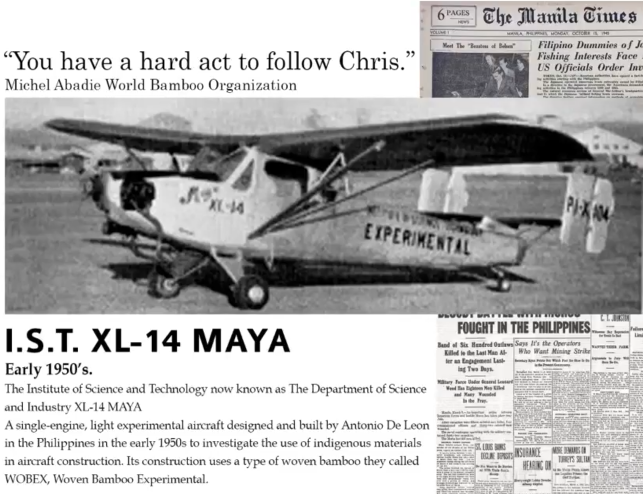
Single engine, light experimental aircraft built and designed by Antonio de Leon in the 1950s

   Through his Kilusang 5K (Kawayan:  Kalikasan, Kabuhayan, Kaunlaran, Kinabukasan), Savellano hosts Usapang Kawayan in order to sustain brain storming on bamboo development as envisioned by Executive Order 879 since 2010.

   “If you analyze, kawayan is not like other plants as jatropha that government once asked us to grow.  We have taken kawayan.  You see it in every barangay, but no one plants,” Savellano said. “That’s why we’re fighting for kawayan. It’s not that we don’t want other plants.  But let’s prioritize kawayan because planting it brings results.”

   The equivalent of a P20 million-worth farm-to-market project makes for a big expansion in bamboo planting.  For one, the 20-hectare plantation project of Kilusang 5K in Karugo, Montalban just costs P1.5 million, even initially.

   “What will you plant? The hardwood that you will harvest in 10-20 years, or the bamboo that you can harvest in 3-4 years?  And we already have many existing clumps.  With the proper management, you can benefit economically immediately.”

Durable body shell

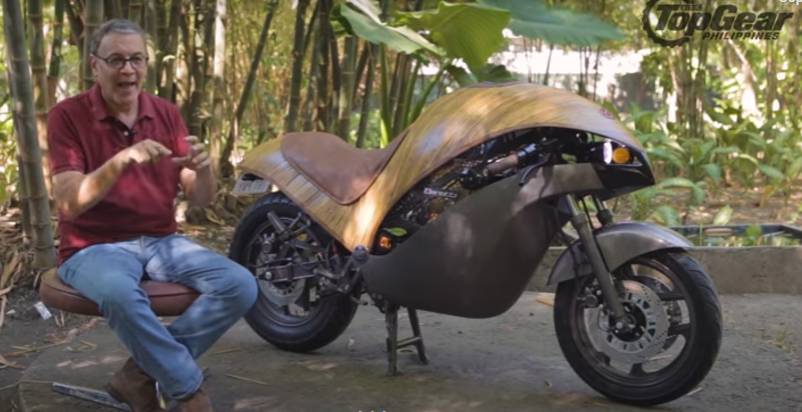
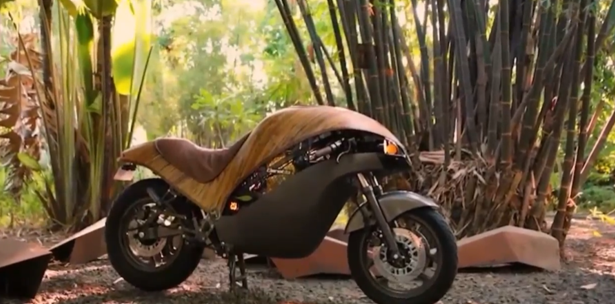
   The Banatti Green Falcon, crafted by Lacson in 2017, has a body shell made of highly durable, elegant-looking, light-weight (four kilo only versus 2-3x more weight in metal ) bamboo. 

Bamboo mobile designed by the old Department of Transportation

   Its body shell that is made of bamboo may just be worth P5,000.  But using bamboo in sophisticated, industrial products can bring about tremendous multiplier effect on the economy.

   “The bamboo that created the body shell of the motorcycle may just be worth P5,000.  But someone has to plant it.  Someone has to cut it.  Someone has to bring it to the place where we bought it from.  Just this, and there are four levels of job across spectrum,” said Lacson.

   “In industries like furnishing or automotive, there are so many tentacles, many roots involved in the design of the product.”

   If other nationalities such as the Germans of Porsche find value in natural materials such as bamboo for vehicles, much more should the Philippines find value in its own indigeneous plant. 

   An advantage of bamboo body shell to complement an electric motorcycle as in Banatti is it can install a good sound system that can enable one to hear music very well, unlike gasoline-run ones. 

   Lacson himself said the Philippines has long been a pioneer of industrial bamboo design as cited by a local newspaper in the early 1950s. 

   Filipino Antonio de Leon designed a single-engine, light experimental aircraft XL-14-MAYA.  It used a type of woven bamboo called WOBEX, woven bamboo experimental.

   Another product is the bamboo mobile, a type of jeepney spearheaded by the Department of Transportation of long ago.  Its  body is made of bamboo. Bambu Batu (House of Bamboo) cites many other modern, fashionable furniture and clothing products made of bamboo.

   Now that climate-related disasters have shown Philippines’ vulnerability, much more should Philippines tap now what is native and ecologically sustainable.

   “History tells us about the ‘ugong’ created by kawayan.  If that has once been happening in Pasig (where bamboo plants in Barangay Ugong hold on relentlessly to the soil and just create the wild ugong sound), why do we choose to spend millions for other projects?” said Savellano.      

   Infrastructure projects–like riprapping that protects soil from erosion– can cost much more money. Whereas, bamboo plants have been proven to control erosion.

   With its rich network of roots and rhizomes and permanent canopy, bamboo protects the soil. 

   “(Bamboo’s root system) grows in the surface layer of the soil (20-60 centimeters deep) and can reach up to 100 kilometers per hectare.  Rhizomes can survive for more than a century, allowing bamboo to regenerate even if stems would be cut or destroyed in a fire or storm,”

according to Guadua.bamboo.com.

EO 879

   EO 879 envisioned bamboo to be a tool for industrialization based on agricultural development. Also, it should be planted as Philippines’ contribution Southeast Asia’s commitment to plant 20 million million hectares of new forest to improve the environment.

   “Bamboo can be easily transformed into a cash crop for farmers… thereby alleviating poverty.   The growing advocacy for green products is fueling the rapid growth of the US$8 billion per annum market for traditional and non-traditional bamboo products,” according to EO 879. 

   “(Bamboo) is fast becoming a cost effective and attractive complement and/or alternative to plastic, metal and wood materials and can generate more jobs and self-employment opportunities in both rural and urban areas.” (Melody Mendoza Aguiba)
Ph should aspire to have UNWTO-named “Best Tourism Villages” to sustain rural economy

March 20, 2023

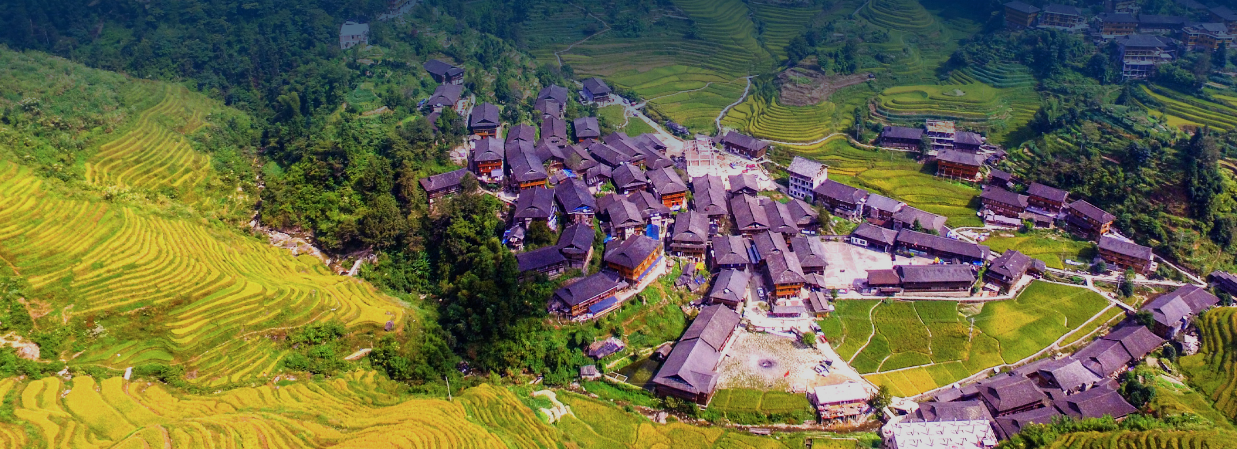
Best Tourism Villages Credit- UNWTO


The Philippines should aspire to have UN-World Trade Organization-named “Best Tourism Villages” that help sustain rural economy and cultural traditions and support livelihood in the outskirts.
   Antonio Lopez de Avila, UNWTO Tourism for Rural Development Programme coordinator, said at a tourism forum of the Southeast Asian Center for Graduate Study and Research in  Agriculture (SEARCA) that farm tourism will play a significant role in post-Covid rural development.
  As borders have started to open since countries imposed movement restrictions at the height of the pandemic, farm tourism will now play a big role in the recovery of economies.
   “We can use tourism as a powerful driver. People are discovering new routes.  They do what they have not done before like harvest crops,” he said.
   One way to encourage rural towns to invest in tourism development is to provide incentives for rural areas to strive to qualify for the Best Tourism Villages, a United Nations WTO program.
   The Alula Framework for Inclusive Community Development through Tourism has been set up by the WTO, G20 Tourism Working Group, and the G20 Saudi Presidency in a vision to improve the livelihood of many people.  The Alula Framework has a vision that livelihood generation can be achieved through education, investment, innovation, and technology in farm tourism sector.
   In the same SEARCA tourism forum titled “Unleashing Untapped Opportunities of Agrifood Tourism, Keneth de Gracia of the Department of Tourism (DOT) 4-A said the Philippines has already emerged as a top farm tourism destination.  
   This has arisen due largely to the ratification of Republic Act 10816 or an “Act Providing for the Development and Promotion of Farm Tourism in the Philippines.”
   Even more, farm tourism is becoming popular especially among the youth who are exposed to a new face of agriculture.  The  pandemic has brought about awareness on agriculture’s role in sustaining food production, nutrition, and health.  
   De Gracia said DOT has engaged in a technical cooperation with the United Nations Food and Agriculture Organization (UN FAO).  This will come up with a standard module for capacity development in farm tourism.  I will train people on  farm tourism sites in Calabarzon (Cavite, Laguna, Batangas Rizal, Quezon).
     Dr. Siti Fatimahwati Pehin Dato Musa, professor at Universiti Brunei Darusalam, also said at SEARCA’s agritourism forum that the current fast food culture has become a threat to food traditions.  This is why there is a hunger for agritourism and farm-to-table (FTT) activities.

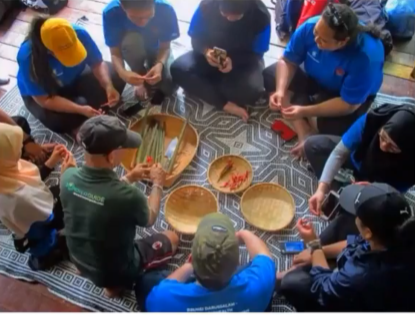
Farm tourists learn foraging in Temburong Jungle

   SEARCA has engaged in discussions on agritourism even as SEARCA Director Glenn B. Gregorio said “agritourism is an innovative pathway to ISARD.”  
   ISARD or inclusive and sustainable agricultural and rural development is the mandate of SEARCA when it was founded as a treaty organisation in 1966.
   Through the farm tourism sector, new markets are created for agricultural products, said Pehin Dato Musa.  
   Traceability of food sources is strengthened, and transport of goods becomes shorter in distance and cheaper as communities get to be aware of farms’ presence.
   “FTT groups have been taking responsibility for promoting local artisans, local farmers, and local flavours through regional events such as taste workshops, wine and food tasting, and farmers’ markets.”

Best Tourism qualification

   To qualify for the “Best Tourism Villages,” a candidate site should have a population of a maximum of 15,000 inhabitants.  Its location should showcase traditional activities particularly agriculture, forestry, livestock, or fishing.  
   As not all can be Best Tourism Villages winners, UNWTO gives support to candidates through partnerships that help improve a site after an evaluation.
  Among the benefits of the UNWTO program are training, sharing of good practices, participation in international events, networking, mentoring, and financing.
   The Best Tourism Villages provides guidance to governments and the private sector on putting up tourism policies through education, investment, innovation and technology to “transform the livelihoods of millions, while preserving our environment and culture.”
   UNWTO advances the role of tourism as it preserves “landscapes, knowledge systems, biological and cultural diversity, values and activities” in rural areas.
   De Avila said UNWTO’s secretary general  Surab Pololikashvili stated that “tourism has proven to be a lifeline for many rural communities, but its true potential has yet to be realized.”
   According to the WTO, tourism accounts for 7% of world trade.  It is among the most resilient sectors of the economy and generates millions of jobs.

Farm-to-table
   Pehin Dato Musa said farm-to-table activities in Southeast Asia include cooking classes, events, tours, markets and school or organization activities.
   Tourists get to value their heritage. People realize it is much safer to tour locally where farms are.
   “Agritourism farms in California can operate despite Covid 19 regulations.  And 61% of revenue direct sales of agricultural products are delivered fresh to consumers.”
   One agritourism site in Brunei, Pehin Dato Musa cites, the Sumbiling Eco Village, is a protected rainforest.  Its natives practice organic farming and agroforestry– planting native trees and bamboo. The Iban people’s food heritage also offers unique culinary experience.  Tourists get the chance to look for edible or medicinal plants, stingless bee honey, and wild herbs in the deep forest as one activity.
   Farm tourism can develop infrastructure in rural areas. A big gap has been observed in the  absence of electricity in rural areas compared to urban areas.  Absence of electricity affects 638 million rural compared to 121 million urban people.  Such big difference is true too in sanitation services and drinking water and financial services. Melody Mendoza Aguiba

Featured Photo Credit: UNWTO


30-hectare bamboo plantation in Montalban upland Sierra Madre put up to give Dumagat tribe livelihood, replenish forestry, capture carbon

February 24, 2023

A 30-hectare bamboo plantation in the Montalban upland in Sierra Madre mountain has been put up by a multi-sectoral group that aims to give live livehood to Dumagat tribes, replenish forestry and capture carbon,  and help prevent Metro Manila flooding and climate disasters.

   The Philippine Bamboo Industry Development Council (PBIDC) is proposing to replicate nationwide the 20-hectare Karugo and 10-hectare Puray bamboo projects in Montalban. 

   It is part of the Marikina Watershed, a portion of the Sierra Madre mountains that hold the water without whose forests Marikina and the entire Metro Manila could be flooded.

   The Karugo and Puray bamboo projects in Montalban, Rizal are an ideal multi-agency collaboration that involves minimal budget, according to PBIDC Vice Chairman Deogracias Victor B. Savellano.

    Yet it has harnessed and consolidated multiple resources that redounds to upland economic benefit.

   “Our best examples (for bamboo propagation) are those in Puray and Karugo. It’s something that’s not difficult to do. It is a joint effort between government Rotary International, Indigenous People, and community. It’s a beautiful model that should be replicated all over the Philippines,” said Savellano.

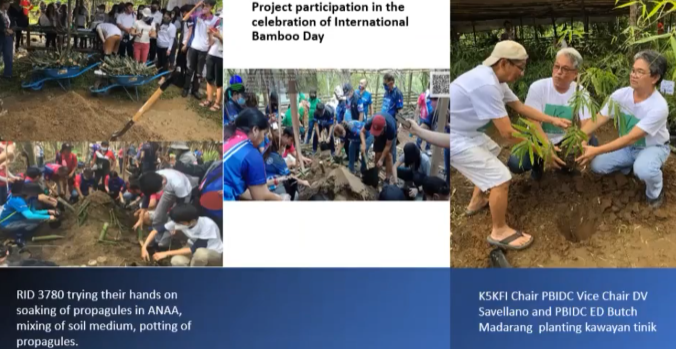
   Bamboo partnership between PBIDC, 5K Foundation, Rotary International (3780, 3830, 3800), Bamboo Professionals Inc., and Indigeous People (IP) belonging to the Samahan ng Kawayan sa Karugo Agri-Farmers Association (SAKKAFA) and Tribal Council Assn. of Puray Inc. (TCAPI).

   Rotary raised a minimal P1.5 million in district grants for Karugo project.

   The Kilusang 5K (Kawayan: Kalikasan, Kaunlaran, Kabuhayan, Kinabukasan) Foundation, founded by Savellano, has supported organization of Puray and Karugo projects. The bamboo propagules planted in 2022 in Karugo is estimated to multiply to 142,000 bamboo culms in five years and 228,000 culms in eight years.

   Now that Trade Secretary Alfredo Pascual has reconvened PBIDC, Savellano said PBIDC is coordinating all bamboo projects and agencies. Thus, such replication can be implemented in every town in the country—as what has been done by Savellano’s former constituents in Ilocos Sur.

   PBIDC has adopted the Montalban projects for its own collaborative, cost-effective model.

   “We tapped the two community-based projects to establish nurseries and do plantation development,” said PBIDC Executive Director Butch Madarang.

   “Using the convergence formula through consultation with different agencies, we’re able to engage everybody. We have an inclusive perspective. Our formula is to tap different agencies’ resources.”

   Lead collaborator is the Department of Environment and Natural Resources (DENR) which identified the project site. Kilusang 5K tapped the Philippine Bamboo Foundation and Bamboo Professionals Inc to train the IPs on bamboo propagation.

   Instead of planting hardwood that takes 10-20 years to harvest, bamboo was chosen as it is harvestable in three years, generating income to the community.

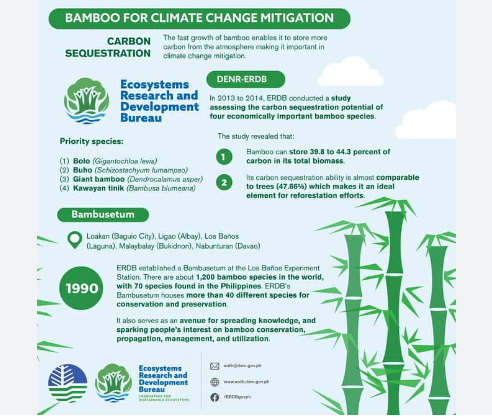
   More so, bamboo plants are climate disaster fighters. Bamboo, at four years old, has been proven to absorb 500 kilos of carbon dioxide yearly. It generates 300 kilos more of oxygen per year compared to other trees. Bamboo plants hold more water than other trees, helping prevent erosion and flooding. It has high survival rate due to endemicity and maintenance care.

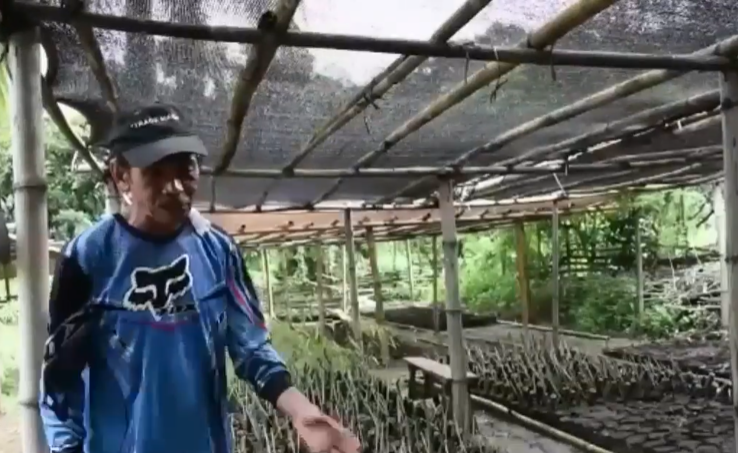
   Puray IPs who used to just cut bamboo plants relentlessly learn sustainable farming

   The 10-hectare Puray project is now generating a P300 per day income for farmers who do potting for growing seedlings. While generating income from selling seedlings, the vision for the bamboo projects is to produce commercially viable products.

    “We should venture first on basic products (before going to high-end sophisticated bamboo products like composites, fibers, engineered bamboo). For me, I will be happy enough if we’re able to produce bamboo chopsticks and barbecue sticks which we are importing even if we have many bamboo culms nationwide,” said Savellano.

   The Montalban projects are part of the bigger Upper Marikina Watershed Project (five municipalities/cities in the Sierra Madre mountains). It covers an estimated 26,000 hectares. It is envisioned to address persistent flooding in Marikina and Metro Manila as a whole.

   The watershed also protects the Wawa Dam which is capable of producing water for 500,000 households.

   The Marikina watershed, while declared a protected area, has been extensively plagued by illegal logging, highly-destructive quarrying, and illegal settlement. These have worsened state of flooding in Metro Manila. (Melody Mendoza Aguiba)
Propagation of climate-smart bamboo on 1,500 towns nationwide signed by government, legislators

February 22, 2023

A memorandum of agreement will be entered by the National Movement of Young Legislators Alumni Association (NMYLAA) for bamboo’s propagation on 1,500 towns nationwide as bamboo carbon offsets are now upheld by the International Bamboo and Rattan Organization (INBAR).

The NMYLAA is signing the MOA with the Department of Trade and Industry Philippine Bamboo Industry Development Council (DTI-PBIDC).

The program will be fulfilling a plan for many years now via Executive Order 879 to position bamboo not only as a primary climate tool and plant species against man-made disasters but as a crop for use as an industrial raw material.

“We are meeting this week with (DTI) Secretary (Alfredo) Pascual for this program to plant bamboo nationwide,” said PBIDC Vice Chairman Deogracias Victor B. Savellano.

“We are adopting the Filipinism of Jose Rizal in Dapitan as we want to make our agriculture areas productive.”

The Philippines is a signatory to several global treaties on climate change including the United Nations Convention on Climate Change (1992), Kyoto Protocol (1997), and Paris Agreement (2015).

To align programs with these commitments, the Department of Environment and Natural Resources (DENR) issued DENR Administrative Order 2021-43 on a carbon accounting and forest carbon project certification.

It is supporting investments in forest plantation activities that sequester carbon dioxide and avoid emissions from deforestation and degradation.

Correspondingly, the International Bamboo and Rattan Organization (INBAR) has supported carbon offsets for bamboo. It recognized bamboo can store substantial carbon. A 30-year giant bamboo plantation can 1.7 times the amount of carbon Chinese fir trees can produce.

“Countries, particularly in tropical and subtropical areas where bamboo grows, should make efforts to include bamboo in national and international carbon markets, as well as their national climate strategies,” INBAR said.

NMYLAA just held last February 11-12 a visioning in Rizal, Zamboanga del Norte that included strategic planning on bamboo.


NMYLA’As Project Climate Change is a mitigation (reduction of greenhouse gas emission) strategy focusing on bamboo due to its fast-growing nature. Bamboo will be used to enhance oxygen presence, reduce pollution, reduce flooding and disaster-related incidences, and improve soil condition.

Bamboo is envisioned to be used for biofuel, food, crafts. It can be developed as raw material for architectural and construction purposes, “ultimately playing a large role in the economy by creating job opportunities,” said Savellano.

The NMYLAA’s mission on Filipinism is also embraced. The innovations of national hero Jose Rizal in his exile in Dapitan, particularly on agriculture, infrastructure, education, and medicine are popularized.

Bamboo is also part of NMYLAA’s Project Disaster Preparedness and Project Farm Tourism.

“Barangays will have additional activity and will provide an additional source of income to communities. Farm tourism draws visitors to the barangay with activities as harvesting crops, feeding and caring for farm animals, fishing, camping, hiking, and sampling local cuisine (bamboo included,)” he said.

PBIDC will be reaching out to the grassroots through the bamboo production by tapping competent barangay leaders to carry this out.

The program can avail of prevailing government programs to support the bamboo propagation.

DENR DAO 2021-43 grants incentives to the private sector, upland organizations, and other entities in forest protection through verified carbon certificates. It will provide a standardized guidance for measurement of carbon projects. A registry for all forest carbon projects will be put up.

The DAO”s Carbon Accounting, Verification, and Certification System (CAVCS) harmonizes with the principles of the Philippine National Standard (PNS), Inter-governmental Panel on Climate Change (IPCC), and Good Practice Guidance for Land Use.

CAVCS projects will have a life of a minimum of 20 years to guarantee stability and long term gain.

The government is funding Forest Carbon Project Plans of investors. (Melody Mendoza Aguiba)

PBIDC urges replication of 20-hectare Karugo, 10-hectare Puray bamboo projects to support tribal livelihood for tribes, prevent MM flooding

February 15, 2022


The Philippine Bamboo Industry Development Council (PBIDC) is proposing to replicate nationwide the 20-hectare Karugo and 10-hectare Puray bamboo projects in Marikina Watershed which give livelihood to tribes and help prevent Metro Manila flooding.

The Karugo and Puray bamboo projects in Montalban, Rizal are an ideal multi-agency collaboration that involves minimal budget, according to PBIDC Vice Chairman Deogracias Victor B. Savellano.


Yet it has harnessed and consolidated multiple resources that redounds to upland economic benefit and protects the environment.

“Our best examples (for bamboo propagation) are those in Puray and Karugo. It’s something that’s not difficult to do. It is a joint effort between government Rotary International, Indigenous People, and community. It’s a beautiful model that should be replicated all over the Philippines,” said Savellano.

Bamboo partnership between PBIDC, 5K, Rotary International 3780, Bamboo Professionals Inc., Puray IPs


Rotary raised a minimal P1.5 million in district grants for Karugo project.

The Kilusang 5K (Kawayan: Kalikasan, Kaunlaran, Kabuhayan, Kinabukasan) Foundation, founded by Savellano, has supported organization of Puray and Karugo projects. The bamboo propagules planted in 2022 in Karugo is estimated to multiply to 142,000 bamboo culms in five years and 228,000 culms in eight years.


Now that Trade Secretary Alfredo Pascual has reconvened PBIDC, Savellano said PBIDC is now coordinating all bamboo projects and agencies. Thus, such replication can implemented in every town in the country—as what has been done by Savellano’s former constituents in Ilocos Sur.

PBIDC has adopted the Montalban projects for its own collaborative, cost-effective model.

“We tapped the two community-based projects to establish nurseries and do plantation development,” said PBIDC Executive Director Butch Madarang.

“Using the convergence formula through consultation with different agencies, we’re able to engage everybody. We have an inclusive perspective. Our formula is to tap different agencies’ resources.”


Puray farmers earn P300 per day from potting for bamboo seedlings

Lead collaborator is the Department of Environment and Natural Resources (DENR) which identified the project site. Kilusang 5K tapped the Philippine Bamboo Foundation and Bamboo Professionals Inc to train on bamboo propagation the IPs belonging to the Samahan ng Kawayan sa Karugo Agri-Farmers Association (SAKKAFA) and Tribal Council Assn. of Puray Inc. (TCAPI).

Instead of planting hardwood that takes 10-20 years to harvest, bamboo was chosen as it is harvestable in three years, generating income to the community.

More so, bamboo plants are climate disaster fighters. Bamboo, at four years old, has been proven to absorb 500 kilos of carbon dioxide yearly. It generates 300 kilos more of oxygen per year compared to other trees. Bamboo plants hold more water than other trees, helping prevent erosion and flooding. It has high survival rate due to endemicity and maintenance care.

Puray Indigenous People who used to just cut bamboo plants relentlessly learn sustainable farming


The 10-hectare Puray project is now generating a P300 per day income for farmers who do potting for growing seedlings. While generating income from selling seedlings, the vision for the bamboo projects is to produce commercially viable products.


“We should venture first on basic products (before going to high-end sophisticated bamboo products like composites, fibers, engineered bamboo). For me, I will be happy enough if we’re able to produce bamboo chopsticks and barbecue sticks which we are importing even if we have many bamboo culms nationwide,” said Savellano.


The Montalban projects are really part of the bigger Upper Marikina Watershed Project (five municipalities/cities in the Sierra Madre mountains). It covers an estimated 26,000 hectares. It is envisioned to address persistent flooding in Marikina and Metro Manila as a whole.


The watershed also protects the Wawa Dam which is capable of producing water for 500,000 households.


The Marikina watershed, while declared a protected area, has been extensively plagued by illegal logging, highly-destructive quarrying, and illegal settlement. These have worsened state of flooding in Metro Manila. (Melody Mendoza Aguiba)
Govt boosts investment interest for bamboo with launching of CITE Marikina training center for PBIDC

January 21, 2022

The government is boosting investment interest for bamboo as it launches the Center Innovation and Technology for Enterprise (CITE) as a training center for the Philippine Bamboo Industry Development Council’s (PBIDC) capacity building and consultative programs.

To be launched in February 2023, the CITE facility of the Department of Trade and Industry (DTI) will be the home base for the sector.

It is the opportune time as bamboo is just starting to gain interest among private and public investors in light of the post Covid scenario and efforts to fight climate change, flooding, and natural disasters.

PBIDC Vice Chairman Deogracias Victor B. Savellano said bamboo is now being recognized as a new “tree of life” that gives livelihood to the poorest in the countryside. That includes even Indigenous People (IP)-occupied ancestral domains that dominate 30-to 40% of Philippines potential productive land.

“DTI Secretary (Alfredo) Pascual who has reconvened the PBIDC has thrown his support for our bamboo programs. Even non-government organizations have laid out their plans for the industry. The private sector is very serious about planting bamboo,” said Savellano.

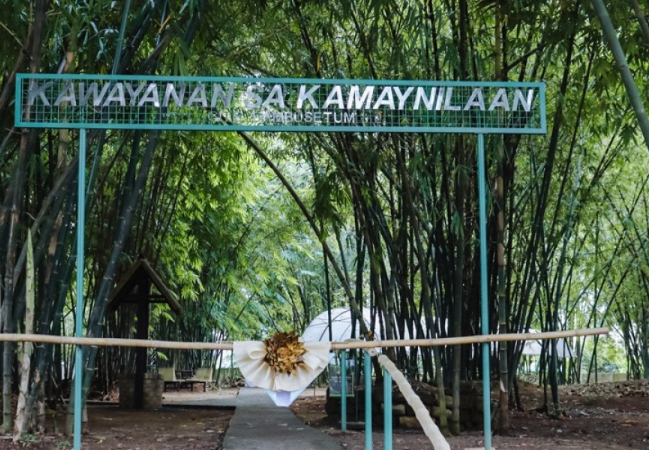
CITE Bambusetum in Marikina City

The CITE facility in Marikina City houses training machines, equipment, function rooms, a dormitory for in-house training, and offices. The CITE also has a Bambusetum in Marikina City that showcases different bamboo varieties and their uses. It has been offering training on bamboo propagule production and bamboo product processing.


“Nobody used to give attention to bamboo before. With PBIDC now reconvened, bamboo programs will have continuity,” said PBIDC Executive Director Butch Madarang.


As involvement of local governments units (LGU) is crucial to bamboo planting, Savellano said the PBIDC executive committee is enjoining the Department of Interior and Local Government (DILG) and League of Cities to be part of PBIDC. Technical Education and Skills Development Authority (TESDA and the Climate Change Commission should also be part of it.


“There is a big demand for bamboo. There’s an urgency in what we’re doing. We want to develop the bamboo industry under President Marcos’s term, and we now only have 5.5 years.” Savellano said. “(That’s why) we have to make our programs inclusive. It should involve everybod,y as many who want to support the industry,” he said.


“If we can’t do it now, when else can it be done? President Marcos already made a declaration during the United Nations General Assembly that fighting climate change will be a priority of his administration. He made a call on his birthday on Sept 13, 2022 during the Nationwide Bamboo and Tree Planting Program for us to uphold environmental protection.”


Other members of PBIDC are the heads of the Department of Agriculture, Department of Education, Department of Environment and Natural Resources, Department of Agriculture, Department of Science and Technology (DOST), Department of Labor and Employment (DOLE), among others. DTI heads the PBIDC.


The PBIDC bill under House Bill 9576 has been approved for third reading in the Lower House and transmitted to the Senate which had two hearings. But the national election has halted the proceedings. Nevertheless, the bill will be refiled in the 19th Congress.


While the bill has not yet been approved, PBIDC is putting up with tapping resources from different agencies that have a budget, albeit minimal, for different bamboo programs. DTI, for one, has programs for bamboo commercialization and processing, Department of Science and Technology (DOST) has bamboo researches.

“Since the budget and programs for 2023 are yet being planned, we are appealing to the different agencies to include bamboo in their programs. The DA, for example, has declared bamboo as a high value crop. Bamboo should be included in its High Value Crop program,” Savellano said.

PBIDC has been created under Executive Order 879. However, a budget has yet to be allocated for bamboo under the General Appropriations Act (GAA). PBIDC is not included in the 2023 GAA.

Even then, Savellano, who is founder of Kilusang 5K (Kawayan: Kalikasan, Kaunlaran, Kabuhayan, Kinabukasan) Foundation, has pushed for bamboo programs including nursery establishment.

Kilusang 5K carried out community-based bamboo reforestation, production and nursery establishment in the Marikina Watershed and at Sitio Karugo, San Rafael, Rodriguez.

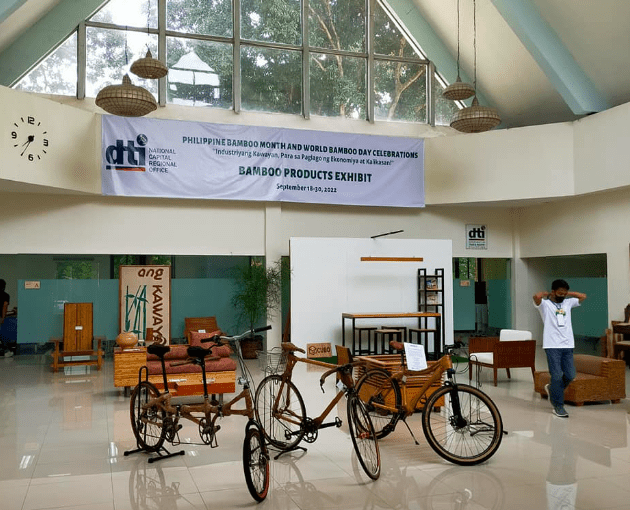
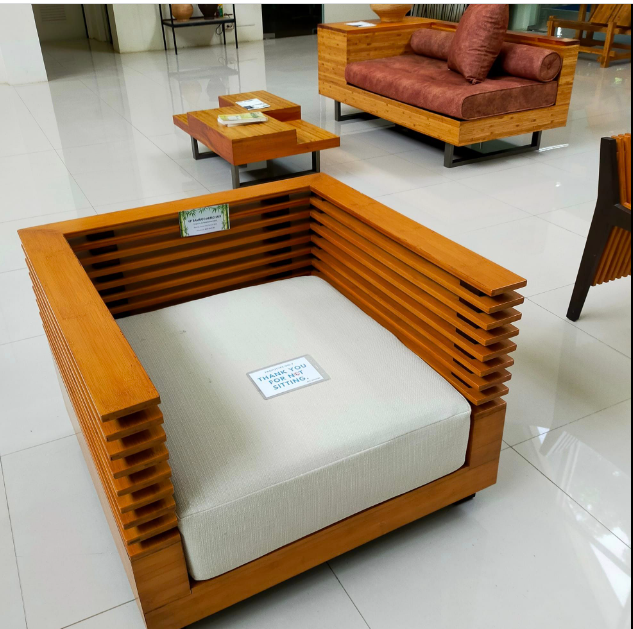
Bamboo-made furniture exhibited at CITE. Credit-Bamboo Network PH


Such bamboo production in Puray, Rodriguez was participated by indigenous people, the SaKKAFA non government organization, and the Council Assn of Puray Inc.
Training was supervised by technology experts from the Philippine Bamboo Foundation and Bamboo professionals. It was funded by the Rotary Foundation Grant of the Rotary International districts 3780 and 3830.

Kilusang 5K, along with Rotary and other stakeholders, decided to choose these locations as the deforestation in the Sierra Madre mountains has been known to cause flooding in Metro Manila.

“We are proud to have accomplished many things in the last two years with zero budget. Bamboo is an advocacy for us. We’re fighting for bamboo because you already have the clumps available. With the proper management and rehabilitation, you have a livelihood. It’s a doable program. It’s productive in 3-4 years from planting. ” he said.

“If we can’t develop our bamboo industry, tell me what else are we capable of doing?” he said.

High value-added engineered bamboo. Credit-Bamboo Network PH


EO 879 saw a $8 billion global market for bamboo. It will have tremendous economic multiplier effect was it is seen to replace plastic, metal and other wood as manufacturing input.


Madarang said PBIDC looks forward in the future to have budget allocation.
“We need it for the upkeep of the CITE facility. We need to support how roadmaps of agencies (like the one drafted by DA mainly for bamboo production and food) will cascade into regional offices,” said Madarang.


PBIDC in the last two years has been coordinating agencies’ programs for harmonization and non duplication. It includes the following:

  1. Localization of bamboo programs with now 48 active local councils.
  2. Bamboo Resources Inventory and Technology-Enabled Mapping in the Philippines (Britemap) to develop bamboo resources inventory system.
  3. Consultative meetings with Cordillera Administrative Region, Regions 1, 2, 4A, 5, 6, and 7-12.
  4. Series of bamboo summits from Luzon to Mindanao that tapped the Mindanao bamboo advocates.
  5. Series of bamboo smmits n mining in a tieup with the Philippine Mining Club, DENR-Mines and Geosciences Bureau.
  6. Declaration of Bamboo Month under House Resolution No. 197 and celebration of World Bamboo Day in order to promote the significance of bamboo planting and production.
  7. PBIDC participation in Smart Bamboo Database Management System of the Philippine Bamboo Society of Advocates, Bamboo Bootcamp, DENR-Forest Management Bureau training,
  8. Pasig River Rehabilitation involving bamboo planting in its tributaries.
  9. Support for DTI’s shared services facilities establishment.
  10. Memorandum of agreement with TESDA on training protocols
  11. Rehabilitation of existing bamboo clusters in the first district of Ilocus Sur under the TUPAD program. (Melody Mendoza Aguiba)

Phil. Bamboo Industry Development bill to establish Ph’s natural bamboo competitive edge in transport, construction, furniture, manufacturing

December 9, 2022

The Philippine Bamboo Industry Development Act (PBIDA) is seen to establish the country’s compettive edge in the natural bamboo market in transport, construction, furniture, and fabric sectors that can lead to industrial-manufacturing development.


Filed under House Bill 9576 which was approved for the third and final reading in August 2021, PBIDA is hoped to be certified as urgent by the administration of President Ferdinand R. Marcos Jr.

“House Bill 9576 should be approved under the admnistration of BBM (Bongbong Marcos). It will substantially help advance our industrial development. We already have the clumps in our inventory. We just need the support for production, training, processing,” said Deogracias Victor “DV” B. Savellano.

Savellano leads private sector advocates of bamboo as nature-friendly, climate smart industrial material through the 5K (Kawayan: Kalikasan, Kabuhayan, Kaunlaran, Kinabukasan).Foundation Inc.

HB 9576 will be refiled by Bohol Representative Edgardo M. Chatto. It will be endorsed in the Senate by the House of Representative.

The bill which envisions to seize part of a global market placed in 2010 at $8 billion will institutionalize the Philippine Bamboo Industry Development Council (PBIDC).
Created by Executive Order 879 in 2010, PBIDC saw the prospect of bamboo replacing plastic, metal, and other wood as manufacturing input.


While Savellano has earlier been appointed vice chairman of PBIDC, the council has not yet been convened since the Marcos Administration stepped in. A budget has neither been allocated for the council.


Aircraft uses bamboo

The bamboo industry holds huge economic potential for contributing to industrialization, being a highly-durable and ecologically-friendly raw material.

Comparable to or even better than other hardwood, bamboo has already been technologically developed into engineered wood, composites, laminated wood, or strand woven bamboo as a sophisticated lumber or construction material.

Filipinos have extensively exhibited their creative genius in using bamboo.

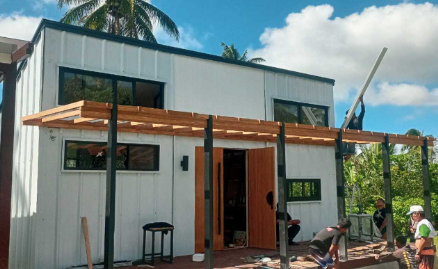
The Cubo modular house, designed by Earl Forlales, is not only a modern but one that is also an aesthetic and durable house made of natural, indigenous materials. In 2017, designer Christopher Paris Lacson crafted the Banatti motorcycle whose body is made of highly durable, elegant-looking, light-weight bamboo.

Lacson himself said Philippines has long been a pioneer of industrial bamboo design as cited by a local newspaper in the early 1950s. Filipino Antonio de Leon designed a single-engine, light experimental aircraft XL-14-MAYA. It used a type of woven bamboo called WOBEX, woven bamboo experimental.


Cubo modular house made of bamboo designed by Earl Forlales

Another product is the bamboo mobile, a type of jeepney spearheaded by the Department of Transportation of long ago. Its body is made of bamboo. Bambu Batu (House of Bamboo) cites many other modern, fashionable furniture and clothing products made of bamboo.

Bamboo also holds tremendous promise as green ethanol or fossil fuel substitute as a renewable energy.

Bamboo mobile introduced by the old Department of Transportation

PBIDC

The PBIDC, according to EO 879, should be be composed of the heads of the Department of Trade and Industry, Department of Environment and Natural Resources, Department of Agriculture, and Department of Science and Technology (DOST), among others.


Bamboo advocates are now petitioning government to allocate at least P100 million to jumpstart the development of bamboo as a manufacturing sector.
EO 879 mandates DENR, Mines and Geosciences Bureau, and Laguna Lake Development Authority to use bamboo in at least 20% in their annual reforestation areas.


Rene Madarang, appointed PBIDC executive director but also actively supports bamboo promotion through 5K Foundation, earlier created a Technical Working Group (TWG) to support PBIDC functions.

TWGs have been put up for three functions– production and propagation, industry and commerce, and training of workforce for propagation and processing.

Chrostopher Paris Lacson’s Banatti bamboo motorcycle

Economic contribution

The Philippines now has an estimated bamboo area of around 104,000 hectares. It generates a value of $60 million yearly. With 5.59 million hectares of arable land, the Philippines can expand bamboo area to 400,000 hectares– if only to level up to at least 10% of China’s bamboo area of 4.2 million hectares.
Such area can yield a whopping $3 billion (P150 billion). The industry can employ one million rural folks including indigenous people that can be organized into cooperatives.
Each 10-hectare area can generate a net income of P922,995 per bamboo worker per year, according to a study of the International Network for Bamboo and Rattan (INBAR).

Sustainable development

Bamboo is a sustainable material. It fights climate change in several ways, INBAR said.
First, its fast-growing trait enables it to sequester carbon more substantially than other plants. It releases 35% more oxygen than other trees. Bamboo plants sequester 12 metric tons of carbon per hectare annually.


“Durable products made from bamboo can also be potentially carbon-negative. Bamboo could also be a favorable substitute for hardwoods, even FSC (Forest Stewardship Council)-certified ones.”

Bamboo also replaces fossil fuels and reduces deforestation. Its solid biomass is used for cooking (charcoal and briquettes) and It can be converted into pellets for electricity and heating.

It is harvestable year-round, providing a stable rural income.

As it thrives in problem soils and steep slopes, it is an excellent land restoration crop.

“It is an effective windbreak, and its sturdy rhizomes and roots regulate water flows and prevent erosion. A case in Allahabad, India, tells of the rebuilding of rural livelihoods where 80,000 hectares of degraded land were brought back into productivity using bamboo as a pioneer species.”

It has been found scientifically in abandoned mines in the Philippines to be useful as bioremediation tool, absorbing toxic metals, fully restoring mined-out barren lands. (Melody Mendoza Aguiba)

Private sector pressed govt to grant tax incentives to mining’s investment in bamboo plantations which can generate $3B revenue

December 2, 2022

The private sector has pressed government to grant tax incentives to the mining sector’s investments in large scale bamboo plantations that will help boost watershed conservation, disaster risk reduction, and generate as much as $3billion in long term revenue.

   Bamboo propagation and mining sector advocates from the Junction Ridge Resources Development Corp.(JRRDC) and the Kilusang 5K (Kawayan:Kalikasan, Kabuhayan, Kaunlaran, Kinabukasan) said bamboo planting will be the best antidote to pervading criticisms thrown on mining.

   Banker and mining leader Isidro C. Alcantara Jr. of JRRDC said bamboo plantations in mining areas can generate huge revenue that can even equal the country’s gold, copper, and nickel revenue.

   The Philippine Statistics authority (PSA) reported in November 2020 that the mining and quarrying sector generated P189.9 billion ($3.45 billion) revenue.

   “To understand why we should concentrate on bamboo, it can generate $3 billion or 10% of China’s (bamboo revenue).  It can equal the mining industry’s output of gold, copper, and nickel,” said Alcantara at the 5K Foundation Inc.’s “Usapang Kawayan.”

Alcantara

   Alcantara was chairman of Marcventures Holdings Inc. (Marcventures Mning parent firm) prior to his retirement. Its mining operation in Surigao del Sur has so far grown 30,875 bamboo plants in the area, pioneering the effort in mining.

    The Philippines can earn $3 billion revenue if only at least 10% of such China industry ($35 billion) is created. 

   At an estimated area of around 400,000 hectares, this is less than 10% of China’s bamboo area of seven million hectares.

   “This is doable. We have so much land to make large scale bamboo plantations,” said Alcantara.

   He cites the country’s 5.59 million hectares of arable land.  This is only 4.4% of the country’s nine million hectares of mineralized land based on Mines and Geosciences Bureau (MGB-Department of Environment and Natural Resources) data.

   Kilusang 5K Foundation Chairman Deogracias Victor B. Savellano also said during the Usapang Kawayan forum bamboo is one of the best crops for land restoration.

   Bamboo plants are the best tools for fighting climate change as it releases 35% more oxygen than other trees.  Bamboo plants sequester 12 metric tons of carbon per hectare annually, he said.

   “Bamboo is one of the best crops for land restoration especially in mined-out areas,” said Savellano.

   It is President Ferdinand R. Marcos Jr himself who said during the United Nations General Assembly that climate change preparedness is a priority of his administration, he stressed.

Savellano

   “Bamboo planting in mining areas has been required by DENR since 2020 to plant bamboo to 20% of their declared mining area,” said Savellano.

   Kilusang 5K Foundation Executive Director Butch Madarang said a “middleground” can be achieved between mining and environment advocates.  Bamboo planting in mining areas plays a significant role in balancing economic gains and environmental protection.

   “Environmental degradation in abandoned mines leave land barren and with permanent scars in the natural landscape.  (But) a middleground can be achieved as bamboo restores lands, and it is a ticket to our poverty reduction,” said Madarang.

   Among the incentives that may be granted mining companies are tax credits for the investment amount, special tax rate of 5% (under CREATE-Corporate Recovery and Tax Incentives Law), and limited term income tax holiday starting on the sixth year onwards, Alcantara said.

   Tax free import of bamboo processing equipment and related value added tax exemption may also be granted.

   Very important, Alcantara said bamboo planting makes for sustainable livelihood for poverty stricken rural communities, particularly boondocks-dwelling Indigenous people (IP).

   “What do we leave these indigenous people with?  Believe it or not, this is a question discussed in the (mining companies’) boardroom.  It is high time we stop the disinformation about mining,” he said.

   Alcantara cited a study showing a mine worker can earn four times more when a bamboo plantation becomes productive three to five years from planting.

   A 10-hectare bamboo farm can generate an income of P922,995, four times that of a mine worker’s P240,000 per year. 

   This is based on a study of the International Network for Bamboo and Rattan (INBAR) on bamboo farming in Anji, China.  It was verified by University of the Philippines scientists.

   Government does not need to provide a subsidy or shell out money for mining companies to invest in bamboo plantations.

   That is given regulations under the Mining Act of 1995 for mines to allocate funds for SDMP (Social Development and Management Program) and EPEP (Environmental Protection and Management Program. 

   If the seven mining companies in Surigao del Sur will each grow bamboo in 1,500 hectares, that totals to 10,000 hectares that can employ IPs through cooperatives and village enterprises for a long time. The plantation becomes sustainable 3-5 years from planting.   Bamboo has a 100-year life.  It becomes sustainable given allowed limited harvesting over an area of perhaps 1o% yearly, making it a revenue generator for many years.

   INBAR,a multilateral agency promoting sustainable development through the natural bamboo and rattan, indicated that bamboo fights climate change in several ways.

   First, its fast-growing trait enables it to sequester carbon more substantially than other plants. 

   “Durable products made from bamboo can also be potentially carbon-negative.  Bamboo could also be a favorable substitute for hardwoods, even FSC (Forest Stewardship Council)-certified ones.”

   Bamboo also replaces fossil fuels and reduces deforestation.  Its solid biomass is used for cooking (charcoal and briquettes) and can be converted into pellets for electricity and heating.

   It is harvestable year-round, providing a stable rural income.

   As it thrives in problem soils and steep slopes, it is an excellent land restoration crop.  

   “It is an effective windbreak, and its sturdy rhizomes and roots regulate water flows and prevent erosion.  A case in Allahabad, India, tells of the rebuilding of rural livelihoods where 80,000 hectares of degraded land were brought back into productivity using bamboo as a pioneer species.”

   It has been found scientifically in abandoned mines in the Philippines to be useful as bioremediation tool, absorbing toxic metals, fully restoring barren lands.   (Melody Mendoza Aguiba)
Bayer, POPCOM push for fact promotion on Family Planning on World Contraception Day to empower women versus Reproductive Health myths, misconception


October 3, 2022

Bayer Philippines Inc. and POPCOM have pushed on World Contraception Day for a more aggressive facts promotion on Family planning even as approximately 218 million women from low-to-middle-income countries, including Philippines, have an unmet need for modern contraception amid myths.


Bayer and the the Commission on Population and Development (POPCOM) are advocating for women’s health and their reproductive choice to combat misinformation as captured by the local theme: “Usap Tayo sa Family Planning.”

Myths and misconceptions on Family Planning and Reproductive Health proliferate– clouding perceptions and access in making informed choices.

While contraceptives are readily available, this does not mean they are accessible to everyone. Barriers to access range from lack of awareness and affordability, to limitations based on age or marital status.

For World Contraception Day 2022, POPCOM also shared that the implementation of Republic Act 10354, or the Responsible Parenthood and Reproductive Health (RPRH) Law which has helped expand the total number of those availing family planning services by 30%.

Currently, there are about 8.1 million Filipinos enjoying the benefits of having their families planned.

According to latest data from health centers and health facilities nationwide, pills remain to be the most preferred family planning method by some 3.2 million Filipino women in 2020.

Pills had an additional 1 million adherents from 2016 figures. Implants also had a significant increase in acceptors: from 103,000 to 474,000 in the span of those years. Same was true for injectables: from 959,000 to 1.6 million.

For males, within that period, about 400,000 resorted to condoms—up from 270,000.

Despite the uptick in access, concerns about contraceptives still persist with regard to their side effects, myths, stigma and opposition from others.

Some of the common ones are that “people who use contraceptives end up with health problems,” or that “contraceptives are dangerous to women’s health,” “contraceptives can harm your womb,” or even endanger future ability to become pregnant.

The World Contraception Day (WCD) takes place yearly on September 26 to raise awareness among women of reproductive age regarding sexual and reproductive health.

Providing women access to scientifically accurate and non-judgmental information about a range of contraceptive methods, their pros and cons, and related sexual health topics encourages them to take control over their reproductive and sexual lives.

Important, this helps them make informed choices.

To help dispel these myths, Bayer Philippines Inc. Managing Director and Country Division Head for Pharmaceuticals Angel-Michael Evangelista shared: “Bayer in the Philippines continues to advocate for women’s health and their ability to make an informed choice through our ongoing online and offline programs.”

“Our existing Ask Mara chatbot on Facebook helps women get in touch with teleconsultation services through our tie-up with telehealth provider HealthNow to provide vouchers for consultation with OB-GYNs, as well as help locate nearby drug stores. We also partner with agencies like POPCOM to achieve the vision of a world where every pregnancy is wanted.”

On top of that, Evangelista adds: “Bayer Philippines is extending awareness on healthcare, contraception and family planning to our smallholder farmers through the Bayer Kubo, our flagship social engagement program which will run in Cabanbanan, Pangasinan and Dolores, Quezon this year.”

“POPCOM sees more Filipinos relying on the benefits of modern contraception methods. This is evidenced by the country’s estimated total fertility rate consistently declining in the past two decades, and in 2021 was recorded at 1.8 children per family or couple,” explained the agency’s Officer In Charge-Executive Director Lolito R. Tacardon.

“Encouraging a nation where every pregnancy is planned, POPCOM places a premium on correct information, proper education and open communication in actively promoting the benefits of family planning and contraceptives,” asserted the POPCOM official.

“To achieve such, we work closely with the national and local governments, as well as partners such as Bayer Philippines in ensuring all bases are covered, and all possible knowledge platforms and pathways are harnessed and maximized—despite limitations presented by the pandemic.”

Citing the latest RPRH Law Annual Report, Tacardon pointed out that efforts in delivering accurate and the most current information on contraceptives to more Filipinos will particularly focus on further increasing demand for modern contraception methods, which stood at 58.1 percent in 2021.

Since its global launch in 2007, there are over a dozen international partners supporting WCD with Bayer being there from the early start.

The partners are dedicated to increasing access to and availability of family planning services and education. They have united to create and enhance awareness, underline the importance of empowering young people to learn about sexual and reproductive health, and to talk boldly about it with their healthcare providers and partners. Together, they call on governments and decision-makers to encourage them in promoting the subject at the political level.

About Your Life: The global campaign

“Your Life” is directed at young people and pursues the vision of a world where every pregnancy is wanted. The annual highlight of the ongoing activities is World Contraception Day on September 26. To support the campaign and its goals, a broad range of international partners form the World Contraception Day Coalition, which is sponsored by Bayer.


The campaign has a dedicated website, www.your-life.com, where young people can get accurate and unbiased information on contraception. The content is presented in a straightforward, interactive and relatable way, without judgment or lectures. It seeks to address the needs and questions of a young audience, counter common myths and provide guidance and preparation for a well-informed discussion on contraceptive methods with a healthcare professional.

The online presence is complemented by the YourLife social media channels on Facebook, Instagram, YouTube, and Twitter as well as the YOURLA chatbot.

About Women’s Healthcare at Bayer

Bayer is a recognized leader in the area of women’s healthcare, with a long-standing commitment to delivering science for a better life by advancing a portfolio of innovative treatments.

Bayer offers a wide range of effective short- and long-acting birth control methods as well as therapies for menopause management and gynecological diseases. Bayer is also focusing on innovative options to address the unmet medical needs of women worldwide. Today, Bayer’s research and development efforts focus on finding new treatment options for menopause as well as gynecological diseases and includes several compounds in various stages of pre-clinical and clinical development.

Together, these projects reflect the company’s approach to research, which prioritizes targets and pathways with the potential to alter the way that gynecological diseases are treated. Additionally, Bayer intends to provide 100 million women in low-and-middle income countries by 2030 with access to family planning by funding multi-stakeholder aid programs and by ensuring the supply of affordable modern contraceptives. This is part of the comprehensive sustainability measures and commitments from 2020 onwards and in line with the Sustainable Development Goals of the United Nations.

About the Commission on Population and Development (POPCOM)

It is the country’s lead organization in population management for well-planned and empowered Filipino families and communities. POPCOM aims to empower Filipino individuals, families and communities by enabling them to achieve their fertility intentions, prevent adolescent pregnancies, and consciously consider population factors in sustainable development initiatives.

JICA, DENR turns over new roads in Banaue, Mayoyao, Lagawe in Ifugao to support upland farmers who serve as forest stewards

September 25, 2022


The Japan International Cooperation Agency and Department of Environment and Natural Resources (JICA-DENR) have turned over new access roads in Banaue, Mayoyao, and Lagawe in Ifugao Province which are seen to support upland farmers who also serve as stewards of vital forest resources.

The roads are critical to helping upland farmers transport their agroforestry goods easily, find new markets, and for people to access basic services such as hospital care and schools.

The roads form part of a total P1.8 billion JICA-DENR cooperation in the construction and rehabilitation of agroforestry support facilities under the Forestland Management Project (FMP).

The FMP, which began in 2012 in collaboration with JICA, has already dramatically contributed to conserving and rehabilitating over seventy thousand hectares of forestlands covering a total of 24 sub-watersheds in the provinces of Ifugao, Quirino, Nueva Vizcaya, Nueva Ecija and Iloilo.

JICA and DENR have partnered to save critical watershed systems in the Philippines as a move to address climate change and improve the livelihood of farmers and grassroots communities dependent on forest resources.

The Philippines has more than 130 watersheds critical to supplying water for irrigation, domestic, and industrial use.

Government data shows that watersheds account for an estimated 70% of the Philippines’ land area.

This vital connection between forestland management and water resources is highlighted in the cooperation of JICA and the DENR conserving the critical river basins in Upper Magat and Cagayan, Upper Pampanga, and Jalaur in Panay Island.

“We join the Philippine government in their self-help efforts to sustainably manage the Philippines’ natural resources for the greatest good of the greatest number of people in the long-term. Conserving vital forest resources such as watersheds is critical to mitigating climate change risks and giving Filipinos opportunities to improve their livelihood through sustainable forestland management,” said JICA Philippines Chief Representative Sakamoto Takema.

Takema said access roads help upland communities implement sustainable community-based forest management activities and protect and maintain a total of nearly twenty thousand hectares of forest areas in the Province of Ifugao.

Recognizing the value of watersheds to future generation, it comes as no surprise that FMP also encouraged the Philippine government to launch a national “Save Our Watershed” campaign in 2021 calling for stakeholders’ collaboration on watershed rehabilitation.

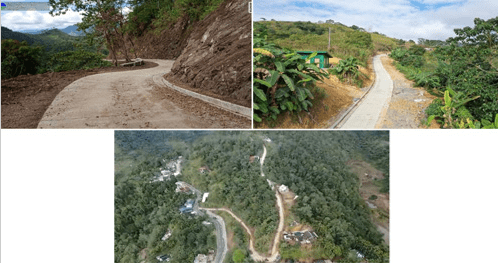
Clockwise from top left: Guinihon Access Road, Montabion Access Road, and Ujah Access Road, newly turned over facilities in Ifugao


The DENR cited JICA’s support to establish watershed management councils under FMP to also involve people’s organizations, non-profit groups, and private sector in conserving this vital forest resource.

The FMP has two core components– comprehensive site development and technical assistance.

The comprehensive site development has several subprojects. These are mapping of watershed ecosystem, community organizing to strengthen partner people’s organizations and boost enterprise development in forest communities, site development or the rehabilitation of denuded areas in the watersheds by establishing forest, agroforestry, and soil and water conservation plantations.

FMP also involves policy making and construction of agroforestry support facilities (ASF) including access roads, irrigation pipelines, pathways and bridges.

JICA is keen to support the country’s forestry programs citing the need to give highest priority to sustainable forest management to ensure future generation reaping the benefits from the Philippines precious natural resources. (JICA)