LGU veterinarians pressed govt to resolve conflict between FDA, BAI on approving authority for vaccines

November 28, 2023

By Melody Mendoza Aguiba

Local government veterinarians have sought for the immediate resolution of the conflict on approving authority for African swine fever (ASF) and avian influenza (AI) vaccines as the immediate supply of vaccines will arrest a “national emergency” in meat and food security.


The Provincial, City, Municipal Veterinarians League of the Philippines (PCM-VLP) has expressed disappointment over the conflict between the Food and Drug Administration (FDA) and the Bureau of Animal Industry (BAI) on the approving authority for vaccines.


The conflict has been dragging the worsening ASF and AI infestation on hog and poultry sectors.
“We have long been waiting for this resolution,” said PCM-VLP President Dr. Mary Grace M. Bustamante during the Animal Health Congress last week.


The Department of Agriculture’s (DA) Livestock Group led by DA Secretary Francisco Tiu-Laurel will coordinate with the Office of the President with which a petition for resolution on the conflict has been filed.


“The spread of ASF is now a national emergency concern. There are provinces that have shortages of pork for their citizens. Prices are soaring at wet markets. We need to ensure food security especially for pork,” said DA Undersecretary Deogracias Victor B. Savellano.


“The approval of ASF vaccines by the FDA is critical to our food security. We have been waiting. I do not know how long we can wait as ASF eats up LGUs who have now been declaring states of emergency.”


DA has not procured any vaccines for ASF since there are no FDA-approved vaccines for ASF, he said.

Local government veterians are concerned that FDA lacks the resources and capability to fully undertake the task of approving veterinary vaccines. This, although an earlier memorandum of agreement (MOA) ordered FDA and BAI to collaborate on regulating such veterinary products.


“FDA has limited people to look after this function. BAI used to do this task as it does have the capability to test and approve (the safety and efficacy) of vaccines. If this conflict is cleared, (then we can work toward ASF-free and avian flu-free status),” said Bustamante.


There is an apparent lack of alignment in the present setup where FDA approves commercial release of the vaccine while BAI is the one testing it.


It has been assumed that since some animal drugs are also being prescribed to human, even vaccines and animal biologics should be approved by FDA.


However, Bustamante asserted that veterinarians precisely know that animal vaccines are only for animals. Veterinarians nor medical practitioners will never prescribe animal vaccines to human. This should not then be a concern for regulators.


“We know that antibitiocs for animals are only for animals. We know that these vaccines should only be for animals. So why is there a need for FDA to approve it? she said.


FDA Advisory 2022-0591 indicated that marketing authorization of veterinary drugs, vaccines, medical devices will be regulated by FDA’s Center for Drug Regulation and Research (CDRF).
This advisory was issued apparently during the time of high Covid infections. It was in compliance with FDA Circular 2021-025 or the “Guidelines for Appplication for Authorization at FDA in light of Extended Stare of Public Health Emergency dated 9 December 2021.”


An earlier Joint DA and DOH Administrative Order (AO 0026) in 2013 indicated that FDA “shall continue to register veterinary drugs in pharmaceutical dosage forms except those intended for feeds and license establishments manufacturing, distributing , importing exporting, selling the same.”


The AO was effective for five years until sooner terminated. A periodic review of a Technical Working Group should also be in order to recommend appropriate actions.


Under the same AO, BAI will regulate veterinary drugs and products including “veterinary vaccines, diagnostic kits and reagents, veterinary medical devices, and other biological products.”


The limited number of veterinarians is also a major concern if the Philippines is seeking after ASF-free and AI-free status. However, Bustamante said that under present laws, only provincial governments and first class municipalities are required to hire veterinarians.


“If a local executive doesn’t find the importance of having veterinarians, we really can’t do much about this problem. How about second, third class municipalities– where hiring of veterinarians is dependent on who the local authority is?”


Dr. Loida M. Valenzuela, provincial veterianarian of Ilocos Norte, told the same Animal Health Congress that veterinarians should have an independent authority in local government units (LGU). They should not be under provincial agriculturists, considering that veterinary medicine is an entirely distinct professional discipline.


Entry level compensation for veterinarians should also be upgraded, according to Valenzuela. This will encourage fresh passers of Veterinary Medicine board examination to take on local government jobs.


The LGU veterinarians were regretful of the low passing rate for takers of Veterinary Medicine board examination. It has been limiting the number of animal experts in local governments. It worsens the already brain drain experienced as veterinarians choose to work in higher-paying private companies, worse abroad.


“Something has to be done about this. This is not favorable for us,” said a veterinarian at the Animal Health Congress.


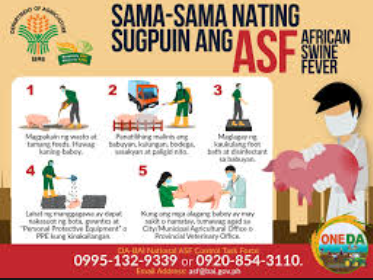
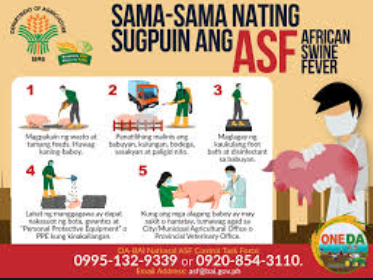
PHOTO Sama sama nating sugpuin ang ASF

DA warns against sale of “hazardous” frozen meat in the wet market, its adverse effect on local industry

Nov. 9, 2023

The Department of Agriculture (DA) has warned against the sale of frozen meat in the wet market as this can put human health at risk due to the absence of refrigeration facilities and a lack of know-how of vendors on handling frozen meat.

   DA Undersecretary Deogracias Victor B. Savellano said DA is collaborating with Department of Trade and Industry (DTI) so as to weed off public wet markets of health hazardous frozen products.

  DA also advised consumers to look for the seal of the National Meat Inspection Service (NMIS) to ensure food safety.

   “Delikado ito sa kalusugan ng tao. Hanapin ang papeles ng NMIS at katayan ng mga LGU (local government units). Walang problema ang imported na karne. Huwag lang ibenta na sariwa sa palengke.”

   (This is dangerous to health.  Look for the NMIS food safety seal and of LGU’s slaughterhouse documents.  Imported frozen meat is not the problem, but their handling as fresh food in wet markets.)

   DA Administrative Order 6-2012 prohibits frozen meat from being sold in the wet market.  Frozen meat should only be confined to hotels, restaurants, and supermarkets which have the refrigeration facilities and handling expertise. 

   Savellano said DA is also examining the price difference of poultry being sold in the market compared to farmgate prices.  While poultry’s price sold in the wet market has been increasing, farmgate price has actually been decreasing. 

   Ang mga nag-aalaga ng manok ay dumadaing sa mababang presyo na kuha sa kanila ng mga biyahero.

   (Poultry farmers have been complaining against the low price at which traders buy their produce.)

   DA believes the excessive dumping of frozen meat in the wet market may be the cause why farmgate price of poultry  has been decreasing to the detriment of farmers.

   Also, Savellano fears poultry farmers have been cutting maturity days for harvesting poultry—down to 27 or 28 days instead of 30 days.  This, as they try to meet poultry demand in time for the Christmas holidays.

   However, instead of increasing their income from increased production, they may be suffering from low farmgate price due to excessive frozen meat in the wet market.

   Savellano said DA’s objective is three-pronged, not just raise supply.  But it is to raise production, bring down price for consumers, and raise farmers’ income.

   DA’s strategy to meet these objectives is to increase feed production to lower price, reported Heaven Torres of DA Livestock.

   “Nagpapatanim na kami ng malalaking plantasyon ng mais para mapababa ang gastos ng mga nag aalaga at siya ding dapat ikababa sa merkado para sa lahat ng Pilipino.  Ang dapat na mababang presyo sa farm ay dapat maramdaman ng mga mamimili sa palengke.”.

   (DA is now expanding planting of corn so as to bring down feed costs of poultry farmers.  This should lead to lower price of chicken for Filipino consumers.  Filipinos should be able to feel the low price of chicken).

   DA has also asked Malacanang to grant it the authority to manage and administer African swine fever and avian flu vaccine. 

   As soon as it is granted this jurisdiction (with which it has conflict with Food and Drug Administration), it can then hasten processing of access of  vaccines to the industries. This is critical in preventing the fast spread of the diseases. Heaven Torres

Ilocos Region inaugurates first biosecure swine multiplier techno-demo farm as part of raising production, fighting ASF

October 29, 2023

By Aurelio Salvador

The first biosecure swine multiplier technology-demonstration farm has been launched in Ilocos Region as part of the Marcos Administration’s program to fight African swine fever (ASF), raise swine production, and give livelihood to small farmers.

   Department of Agriculture (DA) Undersecretary Deogracias Victor B. Savellano graced last October 24 the Swine Multiplier and Technology Demonstration (SMTD) farm in Natividad, Pangasinan.

   “We will repopulate our hog sector through these swine technology centers. We have put in place biosecurity measures that use a standard shelter design for hogs to keep small farms away from ASF,” said Savellano.

   The technology centers will be sites through which good swine genetics will be disseminated to farflung provinces.  Through farmers’ trainings on biosecurity measures, Philippines will be able to raise hog inventory and pork supply, Savellano said.

      “The facility will provide support to local raisers by making available breeders and breeding materials and by producing adequate and quality stocks to supply DA and other agencies’ needs for sustainability in production,” he said.

   A budget of P40 million has been allocated for four SMTDs in Ilocos Region.  A budget of P10 million per SMTD includes provision for tunnel vent type facility and 30 breeder sows and feeds. 

   The Natividad facility is the first.  Three others will be launched within the year.  The sites are Manaoag, Pangasinan and Candon and Vigan in Ilocos Sur.

   Local government units (LGU) provide the land for the swine facility as its counterpart support. Farmers are trained on biosecure hog raising prior to receiving their swine.

   DA’s National Livestock Program (NLP) has partnered with the International Training Center on Pig Husbandry (ITCPH) based in Lipa City, Batangas for the house design for the hogs, according to Agricultural Training Institute livestock focal person Krizel Joy Natividad.

   The SMTD has been introduced under DA-NLP’s Integrated National Swine Production Initiatives for Recovery and Expansion (INSPIRE) Program.  It is a hog repopulation program aimed at raising hog inventory following heavy ASF infestation, reported Aurelio Salvador of DA-Livestock

   Biosecurity measures in the swine program includes disinfestation process under which farm workers are required to bathe for disinfection before and after entering the swine facilities.  They also go through a 24-hour quarantine after entry to the facilities.

   The swine facility itself is air-conditioned and has curtains that keep the facility off infection.

   Present also during the launch were OIC-Provincial Veterinarian Dr. Arcely G. Robeniol (representing Pangasinan Provincial Governor Ramon V. Guico III); LGU-Natividad Municipal Mayor Hon. Rosita G. Rafael; Municipal Agriculturist Engr. John Christian M. Sioco; and ATI-RTC 1 Center Director Dr. Rogelio C. Evangelista.

   The event was also witnessed by the members of the Pagrang-ayan ti San Pedro Farmers Association, Municipal Agriculture and Fisheries Council (MAFC) Chairman Mr. Loujay S. Pagal, Sangguniang Kabataan Federated President Ms. Angelica D. Malaca, Municipal Local Government Operations Officer Ms. Hope Ordonio, and staff of the Municipal Agriculture Office.

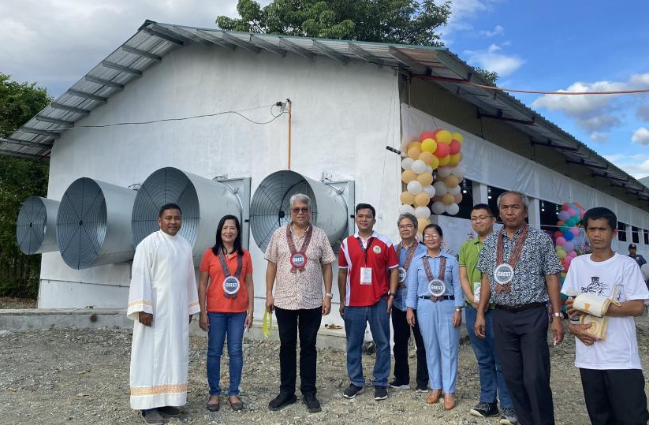
PHOTO DA Usec Deogracias Victor Savellano (third from leflt) leads launch of biosecure Swine Multiplier Techno-Demo Farm in Natividad, Pangasinan

DA-NTA negotiated higher floor price for Virginia tobacco; govt. to earn higher excise tax

October 27, 2023

The Department of Agriculture-National Tobacco Administration has negotiated a higher price for Virginia tobacco, up by an average of P9.90 per kilo for various grades, enabling farmers to enjoy higher income while raising for government excise tax that stands at P150 billion.

   DA-NTA has  successfully haggled for the higher tobacco price during the  tripartite conference last October 3 and 4 attended by farmers and tobacco buyers.

   DA Undersecretary Deogracias Victor B. Savellano expressed satisfaction over the NTA negotiation which is resulting in better income for farmers for trading years 2024 and 2025.

   “This is an unprecedented increase in the price of Virginia tobacco in at least 10 years of  trading history.  It  will surely benefit our farmers.  We also need to continue finding ways to help raise farmers’ income through intercropping and other alternative livelihood,” said Savellano.

   In the same forum, the increase in floor prices for a kilo of Burley tobacco and native-type tobacco are P5.90 and P3.90, respectively over the same trading years.

   DA-NTA reported earlier that for trading years 2022 and 2023, floor price per kilo for Virginia top grades was at P87.10 for Grade AA and P86.10 for Grade A.

   For Burley, the top grades A and B was at P75.10 and P72.10, respectively. The floor price for high grade of the native type was P77.10 per kilo. 

   The NTA Governing Board will release the full details of the 2024-2025 floor prices for various grades and their increases.

   NTA Administrator Belinda S. Sanchez initiated the successful negotiation.  The price increment is the second highest of such price difference brought about by NTA intervention.

   Records show the highest agreed increase on the floor price of Virginia tobacco was P10 a kilo.  It was also a result of a negotiation in a tripartite conference on December 10, 2007.

   “It was a time when the honorable DV (Deogracias Victor) Savellano also intervened when he was then governor of Ilocos Sur.  This is the second time Usec Savellano is intervening,” according to the NTA.

   The succeeding tripartite conferences after the 2007 forum brough an increase in floor prices of Virginia tobacco by a minimal P1 to P3 a kilo.

   The NTA convenes the tripartite conference every two years to review and fix reasonable tobacco floor prices.   Agreements on tobacco price consider factors including world market situations, production costs, and a reasonable margin of profit for farmers, dealers, manufacturers, and exporters.

   “The ultimate aim of our tripartite forum is to strengthen the tobacco industry as part of the directive of President (Ferdinand R.) Marcos for us to help raise income of farmers.  We will also increase our exports and reduce imports as we expand our production,” said Savellano.

   The tobacco industry generates huge tax revenue for government, reaching to P149.7 billion in excise tax in 2020.  It contributes at least P74 billion per year to the Universal Health Care program.

   “We aim to improve our industry while we help balance the tobacco industry’s contribution to the economy, being one of the highest contributors to the government coffer,” Savellano said.

   Tobacco-producing local government units (LGUs) got a P19 billion share from the national government’s 2020 excise tax revenue.  LGU share is being used for cities’ and municipalities’ implementation of priority programs.

   The industry provides livelihood to at least 2.1 million people, including more than 430,000 farmers, farm workers, and their family members.

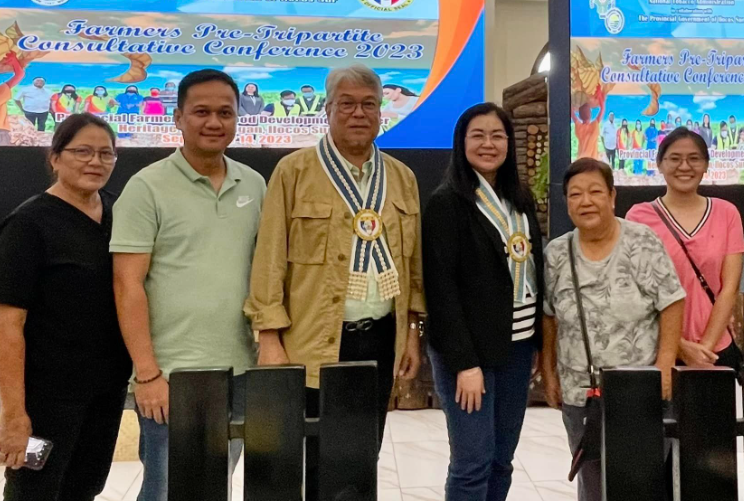
PHOTO Agriculture Undersecretary Deogracias Victor B. Savellano leads a tripartite consultative conference in Ilocos Sur attended by farmers, traders

DA taps FAO for technical expertise on processing of seaweeds into feeds to lower costs of meat and poultry

October 26, 2023

Agriculture Undersecretary Deogracias Victor B. Savellano is eyeing the processing of seaweed through a technical cooperation with the Food and Agriculture Organization (FAO)  in order to produce nutrient-dense and cost-efficient feed to help lower costs of meat and poultry.    

   “We are tapping the expertise of Mr. Lionil Henri Valentin Dabbadie, country representative of the Food and Agriculture Organization (FAO) of the United Nations, to explore the processing of seaweeds as commercial feeds for farm animals and livestock,” said Savellano

   “This will relieve our local animal raisers from the high cost of commercial feeds in the market,” he said.

   Savellano, Department of Agriculture (DA)  undersecretary for livestock, said that the country has abundant seaweed resources that grow in its coastal waters whose length is one of world’s fifth longest. Seaweeds are relatively cheaper and are very rich sources of protein. 

   Savellano is also an oversight official for livestock and poultry feeds development and of the National Tobacco Administration (NTA) along with being alternate chairperson–designate to the NTA Governing Board.

   Seaweed is a sustainable source of macronutrients, particularly dietary fiber, and micronutrients for animal feeds.  It provides several antioxidants which can increase animals’ longevity and may lower the risk of infections.

   There are three main reasons to use seaweed in poultry feed.  These are improving animal immunity, decreasing microbial load in the digestive tract, and enhancing nutrient content of meat and eggs.

   Savellano said during the World Food Day celebration last October 17  that he is also looking at expanding the production of native pigs and native chicken which are easier to raise.  Native animals require commercial feeds at cheaper costs. 

   “We need to go back to the basics and the traditional way of raising our livestock so we can cut on our expenses for food for our family,” he said.

   Considering that corn accounts for  80% of feed formulation, DA is working on the planting of corn at the former sugarcane plantation in Batangas, he said.  This, after the closure of a Batangas sugar mill here.  As such, sugarcane farmers can take on a new livelihood and help supply requirements for animal feed ingredients of the livestock and poultry sector.

   According to Savellano, these ongoing initiatives are in in line with the three marching orders of President Ferdinand R. Marcos, Jr., also concurrent agriculture secretary.

 The orders are stated in an acronym VAM which means 1.  increasing Volume for export  of agricultural products; 2.  making price of food Affordable; and 3. increasing Margin or income of Filipino farmers.

   “These are some of our agency initiatives to achieve the ultimate goal of President Marcos Jr. of producing more foods at affordable for every Filipino consumer,” Savellano said.

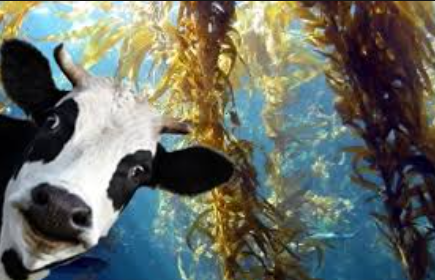
PHOTO Feeding cattle with seaweeds lessens greenhouse gas emission. Credit- Steemit.com

DA asks LGUs to supplement DA’s effort to curb ASF, compels them to report State of Calamity to access disaster funds

October 19, 2023

The Department of Agriculture (DA) has asked local government units (LGU) to supplement DA’s effort to curb African swine fever (ASF) and compelled them to declare a State of Calamity in order to access disaster program budget.

   DA Undersecretary Deogracias Victor B. Savellano said DA and its attached Bureau of Animal Industry (BAI) is strengthening biosecurity measures amid a State of Calamity declaration in Nueva Vizcaya.

   Dr. Arlene Vytiaco, BAI deputy director, said that under the NDRRMC (National Disaster Risk Reduction and Management Council) guidelines, provincial LGUs  are compelled to declare a State of Calamity if more than two of their municipalities have an outbreak. 

   “This (declaring a State of Calamity) will allow them to access disaster funds to combat ASF,” said Vytiaco.

   DA-BAI has already sent investigators, trained personnel and supplies to Nueva Vizcaya as soon as it declared a State of Calamity after its infected areas reached to nine municipalities.

   Savellano urged LGUs to supplement DA’s limited budget for ASF control. As the deliberated budget of DA for vaccines for 2024 just amounts to P1.5 billion, LGU’s accessing its own funds will be a significant move to control the disease.

   “Malaking bagay ang pag access ng LGU funds sa pakikipaglaban ng ASF.  Sa amin sa DA, biosecurity war na ito. Ang laban namin ay sitio kada sitio, bara-barangay, muni- munisipyo at probi-probinsiya.’ Ngayong wala pang aprubadong bakuna, pag iingat na di kumalat ang ASF ang ating ginagawa,” said Savellano.

   He also urged vaccine manufacturers to apply for commercialization with government.

   “We call upon vaccines companies to register and undergo testing and trials for the local market with the proper authorities,” he said.

   Savellano believes that as there is no approved vaccine yet, the P1.5 billion budget should also be made available for biosecurity efforts.

  In coordination with enforcement authorities, it is putting in place checkpoints to monitor movement of diseased hogs.

   There is also a need for a huge indemnification fund which will encourage hog raisers to report ASF as they will be compensated for reporting it. 

DA Usec Savellano holds a position paper asserting DA’s oversight over animal vaccine now needed to contain African swine fever, avian flu

October 11, 2023

Department of Agriculture Undersecretary Deogracias Victor B. Savellano files with Malacanang a position paper asserting that DA’s Bureau of Animal Industry (BAI) should have jurisdiction over animal vaccine (veterinary drugs, supplies) regulation. Food and Drug Administration (FDA) has jurisdiction over food safety regulation and even registration of veterinary drugs and vaccines.  However, evaluation of such veterinary supplies is under the realm of DA-BAI as it has the human resource expertise and laboratories. This policy has become crucial with the escalating pestilence of animal diseases (African swine fever, avian flu) in livestock and poultry—needing expansive vaccination.

Local livestock and poultry production targeted to increase 5x, imports to be minimized as a Marcos legacy

September 30, 2023

Melody Mendoza Aguiba

The Department of Agriculture (DA) will raise by five times in five years the local production of livestock and poultry which will be a Marcos legacy that reverses any record of excessive importation in order to benefit Filipino farmers.

   As a marching order from President Ferdinand R. Marcos Jr, also DA secretary,  government will pursue all means to raise livestock and poultry production to achieve food security, according to DA Agriculture Undersecretary Deogracias Victor B. Savellano.  This will go along with raising farmers’ profit and lowering farm product prices while ensuring availability of sources of protein for consumers.

   At the Poultry Forum 2023, Savellano said that as food security is national security, raising local agricultural production will be prioritized.  It will be realized through a consultative approach to governance.

   “Recommendations from various sectors of our agriculture is currently being heard and studied on what, where, and how government actions are to be applied to boost our poultry sector,” he said.

   “We have started to meet  with stakeholders to strategize a common direction and priorities in order to significantly increase our local food production,  making it efficient, robust, and profitable for farmers.”

   The same assurance of a consultative governance was given by Savellano during an earlier convention of the National Federation of Hog Farmers Inc.

   “We will find ways to produce more to lessen importations.  By consulting with livestock associations on how much each sector can produce, (we will know) the actual demand.  It will be the consideration in determining the minimal quantity” of imports.

   Importation in previous years has brought huge opportunity losses for the local poultry industry.  DA aims to reverse these losses into gains.     

   Chicken meat importation has been consistently rising from 45.772 million kilos in 2008 to 67.264 million in 2009, 101.957 million in 2010, 127.227 million in 2011, and 411.069 million in 2022.

   United Broilers and Raisers Association (UBRA) Chairman Gregorio San Diego said during the same poultry forum that direct impact of this importation is displaced local production totalling to a whopping P58.286 billion (299.366 million broilers).

   Displaced too are 315.122 million day old broilers amounting to P9.138 billion and 2.52 million broiler breeders valued at P756.294 million.  Lost sales from byproducts (head, feet, intestine, blood) totals to P5.987 billion.

   Importation brings lost direct labor totalling to 31,512 at one caretaker per 10,000 broilers and lost jobs in feed milling, trucking, and dressing plants.

   Lost feed sales totals to P4.877 billion.  Lost feeds ingredient sales totals to P11.89 billion (corn); P8.154 billion (soya); P4.478 billion (coconut oil); and P1.132 billion (rice bran).

   There is also opportunity loss for veterinary products (disinfectants, vaccines vitamins, antibiotics), P3.623 billion.  Dressing plants have lost business of P2.993 billion.

   In order to achieve the goal of raising local food production, these are among strategies DA will adopt:

  1.  Synergize (integrate operations of) National Meat Inspection Service, Bureau of Animal Industry, Philippine Carabao Center, National Dairy Authority, and National Livestock Program. 
  2. Include Livestock Group in Regional Field Office (RFO) regular meetings.
  3. Merge livestock with feeds development. Work with the corn program, seaweed program, and other high value crops.

“We have to focus on feeds as we cannot grow livestock without it. We want RFO 4-A to transition its focus from sugarcane to corn,” said Savellano.

  • Rationalize the many committees of the Center for Trans-boundary Animal Diseases even as its  new building is underutilized.
  • Appoint a focal person for all animal disease matters supported by the many units for livestock. 
  • Boost biosecurity (First Border in all Entry Points) through a partnership with the Department of National Defense.
  • Enforce prohibitive policies  on selling of questionable meats, vaccines and veterinary medicines through Lazada and Shopee.
  • Work with Agriculture Marketing Assistance Service (AMAS) on market development functions where the DA livestock group can focus on the supply side and share market surveillance functions.
  •  Pursue memoranda of agreement (MOA) with Department of Interior and Local Government, Department of Agrarian Reform, and Department of Trade and Industry on various DA tasks handed over to other units and local government units (LGUs) during devolution.       

   “DA orders and circulars intended for LGUs should be covered by a MOA. An example is the (Philippine Animal Health Information System (PhilAHIS) which is manned by LGUs, although DA lacks a MOA with LGUs and DILG.  Others are reporting vaccination, insemination and birth instances for livestock. Operation of slaughterhouses, cold storage monitoring and other facility reviews.

   “DILG has agreed in principle, but we have to make our laundry list for the MOA,” said Savellano.

  1. Lobby for access and increase in avail of low interest loan packages with Land Bank.
  2. Fund improvements in the Philippine Agriculture Industry Management Information Service (PhilAIMIS).
  3. Bat for an increased share of livestock in the Philippine Rural Development Program and other Foreign Funded Projects as its present share is too low compared to livestock and poultry’s contribution to gross domestic product (GDP).
  4. Develop and fund a program for agro-industrial complexes for milk, feeds, cattle raising, among others.
  5. Raise insurance coverage of the Philippine Crop Insurance Corp. PCIC refuses to cover formerly ASF (African swine fever)-afflicted area.   When an area recovers, the more should PCIC cover hog raisers to encourage them to repopulate their farms
  6. Strengthen an indemnification program for animals infected with diseases as no indemnification  means no reporting.

   “We must have an indemnification program where it will be attractive for farmers to report ASF or AI (avian flu) outbreak in their farms. Now, nobody is reporting. We need to fund this program,” said Savellano.

L-R Dr. Orlando Fernandez, Atty. Bong Inciong, Dr. Mike Banawa, DA Undersecretary Deogracias Victor Savellano, Dr. Benito Oliveros, Gregorio San Diego

Documentary launched to jumpstart a true “Pinoy industry” in bamboo as a raw material for 10,000 products

September 25, 2023

Melody Mendoza Aguiba

A documentary “Amazing Bamboo” has been launched as part of jumpstarting a true “Pinoy industry” in the versatile bamboo as a raw material for “10,000 products with documented uses” even as bamboo grows ubiquitously throughout Philippines.

   Authored by Department of Agriculture Undersecretary Deogracias Victor B. Savellano and former Department of Science and Technology Undersecretary Florentino O. Tesoro, Amazing Bamboo was launched September 18 as part of this month’s World Bamboo Day celebration.

      Also co-author of the book is Ramon A. Razal, a former dean of the University of the Philippines Los Banos-College of Forestry and Natural Resources.

   The book substantiates findings on how bamboo abates climate change and environmental threats.  Bamboo is used for soil erosion control, water conservation and moisture retention, land rehabilitation, ecotourism, and landscape beautification.

   Senator Cynthia A.Villar who graced the book’s launch said the United Nation’s Sustainable Development Goal recognized bamboo’s contribution to economic growth. 

   Its fast-growing nature makes it a sustainable and renewable material for many consumer and industrial products.

   “Bamboo grows very fast and can be grown easily in different climate conditions and altitudes.  It reduces the pressure on trees to produce timber for wood products,” said Villar.

   “Bamboo regrows from its own root system.  It doesn’t need to be planted again. It plays a leading role as carbon sink.  It can absorb 12 metric tons of carbon dioxide per hectare per year and releases 30% more oxygen than other plants.”

   Savellano stressed that Philippines must now aggressively pursue the development of bamboo as a true Pinoy industry considering its all-pervasive presence nationwide.

   “We must develop the bamboo industry within the next five years of the administration of President (Ferdinand) Bongbong Marcos.  If we cannot develop it now, I don’t think we’ll be able to do it any other time,” he said.

   Savellano has spearheaded the Marcos Administration’s “Buong Bansa Magtanim (BBM) ng kawayan)” in pursuit of bamboo industrialization.

   To prop this development, he insists bamboo bills filed in Congress—mainly Senate Bill 605 and House Bill 7941—should be immediately ratified.  The proposed law provides incentives for private sector to invest in the industry. For one, government land may be used by private owners for free lease for five years.  Other incentives are easy permitting or  permit-free cutting and transportation of bamboo for as long as holders are duly government-registered.

   The bills provide for a P100 million yearly budget for the operation of the future institutionalized Philippine Bamboo Industry Development Council (PBIDC). 

   The council was put up under Executive Order 879 which recognized in 2011-2012 the tremendous revenue potential from the global bamboo market.  Such global value is now foreseen at $90 billion before the end of 2030  from the present $70 billion.

   Asked during the book’s launch about the urgent passage of the Senate bill, Villar hinted this move may rather be pursued by her son, Senator Mark Villar.  The younger Villar presided last August 9 over the Senate hearing on the bamboo bill. 

   PBIDC Executive Director Rene Madarang said  that as government has not allocated any budget for PBIDC, it is good that the private sector has funded projects of PBIDC and Kilusang 5K.  The 5K stands for Kawayan:   Kalikasan, Kabuhayan, Kaunlaran, Kinabukasan) Foundation Inc. which Savellano himself founded when he was yet with the private sector. 

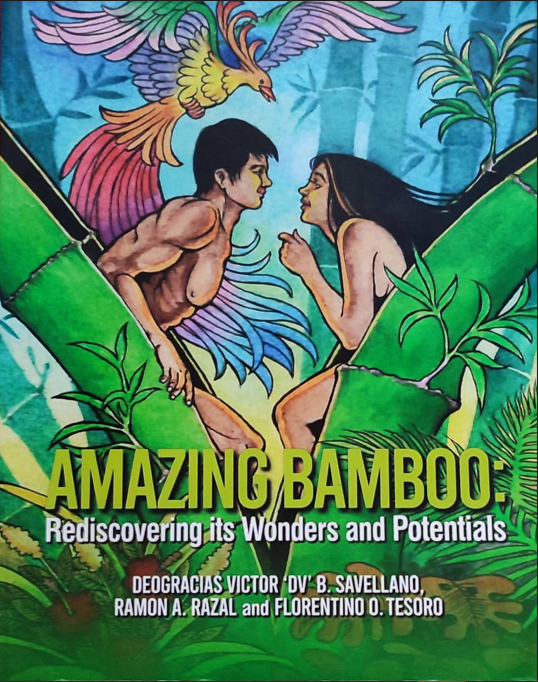
“Amazing Bamboo” by Deogracias Victor B. Savellano, Ramon A. Razal, Florentino Tesoro

   The pilot bamboo propagation project totalling 30 hectares in Puray and Karugo, Montalban is a multi-sectoral cooperation.  It also involved Rotary International which funded it by at least P2 million.  Other private funders of bamboo projects are Philippine Chamber of Commerce and Industry and Philippine Exporters Confederation Inc.

   Madarang also recognized during the book launch Edgar Mariano, president of the Karugo Agri Farmers Association. The farmers operate within Montalban which is part of the Marikina Watershed where massive deforestation has been observed in the past years.

   “If there was someone who planted the bamboo, there should be someone to look after it.  We depend on the residents in the watershed to take care of what was planted,” said Madarang.     

   The book with its complete title “Amazing Bamboo: Rediscovering its Wonders and Potentials” teaches one how to grow bamboo in the farm.

   It demonstrates bamboo’s everyday use in the life of the Filipino—including how it serves as the food “Labong.”  It shows how bamboo supports industries and feeds factories with raw materials. 

   Finally, it updates the reader on how government leads the way into the industry’s development.  The private sector has also been actively advocating the use of bamboo in many innovative and technology-driven products including engineered bamboo for construction, bamboo fiber for clothing, biomass for renewable energy, and many consumer goods.

   During the launch,  Villar noted her family’s own Villar Foundation established in 2005 a Bambusetum, a depository of bamboo genetic species meant for preservation.  It keeps 70 varieties of bamboo species.  It was also put up in order to assure a constant supply of bamboo planting materials for the Sagip-Ilog, a slope protection project along riverbanks.

   Villar cited 28 other bamboo varieties are stored at the Ramsar-listed Las Pinas Paranaque Critical Habitat and Ecotourism Area. 

   Las Pinas City itself has its bamboo processing facility that generates jobs for skilled craftsmen. 

   “The bamboos are sourced outside of our city and are brought to our factory to undergo an 11-step process to become the very useful and aesthetically-pleasing bamboo steps which our company buys.”

   Villar noted her hometown Las Pinas is known for the world-renowned bamboo organ and as “Parol Capital” which uses bamboo as raw material.

  It is but apt that DTI identified bamboo as a priority industry.  Bamboo is documented to have 10,000 uses, according to the International Fund for Agricultural Development.   

PHOTO: “Amazing Bamboo” authors Agriculture Undersecretary Deogracias Victor B. Savellano (third from left) and former Science Undersecretary Florentino O. Tesoro (rightmost) are joined by Senator Cynthia Villar (fourth from left). Also in photo are PBIDC Executive Director Rene Madarang (Leftmost) and Trade Undersecretary Blesila Lantayona (second from left).

Capability building for tobacco farmers on multiple cropping system aims to give alternative income amid health concerns vs tobacco

September 23, 2023

Melody Mendoza Aguiba

   The Marcos Administration will carry out a capability building program for tobacco farmers on multiple cropping system that gives farmers alternative income amid health concerns raised against tobacco.

   “We must seek ways to protect the livelihood of thousands of our tobacco farmers,” said Marcos through a speech delivered for him by Ilocos Norte Governor Matthew Joseph Manotoc during the First  International Tobacco Agricultural Summit.

   “I urge the Department of Agriculture (DA), and the NTA (National Tobacco administration) — together with the academe and the private sector — to explore other crops that can be grown alongside tobacco so as to contribute to our goal of food security.”

   Marcos sees the need to introduce alternative sources of income for tobacco farmers considering intensifying health concerns raised against tobacco.

   “These past years, we had seen so much change in our health policies that affected the tobacco industry. As such, we must seek ways to protect the livelihood of thousands of our tobacco farmers.”

   Government is committed to safeguarding the livelihood of tobacco farmers, recognizing that it is a “vibrant catalyst for economic growth in the country” particularly in Mindanao and Northern Luzon.

   In a separate farmers’ pre-tripartite conference in Vigan City, DA Undersecretary Deogracias Victor B. Savellano said DA and NTA will encourage farmers to similarly adopt a multiple cropping system. 

   Savellano said technical assistance will be extended to farmers so they may also plant rice, corn, sugarcane, vegetables, garlic, onion, and bamboo along with other high value crops.

   Developing alternative livelihood for farmers, such as the planting of the versatile bamboo will enable farmers to no longer depend just on tobacco farming for income especially as health concerns confront the tobacco industry.

   “Don’t forget my advocacy of planting bamboo which supports the daily needs of our farmers  and fisherfolks.  Bamboo plants are versatile and are used as trellis for vegetables, ‘katig’  for fishing boats, brace for fishpens,” said Savellano. 

   For one, bamboo is used as the device where cured tobacco leaves are hung. 

   Bamboo has 10,000 documented uses as wood, pulp and paper, and raw material in many industries.

     Engaging in other businesses, such as livestock farming, will add a significant income for tobacco farmers.

   “When purchasing power of farmers is high, they are able to contribute more to economic growth as they can increase consumption of Filipino-produced goods,” said Savellano.

   The government is also implementing stricter regulations in ensuring illegal tobacco trade is curbed. 

   NTA Regulatory Head Robert Ambros said government’s revenue losses due to illicit tobacco trade is expected to exceed P30 billion by the end of the year.

   The World Health Organization (WHO) reported that illegal tobacco trade involves products that are “untaxed and unregulated, with no health warnings, packaging or labeling requirements; which makes them cheaper, more readily available and accessible, especially to young and poor people.”

   WHO said that eliminating illicit tobacco trade “will increase tobacco product prices, lower consumption, reduce premature deaths, and increase government revenues.”

   DA-NTA has a coordinating mechanism with the Bureau of Internal Revenue and the Bureau of Customs in fighting illegal trade.  End

 PHOTO DA Undersecretary Deogracias Victor B. Savellano (third from left) led a farmers’ consultative conference in Ilocos Sur