PBBM to fight illicit tobacco trade that brings P30B foregone revenue to government

September 21, 2023

By Melody Mendoza Aguiba

President Ferdinand R. Marcos Jr. has vowed to fight illicit tobacco trade that brings P30 billion in foregone revenue to government.

   The Marcos Administration will also introduce a multiple cropping system that gives alternative income to farmers amid health concerns raised against tobacco.

   In a speech delivered for him by Ilocos Norte Governor Matthew Joseph Manotoc during the First  International Tobacco Agricultural Summit, Marcos said the government will not let up on tobacco smuggling which likewise to date this year P16 billion in foregone revenue to the government.

   “We must seek ways to protect the livelihood of thousands of our tobacco farmers,” said the president

   “I urge the Department of Agriculture (DA), and the NTA (National Tobacco administration) — together with the academe and the private sector — to explore other crops that can be grown alongside tobacco so as to contribute to our goal of food security.”

   Marcos sees the need to introduce additional or alternative sources of income for tobacco farmers considering health concerns raised against tobacco.

   “These past years, we had seen so much change in our health policies that affected the tobacco industry. As such, we must seek ways to protect the livelihood of thousands of our tobacco farmers.”

   He recognized that the tobacco industry is a “vibrant catalyst for economic growth in the country” particularly in Mindanao and Northern Luzon.

   In a separate farmers’ pre-tripartite conference in Vigan City, DA Undersecretary Deogracias Victor B. Savellano said DA and NTA will encourage farmers to adopt a multiple cropping system. 

   Savellano said technical assistance will be extended to farmers so they may also plant rice, corn, sugarcane, vegetables, garlic, onion, and bamboo along with other high value crops.

   As part of the aim to raise farmers’ income, DA will carry out an intervention program for the industry. 

   There are six important things to take note of in improving the quality of tobacco, Savellano said.  These are 1.  Water 2.  Fertilizers and pesticides as prescribed by agronomists  3.  Good-quality fuel wood  4.  Upgraded flue-curing barns  5.  Greenhouses 6.  A research and development program. 
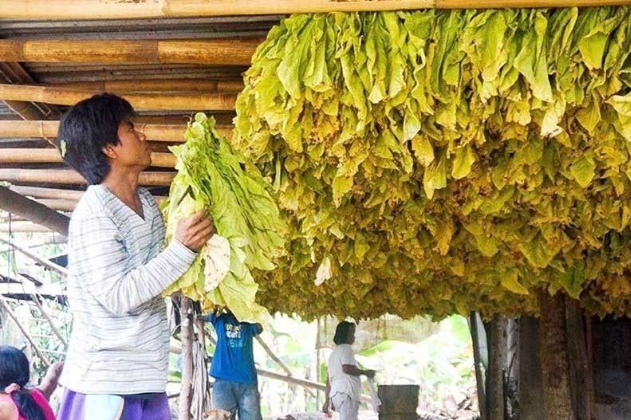
Tobacco leaves are hung for drying on bambo poles. Credit-Philstar

   “Our main goal is to export our tobacco.  That’s why we should produce high quality tobacco in order to be competitive in the world market and earn the dollar revenue we deserve,” said Savellano.

   NTA Regulatory Head Robert Ambros said government’s revenue loss due to illicit tobacco trade is expected to exceed P30 billion by the end of the year.

   The World Health Organization (WHO) reported that illegal tobacco trade involves products that are “untaxed and unregulated, with no health warnings, packaging or labeling requirements; which makes them cheaper, more readily available and accessible, especially to young and poor people.”

   WHO said that eliminating illicit tobacco trade “will increase tobacco product prices, lower consumption, reduce premature deaths, and increase government revenues.”

   DA-NTA has a coordinating mechanism with the Bureau of Internal Revenue and the Bureau of Customs in fighting illegal trade.

   While critics hit tobacco’s role in the economy, Marcos noted that the tobacco industry

is a “significant source of tax revenues that are used to fund government programs.”

   “It is an indispensable bedrock that generates income, livelihood, opportunities, and employment, particularly in areas where its cultivation spans generations and holds pivotal significance in the way of life of its communities,” said Marcos, also DA secretary.

  The tobacco industry provides livelihood to 2.1 million people including more than 89,000 direct labor force in tobacco farming consisting of farmers, laborers, and helpers, according to Savellano.

   These are the other significant contribution of the tobacco industry to the economy, Savellano said:

  1.  Tobacco collections are reinvested into tobacco producing regions via beneficiary local government units (LGUs).  A total of P19 billion was released in 2020 from tobacco excise tax which LGUs use for their priority programs.
  2.   The tobacco industry is a key contributor to public sector revenues.  Excise tax collection amounted to P 160 Billion in 2022.   Tobacco comprises 54% of sin tax collection in 2022.
  3. The tobacco industry is a foreign exchange generator and finances the government’s health programs.  Export values rose by 46.3 % from 2018 to 2022.  The tax revenue from tobacco products is reinvested in government’s universal healthcare program (UHP).  A total of P74.48 billion has been earmarked for (UHP)  in 2022 out of the  tobacco excise tax collections.

High quality tobacco for export

   DA-NTA will increase the quality of tobacco for export to make products more competitive for the export market.”

   “We will create more employment .  We will lower cost of production to increase the income of our farmers.  We will facilitate partnerships between farmers and  their buyers or with manufacturers that use their produce as inputs.”

   LGUs will play a vital role in helping tobacco farmers improve their tobacco to make it of high quality for export.  LGUs should partner with DA-NTA’s in introducing interventions to tobacco farmers.

   “LGUs receive excise tax from the production of tobacco, so they should be proactive in partnering with DA and NTA in helping farmers improve productivity.  Our goal is to raise our production and raise the quality of our products so we can up the dollar value of our export,” said Savellano.

   Developing alternative livelihood for farmers, such as the planting of the versatile bamboo will enable farmers to no longer depend just on tobacco farming for income especially as health concerns confront the tobacco industry.

   “Don’t forget my advocacy of planting bamboo which supports the daily needs of our farmers  and fisherfolks.  Bamboo plants are versatile and are used as trellis for vegetables, ‘katig’  for fishing boats, brace for fishpens,” said Savellano. 

   For one, bamboo is used as the device where cured tobacco leaves are hung. 

   Bamboo has 10,000 documented uses as wood, pulp and paper, and raw material in many industries.

   DA-NTA will continue to engage in programs that will improve sustainability of the tobacco industry—both as a nature-friendly activity and as a constant source of livelihood for farm families.

   “When I was a member of the House of Representatives, DA, NTA, and my office formulated the step (Sustainable Tobacco Enhancement Program),” said Savellano. 

   Engaging in other businesses, such as livestock farming, will add a significant income for tobacco farmers.

   “When purchasing power of farmers is high, they are able to contribute more to economic growth They can increase consumption of goods,” said Savellano..

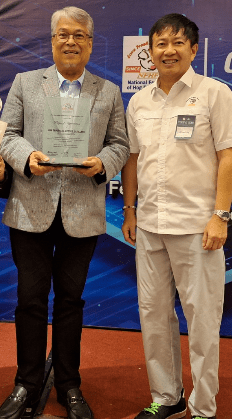
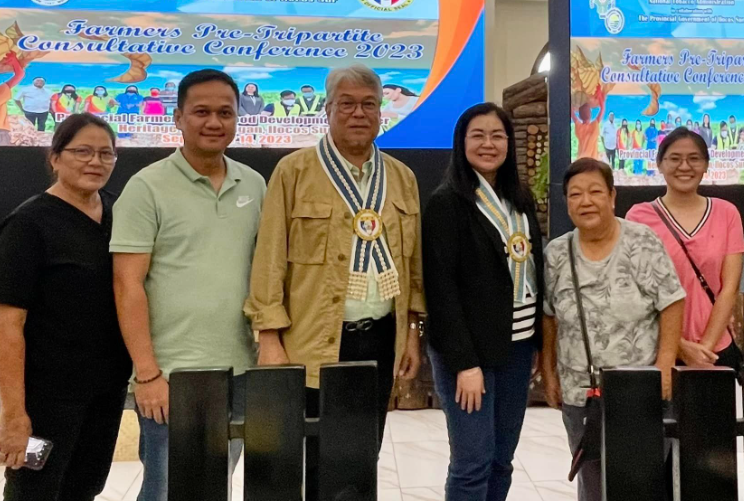
PHOTO DA Undersecretary Deogracias Victor B. Savellano (third from left) led a farmers’ consultative conference in Ilocos Sur

Tobacco leaves are hung for drying on bambo poles. Credit-Philstar

Villar inaugurates Bamboo Shared Service Facility, supports industrialization of bamboo with a skilled workforce

September 19, 2023

Senator Cynthia A. Villar (middle) led Monday the inauguration of the PBIDC Shared Service Facility (SSF) in Marikina City which will help boost Philippines’ vision to industrialize bamboo.     

   Shown is a display at the SSF of a Filipino-designed bicycle that uses bamboo.    

   Department of Agriculture Undersecretary Deogracias Victor B. Savellano (right) assisted Villar on a tour of the Philippine Bamboo Industry Development Council’s (PBIDC) SSF which is housed at the Center for Innovation and Technology for Enterprise (CITE) in Marikina City. 

   The SSF has training machines, equipment, function rooms, a dormitory for in-house training, and offices. The CITE also has a Bambusetum, a depository of bamboo genetic species. PBIDC-SSF offers training on bamboo propagule production and bamboo product processing. The global bamboo industry generates $70 billion in yearly revenue—growing to $100 billion before end-2030. (Melody Mendoza Aguiba)

DA to put up Livestock Animal Registry to ensure legitimate livestock farmers get benefits from government programs

September 15, 2023

By Melody Mendoza Aguiba

The Department of Agriculture (DA) will put up a Livestock Animal Registry (LAR) as part of ensuring legitimate livestock farmers get the benefit from DA programs and in order to carry out repopulation amid diseases like the African swine fever (ASF) that brought farmers huge losses.

   DA Undersecretary Deogracias Victor B. Savellano told the general assembly of the National Federation of Hog Farmers, Inc.(NATFED) that DA will partner with the private sector in establishing the LAR.

   “This will identify how many and where are the different farm animals and to whom should the government give any form of subsidy from funds earmarked by the government.”

   DA’s partnership with the private sector will also ensure accurate industry data.  This will ensure industry leaders will be able to come up with best business decisions.

   “Philippine Statistics Authority  reports there are 10.2 Million Pigs.  But in fact it could be just around 7.5-8 million if industry stakeholders said the industry lost around 40% from African Swine Fever from 2019,”  Savellano said.

   DA will also study ways to help livestock farmers cut costs of farm inputs –  feed ingredients and livestock genetics (superior breed of piglets, calves, chicks).  The aim is to ease farmers’ burden on these costs that represent the sizable 70% of producing meat, milk, and egg.

   Indemnification system will further be improved to aid livestock owners who lost from ASF and other diseases.

   Savellano said DA will also be transferring to farmers the technology that have long been developed in the country’s state universities and colleges (SUC). This may include vaccines and other modern farming systems and technologies that will be adopted in partnership with the Department of Science & Technology.

   “The concern of neglect in our agriculture for decades (as aptly described by our (DA Secretary President BongBong Marcos) should be resolved. One of the solutions is to closely study  particular farm inputs in livestock production,” said Savellano.

   Tax reductions suited to the livestock sector will also be considred.

   A statement released by the Department of Budget and Management indicated that out of the proposed P197.84 billion budget of DA, the National Livestock Program will get a share of P4.3 billion.  Also, based on the proposed budget, P2.22 billion will be allotted for the Integrated National Swine Production Initiatives for Recovery and Expansion program (INSPIRE). 

   DA’s thrust is to repopulate hogs amidst the continuing threat of ASF.  DA will ensure that the vaccine under trial will be proven safe and effective.  The vaccine should follow all universally acceptable protocols.

  These will be implemented by DA:

1.   Promotion in the rural barangay levels of the propagation of different kinds of farm animals.  Such operations should follow strict biosecurity practices.  Genetic improvement will be introduced for profitability and sustainability.

   “Government may help farmers in market identification for small farm holds, semi and commercial scale farms.  It will give direction to livestock farmers on how they can reach their target market.  DA will help them sell direct to retailers and end consumers in order to gain greater margin.

  • DA will curb all kinds of smuggling, hoarding and profiteering.

   “We will find ways to produce more and lessen importations of pork and other food animal products.  We will consult livestock stakeholders on how much each sector can locally produce.  We will study the minimal quantity the private sector and government will  import in order to stabilize consumer market prices and make animal protein source products affordable to consumers.”

  • The focus for the DA Livestock Group will 1) Produce more livestock and products locally in large volumes, (2) Balance local production with minimal importation (3 Ensure enticing profit margin for livestock farmers, creating more livelihood and jobs.

   “Let us campaign for more production– cook more and eat more pork from 10.7- 11 kilos per capita consumption to about 14-15 kilos in the coming years towards BBM- Big Boost for Meat Production.”

   The livestock industry has been pushing for a bigger budget considering that poultry and livestock contribute 30% of the entire agriculture revenue.  In budget, it gets only around 3-4%. 

      Savellano committed to holding regular consulations with industry leaders “in order to hear directly from your end, where and how your government under the PBBM Administration can fully support the food security goal .”

PHOTO: DA Undersecretary Deogracias Victor B. Savellano (Left) and Alfred Ng, National Federation of Hog Farmers vice chairman

PBBM’s Agriculture appointee a bamboo advocate pushing for economic development, poverty reduction

July 31, 2023

Melody Mendoza Aguiba

President Ferdinand “Bongbong” R. Marcos Jr. has appointed former Representative Deogracias Victor Barbers Savellano as Department of Agriculture (DA) undersecretary, recognizing his contribution to economic development  and poverty reduction – being an advocate of bamboo industrialization.

   Also a former governor of Ilocos Sur, Savellano was deputy speaker of the House of Representatives during the 18th Congress.   

   As a bamboo advocate all his life, he has authored House Bill 9576 or the Philippine Bamboo Industry Development Act.

   He has sustained his passion to push for bamboo as a tool for Philippines’ industrialization through his current work as vice chairperson at the Philippine Bamboo Industry Development Council (PBIDC) just before the DA appointment.

   In his own home province in Ilocos Sur, Savellano has inspired communities to put up a Bamboo Park in each barangay.

   This fostered collaboration, skills coaching, and product development involving every age in the community—oldest to youngest—imparting how bamboo is traditionally used for different purposes passed on from a generation to another. This also egged up creation of emerging, innovative bamboo products.

   Savellano’s vision is to see Philippines begin eating up a significant share of the global bamboo market which is expected to grow to $92.62 billion by 2027 (United Nations Comtrade).  This is from $66.22 billion in 2022 and $71.63 billion in 2023.

   Philippine Bamboo Foundation Ed Manda praised PBBM’s appointment of Savellano as DA secretary.

   “Congressman DV’s appointment will further boost efforts of stakeholders to fast track development of the emerging bamboo industry,” Manda said.

   The development of bamboo industry will address or aid in many serious concerns  in the Philippines.  These include emission of pollutant, greenhouse gases, environmental and land degradation, soil erosion, landslides, typhoon surge, and flooding.  Bamboo is a  cost-effective, lower-budget approach—being a grass abundantly growing nationwide and needs modest maintenance.

   Bamboo can catapult to industrial status many simple industries including building and house construction, renewable energy, biomass, cooking fuelwood, furniture, fiber and textile, and lumber from a highly-durable yet beautiful material to substitute for hardwood.  It will generate millions of jobs in rural areas and ancestral lands tended by Indigenous People and bring in needed dollar reserve.

   Savellano co-founded and was president of the National Movement of Young Legislators with which he is continuing to partner for bamboo propagation all over the country.

   As a businessman, he was chairman of the Ilocos Sur Hotels, Restaurants and Related Enterprise and of the Ilocos Sur Convention and Visitors Bureau. He has been running his own fine dining restaurants in Ilocos Sur and Quezon City that have popularized to the city the unique heritage of Ilocano cooking.

   He founded Kilusang 5K (Kawayan:  Kalikasan, Kaunlaran, Kabuhayan, Kinabukasan) Foundation Inc.  Kilusang 5K, together with Rotary International, has put up a 30-hectare pilot bamboo farm (propagation, nursery)  in Karugo and Puray, Montalban, Rizal to demonstrate the economic and environmental value of growing bamboo.  Kilusang 5K will also participate in a long term 20,000 hectare bamboo propagation in the Marikina Watershed as part of fighting perennial flooding and landslides in the area.

   Savellano received in 2009 a Hall of Fame Award for the Best LGU Poverty Reduction program  program. He is also a recipient of a CROWN Award in Nutrition for being a consistent regional outstanding winner in Nutrition National Nutrition Council. 

   He is an immediate past president of the UP Manila College of Arts and Sciences Alumni Society, UP Manila Alumni Association, currently board of director, UP Alumni Association, and president, Rotary Club of Quezon City Circle

 Savellano finished AB Economics at the University of the Philippines Manila and Master in International Business Administration at the Monterey Institute of International Studies in Monterey, California USA.

PHOTO ATTACHED Deogracias Victor Barbers Savellano

“Bamboo Bill” Senate 605 set for Senate public hearing July 19, passage to cement PBBM huge contribution to economic development in 5 years

July 11, 2023

Melody Mendoza Aguiba

“Bamboo Bill” Senate Bill 605 has been set on July 19 for Senate public hearing amid the Marcos Administration’s aim to speed up economic development, create livelihood, and cushion vulnerable poor population from climate disasters.  

   Authored by Senate President Juan Miguel F. Zubiri, SB 605 or an “Act Institutionalizing the Philippine Bamboo Industry Development Program,” will create among the biggest agriculture industries with up to 55,000 hectares of existing bamboo stands across the islands, Zubiri said.

   Six other bamboo development-related bills will be deliberated in the Senate on July 19.  All these bamboo bills, generally strengthening functions of the Philippine Bamboo Industry Development Council (PBIDC), are seen to be consolidated with SB 605.  

   The bills are SB 615 (Senator Cynthia Villar), SB 1044 (Sen. Joel Villanueva), SB 1145; and SB 1552 (Senator Lito Lapid), SB 1118 (Senator Loren Legarda), SB 1145 (Win Gatchalian),  and SB 2172 (Senator Jinggoy Estrada).

   Not only is bamboo a unique Filipino cultural symbol with the “bahay kubo” and the innovative industrial design works of Bobby Manosa and Kenneth Cobonpue.

   Philippines  also has the world’s fifth biggest bamboo industry.  Yet it has to keep up with far distant huge bamboo industries of China and Vietnam, said Zubiri.  Global market is estimated by the Department of Environment and Natural Resources at $17 billion.

   SB 605 fortifies PBIDC’s policy-making role in creating community-based enterprises that will have sufficient supply of quality materials and produce new products from research and development-inspired technologies. 

   Manufacturers are mandated to use bamboo on at least 25% of their raw materials inputs for furniture, lumber (wood processed into uniform sizes such as beams and planks),  and manufactured products that can use bamboo as an alternative to wood.

   Plantations will be accepted as loan collateral in government-owned-and-controlled financial institutions.  Plantation developers and bamboo processors will have priority access to credit and guarantee.  Bamboo plantations will be exempted from security cutting, harvesting, and transporting permits.

   Markets will be created through aggressive trade promotion.  Supply of trained and skilled labor will be stabilized.  There will be a comprehensive program on bamboo nursery expansion;

bamboo propagation, breeding, site-specific bamboo species development; and sustainable planting, harvesting, soil and water conservation protocols.

   Bamboo advocate former House Deputy Speaker Deogracias Victor B. Savellano, currently vice chairman of PBIDC, said he hopes the Bamboo Bill will be ratified on or before the year ends. 

   “It is imperative that the industry that is so natural to us Filipinos can be developed sooner.  It has been waiting for a long time now to help our poorest population.  And you don’t need big budget for infrastructure to address our climate-related ills — soil erosion and environmental degradation that are causes of natural disasters,” Savellano said.

   “Bamboo will substantially support our farmers and fisherfolks.  It supplies their need for simple devices like banana tree’s support pole or the katig (outrigger) in boats,” he said.

   PBIDC Executive Director Rene Madarang said the industry hopes government will cite SB 605 a priority bill in President Ferdinand R. Marcos Jr.’s State of the Nation (SONA) address as the bamboo industry will cement in the next five years the Administration’ contribution to economic growth.

   Edgardo Manda, Philippine Bamboo Foundation president, said the strengthened PBIDC will provide a coherent direction in developing commercial, large scale bamboo plantation to support the manufacturing of bamboo products.

   Without the passage of such bamboo law, PBIDC which is under the Office of the President lacks not only the budget but the powers to harmonize all government bamboo programs that has left the industry undeveloped.

   At least 20% of planting materials needed for the National Greening Program of the Department of Environment and Natural Resources (DENR) will come from bamboo.

   The industry will be supported by accurate and reliable data for decision-making aid of investors and entrepreneurs.

   Among incentives to be granted to stakeholders of bamboo-based products are those under the Board of Investments and National Internal Revenue Code.

   The Bamboo Industry Research and Development Center will be established under the bill.  Local Bamboo Industry Development Councils (BIDC) will be put up in towns and provinces to localize planning and support for budget and policies for industry development.

    The amount needed to implement the Bamboo Bill (Law) will initially come from unexpended contingency fund of the Office of the President and existing bamboo industry budget of the Department of Trade and Industry and DENR.    “Thereafter, such amount … shall be included in the annual General Appropiations Act.” 

PHOTO Florida-based Rizome Philippines produces world-class engineered bamboo that make for sophisticated and beautiful building material.

Bamboo Law passage to prop plantation expansion, capital into industrial plants, free government land use offered for commercial plantations

By Melody Mendoza Aguiba

June 26, 2022

The urgent passage of a law to develop the bamboo industry is seen to prop up capital influx into  farms and industrial plants in line with incentives including exemption from rental fee of government lands for commercial bamboo plantation.
   The exemption for five years from rental fee of government of lands and tax free importation of equipment are the principal incentives proposed under House Bill 7941.

   The bill, approved on third and final reading by the House of Representatives last May 30 was immediately transmitted to the Senate for approval.
   Bamboo advocate Deogracias Victor B. Savellano, former House deputy speaker, said the immediate approval of the Senate of House Bill 7941 augurs well for the bamboo industry that has been waiting to be developed for years now.  
   Executive Order 879 which created the Philippine Bamboo Industry Development Council (PBIDC) was signed in 2010.  

   “The Marcos Administration can be known for a bamboo-led industrial development given immediate ratification of this bamboo law.  We just have five years now, but surely we can manage the resource that we already have in abundance,” said Savellano, PBIDC current vice chairman.

   “We can even use bamboo to comply with our climate change mitigation commitments.”
   In the Senate, at least five bamboo development-related bills have been filed in the last Congress.  These are Senate Bill (SB) 605 with Senator Miguel Zubiri as principal author, SB 615 (Senator Cynthia Villar), SB 1044 (Sen. Joel Villanueva), SB 1145; and SB 1552 (Senator Lito Lapid).

   House Bill 7941 strengthens the power of PBIDC  to develop the industry through policies that encourage planting and development of bamboo product designs.
   Under the approved House version, private plantations registered with the Community Environment and Natural Resources Office (CENRO) of the Department of Environment and Natural Resources (DENR) are exempted from securing a cutting permit for the harvesting of bamboo.   These are exempted too from securing a transport permit for the bamboo materials.
   Bamboo plantations are also exempted from the payment of forest charges and other fees for taxes that LGUs may impose.   
  PBIDC convenes producers of raw materials, processors, marketing and promotion companies, and national and local government and agencies to discuss strategies to revitalize the bamboo industry.

   By itself, PBIDC’s programs will be guided by Cabinet-level agencies including heads of the Department of Environment and Natural Resources, Department of Agriculture, and Department of Education, among others.
   DENR earlier placed the global market for non-timber forest products at $17 billion as of 2020.    

   Isidro C. Alcantara Jr. of Philippine Nickel Industry Association said annual revenue can hit $3 billion if only the Philippines can plant at least 10% of China’s bamboo area.

   Some of the uses of bamboo include house construction, infrastructure, paper, furniture and handicrafts, charcoal and pyroligneous liquor, textile, and clothes. Other uses are for production of food products from bamboo shoots, bamboo beer and medicinal products.  Bamboo pellets can be used for power generation.
   The Philippine Bamboo Industry Program that will be implemented by PBIDC will ensure the sustainable production of quality raw materials; develop relevant technologies and new products; and produce accurate/reliable data.  It will also promote investments; put up capacity building programs that will generate skilled labor; and ensure provision of locally manufactured machines.
   Savellano said that the foreseen huge economic livelihood generated from bamboo industry will pluck out of abject poverty many Filipinos and Indigenous People in rural areas who own vast ancestral lands.  The industry will further be a significant instrument for fighting climate disasters.
   Provincial governments should come up with their own Bamboo Industry Development Program within two years from  the enactment of the bamboo law.
   The legislation also provides for the access of plantations to development loans from government financial institutions.  Crop insurance will be provided too.

   Importation of equipment for plantation development, including tree nursery, will be tax free under Republic Act No. 10863, otherwise known as the Customs Modernization and Tariff Act (CMTA).  Plantations will be accepted  as collateral for loans in government-owned-or-controlled banks.
   No volume restriction in the export of bamboo culms from plantations will be allowed.
   Industrial bamboo plantations in forest lands and priority areas will be included in the annual investment program of the National Economic and Development Authority and will have  priority access to funds  from external and internal sources.
    The Bamboo Industry Development Program will include plans of actions for the scientific propagation, development and management, processing, utilization, business development, and commercialization.

   The bill also provides for the creation of  the Bamboo Industry Research and Development Center (BIRDC) which will partner with the public and private sectors, people’s organizations and non-government organizations, and the academe for  sustained development. 
Photo: Philippines’ Giant Asper species used as engineered bamboo by Rizome for sophisticated construction. Credit: Rizome
   

Florida-based Rizome Philippines invests $100 million for enginereed bamboo plant in Cagayan de Oro, House Bill on bamboo development ok’d  


May 30, 2023

By Melody Mendoza Aguiba


Florida-based Rizome Philippines is investing a whopping $100 million (P5.5 billion) for an enginereed bamboo plant in Cagayan de Oro even as it supports government’s move to prioritize House Bill 7941 passage for bamboo sector development.

   Former Agriculture Secretary Luis P. Lorenzo Jr., a global investor at Rizome Philippines through subsidiary Bamboo Ecologic Export Corp (BEEP), is bringing in cutting edge, proprietary technology in bamboo wood manufacturing.

   Rizome is progressively  infusing capital from $20 million to $100 million in its Cagayan de Oro plant.
   “I became a global investor cause I want to bring the best technology here.  I don’t want the Philippines to be second class.  The investment is big.  But (even now) our business is already a billion peso industry.  And it employs thousands,” said Lorenzo.  
   Lorenzo just met with Philippine Bamboo Industry Development Council (PBIDC) Vice Chairman Deogracias Victor B. Savellano who has been pushing for priority legislation to institutionalize execution of Executive Order 879 issued in 2010.
   Savellano just reported that the Lower House approved on second reading House Bill 7941, promoting the development of the sector.  It buttresses the provisions of EO 879 which aimed to seize a $8 billion bamboo market dominated by China.
   Lorenzo seconded efforts to make bamboo a priority industry.  Appointed Department of Agriculture secretary in 2002, Lorenzo ran one of Philippines’ biggest banana export firms, Lapanday, and pineapple firm Del Monte prior to appointment.

   “Please make bamboo a priority.  I hope government would be friendly toward a new industry.   Government is technically pushing housing.  Why not import-substitute all the components of housing construction,” he said.
   Despite China’s vast bamboo plantation, Lorenzo said Philippines can compete with any country in the world in bamboo wood quality. This is particularly with the Giant Aster species that grow abundantly all over Mindanao.

Former Agriculture Secretary Luis P. Lorenzo Jr, Rizome International global investor, shows the many forms of engineered bamboo lumber. Credit-Melody Aguiba

   “I came across group of Americans who for 13 years were producing from Vietnam high-end, prefabricated homes made of bamboo.  The same group studied ways by which bamboo can be re engineered using technology.  After 13 years,  they finally decided after visiting Brazil, Indonesia, China, India  that the Philippines has the best bamboo.”
   Rizome produces panels, boards, veneers, and strand woven made of giant asper bamboo.
   An important priority policy is to make bamboo a recognized construction material in the implementation of the Building Code.  This, as engineered bamboo is a proven technology strong as steel, tough as concrete, fire resistant, water resistant, pest free, and is even beautiful as hardwood.
   Rizome International is financing its investments in the Philippines through loans, “offset credits” for capital equipment startup and operational expenses.  
   Rizome’s bamboo manufactures are shipped in container loads to Original Equipment Manufacturers (OEMs) in America, Europe, Middle East, Africa, and Asia Pacific.    
   As the passenger terminal of the Mactan Cebu International Airport became the first airport in Asia made entirely of lamellar wood, Rizome is being introduced in the Philippines as global standard quality wood.
  “Because you heard about the beauty of Cebu and Clark airports, we want to introduce bamboo to the Philippines as our national identify.  The beams and all that –we make all of these.  We make these bullet proof.  We can make beams as long as you like.  No more steel, no more concrete,” Lorenzo said.
   Also top among incentives government can do to encourage investments in bamboo plantations and manufacturing is the easier processing of 25 to 50 years of forest management contracts (Industrial Forest Management Agreements, Community Based Forest Management Agreements.)
   Huge ancestral domain lands for bamboo should also be identified by government to give livelihood to rural people and Indigenous People.
   Local government units (LGUs) who can have a significant contribution to bamboo sector’s development should be creative to encourage their constituents to plant bamboo, Lorenzo said.  
   Savellano, through PBIDC and the entity he founded, Kilusang 5K Foundation, has earlier put up a Technical Working Groups (TWGs) primarily for production and propagation of bamboo all over the country.  
   The TWG also works on bamboo’s industry and commerce and training of workforce for bamboo propagation and processing.
   Rizome buys bamboo slats of agrarian reform beneficiaries who have planted bamboo in Bukidnon, North Cotabato, Agusan provinces, and Surigao province.  It also buys bamboo from communities in mining areas.
   Rizome enginereed bamboo keeps up with premiere architectural specifications, equalling “quality, strength, durability of steel and concrete.”
   Through an infusion of clean mineral salts,  Rizome pressure treats bamboo fibers to totally efface insect and mold from the wood.   It is a treatment tested by the Washington State University.
   A finalist to the Musk Foundation’s XPrize, the Rizome Bamboo Project in the Philippines can win the grand prize of $50 million for its carbon offset efforts.  It has been chosen as candidate among 60 others for the potential of bamboo farms to sequester 400 tons of carbon dioxide per year.  
  “Our goal is to have planted 10 miilion bamboo clumps by 2030 for a 10-year carbon drawdown of over 26 million tonnes of carbon dioxide, the equivalent of the greenhouse gas emissions of 5.654 million cars in a year,” according to Rizome.  

PHOTO (Above( Former Agriculture Secretary Luis P. Lorenzo Jr, Rizome International global investor, lifts engineered bamboo wood to demonstrate its light weight, yet highly durable quality. Credit-Melody Aguiba

BIG ON BAMBOO

Former Agriculture Secretary Luis P. Lorenzo Jr.,(third from left) leader of Florida-based Rizome Philippines, explores with Philippine Bamboo Industry Development Council Vice Chairman Deogracias Victor B. Savellano (first from left) vast opportunities to export and create jobs for sustainable, engineered bamboo (known to be strong as steel, sturdy as concrete, beautiful as hardwood) now exported as sophisticated construction material to the United States. Also in photo is PBIDC Executive Director Rene Butch Madarang (fourth from left).

May 18, 2023

Technology transfer pursued by PBIDC with private, research firms as Base Bahay for bamboo development for fiber, housing, biomass

May 2, 2023

A technology transfer program has been pursued by the Philippine Bamboo Industry Development Council (PBIDC) with private firms as Base Bahay and local government for the development of bamboo for low to high-end products– fiber, housing, fuel, and biomass.

   In an Usapang Kawayan forum held in Mendez, Cavite, more bamboo partnerships are reported to be pursued  for bamboo technology sharing and commercialization, according to PBIDC Vice Chairperson Deogracias Victor B. Savellano. 

   These potentially growing tie-ups also include research agencies like Philippine Textile Research Institute (PTRI), Forest Products Research and Development Institute (FPRDI), and local government units (LGU) as Miag ao, Iloilo and Dapitan City in Zamboanga del Norte.

   Sustainable, socialized housing  using bamboo has been shown possible by Base Bahay Innovation in its bamboo villages in Bagong Silangan, Quezon City and Estancia and Jaro, Illoilo, among others.  The houses are disaster-resilient designed to resist typhoons.

   “This is a very good program to support President (Ferdinand) Marcos’s program for housing so that more socialized houses can be built,” said Savellano.

   To further advance the use of bamboo in modern housing, the Philippine Institute of Architects, in a program called “Bamboo’s Tahanang Kawayan,” has been tapped to integrate bamboo in its designs for more sophisticated housing materials.

   Consultation between PBIDC and Department of Human Settlements and Urban Development (DHSUD) has started  to look into cement bamboo frame technology as construction material for socialized housing.

   Also in discussion on possible bamboo partnership for housing  is with former Agriculture Secretary Luis P. Lorenzo Jr. who now runs Rizome Philippines. 

   For the manufacture of engineered bamboo for home finishing and construction material, Rizome Philippines supplies a type of giant bamboo, Dendrocalamus asper, to international partners, particularly in Florida, United States.

   The government has been strengthening the function of PBIDC since it was convened on Dec. 22, 2022 by Trade Secretary Alfredo Pascual to fulfill its mandate to contribute to industrial development under Executive Order 879.

   As PBIDC practically has yet to be budgeted by government, a proposed budget has been filed with Philippine exports Federation (Philexport).  Department of Trade and Industry Regional Director Leah P. Ocampo has also led the crafting of resolutions on a more robust PBIDC function.

   Congressman Joeman Alba of Bukidnon will refile the PBIDC bill (House Bill 9576, Senate Bill 605) which will institutionalize PBIDC as the umbrella organization to steer bamboo to its industrial development role.

Bamboo Textile Fiber Innovation Hub. Credit- PTRI

Bamboo for energy

   For the possible use of bamboo for charcoal as fuel and for biomass, PBIDC has been in talks with Dr. N. Barathi who has developed India’s Beema bamboo for its use as one of the best sources of generating energy.  In the Philippines, the Bayog bamboo species, Bambusa spinosa, may be the equivalent of Beema bamboo for renewable energy–  biomass for heating and cooking.

    FPRDI has also a developed a technology on bamboo’s use for charcoal or fuelwood.  Its bamboo charcoal is cheaper, energy-efficient and is ecology-friendly.  Upland people do not have to do kaingin (forest burning) to produce cooking fuelwood.

   For the propagation of bamboo, a tissue culture technology of the FPRDI is planned to be adopted in PBIDC’s own bamboo plantation program such as those in Karugo, Puray, and Upper Marikina Watershed in general.  Tissue culture will enable massive seedling production. 

Bamboo fiber

   For bamboo fiber, PBIDC is partnering with New York-based Filipino-American fashion designer and textile technologist Anthony Legarda. He has worked with the PTRI and advanced the development of abaca fiber and other indigenous materials.

   “What is good with bamboo for fiber is recovery is big at 35% per pole, while recovery in abaca and other fibers is only at 2%,” said Savellano.

   The Environment Research and Development Bureau’s (ERDB) Bambusetum in Los Banos is also eyed to be replicated by PBIDC nationally. 

   “Where can you find such place with the genetic resource of such large number of bamboo species? It is good to replicate this Bambusetum of ERDB because many of these species grow in different locations all over the country,” said Savellano.

   Irene Marcos Araneta, herself President Marcos’s sister, is involved in the development of bamboo for fiber.  She may enter into similar collaboration with PBIDC in order to give more livelihood to Ilocos Region weavers. 

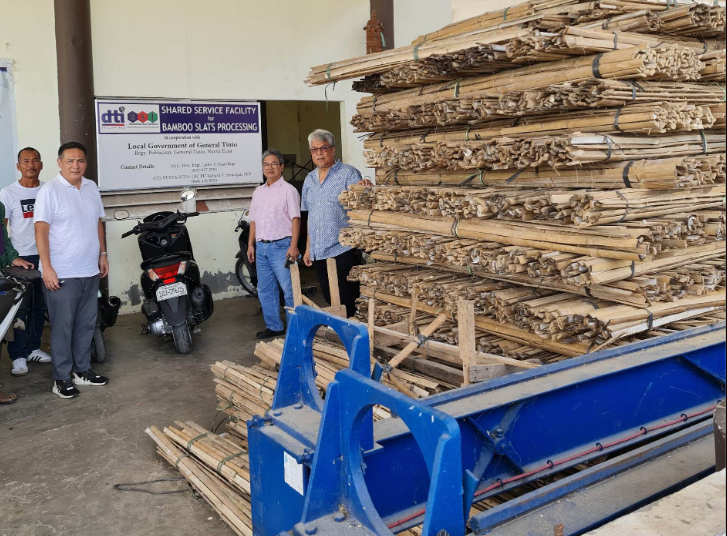
PBIDC Vice Chairman DV Savellano, PBIDC Exec. Dir. Rene Madarang visits a DTI Shared Service Facility in Gen. Tinio, Nueva Ecija producing bamboo slats for housing

These are other possible partnerships:

1.  Health Undersecretary Camilo Cascolan will explore the natural properties of bamboo as medicinal plant.

2. For bamboo planting expansion, the Metro Manila Development Authority (MMDA) and Pasay City LGU eye the planting of bamboo for urban landscaping and livelihood for urban dwellers. 

   The University of the Philippines Manila Alumni Association is also supporting bamboo planting for its “Adopt a Estero” program led by PBIDC Executive Director Rene Madarang. Planting programs are also being discussed with the National Movement of Young Legislators.

3.     PBIDC and KIlusang 5K  Foundation have been meeting with different Local Government Unit (LGU) heads for a Kawayan Karavan and Lakbay Aral for the exploration and development of bamboo for varied uses.  In Nueva Ecija, the Kawayan Karavan was held in plantations and shared service facility in Gen. Tinio and Fort Magsaysay.

4.  To market bamboo products internationally, a potential partnership is with Davao Investment and Tourism Center and Mindanao Development Authority. 

   This– along with CITEM (Center for International trade exhibitions and Mission), Pampanga Furniture Makers led by Myrna Bituin that participated in the 2023 Philippine International Furniture Show, and Tourism Alliance Group (TAG) which promotes eco farm tourism and bamboo in their tourist destination meetings.

5.  Manila Water , which has a major function to protect water sources from watersheds, is eyed to collaborate with PBIDC on planting programs. 

6.  The bamboo manufacturers of Maasin, Iloilo which produce charcoal briquettes, toothpick, chopstick, and barbeque sticks may be able to share their technology to other entrepreneurs through a link with PBIDC.

   The Pangabuhian Weaving and Fiber processing center in Miag-ao, Iloilo may support a similar collaboration.   

7.  A PBIDC visit  to Davao Bamboo Sanctuary and participation in Davao Bootcamp may turn out for the further use of bamboo for housing and other industries. 8.  Another possible partnership is with the academe — the Nueva Ecija University of Science and Technology for the development of bamboo for varied uses.  PBIDC may further support the First Gen Hydropower Corp. which has a bamboo plantation in Pantabangan Dam, Nueva Ecija. (Melody Mendoza Aguiba)

FEATURED PHOTO Former Agriculture Sec. Luis P. Lorenzo Jr. who now runs Rizome Philippines meets with PBIDC Chairman Deogracias Victor B. Savellano, PBIDC Exec. Dir. Rene Madarang. Rizome Philippines supplies bamboo to Florida-based maker of engineered bamboo.

Filipino-designed electric bike that uses climate-smart bamboo to pave way to Ph being globally known world class bamboo producer

April 3, 2023

A Filipino-designed electric bike (EB) brand-named “Banatti” that uses innovative, environmentally sustainable bamboo  is seen to pave the way to Philippines’ being a globally known producer of world class bamboo products.

   Speaking in an “Usapang Kawayan” bamboo forum, Christopher Paris Lacson, Banatti EB’s creator,  said the trendy motorcycle is just the beginning of a highly promising sector that has the potential to catapult Philippines to industrialization.

   “A bike like this can inspire the young, the leaders, the countrymen, and the industries to say ‘Kaya pala yan’ (It can be done!),” said Lacson.  “It’s not (just) about making money.  It’s about making us proud.  We can have our own. We’re creative.  We’re smart.  We’re intelligent.”

   The team that developed Banatti Green Falcon chose to use bamboo as “it is the mandate of the country.”

   “This God-given supergrass is one of our tickets out of poverty.   When people see a picture of Banatti Green Falcon, it brings an incredible feeling. Something goes on to their mind, something shifts,” said Lacson.

   The dream of using bamboo as a jump-off point for Philippines’ development of rural-based industries is  a much practical vision due to the abundance of bamboo in the Philippines, said Philippine Bamboo Industry Development Council (PBIDC) Vice Chairman Deogracias Victor B. Savellano.

Single engine, light experimental aircraft built and designed by Antonio de Leon in the 1950s

   Through his Kilusang 5K (Kawayan:  Kalikasan, Kabuhayan, Kaunlaran, Kinabukasan), Savellano hosts Usapang Kawayan in order to sustain brain storming on bamboo development as envisioned by Executive Order 879 since 2010.

   “If you analyze, kawayan is not like other plants as jatropha that government once asked us to grow.  We have taken kawayan.  You see it in every barangay, but no one plants,” Savellano said. “That’s why we’re fighting for kawayan. It’s not that we don’t want other plants.  But let’s prioritize kawayan because planting it brings results.”

   The equivalent of a P20 million-worth farm-to-market project makes for a big expansion in bamboo planting.  For one, the 20-hectare plantation project of Kilusang 5K in Karugo, Montalban just costs P1.5 million, even initially.

   “What will you plant? The hardwood that you will harvest in 10-20 years, or the bamboo that you can harvest in 3-4 years?  And we already have many existing clumps.  With the proper management, you can benefit economically immediately.”

Durable body shell

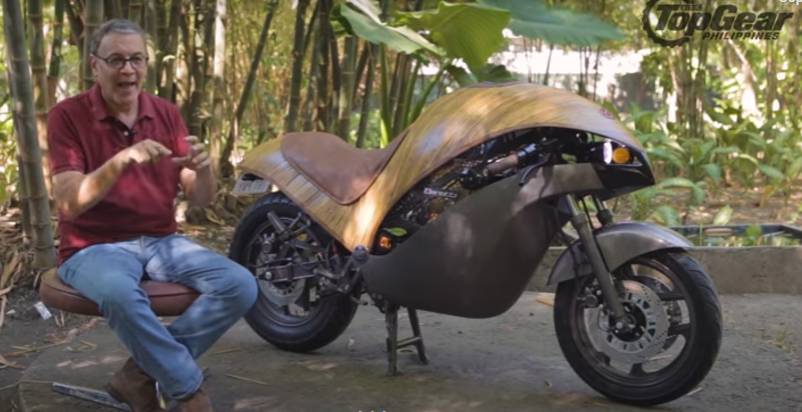
   The Banatti Green Falcon, crafted by Lacson in 2017, has a body shell made of highly durable, elegant-looking, light-weight (four kilo only versus 2-3x more weight in metal ) bamboo. 

Bamboo mobile designed by the old Department of Transportation

   Its body shell that is made of bamboo may just be worth P5,000.  But using bamboo in sophisticated, industrial products can bring about tremendous multiplier effect on the economy.

   “The bamboo that created the body shell of the motorcycle may just be worth P5,000.  But someone has to plant it.  Someone has to cut it.  Someone has to bring it to the place where we bought it from.  Just this, and there are four levels of job across spectrum,” said Lacson.

   “In industries like furnishing or automotive, there are so many tentacles, many roots involved in the design of the product.”

   If other nationalities such as the Germans of Porsche find value in natural materials such as bamboo for vehicles, much more should the Philippines find value in its own indigeneous plant. 

   An advantage of bamboo body shell to complement an electric motorcycle as in Banatti is it can install a good sound system that can enable one to hear music very well, unlike gasoline-run ones. 

   Lacson himself said the Philippines has long been a pioneer of industrial bamboo design as cited by a local newspaper in the early 1950s. 

   Filipino Antonio de Leon designed a single-engine, light experimental aircraft XL-14-MAYA.  It used a type of woven bamboo called WOBEX, woven bamboo experimental.

   Another product is the bamboo mobile, a type of jeepney spearheaded by the Department of Transportation of long ago.  Its  body is made of bamboo. Bambu Batu (House of Bamboo) cites many other modern, fashionable furniture and clothing products made of bamboo.

   Now that climate-related disasters have shown Philippines’ vulnerability, much more should Philippines tap now what is native and ecologically sustainable.

   “History tells us about the ‘ugong’ created by kawayan.  If that has once been happening in Pasig (where bamboo plants in Barangay Ugong hold on relentlessly to the soil and just create the wild ugong sound), why do we choose to spend millions for other projects?” said Savellano.      

   Infrastructure projects–like riprapping that protects soil from erosion– can cost much more money. Whereas, bamboo plants have been proven to control erosion.

   With its rich network of roots and rhizomes and permanent canopy, bamboo protects the soil. 

   “(Bamboo’s root system) grows in the surface layer of the soil (20-60 centimeters deep) and can reach up to 100 kilometers per hectare.  Rhizomes can survive for more than a century, allowing bamboo to regenerate even if stems would be cut or destroyed in a fire or storm,”

according to Guadua.bamboo.com.

EO 879

   EO 879 envisioned bamboo to be a tool for industrialization based on agricultural development. Also, it should be planted as Philippines’ contribution Southeast Asia’s commitment to plant 20 million million hectares of new forest to improve the environment.

   “Bamboo can be easily transformed into a cash crop for farmers… thereby alleviating poverty.   The growing advocacy for green products is fueling the rapid growth of the US$8 billion per annum market for traditional and non-traditional bamboo products,” according to EO 879. 

   “(Bamboo) is fast becoming a cost effective and attractive complement and/or alternative to plastic, metal and wood materials and can generate more jobs and self-employment opportunities in both rural and urban areas.” (Melody Mendoza Aguiba)