Filipino-designed electric bike that uses climate-smart bamboo to pave way to Ph being globally known world class bamboo producer

April 3, 2023

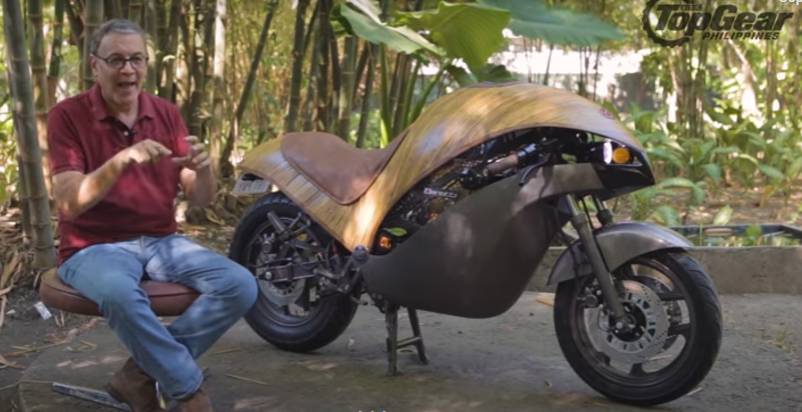
A Filipino-designed electric bike (EB) brand-named “Banatti” that uses innovative, environmentally sustainable bamboo  is seen to pave the way to Philippines’ being a globally known producer of world class bamboo products.

   Speaking in an “Usapang Kawayan” bamboo forum, Christopher Paris Lacson, Banatti EB’s creator,  said the trendy motorcycle is just the beginning of a highly promising sector that has the potential to catapult Philippines to industrialization.

   “A bike like this can inspire the young, the leaders, the countrymen, and the industries to say ‘Kaya pala yan’ (It can be done!),” said Lacson.  “It’s not (just) about making money.  It’s about making us proud.  We can have our own. We’re creative.  We’re smart.  We’re intelligent.”

   The team that developed Banatti Green Falcon chose to use bamboo as “it is the mandate of the country.”

   “This God-given supergrass is one of our tickets out of poverty.   When people see a picture of Banatti Green Falcon, it brings an incredible feeling. Something goes on to their mind, something shifts,” said Lacson.

   The dream of using bamboo as a jump-off point for Philippines’ development of rural-based industries is  a much practical vision due to the abundance of bamboo in the Philippines, said Philippine Bamboo Industry Development Council (PBIDC) Vice Chairman Deogracias Victor B. Savellano.

Single engine, light experimental aircraft built and designed by Antonio de Leon in the 1950s

   Through his Kilusang 5K (Kawayan:  Kalikasan, Kabuhayan, Kaunlaran, Kinabukasan), Savellano hosts Usapang Kawayan in order to sustain brain storming on bamboo development as envisioned by Executive Order 879 since 2010.

   “If you analyze, kawayan is not like other plants as jatropha that government once asked us to grow.  We have taken kawayan.  You see it in every barangay, but no one plants,” Savellano said. “That’s why we’re fighting for kawayan. It’s not that we don’t want other plants.  But let’s prioritize kawayan because planting it brings results.”

   The equivalent of a P20 million-worth farm-to-market project makes for a big expansion in bamboo planting.  For one, the 20-hectare plantation project of Kilusang 5K in Karugo, Montalban just costs P1.5 million, even initially.

   “What will you plant? The hardwood that you will harvest in 10-20 years, or the bamboo that you can harvest in 3-4 years?  And we already have many existing clumps.  With the proper management, you can benefit economically immediately.”

Durable body shell

   The Banatti Green Falcon, crafted by Lacson in 2017, has a body shell made of highly durable, elegant-looking, light-weight (four kilo only versus 2-3x more weight in metal ) bamboo. 

Bamboo mobile designed by the old Department of Transportation

   Its body shell that is made of bamboo may just be worth P5,000.  But using bamboo in sophisticated, industrial products can bring about tremendous multiplier effect on the economy.

   “The bamboo that created the body shell of the motorcycle may just be worth P5,000.  But someone has to plant it.  Someone has to cut it.  Someone has to bring it to the place where we bought it from.  Just this, and there are four levels of job across spectrum,” said Lacson.

   “In industries like furnishing or automotive, there are so many tentacles, many roots involved in the design of the product.”

   If other nationalities such as the Germans of Porsche find value in natural materials such as bamboo for vehicles, much more should the Philippines find value in its own indigeneous plant. 

   An advantage of bamboo body shell to complement an electric motorcycle as in Banatti is it can install a good sound system that can enable one to hear music very well, unlike gasoline-run ones. 

   Lacson himself said the Philippines has long been a pioneer of industrial bamboo design as cited by a local newspaper in the early 1950s. 

   Filipino Antonio de Leon designed a single-engine, light experimental aircraft XL-14-MAYA.  It used a type of woven bamboo called WOBEX, woven bamboo experimental.

   Another product is the bamboo mobile, a type of jeepney spearheaded by the Department of Transportation of long ago.  Its  body is made of bamboo. Bambu Batu (House of Bamboo) cites many other modern, fashionable furniture and clothing products made of bamboo.

   Now that climate-related disasters have shown Philippines’ vulnerability, much more should Philippines tap now what is native and ecologically sustainable.

   “History tells us about the ‘ugong’ created by kawayan.  If that has once been happening in Pasig (where bamboo plants in Barangay Ugong hold on relentlessly to the soil and just create the wild ugong sound), why do we choose to spend millions for other projects?” said Savellano.      

   Infrastructure projects–like riprapping that protects soil from erosion– can cost much more money. Whereas, bamboo plants have been proven to control erosion.

   With its rich network of roots and rhizomes and permanent canopy, bamboo protects the soil. 

   “(Bamboo’s root system) grows in the surface layer of the soil (20-60 centimeters deep) and can reach up to 100 kilometers per hectare.  Rhizomes can survive for more than a century, allowing bamboo to regenerate even if stems would be cut or destroyed in a fire or storm,”

according to Guadua.bamboo.com.

EO 879

   EO 879 envisioned bamboo to be a tool for industrialization based on agricultural development. Also, it should be planted as Philippines’ contribution Southeast Asia’s commitment to plant 20 million million hectares of new forest to improve the environment.

   “Bamboo can be easily transformed into a cash crop for farmers… thereby alleviating poverty.   The growing advocacy for green products is fueling the rapid growth of the US$8 billion per annum market for traditional and non-traditional bamboo products,” according to EO 879. 

   “(Bamboo) is fast becoming a cost effective and attractive complement and/or alternative to plastic, metal and wood materials and can generate more jobs and self-employment opportunities in both rural and urban areas.” (Melody Mendoza Aguiba)
30-hectare bamboo plantation in Montalban upland Sierra Madre put up to give Dumagat tribe livelihood, replenish forestry, capture carbon

February 24, 2023

A 30-hectare bamboo plantation in the Montalban upland in Sierra Madre mountain has been put up by a multi-sectoral group that aims to give live livehood to Dumagat tribes, replenish forestry and capture carbon,  and help prevent Metro Manila flooding and climate disasters.

   The Philippine Bamboo Industry Development Council (PBIDC) is proposing to replicate nationwide the 20-hectare Karugo and 10-hectare Puray bamboo projects in Montalban. 

   It is part of the Marikina Watershed, a portion of the Sierra Madre mountains that hold the water without whose forests Marikina and the entire Metro Manila could be flooded.

   The Karugo and Puray bamboo projects in Montalban, Rizal are an ideal multi-agency collaboration that involves minimal budget, according to PBIDC Vice Chairman Deogracias Victor B. Savellano.

    Yet it has harnessed and consolidated multiple resources that redounds to upland economic benefit.

   “Our best examples (for bamboo propagation) are those in Puray and Karugo. It’s something that’s not difficult to do. It is a joint effort between government Rotary International, Indigenous People, and community. It’s a beautiful model that should be replicated all over the Philippines,” said Savellano.

   Bamboo partnership between PBIDC, 5K Foundation, Rotary International (3780, 3830, 3800), Bamboo Professionals Inc., and Indigeous People (IP) belonging to the Samahan ng Kawayan sa Karugo Agri-Farmers Association (SAKKAFA) and Tribal Council Assn. of Puray Inc. (TCAPI).

   Rotary raised a minimal P1.5 million in district grants for Karugo project.

   The Kilusang 5K (Kawayan: Kalikasan, Kaunlaran, Kabuhayan, Kinabukasan) Foundation, founded by Savellano, has supported organization of Puray and Karugo projects. The bamboo propagules planted in 2022 in Karugo is estimated to multiply to 142,000 bamboo culms in five years and 228,000 culms in eight years.

   Now that Trade Secretary Alfredo Pascual has reconvened PBIDC, Savellano said PBIDC is coordinating all bamboo projects and agencies. Thus, such replication can be implemented in every town in the country—as what has been done by Savellano’s former constituents in Ilocos Sur.

   PBIDC has adopted the Montalban projects for its own collaborative, cost-effective model.

   “We tapped the two community-based projects to establish nurseries and do plantation development,” said PBIDC Executive Director Butch Madarang.

   “Using the convergence formula through consultation with different agencies, we’re able to engage everybody. We have an inclusive perspective. Our formula is to tap different agencies’ resources.”

   Lead collaborator is the Department of Environment and Natural Resources (DENR) which identified the project site. Kilusang 5K tapped the Philippine Bamboo Foundation and Bamboo Professionals Inc to train the IPs on bamboo propagation.

   Instead of planting hardwood that takes 10-20 years to harvest, bamboo was chosen as it is harvestable in three years, generating income to the community.

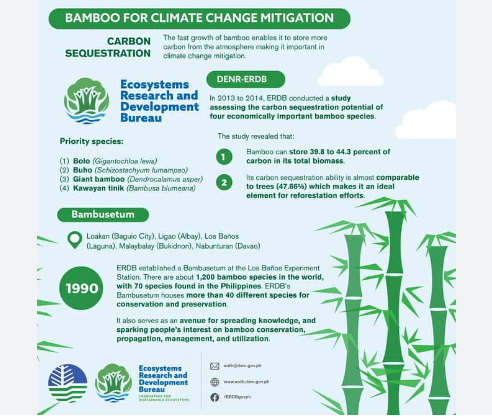
   More so, bamboo plants are climate disaster fighters. Bamboo, at four years old, has been proven to absorb 500 kilos of carbon dioxide yearly. It generates 300 kilos more of oxygen per year compared to other trees. Bamboo plants hold more water than other trees, helping prevent erosion and flooding. It has high survival rate due to endemicity and maintenance care.

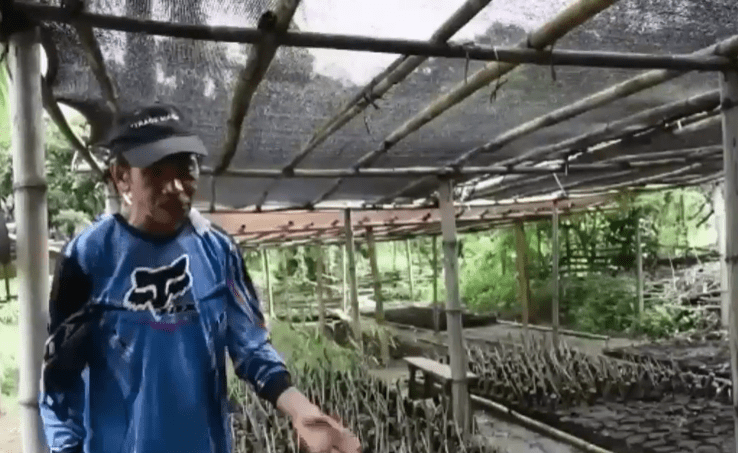
   Puray IPs who used to just cut bamboo plants relentlessly learn sustainable farming

   The 10-hectare Puray project is now generating a P300 per day income for farmers who do potting for growing seedlings. While generating income from selling seedlings, the vision for the bamboo projects is to produce commercially viable products.

    “We should venture first on basic products (before going to high-end sophisticated bamboo products like composites, fibers, engineered bamboo). For me, I will be happy enough if we’re able to produce bamboo chopsticks and barbecue sticks which we are importing even if we have many bamboo culms nationwide,” said Savellano.

   The Montalban projects are part of the bigger Upper Marikina Watershed Project (five municipalities/cities in the Sierra Madre mountains). It covers an estimated 26,000 hectares. It is envisioned to address persistent flooding in Marikina and Metro Manila as a whole.

   The watershed also protects the Wawa Dam which is capable of producing water for 500,000 households.

   The Marikina watershed, while declared a protected area, has been extensively plagued by illegal logging, highly-destructive quarrying, and illegal settlement. These have worsened state of flooding in Metro Manila. (Melody Mendoza Aguiba)

Propagation of climate-smart bamboo on 1,500 towns nationwide signed by government, legislators

February 22, 2023

A memorandum of agreement will be entered by the National Movement of Young Legislators Alumni Association (NMYLAA) for bamboo’s propagation on 1,500 towns nationwide as bamboo carbon offsets are now upheld by the International Bamboo and Rattan Organization (INBAR).

The NMYLAA is signing the MOA with the Department of Trade and Industry Philippine Bamboo Industry Development Council (DTI-PBIDC).

The program will be fulfilling a plan for many years now via Executive Order 879 to position bamboo not only as a primary climate tool and plant species against man-made disasters but as a crop for use as an industrial raw material.

“We are meeting this week with (DTI) Secretary (Alfredo) Pascual for this program to plant bamboo nationwide,” said PBIDC Vice Chairman Deogracias Victor B. Savellano.

“We are adopting the Filipinism of Jose Rizal in Dapitan as we want to make our agriculture areas productive.”

The Philippines is a signatory to several global treaties on climate change including the United Nations Convention on Climate Change (1992), Kyoto Protocol (1997), and Paris Agreement (2015).

To align programs with these commitments, the Department of Environment and Natural Resources (DENR) issued DENR Administrative Order 2021-43 on a carbon accounting and forest carbon project certification.

It is supporting investments in forest plantation activities that sequester carbon dioxide and avoid emissions from deforestation and degradation.

Correspondingly, the International Bamboo and Rattan Organization (INBAR) has supported carbon offsets for bamboo. It recognized bamboo can store substantial carbon. A 30-year giant bamboo plantation can 1.7 times the amount of carbon Chinese fir trees can produce.

“Countries, particularly in tropical and subtropical areas where bamboo grows, should make efforts to include bamboo in national and international carbon markets, as well as their national climate strategies,” INBAR said.

NMYLAA just held last February 11-12 a visioning in Rizal, Zamboanga del Norte that included strategic planning on bamboo.


NMYLA’As Project Climate Change is a mitigation (reduction of greenhouse gas emission) strategy focusing on bamboo due to its fast-growing nature. Bamboo will be used to enhance oxygen presence, reduce pollution, reduce flooding and disaster-related incidences, and improve soil condition.

Bamboo is envisioned to be used for biofuel, food, crafts. It can be developed as raw material for architectural and construction purposes, “ultimately playing a large role in the economy by creating job opportunities,” said Savellano.

The NMYLAA’s mission on Filipinism is also embraced. The innovations of national hero Jose Rizal in his exile in Dapitan, particularly on agriculture, infrastructure, education, and medicine are popularized.

Bamboo is also part of NMYLAA’s Project Disaster Preparedness and Project Farm Tourism.

“Barangays will have additional activity and will provide an additional source of income to communities. Farm tourism draws visitors to the barangay with activities as harvesting crops, feeding and caring for farm animals, fishing, camping, hiking, and sampling local cuisine (bamboo included,)” he said.

PBIDC will be reaching out to the grassroots through the bamboo production by tapping competent barangay leaders to carry this out.

The program can avail of prevailing government programs to support the bamboo propagation.

DENR DAO 2021-43 grants incentives to the private sector, upland organizations, and other entities in forest protection through verified carbon certificates. It will provide a standardized guidance for measurement of carbon projects. A registry for all forest carbon projects will be put up.

The DAO”s Carbon Accounting, Verification, and Certification System (CAVCS) harmonizes with the principles of the Philippine National Standard (PNS), Inter-governmental Panel on Climate Change (IPCC), and Good Practice Guidance for Land Use.

CAVCS projects will have a life of a minimum of 20 years to guarantee stability and long term gain.

The government is funding Forest Carbon Project Plans of investors. (Melody Mendoza Aguiba)