DA asked to scrap MAV to level playing field, ensure Safeguard Measures Act fees be channeled to farm competitiveness

January 19, 2024

By Melody Mendoza Aguiba

The private sector has asked the Department of Agriculture (DA) to scrap the Minimum Access Volume (MAV) in poultry and pork imports while also ensuring that fees collected from the Safeguard Measures Act implementation be channeled for the competitiveness of the agriculture sector.

In a meeting last January 18 with DA Secretary Francisco Tiu Laurel, the Philippine Chamber of Agriculture and Food Inc. (PCAFI) asserted the MAV has become useless as actual import volume for chicken, pork, and corn have ballooned many times more than the MAV.


“The volume of importation for chicken is more than 15 times the MAV.
Thus, our treaty commitment with the GATT-WTO shows that with this
condition, there is no longer need for a MAV,” said PCAFI President Danilo V. Fausto.


Philippines’ committed in 1995 to the General Agreement on Tariff and Trade-World Tade Organization (GATT-WTO) for an import volume of 23,500 metric tons (MT) for chicken with lower tariff of 40% under MAV.


Outside MAV, tariff commitment was at 50%. However, in 2005 tariff rate became equal for in and out of MAV volume.


Removing MAV will result in a “level playing field among importers and importers vis a vis local producers,” Fausto said.


PCAFI is concerned that farmgate price of chicken reported by the United Broilers and Raisers Association as of January 4 was P89.15 per kilo liveweight. This is way below production cost per kilo. For imported chicken, estimated cost was at P84.83 per kilo within MAV and P90.83 per kilo outside MAV.


On the other hand, retail price as per DA Bantay Presyo data on January 4 was at P170 to P180 per kilo.


In 2023, total chicken importation stood at 426,620 kilos. The same sitution is true for corn and pork where actual import volume far exceeds MAV.


In his Aide Memoire No. 2, Fausto also asked government to strictly enforce Section 34, Chapter 4 of the Safeguard Measures Act (Republic Act 8800) which was aimed at protecting local farmers from any surge in imports.


This mandates that fees and safeguard duties from the implementation of RA 8800 totalling to 50% be allocated for the competitiveness of the agriculture sector adversely affected by the surge in imports.

“RA 8800 was approved last July 19, 2000. Two decades have passed and
we have yet to see where the money collected under the law was allocated.
More particularly coffee, pork and chicken,” said Fausto.


As the coffee sector is negatively affected by excessive imports, PCAFI asked DA to use the RA 8800 fees to develop the coffee industry.


“The DA budget should provide for enough planting materials either through cuttings or
tissue culture to a wider coverage of farmer groups to generate at least five million coffee trees with a better yield from 700 kilos per hectare comparable to Vietnam production of 3-5 tons per hectare.”


DA coffee program should also provide training and better technology to farmers; encourage the youth to participate in the project; encourage a wider participant granting National Seed Certification from the Bureau of Plant Industry; and prioritize coffee for intercropping with the coconut trees.


PCAFI also asked DA to simply farmers’ access to the credit guarantee of the Philippine Guaranty Corp. The guarantee will ensure easier access of farmers to credit with banks.


Likewise, the Philippine Crop Insurance Corp. (PCIC) should insure crops, livestock, poultry and dairy against climate change, pests, and diseases. PCIC should expedite payment of insurance calls to provide confidence to investors and banks.


DA in collaboration with the Department of Finance should encourage front-end or forward purchase on planted crops to provide a turn-around capital of farmer-producers. Such production contracts and warehouse receipts should enable farmers to use these as collaterals to avail of loans from Land Bank and Development Bank of the Philippines.


Special safeguard funds must be put up to encourage banks, Land Bank and DBP
to provide farmers easy access to credit.

PHOTO DA Secretary Francisco Tiu Laurel (sixth from left) meets with PCAFI led by President Danilo V. Fausto (fifth from left)

Govt urged to raise biodiesel mix to 5% to take advantage of P23.4 billion forex savings

October 14, 2023

Melody Mendoza Aguiba

The government should take advantage of the lower price of nature-friendly biodiesel by raising coconut methyl ester’s (CME) mix to diesel to 5% so as to generate huge foreign exchange savings equivalent to P23.4 billion yearly.

   Aside from enhancing the fuels’ ability to cut pollutant greenhouse gas emission, the increase in the biofuel will enable Philippines to displace a big amount of imported diesel, according to United Coconut Association of the Philippines (UCAP) Chairman Dean Lao Jr.

   “We are importing 13 billion liters of diesel (yearly).  From B2 (2% biodiesel) to B5 (5% biodiesel), we can displace an additional 390 million liters equivalent to P23.4 billion,” Lao told a press briefing hosted by the Philippine Chamber of Agriculture and Food Inc. (PCAFI).

   The Philippines was a pioneer in 2006 in adopting the biodiesel technology through CME, being itself then the biggest exporter of coconut oil.

   Having ratified Republic Act 9367 or the Biofuels Act of 2006, government subsequently implemented biodiesel mix of 2%.  Despite its early adoption, the Philippines has been overtaken by other Southeast Asian countries in maximizing use of the environment-friendly technology.

   “When we started in 2006, we were the pioneer. Now, we’re the laggard,” said Lao.

   Indonesia is now the leader in biodiesel with its mix reaching to 30% and even announced early this year a 35% blend.

   The country’s commercialization of biodiesel has stagnated since 2009, the last time that the biodiesel mix was raised from 1% to 2%.

  Along with the cheaper price now of biodiesel compared to fossil fuel-based diesel, the Philippines is missing on the other advantages of a higher biodiesel mix. These are improved vehicle mileage and the reduced pollutant carbon dioxide emission to the environment.

   Due to the slow uptake on the technology, several companies are not operating at present, incurring opportunity loss.

   The Philippines, in fact, has excess production of CME.

   “Do we have enough coconut?  There is enough coconut oil to supply biodiesel.  The infractructure is ready to supply the  increase from 2% to 5%.  The capacity is ready.  And It’s the simplest to implement,” said Lao.

   PCAFI, led by its president Danilo V. Fausto, recommended the increase of CME blend to B3 by January 2024; B4 after six months thereafter; then B5 by 2025.  

   “The National Biofuels Board (NBB) has not championed B5 despite its merits. Misinformed politicians campaign against biofuels,” according to PCAFI in a position paper.

   Pollutant emission from 100% biodiesel has been proven to be 74% lower than those from petroleum diesel, according to a life cycle analysis conducted by the Argonne National Laboratory.

   As it uses generally vegetable oils compared to the depleting petroleum resource, biodiesel is deemed a renewable and biodegradable fuel. 

   “Biodiesel meets both the biomass-based diesel and overall advanced biofuel requirement of the Renewable Fuel Standard,” reported the Department of Energy (DOE).

  DOE cites other benefits of biodiesel including clean burning and use of domestic production.

   “Using biodiesel as a vehicle fuel increases energy security, improves air quality and the environment, and provides safety benefits,” according to DOE. “Biodiesel in its pure, unblended form causes far less damage than petroleum diesel if spilled or released to the environment. It is safer than petroleum diesel because it is less combustible.”

   Vehicle engine operation is improved as biodiesel improves fuel lubricity and “raises the cetane number of the fuel.”

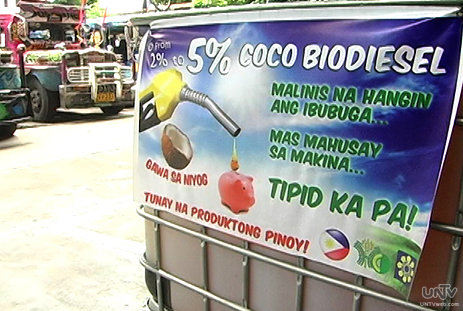
PHOTO Nature friendlier biodiesel at 5% mix Credit- UNTV

Aquaculture exporter urged LGUS to adopt a Sustainable Aquaculture Program to generate jobs, beef up food supply

October 14, 2023

By Melody Mendoza Aguiba

An aquaculture exporter has urged local government units (LGUs) to pursue a Sustainable Aquaculture Program in their domestic water so as to generate jobs and help beef up food security and protein supply in the Filipino diet.

   In a press briefing of the Philippine Chamber of Agriculture and Food Inc (PCAFI), Norberto O. Chingcuanco, Feedmix Specialist Inc. (FSI) vice president, also asked LGUs to issue long term aquaculture permits. 

   This will ensure long term investments in the fishery sector.

  Adopting a Sustainable Aquaculture Program (SAP) can be a major livelihood program of LGUs aligned with national government’s call for sustainable food production.

   It should be an intentional policy program to attract private sector investments.

   “These policies should contain proper zoning and site exclusivity per company or group. 

 Long term permits encourage needed long term investments,” said Chingcuanco     

   Also integrated in the SAP should be priority employment for local or native communities within the LGU.  It should implement safety and labor standards.  Fees and rentals should be appropriate to cover costs of monitoring and regulations.

   Chingcuanco lamented that the Philippine government has made it easier to import raw fish.  That is rather than importing cooked raw materials in order to produce feeds and grow its own fish.

   PCAFI President Danilo V. Fausto government should also boost production of fish fries needed in fishery production.  It should put up more hatcheries where fish and shellfish are spawned and hatched until large enough to be transferred to an aquaculture farm.

   “BFAR (Bureau of Fisheries and Aquatic Resources) said tilapia fry and fingerling production was 208.35 million in 2020 while annual demand is 2.1 billion tilapia fingerlings,” said Fausto.

   Even local communities will be benefitted by an LGU-based SPA as they will have priority access over whatever food is produced.

   FSI with its affiliate firm Fisher Farms is an integrated aquaculture company with seafood processing facilities that enable export products to reach Europe and North America. 

   It boasts of full traceability enabling food safety, technological innovation even in feeds, sustainable farm management, and the largest of its kind in its processed fish production.

   All of Feedmix’s hatcheries and feeds manufacturing facilities are certified and regulated by BFAR.  Fisher Farms’ facilities are certified by Sanitation Standard Operating Procedure (SSOP), Hazard Analysis Critical Control Point (HACCP), Good Manufacturing Practice, and World Halal Council. 

   Calling aquaculture “fish farming” rather than fish hunting, Chingcuanco said aquaculture in the Philippines has exceeded fish hunting production with 2.349 million metric tons as of 2022.  Commercial fisheries only reached 868,408 MT and municipal fisheries, 1.122 million MT.

    In his “Sustainable Aquaculture as a Livelihood Option,” Chingcuanco said the fisheries sector is a major job employer in the Philippines. 

   “WE have over 2 million registered fisherfolks as of 2021,” he said.

   This consists of capture fisheries, 1.095 million fishers; gleaning, 253,825; aquaculture, 247,164; fish vending, 147,038, fish processing 4,524, and related jobs, 404,113.

   An aquaculture or marine culture site employs 10 people per hectare and produces 250 tons of fishery per year.

  The advantage of SAP is it can be done in remote coastal areas, can employ people in the farflung provinces, and is a source of local food supply and local revenue.  It is protective of the environment if only proper policies are in place.

   Fishes are a major source of protein for the Filipino diet.

   “Fish and fishery products constitute 11.68% of each person’s total food intake which is equivalent to 93.9 grams per day,” he said.  “Each Filipino consumes an average of 34.27 kilos of fish and fish products per year, 65% from aquaculture.”

   The Philippines should take advantage of its natural resource, having the second longest coastline among South East Asian countries and China.   It has a coastline of 36,289 kilometers, just second to Indonesia, 99,073 kilometers.

   Even if fishermen and fishing investors take huge risks in the sector with storms, volcanic eruptions, and climate change, he said the country remains lucky as fishery resources just stay in the waters and are not lost.  That makes it less risky compared to crops.

ASEAN farm consortium put up by SEARCA to cut huge greenhouse gas emission, rice straw burning, and raise farmers’ income

By Melody Mendoza Aguiba

July 28, 2023

An ASEAN carbon farming consortium has been put up by the Southeast Asian Regional Center for Graduate Study and Research in Agriculture (SEARCA) to generate carbon credit and cut greenhouse gas emission while raising farmers’ income.

   SEARCA Director Dr. Glenn B. Gregorio said the consortium will give incentives for Asian farmers to adopt innovative technologies that will reduce  emission of a very powerful greenhouse gas, methane, that comes from rice farming.  It will generate carbon credits in the future. 

   Aside from solving a huge environmental problem, it  will raise farmers’ income by at least 50%.  It will generate rural jobs, and produce an organic-type fertilizer.  

   “We will share the data (between Southeast Asian countries), the experience from everyone,  We will get funds together, and SEARCA will commit some funds to start it up,”  said Gregorio at the roundtable discussion on “Sustainable Food and Agriculture System in Southeast Asia. SEARCA co-organized it with the Bangko Sentral ng Pilipinas.

   SEARCA will start with a few pilot sites, use these as model for replication, and do actual measurements (greenhouse gas emissions, income) as scientific basis for replication.

   Farmers will be organized, formed into communities, and incentivized to use the innovations.

   “We’ll incentivize them, and use these incentive system as policy that may be adopted by legislators.  Using these technologies needs a new mindset,”  said Gregorio.

    Among climate-smart varieties to be popularized to farmers are short-maturing and high-yielding, tolerant to biotic and abiotic stresses, and high-biomass varieties,

drought-tolerant rice, submergence-tolerant rice, salt-tolerant rice.

   “We’ll make a model, make it work, and after a few years, once we see farmers benefitting, it will spread like fire,” said Gregorio.   “Once the soil is rehabilitated, it will have health benefits.  It will benefit all.  We will use digital  technology.  It’s a dream, but it’s reachable.”

   In one technology to be adopted by the consortium, SEARCA has partnered with the UK-based Straw Innovation Ltd for the “Rice Straw Biogas Hub.”  The project also involves UK SME Koolmill, and UK academic partner Aston University.

   The project solves the huge problem of disposing rice straw which becomes a waste material from producing rice.  An estimated 750 million metric tons (MT) of rice straw is produced yearly.  To dispose of the waste, an estimated 300 million MT is burned.  The remaining 400 MT is left to decay in the fields, emitting a huge amount of methane, a greenhouse gas 80 times more dangerous to the environment than carbon dioxide when emitted over a 20 year period, according to SIL.  GHG emission is more than that of the entire global aviation industry. 

   However, SIL has developed a harvester enabling synchronous harvesting of both rice and the rice straw. That omits burning, disposal of much waste, and significantly reduces GHG emission.

   Income for farmers is increased by 50%.  The technology enables production of fertilizer that stores carbon. The innovation brings jobs in rural areas, reduces post harvest losses, and generates billions of dollars for the Philippines’ rice sector.

   Other technologies to be popularized among Southeast Asian farmers are water-saving technologies like alternate wetting and drying of rice farms, soil and nutrient management, and cropping and crop-animal system.

   GHG-reducing soil and nutrient management techniques include nutrient-fixing legumes, use of chemical versus organic fertilizer, and methane-oxidating bacteria.

   Cropping and crop animal systems that reduce GHG emission include lowland agroforestry, crop-animal integration, and crop biomass and animal manure management.

   The carbon farming system will improve traceability of farms and agricultural products or the process by which a product in the market or at any stage in the supply chain can be traced to its origin. Such provides for food safety and transparency.

PHOTO Innovative harvester that synchronously reaps rice and the rice straw– omitting much greenhouse gas emission,  much waste burning, and post harvest loss.

Exporter Fishta enabled fishing communities in Palawan to contribute to Philippines’ export to Japan, Canada

By Melody Mendoza Aguiba

June 20, 2023

Filipino seafood exporter Fishta Seafood Inc. (FSI) has enabled fishing communities in Busuanga, Palawan to contribute to Philippines’ fishery export to Japan and Canada through its marketing effort under a USAID sustainable fishing program.

   Speaking at the Philippine Chamber of Agriculture and Food Inc.’s (PCAFI) “Usapang Pagkain,”    Carina Ong Tan, FSI general manager, said long term benefits to the livelihood of at least 50 women in Busuanga are anticipated.

   “Sustainability of the supply chain is something I champion and believe in.   We help the community by investing in the supply chain and by teaching people. We become the linkage (between fishermen and the market),” Tan said.

   FSI has partnered with the United States Agency for International Development (USAID) Fish Right  and Seatrace International Inc. to promote responsible fish sourcing, reversing the adverse impact of  Illegal, Unreported, Unregulated (IUU) fishing.  

   FSI, a spinoff from parent firm aquaculture feeds producer Santeh Feeds Corp., supplies seafoods to supermarkets, restaurants, and overseas markets from its owned or contracted farms.  These are in the form of live, frozen, chilled, and smoked products. 

   It has invested in the seafoods supply chain in order to achieve fish production sustainability, ensure its products’ safety, and reach bigger local and export markets. 

   It has invested in facilities– blast freezing, indirect contract freezing, and individually quick frozen technology.

   “This is an example of the idea of introducing innovation and market linkage direct to the source, from the fishing communities themselves.  We buy their products direct from them, and they no longer have to go to traders,” said Tan.

   “It’s a program that gives attention to the island itself.  Other fishing communities go to us for the replication of this program.  We can contribute these ideas to the seafood industry because we have access to technology and markets.  This way, we can make an impact directly to fisherfolks.” 

   With its ability for traceability, food safety is ensured. Consumers are able to send feedback on the quality of a seafood product as their origin may be traced. With traceability, the company can pull back products in the market that pose any adverse risk on human health.

   “We are still in the process of creating our RSS (responsibility sourced seafood standard) Policy to achieve 100% Traceability & Transparency in our supply chain,” said Tan.

   FSI parent firm SFC was founded by PCAFI Chairman Philip Ong in 1990.   

  SFC boasts of ISO-certified manufacturing facilities that produce optimally bioavailable ingredients for fast seafood growth and for environmental sustainability.

   FSI’s program with USAID  aims to sustain food production while protecting the seas and fish populations. 

   The USAID program recognizes that the Philippines loses an estimated P68.5 billion yearly from illegal, unreported, and unregulated fishing

   It has supported protection of fishery areas through key marine biodiversity areas (KMBA) in Calamianes Island, Southern Negros, and Visayan Sea.

   FSI has also  contributed to the empowerment of 50 women and their families as the Department of Trade and Industry granted them a brine cold storage facility upon FSI’s training of these women.

PHOTO Fishta links Palawan fishermen direct to consumers of value added seafood products like this Halibut

Govt urged to give incentives for private sector to invest in smart agriculture, renewable energy, tap ESG bonds for climate actions

April 18, 2023

Multilateral financier World Bank has urged government to give incentives for private sector to invest in climate smart agriculture and renewable energy and to tap ESG bonds to finance climate actions countering disasters.

   Presenting its Country Climate and Development Report (CCDR) 2022 in a forum of the Southeast Asian Regional Center for Graduate Study and Research in Agriculture (SEARCA), World Bank officials stressed government has to raise access of climate financing to private sector.

   That along with making investment policies for climate action attractive and encouraging access particularly to ESG bonds.

   “Public and private investments are needed to finance adaptation through climate-resilient infrastructure.  Financing mitigation measures from private sector should be incentivized by new regulatory technology-push and demand-pull policies,” said Souleymane Coulibaly, World Bank project leader and lead economist, at the SEARCA forum.

   “On the private side, issuing ESG bonds under the recently introduced Sustainability Financing Framework could leverage private financing for climate actions.”

   ESG bonds (environmental, social, governance) are generally part of sustainability financing supported by the Bangko Sentral ng Pilipinas. Eligible green expenditures are clean transportation, climate change adaptation and disaster risk reduction projects, sustainable agriculture, and renewable energy (solar, wind, geothermal, biomass, hydropower).

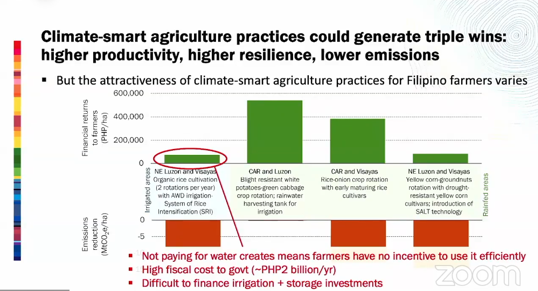
   Dr. Stefano Pagiola, World Bank senior environmental economist, also said at the SEARCA forum that attractiveness to farmers of climate smart agriculture practices should be improved as these have triple wins. 

   These are higher productivity, higher resilience, and lower greenhouse gas emissions.

  Some policies must be avoided.  A policy for farmers not to pay for water does not give farmers incentives to use water efficiently.

   In Luzon and Cordillera, a technology that may have higher financial return for farmers is the use of blight resistant white potatoes in crop rotation with green cabbage and rainwater harvesting.

   Financial return is estimated at more than P500,000 per hectare.

   In Visayas and Cordillera, another technology with good financial return is rice-onion crop rotation with the use of early maturing rice.

   Dr. Glenn B. Gregorio, SEARCA director, said that talks on climate policies are now so critical.  He himself has been immersed since 1986 in developing adaptation solutions to climate challenge.  

  “Sustainable Development Goal 13 for climate action is close to my heart. I have been a plant breeder for abiotic stresses, (developing rice) for drought tolerance, submergence tolerance, and salt tolerance,” said Gregorio.

   Climate change adaptation techniques in agriculture enable crops to withstand increasing temperature from global warming and receding rainfall. 

   Gregorio stressed collaboration from the academe and industries are important to promote sustainable practices.

Focus on benefitting the poorest

   The poorest population will be the most adversely affected by climate disasters– with consumption reducing by almost 9% compared to the richer population’s lower 6%.

 As such, solutions should prioritize the poorest, along with women, for their target beneficiaries.

Climate smart agriculture benefits Credit-World Bank

   The Philippines is extremely vulnerable to erratic climate change, with temperature that has risen by two 0.68 degrees C (Centigrade), further rising by 1-3 degrees C, on various scenarios. 

   As financing the cost of climate solutions is extremely high, total gross domestic product (GDP) of the Philippines is foreseen by 2030 to shrink by 7.6% than what it should be in the absence of climate shocks, the World Bank experts said.

   The good news is climate solutions are well-known as the Climate Change Act (RA9729) has been ratified 15 years ago. 

   For Philippines, these include no construction in flood-prone or coastal areas and prohibition of water facility built-up in areas where ground water is shallow—where land subsidence is high.

   Other solutions are investing in irrigation and in farm technologies that emit less greenhouse gas (such as methane produced in rice farms).

   “When you apply the solutions, you reduce the cost of climate change by two-thirds.  (The other) one-third is inevitable,” said Coulibaly.

   “You see a lot of opportunities for win-win solutions like scaling renewable energy to reinforce energy security and reduce the cost of electricity.” 

Mitigation measures

   With climate change mitigation measures, ominous predictions on GDP could be reversed.       

   Mitigation actions that reduce greenhouse gas emission such as from the use of renewable energy and electrifying transport GDP could increase by about 0.5 percent and generate about 80,000 jobs in 2040. 

   These measures have a positive impact on GDP if carbon tax revenues are used for investment, said Coulibaly.

   To enhance budget procurement, government can also use green public procurement and “layered Disaster Risk Financing Strategy.”

   “Setting a moderate price of $5 per ton of carbon dioxide could signal firms to adopt low carbon technologies while raising revenues of up to 0.4 percent of GDP per year.”

Renewable energy

   Reducing power rates is a significant factor for Philippines’ competitiveness.  Decarbonizing brings enormous savings in health costs as it reduces pollution.

 The greatest reduction in emission of greenhouse gas is from converting transport to electricity. Reduction in GHG may reach 1,000 metric tons of carbon dioxide equivalent given renewable energy investments up to 2050. This entails electrifying 90% of public transport and 72% of private vehicles with $100 billion investment.

   Other climate solutions are scaling up mass transit, additional bike lanes and non-motorized transport, promoting inter-regional passenger and freight rail, and promoting telecommunity through Internet access.

Local approach

   Aside from the private sector, local government units (LGU) should be empowered and trained in capability for climate actions.

  “It’s important to get down to the local level.  You need numerous localized interventions to address local climate change realities,” said Coulibaly.

   Forum participants asserted LGUs should invest too in climate actions as the Mandanas Ruling is enabling these to have increased budget.

  International financing—concessional and grant–  may be limited given many countries’ need for the climate actions.

   “Financing should be concessional to sweeten investment that government wants to do.”

Urban development

   Pagiola said another key sector that must be addressed and financed is urban development as 50% of Filipinos live in urban areas.  Construction in floodplains vulnerable to storm surges must be avoided.

   Water infrastructure should also be beefed up.

   “Improving water storage is not only an infrastructure (solution) but also one of watershed management, along with forest cover improvement.  Their benefits are resilience, diversifying biodiversity, and carbon sequestration,”  said Pagiola.

   There is increasing risk of hunger as food price rises.  So, farm technologies and their financing should be attractive to farmers.  The poor and women will be most vulnerable due to agriculture’s dependence on climate and rainfall.

   Right incentives include using environmental taxes to discourage harmful activities, removing regulatory obstacles to private sector climate action, attracting foreign investors, and strengthening finance sector’s financing capability . 

   Training on green jobs should be made available, along with improving resilience of education system and introducing climate-sensitive health policies. (Melody Mendoza Aguiba)

Rice farmers pleaded to PBBM to restore NFA’s ‘regulatory powers’ to assure farmers of a sure market, protect poor consumers

September 15, 2022

Rice farmers have pleaded to President Ferdinand R. Marcos Jr. to restore National Food Authority’s”regulatory powers” to ascertain farmers of a sure market that pays higher while also assuring lower-price for the poor segment of consumers.


The Mabandi Multi Purpose Cooperative (MPC) in Pulong Bayabas, San Miguel, Bulacan and the Federation of Central Luzon Farmers Cooperative (FCLFC) have also asked the president to raise farmgate price of clean and dry palay (unmilled rice) to P23 per kilo.


Palay buying direct from farmers used to be a major intervention of the former National Food Authority (NFA) prior to this function’s abolition under the Rice Tariffication Law.


While ‘ayuda’ (financial assistance) is given in cash, the farmers insisted they prefer to be treated with fairness and in a more business-proper manner. Ayuda is only given arbitrarily.


“Not everyone gets to receive ayuda. Only those that are close to those in power. But when palay price is raised to P23 per kilo at farmgate, that benefits all farmers,” said Atanacio Santos of the Mabandi MPC.


Only 75% of farmers get to receive ayuda, said Santos.


The Philippines’ food security problems can be significantly solved if government assures farmers of this palay market. Providing a stable farmers’ market is a function that has been practised by countries with progressive, profitable agriculture sector.


“Kung talagang magnanais tayo na magkaroon ng sapat na pagkain ay ipatupad natin ito at hindi puro salita lamang,” said the rice farmers in an open letter. “Ang patuloy na pagwawalang bahala ay hudyat ng kamatayan ng pangsakahan. Patuloy na maghihirap ang mga magsasaka at tuluyang mawawalan ng pagkain ang taong bayan.”


{Marcos should immediately implement the price increase, or ignoring farmers’ plea signals death of the rice sector. More farmers will be impoverished, and consumers will run out of food.)


The increase to P23 per kilo already covers all costs of production including those for seeds, fertilizer, irrigation, according to Simeon Sioson, FCLFC chairman. Farmgate price has dropped to P18 to P19 per kilo and even hit a very low level at P10 to 14 per kilo. This has caused huge losses on farmers and compelled many farmers to give up tilling the land.


“The P23 per kilo farmgate price will cover all increases in costs in the market including those for the higher price of fertilizer now, diesel, and pesticides,” said Sioson.


But aside from farmers, the government will also be a big beneficiary since government can collect additional value added tax (VAT). Such additional VAT may then be used to subsidize the cost of rice for consumers.


Prior to the RTL, the poor used to depend on cheap NFA rice for their staple.


“Now there is no more P27 per kilo NFA rice.”

Trade liberalization advocates stress NFA’s rice subsidy function for consumers renders it bankrupt, dependent on huge loans, and incompliant to free market principles.


But Danilo V. Fausto, Philippine Chamber of Agriculture and Food Inc. president, said NFA is not supposed to be profit-making like private companies.


“NFA’s purpose is not to make a profit (but intervene and assist rice sector),” said Fausto.


But with the P23 per kilo farmgate price, government will even hit its targeted P20 per kilo price at consumers’ market– given government subsidizes rice price for all using the additional VAT it collects.


Sioson said government should strictly monitor the Philippines’ rice shortfall. This will prevent any excess in domestic rice volume that causes further rice competition to farmers.


“Importation only benefits farmers in Vietnam and Thailand. We should rather protect our farmers. Only the shortfall should be imported,” Sioson said.
Even government’s buffer stocking function for the lean months, with inventory level required is at 30 days, will be addressed through higher production from incentivized farmers.


“Our rice sector will flourish. Everybody will be benefitted,” said Sioson.
Mabandi MPC and FCLFC also said government should take into consideration the many climate disturbances adversely are affecting farming.


“Tinatamaan din kami ng climate change tulad ng mga bagyo, pagbaha at kung minsan tagtuot. Apektadong apektado rin kami ng inflation.”


“Dahil sa kasalukuyang tagtuyot sa China, apektado din ang mga bansang Vietnam, Cambodia, at Thailand–dala ng mababawasan ang tubig galing sa China. Babagsak (lahat) ang kanilang produksyon.”


(We are also affected by climate change’s including typhoons, flooding, and sometimes drought. We are also severely affected by inflation. The drought in China also affects Vietnam, Cambodia, and Thailand who suffer from lower level of water from China, Their production will also decline. (Melody Mendoza Aguiba)

PBBM urged to help restore demand for bamboo by compelling DepEd to use it for school chairs so as to boost largely private-led $4.6 million investment

September 5, 2022

The Philippine Bamboo Industry Development Council (PBIDC) has urged government to restore EO 879 mandating Department of Education’s use of bamboo for school chairs–spurring demand for the crop that generates $4.6 million largely private-led investments.


PBIDC, chaired by the Department of Trade and Industry (DTI) but has yet to convene since the start of President Ferdinand Bongbong Marcos Jr.’s term, also pressed Marcos to pick bamboo as the symbolic tree to plant.

On September 13 2022, Marcos will celebrate his first birthday as Philippines’ president and as customary will have a tree planting ceremony.

PBIDC OFficer Deogracias Victor Savellano said PBIDC hopes Marcos will use bamboo for the symbolic tree planting as this will stress bamboo’s high valuation as an indigenous highly-marketable Philippine product.

“Bamboo is important. You can’t have fishing boats without bamboo outriggers. You can’t have fishpens without bamboo poles. Banana or export will yield to the ground without bamboo poles to prop it up,” he said during a Philippine Chamber of Agriculture and Food (PCAFI) press briefing that Savellano hosted at his family-run Victorino’s.

“Labong can only be harvested if there is enough bamboo. Maybe now that PBBM is the DA Secretary, bamboo can be given due focus and its large potential realized”.
Investments in the bamboo industry has been largely private sector-led. The PBIDC hardly had any budget and “could not fully function because of lack of budget,” according to PBIDC.

PCAFI President Danilo V. Fausto said government should support bamboo planting considering its versatility in use. Demand should also be encouraged as it is not only DepEd that’s mandated to use it, but even government offices.

“Garlic (like other commodities) has been allocated with a budget of P100 million. But the budget went missing. With bamboo, there is no budget that was lost. Why? Because there is no budget at all,” according to Fausto.

Executive Order (EO) 879 which created PBIDC mandates that 25% of all desks and tables of the Department of Education (DepEd) schools shall be made of bamboo.
However, there is limited supply to meet the 25% threshold. Thus in 2021, the DepEd unilaterally removed bamboo as part of acceptable material in teacher and student chairs and tables.

The industry has yet to take off and realize its full potential.

“This is the fastest growing tree that can be harvested in three to four years. Hopefully before PBBM steps down in 2028, it is already a huge industry,” said Savellano.

Edgardo C. Manda, PBIDC president, also said during the PCAFI briefing that he hopes PBIDC will soon convene in order to revive the industry. This is considering that Philippines is fifth largest bamboo and rattan product exporter in the world and faces even bigger export potential.

PBIDC’s members include secretaries of the Department of Agriculture, Department of DepEd, Department of Science and Technology, and Department of Labor and Employment.

Bamboo’s many uses

Bamboo is climate smart crop and useful in controlling erosion. It grows faster than hardwood trees and is considered a renewable resource as it is grown as a plantation crop.


“Bamboo propagation battles climate change and global warming by growing faster than hardwood trees and absorbing more carbon to support agricultural productivity and sustainablity,” said Manda.


It can be used as timber for major construction and building uses, along with its many uses for food and beverage.


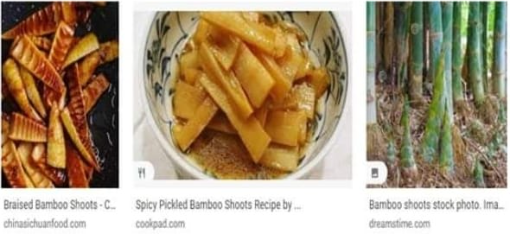
For food it is cooked as “labong,” baked bamboo shoots, braised bamboo shoots, spicy pickled bamboo shoots. Bamboo culm is used to make wine and beer. Bamboo leaves are used as food for livestock.


The special flavor of a fresh culm is used for cooking rice and fish. Bamboo is used for vegetable fruit garden stakes and hangers, pole to support banana trees, and as tobacco curing barns.


Bamboo is used for irrigation as poles carrying water. It is used as planter and container for rural food products, basket for crop harvesting, structure for animal cages, farm fence material, katig in boats, fish cages in fish ponds, and fish traps.

Bamboo takes many forms as crafts and rural home utensils, material for bridges in rural communities, and bahay kubo and resthouses. Bamboo wagons are used to transport farm goods. It is even used as a musical instrument, textile, and Christmas decor. (Melody Mendoza Aguiba)

ADB commissions SEARCA for 10-year agriculture modernization plan that needs a multi-trillion budget

August 17, 2022

The Asian Development Bank (ADB) has commissioned the Southeast Asian Regional Center for Graduate Study & Research in Agriculture (SEARCA) for a 10-year plan in an aim to catapult Philippines to be a major agricultural producer, probably a farm produce exporter.

This endeavor apparently aligns with the pronouncements of President Ferdinand R. Marcos Jr. about Philippines’ pursuing food security aims, even agriculture modernization, having himself taken on the task as secretary of the Department of Agriculture (DA).

SEARCA Director Dr. Glenn B. Gregorio told a press orientation that the “National Agriculture and Fisheries Organization and Industrialization Plan” has an indicate implementation schedule for 2021 to 2030.

The press orientation was in conjuction with the lauch of the SEARCA Hub for Agriculture and Rural Innovation for the Young Generation (SHARING) Cafe.

“We have already submitted our recommendations to the Department of Agriculture (DA),” said Gregorio.

The industrialization plan has a nine-point track to carry out:

  1. Consolidated production and post harvest facilities (commodity systems-oriented
  2. Construction of critical infrastrucutre spatially integrated within agri-fisheries industrial business corridors (AFIBCs
  3. Modernized food terminal facilities and similar facilities linked to transport nodes in urban and peri-urban areas.
  4. Smart irrigation and water impoundment or retention systems serving two or more commodities
  5. Other large-scale infrastructure (waste management facilities, fish ports, ICT (Information Communication Technology) including high-speed connectivity
  6. Scaled up mechanization and adoption of other commercial scale-oriented technologies
  7. Large-scale production and distribution of biologically safe technologies including biopackaging
  8. State-of-the art R&D (research and development) facilities linked to PAFES (province-led agriculture and fisheries extension systems) networks
  9. Development of agri-fishery enterprises and business incubation initiatives linked to large investors.


Gregorio said the 10-year industrialization plan requires a budget of P5.03 trillion.

“The budget should come from the public sector, P2.5 trillion, while the other P2.5 trillion will come from the private sector,” he said.

SEARCA itself has launched its own programs inspiring investments in the knowledge economy which taps on the economy’s intellectual resources in order to generate wealth.

For one, the SHARING Cafe provides for creative learning experience that can lead the young generation to contribute to farm industrialization.


SEARCA conducts sessions on Lego education robotics at its SHARING Cafe

“The SHARING Café is an interactive component of the SHARING innovation spaces, which aims to provide a creative learning experience geared towards Agriculture 4.0 in Southeast Asia,” said SEARCA.

“The SHARING Café will be an innovative venue for ‘play-to-learn’ activities for guests and fun learning modules for K-12 students in the beginner, intermediate, and advanced levels.” (Melody Mendoza Aguiba)

Amid imminent “food catastrophe,” government urged to support private businesses that invest 95% of agricultural production

May 25, 2022

The private sector has pressed government to bolster support for private businesses given the imminent “food catastrophe” arising from many global phenomena topped by the Russian invasion that compel food producers to ban export.

Russia, Ukraine, India, among others, have already stopped wheat exports while many other countries contemplate to keep their food production for their own security.

As such, Philippines faces food security threats, along with soaring food prices, because of its heavy food import dependence.

Philippine Chamber of Agriculture and Food Inc. (PCAFI) President Danilo V. Fausto said the private sector plays a critical role now that the country still lurks with travails from Covid 19.

“Government should provide the right environment and incentives for the private sector to invest, expand their production, value chain and supply chain logistics,” said Fausto at PCAFI’s first face-to-face assembly two years since the pandemic began.

“Government should not kill them with competition from cheap and subsidized imported products.”

While the Department of Agriculture (DA) has made importation its pivotal policy to produce food, this is a mere short term solution.

“Providing cheap food for the consumers and fighting inflation through imports is a short term solution. Producing our own food requirements, although a longer process, will be more sustainable for our people,” Fausto said.

The private sector provides 95% of the investments that bring about agriculture production, he stressed.

In the face of world hunger, the more should agriculture sector get a bigger share in budgetary increase even despite the country’s ballooning debt of P12.7 trillion.

“We appeal that food production should not be sacrificed as the Department of Budget and Management undertakes hair-cuts for future budget allocation.”

Livestock and poultry, contributing a third or 30% of agricultural production should get a sizable budget from only 3-4% of the DA budget.

With the supply of imported feed wheat now limited, local corn production should be raised. Corn supply is currently at measly 57% sufficiency level. Feed wheat is an alternative to corn which represents 60% of feed ingredients. Feed itself represents around 70% of cost in growing chickens and pigs.

Cheaper alternative to feed inputs should be tapped as those developed by Filipino scientists from University of the Philippines Los Banos.

DA should promote use of inorganic oil-based fertilizers, utilizing organic materials, resulting in equally high yield and efficient production of rice and other crops.

PCAFI expects ratification of the Philippine Livestock Industry Development Act.
It has repeatedly appealed for the establishment of a first border quarantine facility, undertaking food safety measures amid the debilitating African swine flu and fighting smuggling of agriculture products.

All tax revenues derived from imported commodities must be utilized to the same sector where it was generated to help develop the said industry.

If the Regional Comprehensive Economic Partnership (RCEP) is ratified, incentives should be given for export winners to expand jobs creation. More protection should be granted to losing products facing stiffer competition from imports.

“More products have to be supported to expand our variety of agricultural exports to bring in more dollars, We must not suffer the same fate from our painful lessons when we joined the World Trade Organization,” said Fausto.

“Appropriate laws were passed by Congress and the Senate. But the implementation of these laws were not done to keep our affected agriculture sub-sectors protected, compared to other countries like Vietnam and Thailand.”

PCAFI also presses government to implement the following long awaited programs.

  1. Establishment of reliable and real time data information system.
  2. Incentives to investments and easy access to credit and capital. Review of the implementation priorities of Philippine guarantee fund.
    Out of the total outstanding guarantee done by Philippine Guarantee Corp. (PGC) of ₱207 billion, only ₱500 million is for agriculture credit and ₱300 million for micro small medium enterpries (MSMEs).
    But a whopping ₱203 billion is allocated for real estate, benefitting big developers that do not need to be guaranteed by government.
    The farm sector also needs more the institutionalization of the use of warehouse receipts in guaranteeing credit which is a former function of the bankrupt Quedan and Rural Guarantee Corp.
  3. Rationalizing legal framework for the use of generic seeds for corn and balancing the use of organic fertilizers to reduce dependence on expensive oil- based inorganic fertilizers
  4. Accelerate effort to farm consolidation and clustering for mechanization and economies of scale. (Melody Mendoza Aguiba)