Poultry raisers denounced anew misleading DA claims, poultry imports shot up dramatically by up to 371%

June 16, 2020

Poultry raisers denounced anew government claims that “deboned” meat is not “locally available” and dismissed misleading data that imports dropped in 2020 as Bureau of Animal Industry (BAI) data showed it shot up 32% to 371%, including fully-finished whole chicken.

   The slowdown in import arrivals claimed by the Department of Agriculture (DA) in its website statement “Drop in poultry imports bodes well for local industry” is misleading.

   It was artificial as it was caused only by logistics problems due to the COVID 19 lockdown, showing a drop in imports volume from January to May.

   But newly-released actual BAI data showed cumulative imports from January to May 2020 of chicken cuts skyrocketed by a whopping 140.57% to 22,941 million kilos from only 9.536 million kilos in January to May in 2019.

   A perplexing data is the importation from the same period of whole chicken  at 545,406 kilos, a staggering 371.43% increase from last year.

   Imports of chicken leg quarters was at 43.445 million kilos for the first five months, a 45.21% increase.

   Total imported chicken products ballooned to 178.334 million kilos, an increase of 50.34% from 118.616 million kilos in the same period last year. 

   Imports of offals grew to 1.061 million kilos or by 32.97%.  Only fats and rind skin recorded decline in imports from January to May at 1.513 million kilos for fats, down by 11.68%.  Rind and skin dropped by 52.19% to 398,404 million kilos.

   Mechanically deboned meat (MDM) imports climbed to 108.428 million kilos, up by 45.21%.

Controversial “deboned” meat

   The importation of deboned meat is a major bone of contention as UBRA said in a fresh open letter to DA Secretary William D. Dar dated June 15, 2020 that this is available locally.

   Dar said earlier that DA and its attached BAI only allows importation of manufacturing inputs—mainly deboned meat–  for products needed by meat processors.

   But first, UBRA said in the letter that such chicken importation supposedly as “manufacturing input” has dragged down development of the poultry processing industry in the Philippines. The letter was signed by Lawyer Elias Jose Inciong, president, and Gregorio San Diego, chairman.
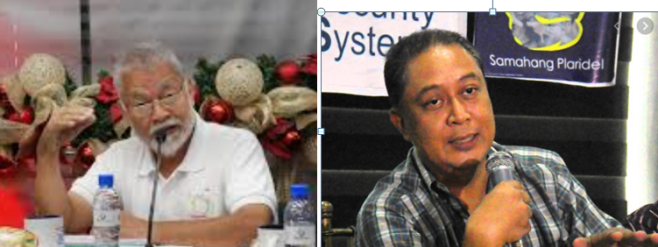

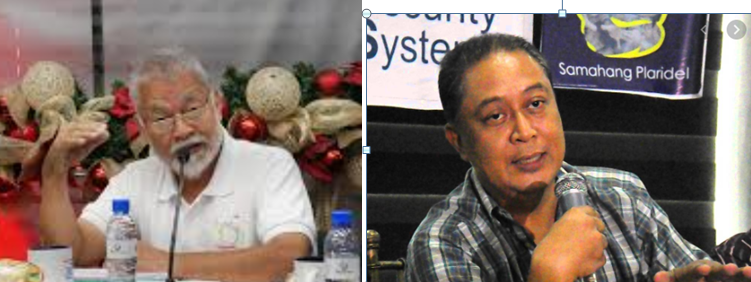
UBRA officials Gregorio San Diego, Elias Jose Inciong. Credit—DZMM, Tindig Balitaan sa Rembrandt

   Already, a major company has facilities to supply part of MDM requirements with assurance of quality.

   But instead of supporting MDM local production so as to develop the MDM industry and raise utilization of local chicken, DA-BAI has apparently supported imports.

   “The importation agenda and mindset prevented such a development.  There has been a significant increasing trend in both the total imports and the key composite items in the last five years.”

   It is a blatant attempt to distort the truth that DA and BAI refuse to accept that imports have threatened the industry and jobs of local farmers and poultry raisers.  That even as farmgate price of chicken collapsed to P30 per kilo during the COVID 19 lockdown.

   “BAI attempts to minimize the threat of imports by saying that 70% is MDM, fats, offals, and rind/skin used by industrial processors.”

Shutdown

   Worse, chicken imports in the past have already caused a shutdown of several broiler producers.

   Broiler producers Purefoods, RFM-Swift, General Milling, and Robina already closed due to losses.  Only San Miguel Corp. and Bounty Fresh have remained. 

   “Vitarich is back after suffering the ravages of importation and is now our member,” UBRA said.

   “This is the reason why we cannot accept the reasoning of DA especially BAI that imports are not threat much less a cause of the sufferings of the industry.  UBRA was born out of the struggle to survive such wrongheaded thinking.”  

Inaction

   Evidence of passive response and inaction of DA and BAI on serious concerns of poultry growers is so glaring.

    In an urgent situation as the COVID 19 crisis that sent poultry farmgate price to collapse down to P30 per kilo, it took DA and BAI to respond after three weeks just to call a meeting.  Its letter was on May 8; the meeting was on May 28.

   UBRA denied that a “miscommunication” between UBRA and BAI happened as a video of the meeting last May 28.

   “We never said that BAI gave an order to stop production. This is either a wicked spin by DA to muddle the public discourse or you were addressing other parties who have expressed their own sentiments.

   UBRA stressed DA and BAI’s pronouncements clearly sent a message to poultry producers to limit production.

   “We do not know how DA understands its recommendation to us that there should be “industry regulation on the level of production by each region or enterprise to prevent oversupply.” 

   “As chicken farmers, we understand this to mean as limiting our production to give way to imports as you feel helpless to stop it.”

Sacrificial lamb, technical smuggling

   The poultry sector has been sacrificed in the country’s attempt to protect the rice sector through Quantitative Restriction or QR (restricts volume of rice imports).  Tariff of MDM was offered (to WTO) to be cut to 5% for Philippines to retain the rice QR.

   Unfortunately, MDM is used in misdeclaration of products.

   Inciong and San Diego said Senate Committee Chairman Cynthia Villar supported UBRA’s plea for a suspension of imports upon finding out  MDM is a tool in technical smuggling.

   “Non-MDM items with tariffs of 40% were smuggled as were declared as MDM.  The committee also found that there was no assurance that MDM was being used properly.  The Food and Drug Administration said that the inclusion rate should only be 20%.  The National Meat Inspection Service stated that it was alright to use 40%. The processors answered that they were using it up to 80%.”

   UBRA wrote Villar a letter on May 17. The Senate office received evidence on technical smuggling from the Samahan ng Industriya ng Agrikultura .

Farmgate, retail price disconnect

   It is unfortunate that both DA and the Department of Trade and Industry (DTI) know the disconnect between retail prices and farmgate price of products.

   But they turn a blind eye in the knowledge that traders, not the farmers or consumers, enjoy the windfall profit, from low farmgate prices as these are not passed on to consumers.

   “Importers are happier if wholesale and retail prices are high because they will have more margins to pocket.”

Diseases

   UBRA also dismissed the position of BAI that they can only stop issuance of import permit if there are sanitary and phytosanitary (SPS) questions or threat of disease from animal imports that may infect local industry.

   The truth is “African Swine Fever is not a homegrown disease but an imported one. It is a major failure of BAI.”

   It was even Manila Mayor Isko Moreno that led the interdiction of the entry of illegal poultry and pork products from CHIna.  It was not DA-BAI despite its mandate on meat quarantine.

   “These all happened because of the absence of quarantine facilities at the customs border.  Stakeholders have lobbied long for its construction not BAI,” they said.

Traders’ price manipulation

   Importers have gain control over prices.  Because of dumping of cheap imports, local producers are compelled to reduce and stop operations.

   When that happens, shortage occurs, and importers take advantage of the opportunity to raise prices. 

   “This is what happened in the 2003 after the Great Glut of 2002.  Aside from the financial damage, imports have been the source of diseases which have decimated livelihoods in the across the countryside.”

Importers’ manipulation

   The government, in its absence of devotion to local farm producers, has been made to believe by importers that they are indispensable in satisfying consumers’ demand for cheap poultry meat. 

It refuses to recognize the truth  that the huge volume of import is the reason why farmgate price of poultry collapsed during the COVID 19 lockdown down to P30 per kilo.

   “Importers have the habit of cherry-picking high retail prices through the years to prove that they are necessary and indispensable. Look at what will happen to the consumers without us? They are blatantly silent on the very low farmgate prices which they cause that damage stakeholders throughout the value chain.  From corn farmers to the wet markets.”

Passive

   DA’s passive stance on protecting local farmers have relegated DA and agriculture as a less important industry in the Philippines.

   “The issues we have raised are about fundamental policies and mindset. It goes beyond the poultry sector.  It is probably the reason why DA is not a priority in the national budget. The absence of plans and what the Jesuits call modo de proceder, a way of proceeding, that engenders confidence in the system is the cause why we have been left behind by our peers.”

   UBRA said that Philippines does not even have to resign from the World Trade Organization (WTO) to promote its local industry.

   “Other countries have managed to develop under its rules.  It’s just that the mindset and priorities of their agricultural authorities are not as screwed up as ours.”

   “The WTO commitments have become an excuse to feign helplessness and, worse, to push for the agenda of the importers.  This attitude is scandalous in its particular unfairness towards the broiler industry.”  

Other agenda

   These are other concerns reiterated by UBRA in its June 15 letter to DA:

  1. UBRA affirmed the recommendation of Senate President Pro Tempore Ralph Recto that there is a surplus in poultry.

 “All of the three projections point to a surplus. If such is the case, why encourage imports? Kung 136 percent hanggang 183 percent ang chicken sufficiency forecast, bakit mag-aangkat pa?” Recto said.

   UBRA said Recto’s question “crystallizes the plight of the broiler industry.”

   “The pervading mindset at the DA is that it is helpless in the face of our WTO free trade commitments. It has become the perpetual excuse to do nothing and just leave farmers and producers to be slaughtered by commodities from countries with heavily subsidized agricultural systems.”

  •  UBRA has invoked a decision of  the late Senator Edgardo Angara, when he was DA secretary in 2000-2001, to suspend poultry imports upon knowing of dumping of these products.

   It was a time the poultry industry was at a “brink of collapse and had suffered enormous losses because of unfair competition from imports and smuggling.”

   “This was at the height of the ideological power of free trade as embodied by the WTO. An importer took him to court but the case did not prosper.  This is the reason why our members still vote for Senator Angara, the son, even though some of us are not always in agreement with him. We remember his late father.”

   Yet, present DA officials ignore these issues on huge trade subsidies and support of the US and other governments to their farmers.

     “Philippine agriculture has failed to flourish because the government has turned a blind eye to the subsidies and non-tariff barriers of developed countries.  The United States has had several Farm Bills to support both producers and consumers.  It is one of the reasons the Doha Development Round of the WTO failed.”

   Trade support is “anchored on the fundamental interests of the farmers and producers.”

    With full government budgetary and credit support, it has enabled “our peers in ASEAN to have successful agricultural sectors.”

   “Unfortunately for the Philippine broiler industry, after Senator Angara’s very brief tenure as Secretary, the importation agenda again dominated the policy landscape.” Melody Mendoza Aguiba
DA flooded with more petitions to stop import permit issuance for poultry, pork products as DA denies asking the sector to stop production

June 12, 2020

The Department of Agriculture (DA) was flooded Thursday by more petitions to stop chicken and pork importation, pleading this is the help farmers need most amid the “debilitating” COVID 19 crisis that threatens to render millions of Filipino jobless.

   In a joint statement, eight agriculture and related organizations appealed for DA and the Bureau of Animal Industry (BAI) to stop issuing import permits for chicken meat, pork, and processed products until the end of the year to allow poultry producers to survive. 

   Imports are causing a “ despicable” damage to “millions of Filipinos.

   “Allowing the importation of meat and limiting local production in this critical juncture will cause a stoppage in the operations of some farms.  Their production cannot be revived for another 12-18 months. One can just imagine the despicable damage this  could bring to millions of Filipinos reliant on the sector. We trust that this is not what the government wants,” according to the eight organizations.

   Signatory in the joint statement are Philippine Association of Feed Millers Inc. (Stephanie Nicole S. Garcia); Pork Producers Federation of the Philippines (Arch Edwin G. Chen); Philippine Maize Federation Inc. (Engr. Roger Navarro); Philippine Chamber of Agriculture and Food Inc. (Danilo V. Fausto); United Broilers and Raisers Association (Lawyer Elias Jose Inciong); National Federation of Hog Farmers Inc. (Chester Warren Y. Tan); Philippine Eggboard Association Inc. (Irwin M. Ambal); and Philippine Veterinary Medical Association (Corazon P. Occidental).

   “Helping our local meat producers and raisers, including feed millers and even feed crop planters, dealers, merchants, transporters, workers, and helpers, is the necessary steps in mitigating the debilitating impact of COVID-19 on the agricultural economy,” they said.

   The groups’ appeal comes after DA Secretary William D. Dar’s pronouncement Thursday that neither DA, nor its attached Bureau of Animal Industry” did not ask the poultry sector to “stop production.”

   Rather, Dar said in a press briefing Thursday that government is only allowing importation of  deboned poultry products that cannot be produced by local farmers.  Such processed products are imported as manufacturing input of meat processors, DA said.  

   However, the poultry raisers said “there is an abundant supply of live and frozen meat” to cater to the national demand.

   “To give way to meat importation means aggravating the already devastating impact that the stringent lockdown measures have brought upon to the local ecosystem.”

   Even the hog raisers asked for a similar cessation in importation of other livestock products. 

   “We humbly request that this importation stoppage be undertaken for the rest of 2020 to facilitate healing of our industry.  We will do our best to support our employees who have been working doubly hard to guarantee the constant supply of food to the Filipino people amidst this pandemic. The stoppage must not only cover poultry products but also other products of the rest of the livestock industry,” the agriculture producers said.

   “Government would be able to promote nation rebuilding by allowing local meat production to continuously flourish. As the local industry regains growth, millions of workers and raisers would be provided with jobs and income security. This industry has been historically resilient. (But) it needs an enabling environment to stay strong and capable, and continue providing for the people.”

   Gregorio San Diego and Lawyer Elias Jose Inciong of UBRA said in an open letter to Dar that they were surprised that a BAI official has asked them to limit production “to give space” to imports.

   The groups committed to DA to produce what is needed by Filipino consumers— that at a “fair” price to help other businesses flourish.

   “With the regeneration of our local food supply and capacity, our joint industry associations commit to government that we will be able to supply and secure the food cycle of the whole country, as what we have done even during the ECQ period.”
   “We are also committing fair market prices products to help our fellow business owners and  consumers recover with us and fight this global pandemic. A true Bayanihan is uplifting too the Filipino industries to thrive and flourish in this critical time. Let us all heal and recover together by caring for the Philippine agricultural economy.” Melody Mendoza Aguiba
Poultry sector opposes DA’s ‘bizaare’ import policy which is against Pres. Duterte’s food production augmentation policy

June 2020

The poultry sector has opposed  Department of Agriculture-Bureau of Animal Industry’s recommendation for more poultry imports as this “bizaare” policy is against upholding Filipino farmers’ welfare and is in contrast to President Rodrigo Duterte’s stance to boost local food production.

   It is strange that BAI is asking Filipino poultry producers to limit their production in order to “give way” to foreign producers.

   In an open letter to Department of Agriculture (DA) Secretary William D. Dar, the United Broilers and Raisers’ Association (UBRA), supported by the Philippine Chamber of Agriculture and Food Inc (PCAFI), has dismissed the claim of BAI that poultry imports are too “minimal” to hurt Filipino producers. 

   BAI is an attached agency of DA.

   “Imports are not a ‘mere threat.’ But it has caused actual damage in the last 25 years. The volume of imports need not be overwhelming to cause damage.  It only takes a relatively minimal volume to move farmgate prices from profit to loss as agricultural products are commodities,” said UBRA.

   The open letter was signed by UBRA Chairman Gregorio San Diego and Lawyer Elias Jose M. Inciong, UBRA president.  San Diego and Inciong stressed the letter is for “information on the challenges involved in the reform of the (DA-BAI) system.”

   Private farm sector group PCAFI lamented that DA hardly listened to the voice of Filipino poultry raisers.

   “PCAFI fully supports the complaint sent to Secretary Dar which is apparently not taken with serious attention and without considering the plight of the poultry industry. Food production is the main focus of the economic managers to recover from COVID-19.  But the people of DA  recommendi the opposite in favor of foreign producers,” said PCAFI President Danilo V. Fausto.

   Even more ironic, DA is supporting foreign farmers that are fully supported by their governments.

   “Prices of imports are low because these come from countries with subsidized agricultural system.”

      The Foreign Agricultural Service of the United States DA placed Philippines’ poultry imports at an increasing rate from 320,000 metric tons (MT) in 2018 to 345,000 MT  in 2019, and 390,000 MT in 2020.

   UBRA and PCAFI officials were invited to a virtual meeting last June 4 by DA-BAI regarding meat supply with high expectation that their pleading for suspension of poultry imports will be supported.

   They petitioned last May 4  for the immediate suspension of imports of poultry meat and poultry products.

   Unfortunately, the virtual meeting turned to be extremely frustrating as BAI asked the local poultry raisers to “self regulateand limit local production.”

   “In the kindest possible terms, this is one of the most bizaare thinking that ever emanated from DA. The incongruence is glaring.  At a time when the secretary of DA, together with the economic managers, is encouraging local production, BAI is telling a key industry to limit  production in order to give space to imports,” said San Diego and Inciong.

   Oddly, while BAI intends to deprive local poultry raisers of a better market right in the Philippines, it suggests to Filipino poultry to rather explore “exports.”

   “It is disappointing, to say the least, that BAI is pretending to be unaware of the competitive international market dominated by the United States, Brazil, and Thailand.”

   BAI, together with the National Meat Inspection System (NMIS), has gained prominence in accrediting importers and foreign meat establishments as suppliers with alacrity.”

   BAI never at all presented any serious plan to support exports. 

   “For exports to happen, an ecosystem must be established with the cooperation of government, academe, and private sector.”

   The private farm associations believe DA should have more competent animal industry officials who have the compassion and empathy for the plight of Filipino poultry raisers.

   “If the grievance lodged by UBRA is not immediately acted upon, I think Secretary Dar should find somebody else who can implement his vision and action plan for Philippine agriculture and follow the direction of President Rodrigo Duterte’s economic managers,” said Fausto.

   These are the other reforms asserted by UBRA-PCAFI:

  1. Urgent need for decentralization of functions at DA-BAI
  2. Reformatting of systems to simplify collection of tariffs and duties and simplify its reporting
  3. Address undervaluation through methods allowed by the World Trade Organization (WTO) on the regular comparison and publication of the composition and volume of exports.  This will compare data of BAI and Bureau of Customs.  This minimizes misdeclaration of products.
  4. Conduct studies on trade remedies not only for poultry and livestock sector but the entire agriculture sector
  5. Establish confidence in the trading of chicken meat by addressing alleged abuses in the implementation of Customs Bonded Warehouse 0% tariff privileges.  BAI and NMIS have not presented data on this for many years.
  6. Implement the Cold Chain-Ready Quarantine Facilities at Customs Border so that inspection can be done before the payment of tariffs and duties.  The  so called Second Border is a failure as it is a sham. The system is below international standards and has caused entry of diseases such as African swine flu, bird flu, and the smuggling of prohibited products like poultry products of China.
  7. Support for the corn sector and access to affordable yellow corn and feeds when there are no corn harvests. This is also to support poultry and livestock sectors that depends largely on feed for competitiveness.
  8. Address disconnect between farmgate and retail price through strict enforcement of the Price Act and a consumer subsidy program similar to that in the United States Farm Bill.

   “The need for reforms in DA and BAI is acute.  These reforms have never been more urgent than in the time of COVID 19.  These will assure stakeholders in the agriculture and fisheries sector that they will at last be given the chance to succeed and make a difference in the lives of people,” said San Diego and Inciong. Melody Mendoza Aguiba

Small Mindanao vegetable farmers, Dong Lieu starch farmer- processors in Vietnam now ‘agricultural clustering’ success models

June 1, 2020

Small Mindanao vegetable farmers and the Dong Lieu cassava starch farmer-processors in Vietnam have levelled up to global competitiveness, being now success models of “agricultural clustering” and of achieving efficiencies through ‘economies of scale.’

   The Mindanao farmers have raised income by 47% after having been aided by a project of the Australian Centre for International Agricultural Research (ACIAR) focused on organizing them to become somehow “big.”

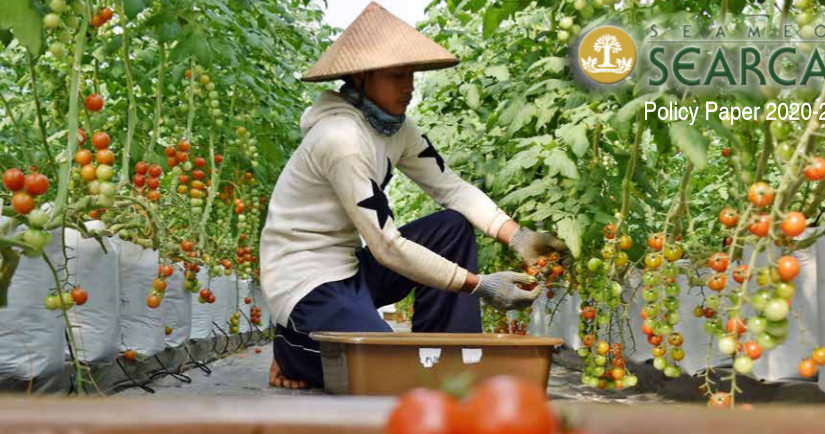
Tomatoes yield higher through technologies obtained from agricultural clustering

   The Catholic Relief Services was also an institutional support.

   The Mindanao model, along with the Dong Lieu Root Crop Center (DLRCC-Vietnam) and the Malaysian Rice Cluster (MRC) are also now success models of the more profitable agricultural clustering.

  This was reported by think tank Southeast Asian Regional Center for Graduate Study and Research in Agriculture (SEARCA) in a study authored by Dr. Glenn M. Gregorio and six researchers.

   “Small is beautiful.  But big is powerful,” said Gregorio, also SEARCA director.

   Upon having been organized, Mindanao farmers collectively raised their production for nine vegetables out of a total of 11 that they grow.

   The increased volume of produce was accompanied by an increase in value. 

   This is as the united group captured the market of institutional buyers— supermarkets, hotels, hospitals, restaurants, and fast food chains.

   Selling to these bigger customers became possible as the combined farmers had a bigger volume of produce.  This empowered them to negotiate for a higher price.

   They raised revenue from sweet pepper from (figures approximated) P27,000 when they were yet disorganized to P39,000 upon clustering; bitter gourd, from P5,100 to P13,000; squash, from P1,000 to P10,000; and eggplant, from P4,500 to P41,000.

   The other gainers were chayote, from P3,000 to P28,000; string beans, from P3,000 to P3,500; tomato, from 9,000 to P42,000; okra, and from 2,000 to 4,000.

   The winning was also true in terms of net income for each of the vegetables.  For  sweet pepper, bottomline recovered from a loss of (figures approximated) P11,000 to a positive earnings of P22,000; bitter gourd, from P2,000 to P9,000; squash, from a loss of P1,000 to a net income of P7,000. 

   For chayote, it was a leap of net gain from P1,000 to P27,000; string beans, from P1,000 to P2,000; tomato, from P4,000 to P24,000; and okra, from P500 to P2,000.

Clustered farmers are more productive, more powerful

   At the Dong Lieu Root Crop Processing Center in Vietnam, farmers succeeded as the cluster enabled them to produce h igher-valued, higher-priced cassava starch.     

   They used to just grow raw cassava and canna roots. Now they are not just farmers but food processors.

   “They extracted and processed the starch through grating, filtering, and sedimentation.  The  actors of the clusters extended from root crop producers, root crop traders, starch processors,” said SEARCA.

   Their association with each other empowered them to use technology in farming to produce bigger quantity of the root crops. 

   “It also introduced the use of equipment, such as mechanical filtration, root washer, water filters, and tiling of tank walls with ceramic tiles to improve quality. The diffusion of technology  were greatly influenced by the linkages built with local engineers.”

   The cluster became an organized group of not only farmers but root traders  (built links with cassava and canna production zones in other provinces; communal engineers (repaired old and built new machines); and residue collectors (collected root processing by-product from household processors).

   The other cluster players are fish/pig raisers (utilized by-product of residue collector in fish and pig production as feeds) and maltose processor  (purchased starch from household processors for maltose production.

   There are also candy manufacturer that make candy from maltose, starch refiners and traders, and canna noodle makers.

. In another success model, the Malaysian Rice Cluster  remained to be producers of the Asian staple— rice– before and after  organizing themselves.

   The difference that raised their productivity and competitiveness is knowledge transfer between farmers and the ability to produce more.  This was after having availed of credit from Agrobank.  They also received government subsidy.

      “(Knowledge transfer) pertains to  appropriate input use. Information was obtained through informal channels such as observation of good practices from neighboring farmers.  This also includes information about the prevailing market risk, source of inputs, and awareness of new technologies.”

   The Malaysian cluster was able to attract more winning stakeholders that support each other–  local enterprises and market, research and development agencies, financial institutions, government agencies, and other marketing firms.

   The success of these organized farmers were attributable to several factors, according to Gregorio and co-authors Rodolfo V. Vicerra, Rico C. Ancog, Nikka Marie P. Billedo,  Rebeka A. Paller, Ma. Christina G. Corales, and Imelda L. Batangantang.

   First, farmers were linked to each other.  They were able to share the same techniques and best practices in farming- exchanging innovation in production.

  Marketing-wise, they have been able to commit a fixed quantity and a level of quality of produce to institutional buyers that demand a bigger volume of quality supply.  Their ability to supply the quantity and quality enabled them to negotiate for the higher price.

   Small farms that are “clustered” to achieve economies of scale face vast economic opportunities from the globalized market—only if they are aided to organize.

   “There are 500 million small and medium farms worldwide, 87 percent of which are in Asia Pacific.  Majority  are in remote locations and are geographically dispersed, making it harder for them to access modern technology, services, and information. Their profit margin is negatively affected by the market intermediaries involved in the value chain who could take advantage of the farmers’ limited knowledge of the market.”

    “They face difficulty in entering bigger and overseas markets where they can sell their produce at a higher price.  They experience higher transaction costs due to changing preferences of the consumers, which resulted in different and new sets of standards and regulations set by larger firms. Smallholder farms lose competitiveness, relative to the commercial farms, due to difficulty in accessing financial institutions and modern innovations that would help boost their productivity.” Melody Mendoza Aguiba

COVID 19 to reduce agricultural production in Southeast Asia (MT) by 3.11%, 100.77 million farmers affected

May 21, 2020

COVID 19 is foreseen to substantially reduce by a significant 3.11% the volume of agriculture output in Southeast Asia (at 17.03 million metric tons or MT) for the first quarter of 2020 as a result of a decrease in farm labor affecting 100.77 million farmers. 

   This loss is equivalent to $3.76 billion or 1.4% in gross domestic product (GDP) for the Southeast Asian region, according to the Southeast Asian Regional Center for Graduate Study and Research in Agriculture (SEARCA).

   In a policy paper, “Impact of COVID-19 Pandemic on the Agriculture Production  in Southeast Asia: Reinforcing Transformative Change in Agricultural Food Systems,” SEARCA asserts that a unique balance must be achieved among Southeast Asian countries on two important goals—trade and food security. 

   It is understandable that countries would first think of its own food security before others. But a
“collective” enhancement of capacities leading to higher agricultural productivity is crucial.  It will benefit all ASEAN (Association of Southeast Asian Nations) countries, the paper of Dr. Glenn B. Gregorio, SEARCA director and Rico C. Ancog suggested.

   “While most of the efforts are targeted within a country, it would be critical that policies supporting trade in ASEAN must be strengthened to simultaneously support productive and inclusive agricultural systems that ensure food security in the region.”

   As COVID 19 has become a universal problem in ASEAN that requires a region-wide approach, more collaborations may be done via the platform of the ASEAN Economic Cooperation (AEC).

   Factors and actions that block more open trade flows and enhanced partnerships must be controlled.

   “Effective coordination mechanisms among countries to reduce trade and food insecurities both at the national and regional levels in the long-term must be continuously pursued.” Further studies are recommended on this collaboration.

   Agri-entrepreneurship, rather than considering farming as a mere job, must be supported through policies at the domestic fronts. 

Impact of COVID-19 Pandemic on Agriculture Production in Southeast Asia

   That would need to train and mentor significant number of a new breed of farmer-entrepreneurs, given that the average age of traditional farmers in the Philippines is 57-year old. It should include the youth, and especially women who usually take the the lead in a family’s food and nutrition aspects.

   In light of ongoing pandemic, this also urgently calls for a food policy on immune system-boosting, and the need for a COVID 19-controlling nutritional food orientation.

   “At the individual and household levels, information related to healthy diets and lifestyles, agricultural produce that are nutritious and rich in micronutrients, food preparation and preservation techniques, as well as waste management strategies must be made accessible.”

   Obviously, critical in this “transformative” food security policy is financing.

   Newbies in agriculture will be afraid to try a new business, risk-laden at that due to its vulnerability to changing climate.

   “As risks and uncertainties arise related to price volatilities, inclement weather, and climate-change related hazards that characterize farm production systems, there is a need to support (studies on) design of financial technologies for farmers,” said Gregorio and Ancog.

   That finance access includes more inclusive loans and and accessible insurance to assure farmers a reserve capital to start planting anew when calamities like typhoon strikes.

   Such innovative system of financial technologies need to be brain-stormed so that wider participation could be ensured

   The purpose is also to make financing of agricultural activities benefit a significantly larger scale of population.  This is to include middle class in urban areas that may engage in urban farming and more especially resource-poor communities in rural areas.

   Agriculture remains a major job-generating sector in ASEAN with 31% of combined population employed in agriculture.

   This is antithetical as the sector’s contribution to GDP has been decreasing.

   “Except for Singapore, Malaysia and Brunei Darussalam, at least 23% of total labor force of each of ASEAN countries has agriculture as its main source  of livelihood, and as high as 62% in the case of Lao PDR.”

   Regrettably, this is the sector where the poorest people and income inequality among the population in Southeast Asia are found.

  For a five-year period from 2015 to 2019, SEARCA noted 36 million people live below the international poverty line of $1.9 (approximately P100) per day.

   Poverty among farmers is blamed on many factors—“small farm holdings; problematic land and tenurial systems; limited availability of high quality seeds; pests and diseases; constrained access to farm inputs, irrigation, and recommended agricultural practices; weather and climatic hazards; environmental degradation; absence of sufficient safety nets and financial support; and lack of strong market institutions.”

    That poverty among farmers is not without severe consequences to food security and nutritional status of the region’s population.

   The COVID 19 lockdown, along with the poverty factors just cited, is further draining the number of agricultural labor force, dragging GDP lower.

   The COVID-19 constraints on transportation and people’s movement results in a 1.4% decrease in labor supply (International Policy Research Institute or IFPRI).

   “This decrease in GDP could mean more families being pushed below the poverty line. Poverty impacts in Southeast Asia could push an additional 14.68 million families to live below the $1.90 a day threshold thereby straining the region’s ability to meet its poverty eradication targets per Sustainable Development Goals (SDGs) in 2030 .”

  Moreover, as of 2019, there were 81.7 million undernourished population in South East Asia. The Philippines itself has critical undernourishment level – at around 15% of population as of 2017, placing third next to the most undernourished countries in ASEAN (Lao PDR and Cambodia).

   Nevertheless, the following transformations, among other recommendations, are reinforced to radically improve agriculture sector’s role in socio-economic development and in addressing poverty:

1.       Changing a mindset that “agriculture is mere production” into “agriculture is sustainable agribusiness.”

2.      Rather than thinking agriculture is highly dependent on government, a strong collaboration between private enterprises, the academe which is the center of innovation and technology, and government should be nurtured.  Here, government strengthens its role as an “enabler”.

3.      Value chain thinking (maximizing profit from producing just raw materials or value added products) is upgraded into “ecosystem thinking.”  Consumers’ or market needs are the central consideration in value adding and production.  Convenience and cost efficiency are achieved through digital transformations.

   “Consumers are now becoming more aware of the intricate link between what they have on their plates and the quantity and quality of farm production.  This could be capitalized to encourage more programs and budget allocation from governments as well as private initiatives related to agriculture, such as farm-based small-and-medium enterprises.” Melody Mendoza Aguiba

“Rethink” agriculture interventions as COVID-19 lockdown reduces number of farmers, their income, and GDP – SEARCA chief

 May 8, 2020

The government should “rethink” interventions in agriculture as the COVID-19 lockdown has further cut number of farmers and their income,  —resulting in depressed demand for goods, food insecurity, and declining Gross Domestic Product (GDP).

   Onto the second month of the lockdown, a decline in Philippines’ agricultural production is being placed at 2.97% due to a decrease in the number of farmers tilling the land.

   “Due to lockdown, mobility restrictions result to quantity reduction in farm labor.  If it continues longer, this would translate to reduction in agriculture productivity,” according to Dr. Glenn B. Gregorio, director of the Southeast Asian Regional Center for Graduate Study and Research in Agriculture (SEARCA).

   “The loss of income and economic slowdown would also result in decrease in demand, particularly among the farmers and farming families with no safety nets,” said the SEARCA chief over SEARCA Online Learning and Virtual Engagements (SOLVE) webinar on food security.

   The downturn in agricultural production is worsened by farmers’ limited access to farm inputs and markets to sell produce. 

   This has already resulted in profit losses and wastage of farm produce such as that in vegetable capital Benguet.

   Finally, the decrease in labor productivity due to COVID-19 could translate in reduction in GDP among ASEAN (Association of Southeast Asian Nations) countries.

   Reduction in GDP due to farm labor productivity decline is placed at 1.4% (although this decline may be applied on most ASEAN countries affected by COVID-19).

Dr. Glenn B. Gregorio, SEARCA chief, suggests an intensive collaborative approach to solving food security problems.

   Gregorio suggested a more collaborative approach in solving the food security problem.

   Collaboration should be intensified between government, industries, and the academe—the center and origin of many innovations and technology.

   “Our experience with COVID-19 highlights the importance of how we define food security. This becomes the basis of how we design programs and projects,” Gregorio stressed.

  Gregorio added that what is positive about the crisis from the pandemic is the increasing support of consumers as a result of their understanding between “what is on their plate and agriculture.”

   This is what government should capitalize on.

   Consumers have realized during the COVID-19 lockdown that if they do not support Filipino farmers and the farm sector, they will have nothing to eat—not the ideal nutritious kind everyone desires.

   Now everyone wants to turn to farming.

   “The agriculture sector could capitalize on this increasing support to identify several investments needed to strengthen the agriculture systems as food systems,” he said.

Massive Rice Imports

   An example may be on rice policy. 

   In the past, government has been threatened by imminent consumer protests against any high price in the staple.  Rice has become a political issue that compels government to come up with a food security policy with the fear that rice rationing may destabilize government; hence the massive rice importation.

   However, the liberalized rice importation has been pushing down local palay price.  If not complemented with appropriate safety nets program, this could send vulnerable farmers to avoidable poverty.  

   With present consumer support, government must expedite implementing more programs that also prioritize raising farmers’ income. 

   Reforms may zero in on producing value-added farm goods or consumer-demanded finished products.

Food security laggard

   As of 2019, the Philippines stood as one of the laggards in Global Food Security Index (GFSI) in ASEAN.  It placed fourth from bottom at around 60 points. 

   Other laggards are Lao PDR, Cambodia, and Myanmar which placed first to third from bottom.

   Those faring higher in GFSI among ASEAN countries are Singapore at  87.4 which was  reported by the GFSI March 2020 to be the most food secure in the world. 

   It was followed by Malaysia (73.8), Thailand (65.1), Vietnam and Indonesia (both 63 to 65).

   GFSI is a widely accepted metric in measuring food security based on food availability and affordability.

   While food availability and food affordability are two concerns, an underrated issue is nutritional security.

   It is a critical concern as Philippines was recorded to already have serious undernourishment level at around 15% of population as of 2017, making it the third most undernourished ASEAN country.

   “The highest prevalence of undernourishment (2017) in terms of percentage of the total population of a country was noted in Laos PDR (16.5%) and Cambodia (16.4%).Clearly, agriculture must not just aim for increased food production but also to improve the nutritional status of the population,” said Gregorio.

Five-Year Plan

   SEARCA under its 11th Five Year Plan (FYP) named these agenda  on Agriculture 4.0 which is a  concept of the future of agriculture focusing on use of technology for business efficiency.

    One is Open Innovation and Agri-Incubation. This entails partnering with the players and actors of the innovation community such as incubator houses, venture capital funders, universities, research institutions, as well as startups, small and medium enterprises, and corporations could support the goal of SEARCA.

  “While most startups are focused on developing digital technologies, incubators, and start-ups focused on Agriculture Research and Development technologies do not appear as popular in Southeast Asia,” said a SEARCA report.

Also on SEARCA’s agenda is Knowledge and Technology Transfer through an INtellecual Property Policy.

   SEARCA will also work with industry partners to implement Grants for Research Towards Agricultural Innovative Solutions (GRAINS) through four mechanisms: 1) Graduate Research with an Industry Partner, 2) Call for Research Proposals Based on Industry Need, 3) Engaging the Industry and the Youth in Promoting Agriculture and Rural Development, and 4) Academe-Industry-Government Interconnectivity.    

   Echoing the United Nations, Gregorio said food security is the combination of three elements:

   First is food availability which means food  must be available in sufficient quantities and on a consistent basis. It considers stock and production in a given area and the capacity to bring in food from elsewhere, through trade or aid. 

   Second is  food access  which means people must be able to regularly acquire adequate quantities of food, through purchase, home production, barter, gifts, borrowing or food aid.

   Third is food utilization which means consumed food must have a positive nutritional impact on people. It entails cooking, storage and hygiene practices, individuals ‘health, water and sanitation, feeding and sharing practices within the household.

  “Food stability has been added as a fourth pillar especially in consideration of the inherent exposure of Southeast Asia to weather and climate change-related hazards,” Gregorio said. Melody Mendoza Aguiba
P32 B economic stimulus package asked to be allocated for “productivity” and value added farm goods as livestock and fishery, logistics to enable recovery from Covid 19

May 5, 2019

The private sector has asked government to focus allocation of the P32 billion stimulus package for “productivity” and value-added farm goods such as livestock and fishery,  not just on rice and corn, to enable economic resurgence amid the Covid 19 crisis.

   In a letter to Congress’s ESRP (Economic Stimulus Response Package) chairperson, Rep. Joey Salceda and Agriculture Sec. William D. Dar,  the Philippine Chamber of Agriculture and Food Inc. (PCAFI) acknowledged the significant value of the P32 billion ESRP.

   Nevertheless, with the budget’s limitation compared to the gargantuan need in agriculture , PCAFI asserted the budget should primarily zero in on productivity even in livestock, fishery, export-oriented fruits and vegetables that bring higher income.

   “Focus should be on productivity, in time for the increasing demand and consumption towards the 3rd and 4th quarter of 2020, as a result of the grand stimulus package in order for the Philippine economy to recover,” said PCAFI President Danilo V. Fausto.

   “While the P 32.0 Billion proposed supplemental budget will be of tremendous help to enable the agriculture stakeholders to recover from the COVID-19 pandemic that brought havoc to the industry, we feel it is inadequate and might leave the exclusions of concerns not properly addressed.”

PCAFI led by Danilo V. Fausto (second from right) meets with Department of Agriculture Secretary William D. Dar (third from right)

   It is important to allocate budget for logistics to move fish and agriculture goods, not only in Luzon, but in Mindanao.

   “A lot of these products are wasted due to suspension of airline operation, difficulty in the land transport of perishable fruits, vegetables, fish, meat (specifically pork) and including fingerlings. Since these products are highly perishable, they need enhancement for cold chain support (refrigerated trucks),” said Fausto.

   Budget for artificial insemination (AI) in reproducing livestock and for controlling ASF (African swine flu) is also important.

   “There is an obvious slant towards rice and corn. Aside from rice, livestock, fishery and aqua need help. The ASF task force are running out of kits and lack veterinarians to monitor the livestock industry. There is a need to provide support on a consistent manner not only when disease outbreaks occur.”

   PCAFI also asked government to channel a P1.5 billion budget to more “value added” dairy, poultry, hogs, fisheries, and feed crops. 

   This P1.5 billion budget is originally proposed for urban agriculture and  protective personal equipment (P500 million each);  corn for food project (P300 million; and information, education and communications (P200 million).

   “We would like to recommend that portions thereof be transferred to dairy, poultry, hogs, fisheries, and feed crops. These sectors have been hit hard by the ECQ (enhanced community quarantine) with the closure or limited working hours of food outlets and will continue to suffer losses even under a GCQ (general community quarantine,” said Fausto.

   To maximize productivity that will generate higher income for farmers and enable them to contribute to higher GDP (gross domestic product), these are proposed by PCAFI under government’s “Ahon Lahat, Pagkaing Sapat (ALPAS) Kontra sa COVID-19“:

  • Programs that will encourage meat processors to use local supply, requiring minimum inclusion of local producers
  • Inclusion of stimulus budget for agricultural producers, processors and suppliers of raw materials for high value fruits, vegetables and other commodities for export and local markets
  • Programs to make corn (for animal feed) more competitive even during rainy season to ensure consistent supply and quality to the poultry or livestock sectors
  • Production of feed grade animal feeds including copra and coconut oil, palm oil, and production of fish oil and fish meal as an alternative to the imported soybean meal for protein content of feeds
  • Establishment of more laboratories to be accredited at strategic locations due to GCQ (General Community Quarantine) reason

   “Credit guarantees should be focused towards the agriculture sector where banks shied away due to the risk inherent to food production. Guarantees should also be provided for suppliers of inputs who provide credit to farmer producers especially the small and medium livestock owners majority of which are asking for a reprieve on their payables due to huge losses,” Fausto said

Equal attention should be provided in budgeting for the following.

  • Improvement of irrigation system
  • Fertilizers to sustain and increase crop and vegetable production
  • Start-up planning and showcasing of “Balik Probinsya” resettlement and inclusive agribusiness under government and private sector partnership
  • To encourage investment in rice production, the Philippine Crop Insurance Corporation should provide insurance “unconditionally” to palay producers guaranteeing the return of capital (at say P 45,000.00 per hectare) in case of natural calamities

   “Price support and subsidy should be provided to rice farmers guaranteeing minimum purchase price of palay at P17 per kilo.”

   This was reportedly the original breakdown for the P32 budget under which rice continues to take up the biggest chunk of the budget:

P 8.5 billion – rice resiliency project

P 7  billion – palay procurement fund of the National Food Authority

P 3 billion – expanded SURE Aid and recovery  (loan to farmers at zero interest)

P 3 billion – expanded agriculture insurance

P3 billion – social amelioration for farmers and farm workers

P 1 billion – upscaling of KADIWA ni Ani at Kita

P1 billion – integrated livestock and corn resiliency project

P1 billion – expanded small ruminants and poultry project; i)

P1billion– coconut-based diversification

P 1  billion- fisheries resiliency project

P 1 billion–revitalized gulayan

P 500 million – urban agriculture

P500 million– acquisition of protective personal equipment

P 300 million – corn for food project

P 200 M – information, education and communications project

   The letter was also sent to ESRP Cluster co-chairpersons, Rep. Sharon S. Garin and Rep. Stella Luz A. Quimbo, and Agriculture and Food chairperson Wilfrido Mark M. Enverga. (Melody Mendoza Aguiba)

Agri digitalization, e-agriculture, e-Kadiwa pushed as COVID-19 threatens food security, drags down farmers’ income


April 29, 2020

A new approach on digitalization, e-Agriculture and e-Kadiwa is being pushed by government and agriculture institutions as the global COVID-19 lockdown has threatened food security, dragging down farmers’ income.

   The Department of Agriculture (DA) will partner with Grab and other enterprises with online-driven platform in doing business as part of speeding up movement of food and agricultural products from provinces to consumers. 

   DA Secretary William D. Dar said this Tuesday in a webinar hosted by the Southeast Asian Regional Center for Graduate Study and Research in Agriculture (SEARCA).

   The three types of Kadiwa will all be technology-steered as delivery of goods is now available to consumers online through Grab, among others, and will just be expanded via “Kadiwa Express,” Dar said.

   The Kadiwa Express will use cloud and other information systems in tracking goods—possibly including RFID  (radio frequency identification)  that can monitor where goods are located while in transit or where the blockade in their transport happens.

   The “Kadiwa on Wheels” may similarly be able to track where the goods are needed and may become venues for consumers to buy food direct from farm producers.

   The “e Kadiwa” may enable consumers to order agricultural goods at their fingertips (cellphones and portable devices).

   Such digitalization will make food not only more available but affordable.

   The lockdown due to COVID-19 restricted delivery of food and agricultural goods, sending much volume to waste.  Worse, consumers suffer from higher prices due to supply logistics bottlenecks.

   “Because of COVID-19, food affordability, not only availability, becomes critical.  The threat (food affordability) is as real as hunger itself.  If the supply chain is disrupted, food produced in rural areas just go to waste,” said Dar.

   “Price stability, price affordability, is key to grow the economy.  We need to promote  digitalization of agriculture even in marketing.”

   SEARCA Director Glenn B. Gregorio said during the SEARCA webinar that despite the odds due to the global pandemic, the COVID-19 lockdown has opened opportunities for urban agriculture. 

   It is further opening up the agriculture environment to the envisioned Agriculture 4.0 which SEARCA plans to pursue under the11th Five Year Plan (FYP).

   Agriculture 4.0 is  a concept of the future of agriculture focusing on the use of big data, Internet of Things (IoT), precision farming, and disruptive agriculture for increased business efficiency (Proagrica). 

   It is unfortunate that COVID-19 has not only raised food price but also threatened nutritional security for Filipino consumers, said Gregorio.

  This becomes a critical concern as the Philippines was recorded to already have serious undernourishment level – at around 15% of population as of 2017, placing third after Cambodia (21%) and Laos (20%).

   Nevertheless, the global health crisis brings about  a change in perspective of consumers.  They have now become interested in urban agriculture—even producing their own food from their backyards—no matter how small.

   “Now everyone is interested in agriculture.  Consumers now appreciate the (connection between) the quality of food on their table and agriculture,” Gregorio said.

   The “new normal” where people are encouraged to “work from home” has prompted SEARCA to exercise its strength in conducting forums—even involving a large audience—via digital means.

   This in order to harness and distribute learning and knowledge in agriculture where SEARCA has expertise to benefit a greater number, not only farmers but also consumers and the economy.

   SEARCA, along with its partners, facilitates the distribution of high-quality seeds to not only provincial but city dwellers interested in urban farming. 

   SEARCA will beef up the supply of seeds of the DA and its attached agency Bureau of Plant Industry (BPI).

   The quality of seeds, Gregorio said, is the foundation of good soil cultivation and farming.

   BPI Assistant Director Gerald Glenn F. Panganiban said that since the COVID-19 lockdown started in mid-March, BPI has been flooded with calls from people requesting seeds and inquiring on urban farming.

   “We have never received more calls at BPI than what we receive now daily,” said Panganiban who also confesses to receiving a huge volume of email from interested urban farmers.

   Garry Hidalgo, Farmers’ Factory general manager, said in the same SEARCA webinar that no matter how small residences are, city dwellers are likely to find a space for urban farming. 

   He is in this webinar series to give tips on urban farming—including the use of portable or used containers as pot materials. Containers may be positioned anywhere in the house or even hung in windows and walls. 

   Dar said government eyes 10 to 15 percent of the area of Metro Manila for urban farming—beefing up  food security level in the National Capital Region.

   DA has started distributing seeds to the cities through local government units (LGU).  It has so far partnered with the LGUs of Quezon City and Manila on this project.

   DA is adopting new strategies for raising the country’s food security level which include the following plans:

1.       Lending via the Sure Aid program not only to individual farmers but to Small and Medium Enterprises (SMEs) at P10 million per SME payable in 5 years at 0 interest.

2.      Promotion of Small Brother Big Brother program that raises farmers’ cooperatives’ participation in value adding and export of agricultural goods. This is by tying them up with bigger companies that can enter contract growing agreements with cooperatives.  Economies of scale will drive private sector to invest more in agriculture.

3.      Training of young farm entrepreneurs and young farm technicians who will monitor and implement agricultural projects (teaching farmers proper fertilization).  DA will provide grant and startup fund for agri-entrepreneurship.

4.      Development of infrastructure—roads food terminals, irrigation, rain water harvesters.

5.      Supporting a “whole of nation” approach to making sure farmers in farflung rural areas have access to internet and technology through partnerships with the Department of Information and Communications Technology  (DICT).  Melody Mendoza Aguiba

Food security solution through “urban agriculture” seen as a “new normal” in a digital brainstorming webinar of SEARCA

April 27, 2020      

Agriculture experts are stirring interest in urban agriculture as a proposed “new normal” as an alternative food security solution in urban areas and will be the maiden subject at SEARCA’s digital brainstorming webinar.

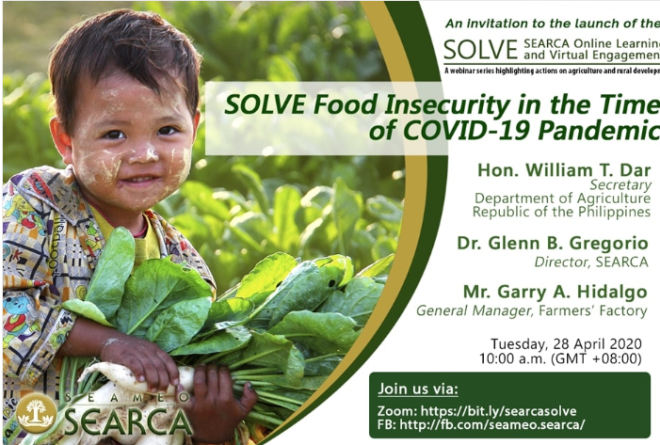
   To be held on Tuesday, April 28, 2020 at 10am via Zoom, the Southeast Asian Regional Center for Graduate Study and Research in Agriculture (SEARCA) envisions to widen citizens’ participation in solving an impending food security problem in urban areas.

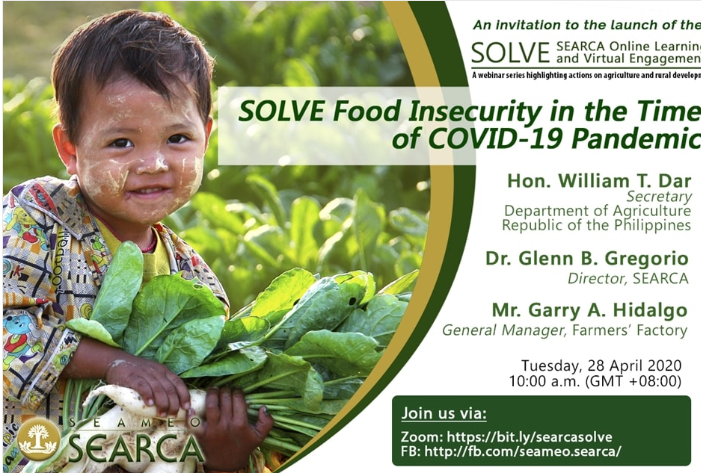
    The inaugural run of SEARCA’s SOLVE  (SEARCA Online Learning and Virtual Engagement) tackles food security amid the COVID-19 pandemic.
   As many parts of the world remain in lockdown due to COVID 19,  SEARCA brings discussions direct to its stakeholders and the general public via Zoom:  https://bit.ly/searcasolve or FB http://fb.com/seameosearca/

  “SOLVE IS SEARCA’s own way of channeling proven and tested solutions to a number of  problems in agriculture sector and farm operations,” said SEARCA Director Glenn B. Gregorio

   “Solutions to these problems actually abound so we are offering SEARCA as a gateway for these information to be made more accessible to farmers, farming families, and farmer organizations.”

   Dr. William T. Dar, Agriculture secretary, will elaborate on the “Plant, Plant, Plant” program as an extensive food problem solution even in farflung rural areas. .

   To provide concrete examples of what can be done at the farm level, Garry A. Hidalgo, general manager of Farmers’ Factory, will share specific urban agriculture approaches like containerized and modular farming strategies.

   The “new normal” brought about by the COVID-19 pandemic has firmed up SEARCA’s resolve to embark on new modalities and use technology-mediated platforms of interactions to effectively deliver valuable services to its stakeholders– farmers and the public.

   Gregorio himself will give a talk on  “Rethinking food security, Sowing seeds of curiosity: What, Where and How for the Philippines and Southeast Asia.”

   SOLVE will highlight concrete actions in the production, processing, marketing, retail, consumption of agricultural goods.

   “SEARCA will use its SOLVE webinar series as a venue to expound on the importance of transformational change to systemically revitalize agricultural systems and strengthen food systems,” said Gregorio. Melody Mendoza Aguiba

Intellectual property assets to boost investment in agriculture, uplift poor farmers in a new SEARCA program

SEARCA Director Glenn B. Gregorio advocates equal distribution of wealth in agriculture especially among marginalized farmers

April 17, 2020

Philippines-based  Southeast Asian Regional Center for Graduate Study and Research in Agriculture (SEARCA) is boosting  ownership of intellectual property (IP) assets to help prop up agriculture investments while ensuring broader based wealth distribution among “poorest of the poor” farmers.

   As IP assets encourage ownership of wealth, acquisition of IP assets by more farm technocrats, enterprises, and farmers’ cooperatives is part of the agenda in SEARCA’s 11th Five-Year Plan (11FYP).

   The Philippines still has very limited capacity to obtain IP assets—commercialization licenses, patents, copyright, trade secrets, trademarks—that hold tremendous value in creating wealth among new entrepreneurs.

   “SEARCA will formulate and establish its intellectual-property (IP) policy to ensure that product and technologies reach the intended and ultimate beneficiaries without much financial burden,” according to SEARCA’s 11thFYP.

   “Guided by this IP policy, SEARCA will facilitate licensing and transfer of technologies developed by universities to industry players to create products for the marketplace.”

   SEARCA Director Dr. Glenn B. Gregorio is advocating for adoption of Agriculture 4.0—a concept of the future of agriculture focusing on the use of big data, Internet of Things (IoT), precision farming, and disruptive agriculture  for increased business efficiency, according to Proagrica.

   “SEARCA will be a gateway to the future of agricultural development as it builds open innovation and open science spaces. These spaces will operate a platform—online and otherwise, systems or modular—of agri-innovations, sustained best practices, emerging agribusiness models, and smart disruptive solutions.”

   While tapping digital and technology for agriculture advancement, SEARCA is concerned about how benefits will be distributed equally, particularly among poor farmers as poverty remains prevalent among rural farmers in the Philippines, among other Southeast Asian (SEA) countries.

   One strategy of SEARCA in its new five-year plan to be implemented up to 2025 is to tap not only private enterprises but also mass-based, grassroots-based farmers’ cooperatives.

   “Cooperatives can be the best participatory organizational form that could effectively deliver the attainment of the Sustainable Development Goals (SDGs). SEARCA will contribute to providing access to new sources of capital that will allow them to grow and flourish.”

   “SEARCA will facilitate access of cooperatives to a new breed of talent that will lead and manage agribusiness enterprises as well as appropriate, safe breakthrough technologies.”

   Several projects of SEARCA have shown that while investments in agriculture has increased in the past decades among SEA countries, wealth distribution particularly among poor farmers has been limited.

  Such equitable distribution of benefits among the poorest farmers is viable via legal tools through policies that SEARCA also encourages to be adopted by government.

   “(Cooperatives will be a) leader in economic, social, and environmental sustainability. (Cooperatives are) the model of participation more preferred by people and the fastest growing form of enterprise.”

Dr. Glenn B. Gregorio, SEARCA director, pushes for adoption of Agriculture 4.0 toward digital and innovative farm practices

   For business and industry, formation of more public-private partnerships, new business models, and more innovative entrepreneurial ecosystems for new start-ups should be encouraged. 

   “Business and industry, together with SEARCA, will endeavor to invest mission-oriented efforts to enact the governance mindset change needed to balance the interests of business and society, considering social and institutional innovation to improve transparency, participation, and sustainability.”

   These are the other parts of the Agriculture 4.0 agenda in SEARCA’s five-year plan:

 1.      Open Innovation and Agri-Incubation.  Partnering with the players and actors of the innovation community such as incubator houses, venture capital funders, universities, research institutions, as well as startups, small and medium enterprises, and corporations could support the goal of SEARCA.

   “While most startups are focused on developing digital technologies, incubators and start-ups focused on Agriculture Research and Development technologies do not appear as popular in Southeast Asia.”

2.      Knowledge and Technology Transfer SEARCA (through IP Policy).

3.      Project Development, Monitoring and Evaluation.  SEARCA will implement Research Grants with Industry Partners – Grants for Research Towards Agricultural Innovative Solutions (GRAINS) through at least four distinct mechanisms: 1.) Graduate Research with an Industry Partner, 2.) Call for Research Proposals Based on Industry Need, 3.) Engaging the Industry and the Youth in Promoting Agriculture and Rural Development, and 4.) Academe-Industry-Government Interconnectivity.

   SEARCA crafted its five-year plan with these products and services in mind to be delivered by its programs:

 1. Development of next generation agriculture leaders and professionals;

2. Policy analysis and recommendations for the international, national, and local levels;

3. Economic, social, and technological knowledge creation in the agricultural ecosystem;

4. Program design, implementation, and support;

5. Just-in-time decision making support for decision makers; and

6. Incubation and innovation of new products, services, and business models.

   SEARCA is hosted by the Philippine Government under the Southeast Asian Ministers of Education Organization (SEAMEO), an intergovernment organization, with funding support from international and local partners for joint programs and projects. Melody Mendoza Aguiba