Small Mindanao vegetable farmers, Dong Lieu starch farmer- processors in Vietnam now ‘agricultural clustering’ success models

June 1, 2020

Small Mindanao vegetable farmers and the Dong Lieu cassava starch farmer-processors in Vietnam have levelled up to global competitiveness, being now success models of “agricultural clustering” and of achieving efficiencies through ‘economies of scale.’

   The Mindanao farmers have raised income by 47% after having been aided by a project of the Australian Centre for International Agricultural Research (ACIAR) focused on organizing them to become somehow “big.”
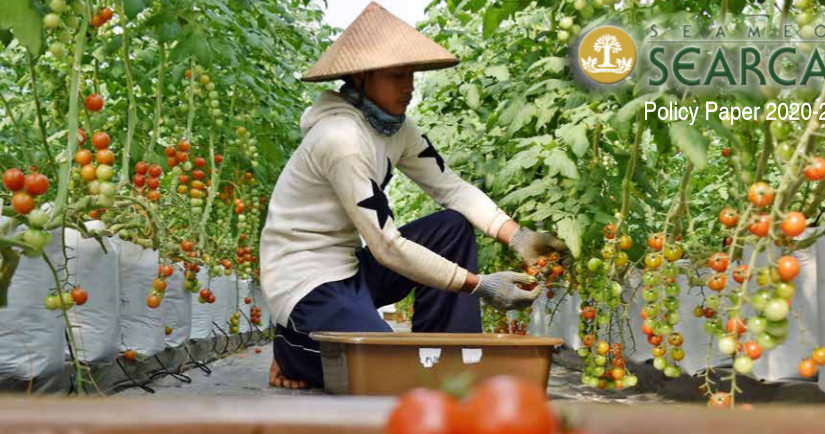
Tomatoes yield higher through technologies obtained from agricultural clustering

   The Catholic Relief Services was also an institutional support.

   The Mindanao model, along with the Dong Lieu Root Crop Center (DLRCC-Vietnam) and the Malaysian Rice Cluster (MRC) are also now success models of the more profitable agricultural clustering.

  This was reported by think tank Southeast Asian Regional Center for Graduate Study and Research in Agriculture (SEARCA) in a study authored by Dr. Glenn M. Gregorio and six researchers.

   “Small is beautiful.  But big is powerful,” said Gregorio, also SEARCA director.

   Upon having been organized, Mindanao farmers collectively raised their production for nine vegetables out of a total of 11 that they grow.

   The increased volume of produce was accompanied by an increase in value. 

   This is as the united group captured the market of institutional buyers— supermarkets, hotels, hospitals, restaurants, and fast food chains.

   Selling to these bigger customers became possible as the combined farmers had a bigger volume of produce.  This empowered them to negotiate for a higher price.

   They raised revenue from sweet pepper from (figures approximated) P27,000 when they were yet disorganized to P39,000 upon clustering; bitter gourd, from P5,100 to P13,000; squash, from P1,000 to P10,000; and eggplant, from P4,500 to P41,000.

   The other gainers were chayote, from P3,000 to P28,000; string beans, from P3,000 to P3,500; tomato, from 9,000 to P42,000; okra, and from 2,000 to 4,000.

   The winning was also true in terms of net income for each of the vegetables.  For  sweet pepper, bottomline recovered from a loss of (figures approximated) P11,000 to a positive earnings of P22,000; bitter gourd, from P2,000 to P9,000; squash, from a loss of P1,000 to a net income of P7,000. 

   For chayote, it was a leap of net gain from P1,000 to P27,000; string beans, from P1,000 to P2,000; tomato, from P4,000 to P24,000; and okra, from P500 to P2,000.
Clustered farmers are more productive, more powerful

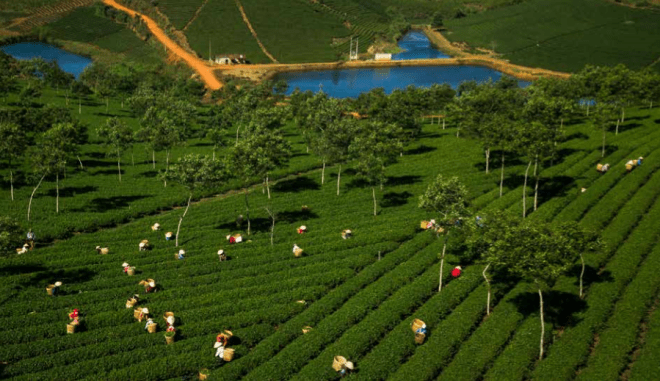
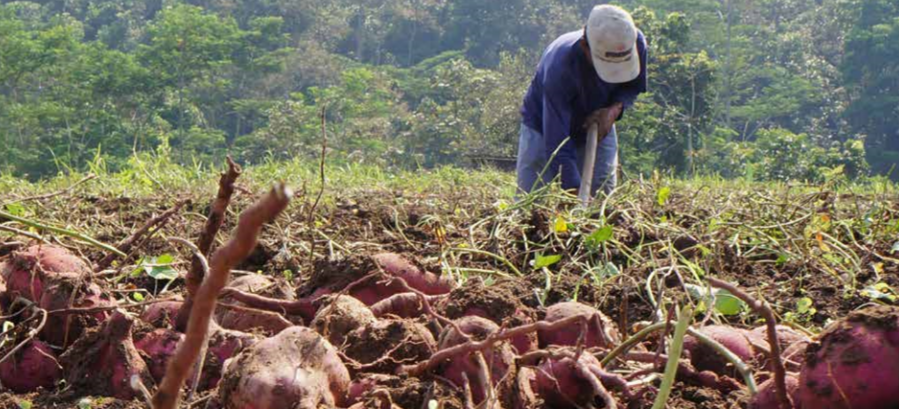
   At the Dong Lieu Root Crop Processing Center in Vietnam, farmers succeeded as the cluster enabled them to produce h igher-valued, higher-priced cassava starch.     

   They used to just grow raw cassava and canna roots. Now they are not just farmers but food processors.

   “They extracted and processed the starch through grating, filtering, and sedimentation.  The  actors of the clusters extended from root crop producers, root crop traders, starch processors,” said SEARCA.

   Their association with each other empowered them to use technology in farming to produce bigger quantity of the root crops. 

   “It also introduced the use of equipment, such as mechanical filtration, root washer, water filters, and tiling of tank walls with ceramic tiles to improve quality. The diffusion of technology  were greatly influenced by the linkages built with local engineers.”

   The cluster became an organized group of not only farmers but root traders  (built links with cassava and canna production zones in other provinces; communal engineers (repaired old and built new machines); and residue collectors (collected root processing by-product from household processors).

   The other cluster players are fish/pig raisers (utilized by-product of residue collector in fish and pig production as feeds) and maltose processor  (purchased starch from household processors for maltose production.

   There are also candy manufacturer that make candy from maltose, starch refiners and traders, and canna noodle makers.
. In another success model, the Malaysian Rice Cluster  remained to be producers of the Asian staple— rice– before and after  organizing themselves.

   The difference that raised their productivity and competitiveness is knowledge transfer between farmers and the ability to produce more.  This was after having availed of credit from Agrobank.  They also received government subsidy.

      “(Knowledge transfer) pertains to  appropriate input use. Information was obtained through informal channels such as observation of good practices from neighboring farmers.  This also includes information about the prevailing market risk, source of inputs, and awareness of new technologies.”

   The Malaysian cluster was able to attract more winning stakeholders that support each other–  local enterprises and market, research and development agencies, financial institutions, government agencies, and other marketing firms.

   The success of these organized farmers were attributable to several factors, according to Gregorio and co-authors Rodolfo V. Vicerra, Rico C. Ancog, Nikka Marie P. Billedo,  Rebeka A. Paller, Ma. Christina G. Corales, and Imelda L. Batangantang.

   First, farmers were linked to each other.  They were able to share the same techniques and best practices in farming- exchanging innovation in production.

  Marketing-wise, they have been able to commit a fixed quantity and a level of quality of produce to institutional buyers that demand a bigger volume of quality supply.  Their ability to supply the quantity and quality enabled them to negotiate for the higher price.

   Small farms that are “clustered” to achieve economies of scale face vast economic opportunities from the globalized market—only if they are aided to organize.

   “There are 500 million small and medium farms worldwide, 87 percent of which are in Asia Pacific.  Majority  are in remote locations and are geographically dispersed, making it harder for them to access modern technology, services, and information. Their profit margin is negatively affected by the market intermediaries involved in the value chain who could take advantage of the farmers’ limited knowledge of the market.”

    “They face difficulty in entering bigger and overseas markets where they can sell their produce at a higher price.  They experience higher transaction costs due to changing preferences of the consumers, which resulted in different and new sets of standards and regulations set by larger firms. Smallholder farms lose competitiveness, relative to the commercial farms, due to difficulty in accessing financial institutions and modern innovations that would help boost their productivity.” Melody Mendoza Aguiba

COVID 19 to reduce agricultural production in Southeast Asia (MT) by 3.11%, 100.77 million farmers affected

May 21, 2020

COVID 19 is foreseen to substantially reduce by a significant 3.11% the volume of agriculture output in Southeast Asia (at 17.03 million metric tons or MT) for the first quarter of 2020 as a result of a decrease in farm labor affecting 100.77 million farmers. 

   This loss is equivalent to $3.76 billion or 1.4% in gross domestic product (GDP) for the Southeast Asian region, according to the Southeast Asian Regional Center for Graduate Study and Research in Agriculture (SEARCA).

   In a policy paper, “Impact of COVID-19 Pandemic on the Agriculture Production  in Southeast Asia: Reinforcing Transformative Change in Agricultural Food Systems,” SEARCA asserts that a unique balance must be achieved among Southeast Asian countries on two important goals—trade and food security. 

   It is understandable that countries would first think of its own food security before others. But a
“collective” enhancement of capacities leading to higher agricultural productivity is crucial.  It will benefit all ASEAN (Association of Southeast Asian Nations) countries, the paper of Dr. Glenn B. Gregorio, SEARCA director and Rico C. Ancog suggested.

   “While most of the efforts are targeted within a country, it would be critical that policies supporting trade in ASEAN must be strengthened to simultaneously support productive and inclusive agricultural systems that ensure food security in the region.”

   As COVID 19 has become a universal problem in ASEAN that requires a region-wide approach, more collaborations may be done via the platform of the ASEAN Economic Cooperation (AEC).

   Factors and actions that block more open trade flows and enhanced partnerships must be controlled.

   “Effective coordination mechanisms among countries to reduce trade and food insecurities both at the national and regional levels in the long-term must be continuously pursued.” Further studies are recommended on this collaboration.

   Agri-entrepreneurship, rather than considering farming as a mere job, must be supported through policies at the domestic fronts. 

Impact of COVID-19 Pandemic on Agriculture Production in Southeast Asia

   That would need to train and mentor significant number of a new breed of farmer-entrepreneurs, given that the average age of traditional farmers in the Philippines is 57-year old. It should include the youth, and especially women who usually take the the lead in a family’s food and nutrition aspects.

   In light of ongoing pandemic, this also urgently calls for a food policy on immune system-boosting, and the need for a COVID 19-controlling nutritional food orientation.

   “At the individual and household levels, information related to healthy diets and lifestyles, agricultural produce that are nutritious and rich in micronutrients, food preparation and preservation techniques, as well as waste management strategies must be made accessible.”

   Obviously, critical in this “transformative” food security policy is financing.

   Newbies in agriculture will be afraid to try a new business, risk-laden at that due to its vulnerability to changing climate.

   “As risks and uncertainties arise related to price volatilities, inclement weather, and climate-change related hazards that characterize farm production systems, there is a need to support (studies on) design of financial technologies for farmers,” said Gregorio and Ancog.

   That finance access includes more inclusive loans and and accessible insurance to assure farmers a reserve capital to start planting anew when calamities like typhoon strikes.

   Such innovative system of financial technologies need to be brain-stormed so that wider participation could be ensured

   The purpose is also to make financing of agricultural activities benefit a significantly larger scale of population.  This is to include middle class in urban areas that may engage in urban farming and more especially resource-poor communities in rural areas.

   Agriculture remains a major job-generating sector in ASEAN with 31% of combined population employed in agriculture.

   This is antithetical as the sector’s contribution to GDP has been decreasing.

   “Except for Singapore, Malaysia and Brunei Darussalam, at least 23% of total labor force of each of ASEAN countries has agriculture as its main source  of livelihood, and as high as 62% in the case of Lao PDR.”

   Regrettably, this is the sector where the poorest people and income inequality among the population in Southeast Asia are found.

  For a five-year period from 2015 to 2019, SEARCA noted 36 million people live below the international poverty line of $1.9 (approximately P100) per day.

   Poverty among farmers is blamed on many factors—“small farm holdings; problematic land and tenurial systems; limited availability of high quality seeds; pests and diseases; constrained access to farm inputs, irrigation, and recommended agricultural practices; weather and climatic hazards; environmental degradation; absence of sufficient safety nets and financial support; and lack of strong market institutions.”

    That poverty among farmers is not without severe consequences to food security and nutritional status of the region’s population.

   The COVID 19 lockdown, along with the poverty factors just cited, is further draining the number of agricultural labor force, dragging GDP lower.

   The COVID-19 constraints on transportation and people’s movement results in a 1.4% decrease in labor supply (International Policy Research Institute or IFPRI).

   “This decrease in GDP could mean more families being pushed below the poverty line. Poverty impacts in Southeast Asia could push an additional 14.68 million families to live below the $1.90 a day threshold thereby straining the region’s ability to meet its poverty eradication targets per Sustainable Development Goals (SDGs) in 2030 .”

  Moreover, as of 2019, there were 81.7 million undernourished population in South East Asia. The Philippines itself has critical undernourishment level – at around 15% of population as of 2017, placing third next to the most undernourished countries in ASEAN (Lao PDR and Cambodia).

   Nevertheless, the following transformations, among other recommendations, are reinforced to radically improve agriculture sector’s role in socio-economic development and in addressing poverty:

1.       Changing a mindset that “agriculture is mere production” into “agriculture is sustainable agribusiness.”

2.      Rather than thinking agriculture is highly dependent on government, a strong collaboration between private enterprises, the academe which is the center of innovation and technology, and government should be nurtured.  Here, government strengthens its role as an “enabler”.

3.      Value chain thinking (maximizing profit from producing just raw materials or value added products) is upgraded into “ecosystem thinking.”  Consumers’ or market needs are the central consideration in value adding and production.  Convenience and cost efficiency are achieved through digital transformations.

   “Consumers are now becoming more aware of the intricate link between what they have on their plates and the quantity and quality of farm production.  This could be capitalized to encourage more programs and budget allocation from governments as well as private initiatives related to agriculture, such as farm-based small-and-medium enterprises.” Melody Mendoza Aguiba

“Rethink” agriculture interventions as COVID-19 lockdown reduces number of farmers, their income, and GDP – SEARCA chief

 May 8, 2020

The government should “rethink” interventions in agriculture as the COVID-19 lockdown has further cut number of farmers and their income,  —resulting in depressed demand for goods, food insecurity, and declining Gross Domestic Product (GDP).

   Onto the second month of the lockdown, a decline in Philippines’ agricultural production is being placed at 2.97% due to a decrease in the number of farmers tilling the land.

   “Due to lockdown, mobility restrictions result to quantity reduction in farm labor.  If it continues longer, this would translate to reduction in agriculture productivity,” according to Dr. Glenn B. Gregorio, director of the Southeast Asian Regional Center for Graduate Study and Research in Agriculture (SEARCA).

   “The loss of income and economic slowdown would also result in decrease in demand, particularly among the farmers and farming families with no safety nets,” said the SEARCA chief over SEARCA Online Learning and Virtual Engagements (SOLVE) webinar on food security.

   The downturn in agricultural production is worsened by farmers’ limited access to farm inputs and markets to sell produce. 

   This has already resulted in profit losses and wastage of farm produce such as that in vegetable capital Benguet.

   Finally, the decrease in labor productivity due to COVID-19 could translate in reduction in GDP among ASEAN (Association of Southeast Asian Nations) countries.

   Reduction in GDP due to farm labor productivity decline is placed at 1.4% (although this decline may be applied on most ASEAN countries affected by COVID-19).

Dr. Glenn B. Gregorio, SEARCA chief, suggests an intensive collaborative approach to solving food security problems.

   Gregorio suggested a more collaborative approach in solving the food security problem.

   Collaboration should be intensified between government, industries, and the academe—the center and origin of many innovations and technology.

   “Our experience with COVID-19 highlights the importance of how we define food security. This becomes the basis of how we design programs and projects,” Gregorio stressed.

  Gregorio added that what is positive about the crisis from the pandemic is the increasing support of consumers as a result of their understanding between “what is on their plate and agriculture.”

   This is what government should capitalize on.

   Consumers have realized during the COVID-19 lockdown that if they do not support Filipino farmers and the farm sector, they will have nothing to eat—not the ideal nutritious kind everyone desires.

   Now everyone wants to turn to farming.

   “The agriculture sector could capitalize on this increasing support to identify several investments needed to strengthen the agriculture systems as food systems,” he said.

Massive Rice Imports

   An example may be on rice policy. 

   In the past, government has been threatened by imminent consumer protests against any high price in the staple.  Rice has become a political issue that compels government to come up with a food security policy with the fear that rice rationing may destabilize government; hence the massive rice importation.

   However, the liberalized rice importation has been pushing down local palay price.  If not complemented with appropriate safety nets program, this could send vulnerable farmers to avoidable poverty.  

   With present consumer support, government must expedite implementing more programs that also prioritize raising farmers’ income. 

   Reforms may zero in on producing value-added farm goods or consumer-demanded finished products.

Food security laggard

   As of 2019, the Philippines stood as one of the laggards in Global Food Security Index (GFSI) in ASEAN.  It placed fourth from bottom at around 60 points. 

   Other laggards are Lao PDR, Cambodia, and Myanmar which placed first to third from bottom.

   Those faring higher in GFSI among ASEAN countries are Singapore at  87.4 which was  reported by the GFSI March 2020 to be the most food secure in the world. 

   It was followed by Malaysia (73.8), Thailand (65.1), Vietnam and Indonesia (both 63 to 65).

   GFSI is a widely accepted metric in measuring food security based on food availability and affordability.

   While food availability and food affordability are two concerns, an underrated issue is nutritional security.

   It is a critical concern as Philippines was recorded to already have serious undernourishment level at around 15% of population as of 2017, making it the third most undernourished ASEAN country.

   “The highest prevalence of undernourishment (2017) in terms of percentage of the total population of a country was noted in Laos PDR (16.5%) and Cambodia (16.4%).Clearly, agriculture must not just aim for increased food production but also to improve the nutritional status of the population,” said Gregorio.

Five-Year Plan

   SEARCA under its 11th Five Year Plan (FYP) named these agenda  on Agriculture 4.0 which is a  concept of the future of agriculture focusing on use of technology for business efficiency.

    One is Open Innovation and Agri-Incubation. This entails partnering with the players and actors of the innovation community such as incubator houses, venture capital funders, universities, research institutions, as well as startups, small and medium enterprises, and corporations could support the goal of SEARCA.

  “While most startups are focused on developing digital technologies, incubators, and start-ups focused on Agriculture Research and Development technologies do not appear as popular in Southeast Asia,” said a SEARCA report.

Also on SEARCA’s agenda is Knowledge and Technology Transfer through an INtellecual Property Policy.

   SEARCA will also work with industry partners to implement Grants for Research Towards Agricultural Innovative Solutions (GRAINS) through four mechanisms: 1) Graduate Research with an Industry Partner, 2) Call for Research Proposals Based on Industry Need, 3) Engaging the Industry and the Youth in Promoting Agriculture and Rural Development, and 4) Academe-Industry-Government Interconnectivity.    

   Echoing the United Nations, Gregorio said food security is the combination of three elements:

   First is food availability which means food  must be available in sufficient quantities and on a consistent basis. It considers stock and production in a given area and the capacity to bring in food from elsewhere, through trade or aid. 

   Second is  food access  which means people must be able to regularly acquire adequate quantities of food, through purchase, home production, barter, gifts, borrowing or food aid.

   Third is food utilization which means consumed food must have a positive nutritional impact on people. It entails cooking, storage and hygiene practices, individuals ‘health, water and sanitation, feeding and sharing practices within the household.

  “Food stability has been added as a fourth pillar especially in consideration of the inherent exposure of Southeast Asia to weather and climate change-related hazards,” Gregorio said. Melody Mendoza Aguiba

Agri digitalization, e-agriculture, e-Kadiwa pushed as COVID-19 threatens food security, drags down farmers’ income


April 29, 2020

A new approach on digitalization, e-Agriculture and e-Kadiwa is being pushed by government and agriculture institutions as the global COVID-19 lockdown has threatened food security, dragging down farmers’ income.

   The Department of Agriculture (DA) will partner with Grab and other enterprises with online-driven platform in doing business as part of speeding up movement of food and agricultural products from provinces to consumers. 

   DA Secretary William D. Dar said this Tuesday in a webinar hosted by the Southeast Asian Regional Center for Graduate Study and Research in Agriculture (SEARCA).

   The three types of Kadiwa will all be technology-steered as delivery of goods is now available to consumers online through Grab, among others, and will just be expanded via “Kadiwa Express,” Dar said.

   The Kadiwa Express will use cloud and other information systems in tracking goods—possibly including RFID  (radio frequency identification)  that can monitor where goods are located while in transit or where the blockade in their transport happens.

   The “Kadiwa on Wheels” may similarly be able to track where the goods are needed and may become venues for consumers to buy food direct from farm producers.

   The “e Kadiwa” may enable consumers to order agricultural goods at their fingertips (cellphones and portable devices).

   Such digitalization will make food not only more available but affordable.

   The lockdown due to COVID-19 restricted delivery of food and agricultural goods, sending much volume to waste.  Worse, consumers suffer from higher prices due to supply logistics bottlenecks.

   “Because of COVID-19, food affordability, not only availability, becomes critical.  The threat (food affordability) is as real as hunger itself.  If the supply chain is disrupted, food produced in rural areas just go to waste,” said Dar.

   “Price stability, price affordability, is key to grow the economy.  We need to promote  digitalization of agriculture even in marketing.”

   SEARCA Director Glenn B. Gregorio said during the SEARCA webinar that despite the odds due to the global pandemic, the COVID-19 lockdown has opened opportunities for urban agriculture. 

   It is further opening up the agriculture environment to the envisioned Agriculture 4.0 which SEARCA plans to pursue under the11th Five Year Plan (FYP).

   Agriculture 4.0 is  a concept of the future of agriculture focusing on the use of big data, Internet of Things (IoT), precision farming, and disruptive agriculture for increased business efficiency (Proagrica). 

   It is unfortunate that COVID-19 has not only raised food price but also threatened nutritional security for Filipino consumers, said Gregorio.

  This becomes a critical concern as the Philippines was recorded to already have serious undernourishment level – at around 15% of population as of 2017, placing third after Cambodia (21%) and Laos (20%).

   Nevertheless, the global health crisis brings about  a change in perspective of consumers.  They have now become interested in urban agriculture—even producing their own food from their backyards—no matter how small.

   “Now everyone is interested in agriculture.  Consumers now appreciate the (connection between) the quality of food on their table and agriculture,” Gregorio said.

   The “new normal” where people are encouraged to “work from home” has prompted SEARCA to exercise its strength in conducting forums—even involving a large audience—via digital means.

   This in order to harness and distribute learning and knowledge in agriculture where SEARCA has expertise to benefit a greater number, not only farmers but also consumers and the economy.

   SEARCA, along with its partners, facilitates the distribution of high-quality seeds to not only provincial but city dwellers interested in urban farming. 

   SEARCA will beef up the supply of seeds of the DA and its attached agency Bureau of Plant Industry (BPI).

   The quality of seeds, Gregorio said, is the foundation of good soil cultivation and farming.

   BPI Assistant Director Gerald Glenn F. Panganiban said that since the COVID-19 lockdown started in mid-March, BPI has been flooded with calls from people requesting seeds and inquiring on urban farming.

   “We have never received more calls at BPI than what we receive now daily,” said Panganiban who also confesses to receiving a huge volume of email from interested urban farmers.

   Garry Hidalgo, Farmers’ Factory general manager, said in the same SEARCA webinar that no matter how small residences are, city dwellers are likely to find a space for urban farming. 

   He is in this webinar series to give tips on urban farming—including the use of portable or used containers as pot materials. Containers may be positioned anywhere in the house or even hung in windows and walls. 

   Dar said government eyes 10 to 15 percent of the area of Metro Manila for urban farming—beefing up  food security level in the National Capital Region.

   DA has started distributing seeds to the cities through local government units (LGU).  It has so far partnered with the LGUs of Quezon City and Manila on this project.

   DA is adopting new strategies for raising the country’s food security level which include the following plans:

1.       Lending via the Sure Aid program not only to individual farmers but to Small and Medium Enterprises (SMEs) at P10 million per SME payable in 5 years at 0 interest.

2.      Promotion of Small Brother Big Brother program that raises farmers’ cooperatives’ participation in value adding and export of agricultural goods. This is by tying them up with bigger companies that can enter contract growing agreements with cooperatives.  Economies of scale will drive private sector to invest more in agriculture.

3.      Training of young farm entrepreneurs and young farm technicians who will monitor and implement agricultural projects (teaching farmers proper fertilization).  DA will provide grant and startup fund for agri-entrepreneurship.

4.      Development of infrastructure—roads food terminals, irrigation, rain water harvesters.

5.      Supporting a “whole of nation” approach to making sure farmers in farflung rural areas have access to internet and technology through partnerships with the Department of Information and Communications Technology  (DICT).  Melody Mendoza Aguiba

Food security solution through “urban agriculture” seen as a “new normal” in a digital brainstorming webinar of SEARCA

April 27, 2020      

Agriculture experts are stirring interest in urban agriculture as a proposed “new normal” as an alternative food security solution in urban areas and will be the maiden subject at SEARCA’s digital brainstorming webinar.

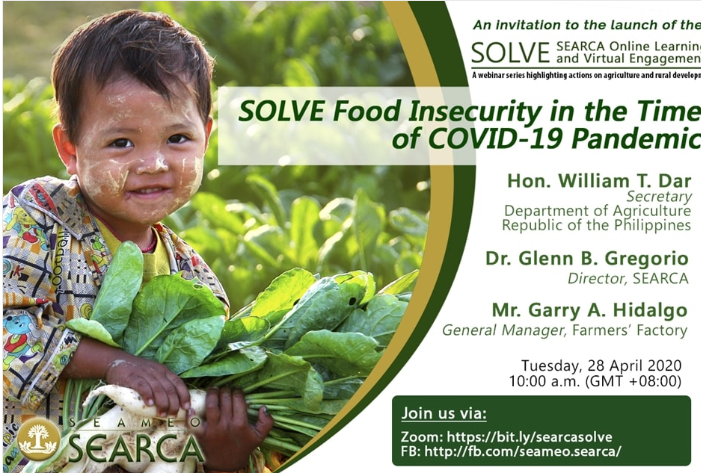
   To be held on Tuesday, April 28, 2020 at 10am via Zoom, the Southeast Asian Regional Center for Graduate Study and Research in Agriculture (SEARCA) envisions to widen citizens’ participation in solving an impending food security problem in urban areas.

    The inaugural run of SEARCA’s SOLVE  (SEARCA Online Learning and Virtual Engagement) tackles food security amid the COVID-19 pandemic.
   As many parts of the world remain in lockdown due to COVID 19,  SEARCA brings discussions direct to its stakeholders and the general public via Zoom:  https://bit.ly/searcasolve or FB http://fb.com/seameosearca/

  “SOLVE IS SEARCA’s own way of channeling proven and tested solutions to a number of  problems in agriculture sector and farm operations,” said SEARCA Director Glenn B. Gregorio

   “Solutions to these problems actually abound so we are offering SEARCA as a gateway for these information to be made more accessible to farmers, farming families, and farmer organizations.”

   Dr. William T. Dar, Agriculture secretary, will elaborate on the “Plant, Plant, Plant” program as an extensive food problem solution even in farflung rural areas. .

   To provide concrete examples of what can be done at the farm level, Garry A. Hidalgo, general manager of Farmers’ Factory, will share specific urban agriculture approaches like containerized and modular farming strategies.

   The “new normal” brought about by the COVID-19 pandemic has firmed up SEARCA’s resolve to embark on new modalities and use technology-mediated platforms of interactions to effectively deliver valuable services to its stakeholders– farmers and the public.

   Gregorio himself will give a talk on  “Rethinking food security, Sowing seeds of curiosity: What, Where and How for the Philippines and Southeast Asia.”

   SOLVE will highlight concrete actions in the production, processing, marketing, retail, consumption of agricultural goods.

   “SEARCA will use its SOLVE webinar series as a venue to expound on the importance of transformational change to systemically revitalize agricultural systems and strengthen food systems,” said Gregorio. Melody Mendoza Aguiba

Intellectual property assets to boost investment in agriculture, uplift poor farmers in a new SEARCA program

SEARCA Director Glenn B. Gregorio advocates equal distribution of wealth in agriculture especially among marginalized farmers

April 17, 2020

Philippines-based  Southeast Asian Regional Center for Graduate Study and Research in Agriculture (SEARCA) is boosting  ownership of intellectual property (IP) assets to help prop up agriculture investments while ensuring broader based wealth distribution among “poorest of the poor” farmers.

   As IP assets encourage ownership of wealth, acquisition of IP assets by more farm technocrats, enterprises, and farmers’ cooperatives is part of the agenda in SEARCA’s 11th Five-Year Plan (11FYP).

   The Philippines still has very limited capacity to obtain IP assets—commercialization licenses, patents, copyright, trade secrets, trademarks—that hold tremendous value in creating wealth among new entrepreneurs.

   “SEARCA will formulate and establish its intellectual-property (IP) policy to ensure that product and technologies reach the intended and ultimate beneficiaries without much financial burden,” according to SEARCA’s 11thFYP.

   “Guided by this IP policy, SEARCA will facilitate licensing and transfer of technologies developed by universities to industry players to create products for the marketplace.”

   SEARCA Director Dr. Glenn B. Gregorio is advocating for adoption of Agriculture 4.0—a concept of the future of agriculture focusing on the use of big data, Internet of Things (IoT), precision farming, and disruptive agriculture  for increased business efficiency, according to Proagrica.

   “SEARCA will be a gateway to the future of agricultural development as it builds open innovation and open science spaces. These spaces will operate a platform—online and otherwise, systems or modular—of agri-innovations, sustained best practices, emerging agribusiness models, and smart disruptive solutions.”

   While tapping digital and technology for agriculture advancement, SEARCA is concerned about how benefits will be distributed equally, particularly among poor farmers as poverty remains prevalent among rural farmers in the Philippines, among other Southeast Asian (SEA) countries.

   One strategy of SEARCA in its new five-year plan to be implemented up to 2025 is to tap not only private enterprises but also mass-based, grassroots-based farmers’ cooperatives.

   “Cooperatives can be the best participatory organizational form that could effectively deliver the attainment of the Sustainable Development Goals (SDGs). SEARCA will contribute to providing access to new sources of capital that will allow them to grow and flourish.”

   “SEARCA will facilitate access of cooperatives to a new breed of talent that will lead and manage agribusiness enterprises as well as appropriate, safe breakthrough technologies.”

   Several projects of SEARCA have shown that while investments in agriculture has increased in the past decades among SEA countries, wealth distribution particularly among poor farmers has been limited.

  Such equitable distribution of benefits among the poorest farmers is viable via legal tools through policies that SEARCA also encourages to be adopted by government.

   “(Cooperatives will be a) leader in economic, social, and environmental sustainability. (Cooperatives are) the model of participation more preferred by people and the fastest growing form of enterprise.”

Dr. Glenn B. Gregorio, SEARCA director, pushes for adoption of Agriculture 4.0 toward digital and innovative farm practices

   For business and industry, formation of more public-private partnerships, new business models, and more innovative entrepreneurial ecosystems for new start-ups should be encouraged. 

   “Business and industry, together with SEARCA, will endeavor to invest mission-oriented efforts to enact the governance mindset change needed to balance the interests of business and society, considering social and institutional innovation to improve transparency, participation, and sustainability.”

   These are the other parts of the Agriculture 4.0 agenda in SEARCA’s five-year plan:

 1.      Open Innovation and Agri-Incubation.  Partnering with the players and actors of the innovation community such as incubator houses, venture capital funders, universities, research institutions, as well as startups, small and medium enterprises, and corporations could support the goal of SEARCA.

   “While most startups are focused on developing digital technologies, incubators and start-ups focused on Agriculture Research and Development technologies do not appear as popular in Southeast Asia.”

2.      Knowledge and Technology Transfer SEARCA (through IP Policy).

3.      Project Development, Monitoring and Evaluation.  SEARCA will implement Research Grants with Industry Partners – Grants for Research Towards Agricultural Innovative Solutions (GRAINS) through at least four distinct mechanisms: 1.) Graduate Research with an Industry Partner, 2.) Call for Research Proposals Based on Industry Need, 3.) Engaging the Industry and the Youth in Promoting Agriculture and Rural Development, and 4.) Academe-Industry-Government Interconnectivity.

   SEARCA crafted its five-year plan with these products and services in mind to be delivered by its programs:

 1. Development of next generation agriculture leaders and professionals;

2. Policy analysis and recommendations for the international, national, and local levels;

3. Economic, social, and technological knowledge creation in the agricultural ecosystem;

4. Program design, implementation, and support;

5. Just-in-time decision making support for decision makers; and

6. Incubation and innovation of new products, services, and business models.

   SEARCA is hosted by the Philippine Government under the Southeast Asian Ministers of Education Organization (SEAMEO), an intergovernment organization, with funding support from international and local partners for joint programs and projects. Melody Mendoza Aguiba


National Taiwan University scholarship for aspiring agri technocrats-entrepreneurs

Taiwan tea farm. Credit: Tripstation

March 28, 2020

Aspiring Filipino agriculture technocrats or entrepreneurs have been granted a scholarship opportunity to hone skills at the National Taiwan University (NTU) in a country venue that leads  Asia  in agriculture modernization,-tourism, and technology.

   The Southeast Asian Regional Center for Graduate Study in Agriculture (SEARCA), in collaboration with NTU, has opened application for scholarship on an inaugural course, Master Program in Global Agriculture Technology and Genomic Science (ATGS).

   Dr. Glenn B. Gregorio, SEARCA Director., said the NTU-SEARCA Joint Scholarship Program for Global ATGS aims to cultivate agricultural professional talents, encourage academic excellence, and promote the research and development of agriculture within Southeast Asia.”

“The program also provides an opportunity for internship and field visits in line with NTU’s efforts to connect with industries and promote hands-on training. The program’s curriculum is interdisciplinary to develop global bio-agricultural talents that are responsive to the needs of the agriculture sector and with advanced knowledge and practical skills on contemporary agriculture,” said Dr. Maria Cristeta N. Cuaresma, SEARCA Program Head for Graduate Education and Institutional Development.

    Offered by the NTU International College, Dr. Cuaresma said the Global ATGS aims to provide a deeper understanding on smart farming technology, genome science research, and breeding science and technology.

   She added that keystone courses include global agriculture technology foresight, mathematical method for life science, and scientific writing.

   Under Digital Agriculture Technology, students will explore the application of blockchain technology in agriculture, process control for smart farming, plant factory, smart technology applied to livestock production, and agriculture waste treatment engineering.

   In Genome Science, discussions will be on genetics and genomics, crop genomic breeding, advanced plant molecular biology, core biotechnology: DNA, RNA, and protein, special topics in poultry production, and medicine and products processing.

   For Breeding Science and Technology, studies will be on the agriculture of Taiwan, introduction to bioinformatics, crop modeling, and plant phenotyping.

   The program is offered in English. It requires students to finish their thesis and at least 24 credits of coursework which includes 12 credits of compulsory courses and 12 credits of elective courses to earn the degree.

   Dr. Gregorio said prior to collaborating on this joint scholarship, SEARCA and NTU have worked together in other academic activities under the auspices of the Southeast Asian University Consortium for Graduate Education in Agriculture and Natural Resources (UC).

   SEARCA initiated the UC in 1989 and has since served as its secretariat, while NTU is a UC associate member.

   The opportunity is also open to other ASEAN (Association of Southeast Asian Nations) nationals– nationals of Brunei Darussalam, Cambodia, Indonesia, Laos, Malaysia, Myanmar, Singapore, Thailand, Timor-Leste, and Vietnam.

Agri think tank strengthens partnerships on School +Home Garden needed in crises like Covid 19

Agri think tank strengthens partnerships on School +Home Garden needed in crises like Covid 19

March 26, 2020

An agricultural think-tank has strengthened its partnerships on its “School Plus Home Garden Project” (S+HGP) as farming is evidently  a pressing need in light of crises like Covid 19 that poses critical food security concerns especially in urban areas.

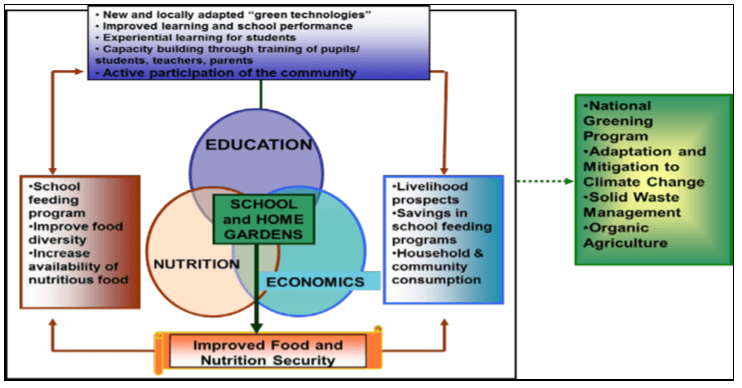
   While old school garden programs used to focus on just “educating” children on agriculture, the S+HGP of the Southeast Asian Regional Center for Graduate Study and Research in AGriculture (SEARCA) also stresses nutrition and economic and overall welfare of learners.

   Thus, its application includes homes even in urban areas that are faced with food security problems particularly in crises as the lockdowns. 

   Incidentally, lockdowns—when people could hardly go out of their homes just to buy food–  are implemented globally may lengthen indefinitely for a period of time.

   SEARCA is now replicating its S+HGP through partnerships, primarily with the Department of Education (DepEd).

   And this is open to other institutions even in urban areas that find it critically important to keep their own food gardens for food, sustainability—and many other purposes.

School+Home Garden model together with Department of Agriculture, DepEd, and LGUs

   In its pilot work on S+HGP in six schools in Laguna, SEARCA found out even parents of schoolchildren learned the multiple importance of home gardens.”

   “More than just establishing home gardens, the parents developed a greater sense of responsibility to ensure good nutrition for their children, while also saving on food expenses. It highlighted the multi-functionality of school gardens,” according to Blesilda M. Calub, Leila S. Africa, and Bessie M. Burgos—SEARCA resource persons.

   Such “multi-functionality” of great significance includes home gardens’ use to promote environmental sustainability, organic agriculture, edible landscaping, learning about climate change, and solid waste management (use of agricultural wastes as organic fertilizer).

   The S+HGP easily expanded. From the 6 pilot schools in Laguna, S+HGP is also now in 2 adopted schools, 23 sister schools, and 3 brother schools, according to the SEARCA officials, along with team members Henry M. Custodio, Shun Nan Chiang, Ann Gale C. Valles, Elson IanNyl E. gAling, and Maria Katrina R. Punto

   The S+HGP also stresses the important role in the local economy of local government units (LGU) that can provide funds for a more unified, LGU wide home gardening.

   “Plus in S+HGP promotes year-round production of nutritious food from both the school and home gardens… and (involving) LGUs to allocate funds, providing capacity building initiatives and services to maintain the school gardens or helping parents establish home gardens,” said SEARCA.

   SEARCA Director Dr. Glenn B. Gregorio said an important function of home and school gardens is in opening minds of the youth in making them appreciate farming or agri-preneurship as a potential career, business, or profession.

  Gregorio has pushed for SEARCA’s partnership with DepEd on including an agriculture subject or course into DepEd’s K-12 curriculum, particularly in senior high school, where youngsters are trained on technical-vocational skills.

   Under the pilot study, the SEARCA program aimed to increase diversity and availability of food to meet the nutritional needs of children, increase knowledge and improve skills of students, teachers, and parents on food production and nutrition, reduce food expenses, create savings, and provide an alternative source of income for families to alleviate poverty.

Multi functions of Home+School Garden Program

Pilot program results

   Under the pilot program, teachers learned to prepare cropping calendars, the sequence of plant specific crops based on good timing so harvest can be year-round. The top 10 most produced crops were mustard, pechay, okra, radish, lettuce, kulitis (amarathn), papaya, upo, patola, and talinum.

   These are other positive results of the program, according to SEARCA report:

  • The improved supply quality of fresh vegetables in the school-year studied had an estimated aggregate yield of 1,396 kilos valued at P42,559. Harvest per school ranged from 87-465 kilos depending on garden area with 19 to 77 percent used for school feeding, 0.5-36 percent shared with pupils and parent helpers, and 1-45 percent sold to other parents and teachers or cooked in class.
  • There were significant increases in height, weight, and Body Mass Index (of participating students), translating to 33 percent rehabilitation rate from wasted to normal nutritional status among the pilot elementary schools and 44 percent rehabilitation rate in the secondary school.
  •  There was an increase from 49 to 55 percent in the proportion for studetns who ate vegetables.
  •  The program became a venue for learning environmental sustainability. Topics included producing organic fertilizer from segregated biodegradable wastes, and mulching to protect soil from erosion, conserve soil moisture, control weeds, and increase soil organic matter for soil carbon build up. The mini-greenhouse provided by the project was designed with a rainwater collection system to showcase a simple climate-smart strategy to adapt to climate change.
Grade school pupils are able to eat nutritious vegetables, learn farming, and find work fulfillment from the School + Home Garden Program

Garden tools

   The S+HGP provided its participants garden inputs and tools,  a mini greenhouse with rainwater collection system for schools, garden inputs, and tools. From these, the schools produced vegetable seedlings year-round.

   “This used to be a major constraint because their practice of direct seeding exposed the seeds to too much rain, sunlight, or to insect pests. Capacity building for teachers included training on garden planning, edible landscaping, organic vegetable production and pest management, and vermicomposting,” SEARCA reported.

    In Alaminos, the pilot school was provided by the LGU with a vermicomposting shed.

   The S+HGP was funded by SEARCA and the Asian Development Bank-Japan Fund for Poverty Reduction through the SEAMEO College.

   Meanwhile, SEARCA’s K-12 curriculum program already prepares youngsters for a more in-depth professional agri-preneurship career.

   “The programs include faculty development — offering graduate scholarships in agriculture and allied degrees, short courses on agribusiness and agri-entrepreneurial mindset and education, and continuing education and professional licensure exams review services,” Gregorio said.

“The program shall embed upgraded agri-business context and examples in the K to 12 curriculum”.

   DepEd Secretary Leonor M. Briones said the DepEd will explore urban-based gardening for schools in urban areas like gardening on rooftops and pots.

“Make agriculture sexy like grafting. That is very interesting, kasi may (application) ng science iyan (Science has an application on that). Hindi ka lang nagtatanim at gumagawa ng (You are not just planting and making) organic fertilizers,” she added.

   Briones reported that there are existing schools with little farms and school sites bigger in size and even have tilapia farms.

   Gregorio said the Southeast Asian population is young — providing their respective countries many benefits because “they can become good leaders and the catalyst for economic, social, and cultural development” Melody Mendoza Aguiba

SEARCA pushes for favourable biotechnology regulations amid calls for Golden Rice permit revocation

Pro Vitamin A-rich Golden Rice. Image credit: International Rice Research Institute

December 30, 2019

ASEAN’s farm research center SEARCA is boosting support for  favourable agri-biotechnology regulatory policies amid local calls for the revocation of the commercial permit of pro-Vitamin A-rich Golden Rice.

   Believing agri-biotechnology will be key to food security and upliftment of farmers’ lives,   the Southeast Asian Regional Center for Graduate Study and Research in Agriculture said it has

 partnered with three expert groups for this program to boost expert knowledge in regulations on Living Modified Organisms (LMOs).   LMOs include farm products more known to be the controversial GMOs (genetically modified organisms).

   This is through the opening of the program “Second Asian Course on Agribiotechnology.”

   Despite safety questions on these biotechnology products, SEARCA deems it important to harness the fully potential of agri-biotechnology through “effective communication and science-based regulatory frameworks.”

   SEARCA Director and National Academician Glenn B. Gregorio, highlighted SEARCA’s important role in advancing science-based innovations to address poverty and food security.

   “We stand behind products of agribiotechnology that increase agricultural productivity to feed a growing population in the midst of dwindling natural resources and erratic changes in climate,” Gregorio said. 

   “Due attention must be given to our resource-poor farmers by providing them access to information, best practices, and new technologies that gives them a fighting chance to cope with the many challenges they face and to open up better opportunities for them and their families so that they can have better quality lives,” said Gregorio. 

   According to Dr. Mahaletchumy Arujanan, ISAAA Global Coordinator, “we organized this training program to bring our Asian stakeholders updated information and hands-on experience on agribiotechnology, exercises on food/feed safety assessment, and tips on strategic communication, and risk management and communication.” 

   This year’s Asian Short Course on Agribiotechnology gathers 25 participants from both public and private sectors of eight countries. These are China, Indonesia, Malaysia, Pakistan, the Philippines, Taiwan, Thailand, and Vietnam.  

   SEARCA’s partnership is with the International Service for the Acquisition of Agribiotech Applications (ISAAA), Malaysian Biotechnology Information Center, and Monash University.    

   The program focuses on Agribiotechnology, Biotechnology Regulation, and Communication. 

   While government has just approved permit for use for food, feed, and processing of Golden Rice, Greenpeace  has reportedly filed a petition for the permit’s revocation.

   Golden Rice has been questioned by interest groups due to the technology that inserted a gene into the grain that enables the staple to produce increased Vitamin A, helping reduce massive Vitamin A-deficiency (VAD).

    It is targeted at preventing blindness that develops in around 500,000 people, mainly children, yearly, reported the Golden Rice Humanitarian Board (GRHB)

   “Nearly nine million children die of malnutrion every year. Vitamin A deficiency (VAD) severely affects their immune system, hence it is involved in many of these children’s deaths in the guise of multiple diseases. Malaria deaths in children under five years of age has been linked with deficiencies in the intake of protein, vitamin A and zinc,” said the board.

   The rice technology will have huge economic impact for poor farmers as they no longer have to invest more into the seed.  The technology is being offered for free by humanitarian groups that helped its development. 

   Developers include Sygenta, the Philippine Rice Research Institute and International Rice Research Institute, among others.

   “The technology is built into each and every harvested seed, and does not require any additional investment. Let’s consider the potential of a single Golden Rice seed: a single plant will produce in the order of 1,000 seeds; within four generations or less than two years, that one plant will have generated seeds (amounting to more than 10to the twelfth power)”.

   “This represents up to 28-thousand metric tons of rice, which would be already sufficient to feed 100-thousand poor people for one year,” said the GRHB. Melody Mendoza Aguiba

Economists, rice leaders: Sustain rice tariffication, but guarantee farmers’ support, correct trade imbalances– rice hoarding, illegal trading, pricing; form farmer alliances

Dr. Glenn B. Gregorio (fifth from left), SEARCA director, leads forum on Rice Tariffication Law

December 4, 2019

Economists and rice sector leaders have pushed for mixed policy recommendations in light of the rice tarification law (RTL) — pressing for sustained implementation yet strong and “guaranteed” farmer support, or the RTL may turn to be “disastrous.”

   Safety nets for the protection of farmers are of prime importance as these apparently have not been installed as evidenced by farmers’ poor plight from palay’s collapsing price.    

   This has been raised during the “Regional Implications in the Philippines’ RTL” forum organized by the Southeast Asian Regional Center for Graduate Study and Research in Agriculture (SEARCA). 
   “The challenges we always face every cropping season relative to systemic barriers to farmers’ income  were not addressed head on in the RTL,” said Cresencio C. Paez, director of Asian Farmers Association for Rural Sustainable Development.

   “Safety nets for the protection of the farmers and consuming public were not taken into account concretely and strongly. A lot is said about promises. (But there is a need for) ‘guarantee’ of protection.”

   The challenges waiting to be addressed, Paez said,  amid the RTL’s implementation are “price volatility, land productivity, climate change’s effects, market power which involves cartel (traders hoarding rice) resulting in market abnormalities, governance, corruption, weak government agencies, and faulty extension delivery.” 

   “The RTL, if not well calibrated in its implementation, will be disastrous, and it is now happening this early,” said Paez at the SEARCA forum.

   SEARCA, in its mandate to help upgrade graduate education in agriculture in South East Asian countries, believes the vision toward a common ASEAN (Association of Southeast Asian Nations) market is steering farms to form regional alliances. 

   That leads to“promoting and strengthening intra-ASEAN trade.” A liberalized rice sector under the RTL regime readies Philippines   in such globalized trade,

   Dr. Glenn B. Gregorio, SEARCA director, said government should have a system by which the
“right price of the right rice” can be determined. 

   This has significant implication for both the farmers and consumers, Gregorio said.

   Farmers depend on the right price of rice for their income and livelihood.  Consumers likewise depend on the right price of rice for their economical consumption of the staple as an important factor in keeping a desirable standard of living.  

   The ASEAN Plus Three Emergency Rice Reserve (APTERR), designed to beef up food security in emergencies in among ASEAN countries, should be sustained, although threatened, with the RTL.

   Jansinee Kankaew of the APTERR Secretariat, said the National Food Authority (NFA)’ s function has been altered as a result of the RTL.  This may adversely affect implementation of APTERR. 

   Thus, the APTERR program should be maintained for emergency purposes amid the RTL, Kankaew said at the SEARCA forum.

   APTERR is a reserve fund of 787,000 metric tons (MT) contributed by ASEAN members for emergency use .  Philippines contributes 12,000 MT of rice for this reserve.

   Jerry E. Pacturan International Fund for Agricultural Development country program officer, said the RTL is in track in supporting rural transformation and modernization. 

   “It will foster better use of resources, higher productivity, farm consolidation, mechanization of the rice sector, and improved focus on suitable rice areas,” he said at the SEARCA forum.

   Nevertheless, government should have a “more responsive strategy” so that vision toward diversification of the agriculture sector will be a reality.  With diversified agriculture, farmers will be able to shift or add growing of more profitable high value crops—fruits and vegetables–  and earn higher income.

   “If resources are managed properly and government focuses equal attention on other high value crops that the country has competitive advantage in,  a highly productive, quality-oriented, product-differentiated, and modernized rice industry will improve agriculture performance,” said Pacturan.

   The country may even be able to export specialty and heirloom rice from upland farms, he said.

   Dr. Ramon L. Clarete of the UP School of Economics said that there has been initial shock as Philippines appears imported rice this year at a higher 10% of  total consumption.

   That is a significant jump compared to just 5-7% imports in previous years. 

   Yet this import percentage will likely no longer exceed 15%, Clarete said.

    This is as the rice sector steps up to demands of competitiveness as a result of the RTL

   “The import liberalization may cause higher productivity to local rice farms and efficiency along its local rice value chains– milling and logistics. We will retire those inefficient and marginal rice farms, and what’s left would be the efficient farms. Old rice mills would have to go.  Like Cambodia the remaining rice millers invest in modern rice mills and much larger storage and other post-harvest facilities,” he said.

   Clarete’s policy recommendation is for government to help facilitate alliances of farms in order to boost productivity.  This will help small farms to commonly achieve economies of scale.

   “The one-hectare farm household or so can still be part of the industry. The farm can actually boost its productivity if it joins an alliance of several others and get their aggregated farm managed professionally.” (Melody Mendoza Aguiba)