DA-BAI to implement P850 million livestock dispersal among coconut farmers under RA 11524, the trust fund managing coconut levy

December 1, 2023

By Melody Mendoza Aguiba

The Department of Agriculture (DA) is implementing an P850 million livestock dispersal program for coconut farmers in partnership with the Philippine Coconut Authority (PCA).

   In accordance with the Coconut Farmers Industry and Trust Fund Act (CFI-TFA) under Republic Act 11524, DA will start dispersing chicken, native pigs, and goats perhaps toward the end of the year. 

   This is in support of coconut farmers, coconut industry in general, who are the intended beneficiary of the coconut levy fund that is now under the management of the Coconut Farmers Industry Trust Fun).

   Dr. Rene C. Santiago of the DA-Bureau of Animal Industry said during the Animal Health Congress that the budget for the livestock program stands at P166 million or thereabouts per year for five years. It totals to around P850 million over five years.

   “It is now under process with the procurement.  There is already a supplier for chicken, native pigs and goats,” said Santiago.

   The five-year program will make a significant difference in the lives of coconut farmers who own or tend not more than five hectares of coconut farms as per the CFI-TFA. 

   “We  in DA’s Livestock Group and with the leadership of Secretary (Francisco) Tiu Laurel all follow the same mission to help raise income of farmers among whom coconut farmers are the poorest.  Teaching them how to raise animals will make so much difference in their ability to earn income for their families,” said DA Undersecretary Deogracias Victor B. Savellano.

   Beneficiaries who are now being identified by PCA also include leaseholders or tenants who till coconut on not more than five hectares.

   Farm laborers, whether occasional or itinerant, who are harvesting coconuts or work in the processing of copra as a major means of livelihood are also beneficiaries.   

   Santiago said that since the program will be implemented by DA-BAI, the potential for successful adoption of animal raising technology even among coconut farmers is high.

   “We are already integrating training of coconut farmers on how to raise animals.  Farmers need to sign a form, and they need to declare that they have undergone trainings and seminars in order to start an animal raising business,” Santiago said.

   Local government veterinarians forming the Provincial, City, Municipal Veterinarians League of the Philippines (PCM-VLP)  have observed that many livestock dispersal programs of government have failed. 

   This is apparently due to the absence of support systems to help crop farmers run livestock and poultry businesses.

   “They should involve us provincial  veterinarians from the very beginning so we may hold trainings and seminars even before farmers start raising animals.  What has been happening is we are called when there is already a problem (animals get sick).  This is so that we won’t waste our resources when animals die before we come in,” said Dr. Mary Grace Bustamante during the Animal Health Congress.

   The livestock program is set now for just five years in line with the DA’s mandate to raise livestock production during the term of President Ferdinand R. Marcos Jr.  However,  the trust fund itself extends to 50 years. 

   As such, the trust fund could help sustain a long term livelihood enhancement program for farmers who may continue to integrate livestock raising in their coconut farming.  

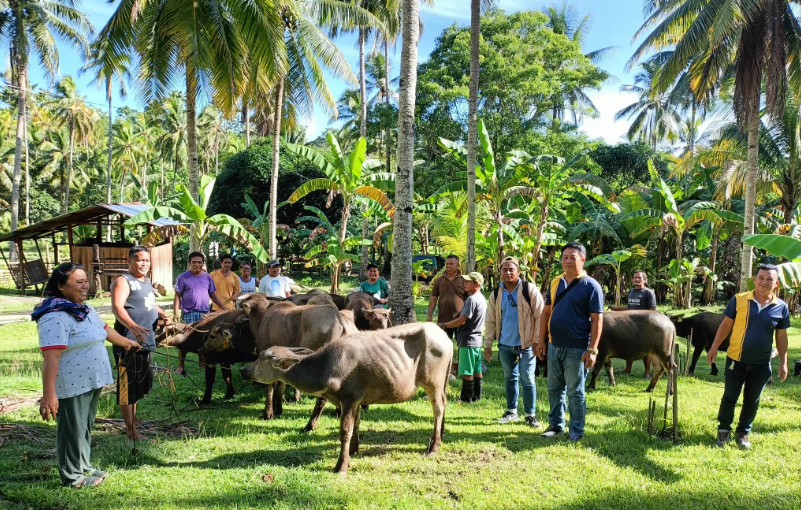
PHOTO Farmers receive carabao dairy under a Department of Agriculture program

DA throws support for Anti-Agricultural Economic Sabotage Act

November 30, 2023

The Department of Agriculture (DA) has thrown its support for the Anti-Agricultural Economic Sabotage Act as it sought collaborators in the fight against illegal tobacco trade that brings P25 billion yearly in foregone revenue for government.

   DA Undersecretary Deogracias Victor B. Savellano said Senate Bill 2432 should be immediately approved to help eliminate illegal trade and smuggling of tobacco and other agricultural produce.

   Illegal tobacco trade even has serious impact against the health of minors.

   “It may worsen the country’s problem on smuggling. Illicit tobacco trade reduces the effectiveness of public health policies designed to discourage smoking, with unregulated, substandard quality and non-compliant products.  It makes it easier for minors to access tobacco products and undermines the legitimate industry’s business,” according to SB 2432.

   The livelihood of thousands of Filipino farmers is adversely affected by illegal agricultural trade. 

   Among these are farmers belonging to Philippine Tobacco Growers Association (PTGA) and the National Federation of Tobacco Farmers Association and Cooperatives (NAFTAC) which are lobbying for the bill’s passage.    PTGA and NAFTAC has membership base of around 50,000 farmers.

   Speaking at the “Anti-Illicit Trade Interagency Dialogue: Protecting National Economic Interests through Greater Synergy and Cooperation,” Savellano said DA needs collaborators in this seemingly unsurmountable task of fighting illegal trade. 

   “Combating such highly organized crime requires substantial resources, specialized skills, effective inter-agency cooperation which can be difficult to coordinate and sustain,” he said.    

   “Illicit tobacco trade often involves the movement of products across international borders, making border coordination and cooperation within the country’s jurisdiction  essential.”

   Adequate investment in training programs, modern technology, and sufficient staffing levels is crucial to enhance the capacity of these agencies to combat illicit trade effectively.

   Senator Cynthia Villar, in her sponsorship of the Senate bill, cited Samahang Industriya ng Agrikultura or SINAG. The farmers’ group indicated that government loses P200 billion yearly in revenue due to smuggling.

   The Senate bill amends the Anti-Agricultural Smuggling Act of 2016 or Republic Act No. 10845.

   “With no conviction made seven years after the Anti-Agricultural Smuggling Act the, law is a failure at the hands of the Bureau of Customs (BOC). It’s been seven years and there is not a single conviction,” she said.

   “Smuggling brings about unfair competition for locally produced goods because it floods the market of cheaper agricultural products.  It puts undue risk to our consumer’s health.  It encourages corruption and threatens the rule of law.”

   Aside from tobacco, illegal trade involves sugar, corn, pork, poultry, garlic, onion, carrots, fish, and cruciferous vegetables, according to the Southeast Asian Regional Center for Graduate Study and Research in Agriculture.

   The Euromonitor reports that 16.7 percent or about 9.52 billion sticks of the total cigarette volumes sold in the Philippines comes from illegal sources as of 2022.

   “Most illicit cigarettes are shipped from Cambodia, Vietnam, and China, and enter through Sulu and Tawi-Tawi,” said Villar’s sponsorship statement.

   Illegal trade destroys tobacco industries in in Ilocos Norte, Ilocos Sur, Abra, La Union, Pangasinan, Isabela, Cagayan, Nueva Vizcaya, Quirino, Tarlac and Occidental Mindoro.

   It competes with the produce of at least 2.1 million people, including more than 430,000 farmers, farm workers and their family members.  (Melody Mendoza Aguiba)

Local livestock and poultry production targeted to increase 5x, imports to be minimized as a Marcos legacy

September 30, 2023

Melody Mendoza Aguiba

The Department of Agriculture (DA) will raise by five times in five years the local production of livestock and poultry which will be a Marcos legacy that reverses any record of excessive importation in order to benefit Filipino farmers.

   As a marching order from President Ferdinand R. Marcos Jr, also DA secretary,  government will pursue all means to raise livestock and poultry production to achieve food security, according to DA Agriculture Undersecretary Deogracias Victor B. Savellano.  This will go along with raising farmers’ profit and lowering farm product prices while ensuring availability of sources of protein for consumers.

   At the Poultry Forum 2023, Savellano said that as food security is national security, raising local agricultural production will be prioritized.  It will be realized through a consultative approach to governance.

   “Recommendations from various sectors of our agriculture is currently being heard and studied on what, where, and how government actions are to be applied to boost our poultry sector,” he said.

   “We have started to meet  with stakeholders to strategize a common direction and priorities in order to significantly increase our local food production,  making it efficient, robust, and profitable for farmers.”

   The same assurance of a consultative governance was given by Savellano during an earlier convention of the National Federation of Hog Farmers Inc.

   “We will find ways to produce more to lessen importations.  By consulting with livestock associations on how much each sector can produce, (we will know) the actual demand.  It will be the consideration in determining the minimal quantity” of imports.

   Importation in previous years has brought huge opportunity losses for the local poultry industry.  DA aims to reverse these losses into gains.     

   Chicken meat importation has been consistently rising from 45.772 million kilos in 2008 to 67.264 million in 2009, 101.957 million in 2010, 127.227 million in 2011, and 411.069 million in 2022.

   United Broilers and Raisers Association (UBRA) Chairman Gregorio San Diego said during the same poultry forum that direct impact of this importation is displaced local production totalling to a whopping P58.286 billion (299.366 million broilers).

   Displaced too are 315.122 million day old broilers amounting to P9.138 billion and 2.52 million broiler breeders valued at P756.294 million.  Lost sales from byproducts (head, feet, intestine, blood) totals to P5.987 billion.

   Importation brings lost direct labor totalling to 31,512 at one caretaker per 10,000 broilers and lost jobs in feed milling, trucking, and dressing plants.

   Lost feed sales totals to P4.877 billion.  Lost feeds ingredient sales totals to P11.89 billion (corn); P8.154 billion (soya); P4.478 billion (coconut oil); and P1.132 billion (rice bran).

   There is also opportunity loss for veterinary products (disinfectants, vaccines vitamins, antibiotics), P3.623 billion.  Dressing plants have lost business of P2.993 billion.

   In order to achieve the goal of raising local food production, these are among strategies DA will adopt:

  1.  Synergize (integrate operations of) National Meat Inspection Service, Bureau of Animal Industry, Philippine Carabao Center, National Dairy Authority, and National Livestock Program. 
  2. Include Livestock Group in Regional Field Office (RFO) regular meetings.
  3. Merge livestock with feeds development. Work with the corn program, seaweed program, and other high value crops.

“We have to focus on feeds as we cannot grow livestock without it. We want RFO 4-A to transition its focus from sugarcane to corn,” said Savellano.

  • Rationalize the many committees of the Center for Trans-boundary Animal Diseases even as its  new building is underutilized.
  • Appoint a focal person for all animal disease matters supported by the many units for livestock. 
  • Boost biosecurity (First Border in all Entry Points) through a partnership with the Department of National Defense.
  • Enforce prohibitive policies  on selling of questionable meats, vaccines and veterinary medicines through Lazada and Shopee.
  • Work with Agriculture Marketing Assistance Service (AMAS) on market development functions where the DA livestock group can focus on the supply side and share market surveillance functions.
  •  Pursue memoranda of agreement (MOA) with Department of Interior and Local Government, Department of Agrarian Reform, and Department of Trade and Industry on various DA tasks handed over to other units and local government units (LGUs) during devolution.       

   “DA orders and circulars intended for LGUs should be covered by a MOA. An example is the (Philippine Animal Health Information System (PhilAHIS) which is manned by LGUs, although DA lacks a MOA with LGUs and DILG.  Others are reporting vaccination, insemination and birth instances for livestock. Operation of slaughterhouses, cold storage monitoring and other facility reviews.

   “DILG has agreed in principle, but we have to make our laundry list for the MOA,” said Savellano.

  1. Lobby for access and increase in avail of low interest loan packages with Land Bank.
  2. Fund improvements in the Philippine Agriculture Industry Management Information Service (PhilAIMIS).
  3. Bat for an increased share of livestock in the Philippine Rural Development Program and other Foreign Funded Projects as its present share is too low compared to livestock and poultry’s contribution to gross domestic product (GDP).
  4. Develop and fund a program for agro-industrial complexes for milk, feeds, cattle raising, among others.
  5. Raise insurance coverage of the Philippine Crop Insurance Corp. PCIC refuses to cover formerly ASF (African swine fever)-afflicted area.   When an area recovers, the more should PCIC cover hog raisers to encourage them to repopulate their farms
  6. Strengthen an indemnification program for animals infected with diseases as no indemnification  means no reporting.

   “We must have an indemnification program where it will be attractive for farmers to report ASF or AI (avian flu) outbreak in their farms. Now, nobody is reporting. We need to fund this program,” said Savellano.

L-R Dr. Orlando Fernandez, Atty. Bong Inciong, Dr. Mike Banawa, DA Undersecretary Deogracias Victor Savellano, Dr. Benito Oliveros, Gregorio San Diego

Milk retort facilities  to be put up in Bohol, Zamboanga, to raise farmers’ income from the P2B-generating milk program

By Ma. Cecilia I. Mariano and Melody Mendoza Aguiba

September 12, 2023

The Philippine Carabao Center (PCC) will put up milk retort facilities in Bohol and Zamboanga del Sur as part of an aim to supply 100% of the government’s milk feeding program and improve revenue that has so far reached P2 billion for dairy farmers.

   Department of Agriculture (DA) Undersecretary Deogracias Victor B. Savellano said DA will work to close the 13% gap in the milk supply for the program. 

   “We need to overcome the lingering 13% dependency on commercially-outsourced milk,” said Savellano.

   A retort facility costs P35 million for the whole setup, according to Joel C. Cabading, PCC milk feeding program coordinator.  It is funded under the United States government’s Public Law 480 (Agricultural Trade Development & Assistance and Act). 

   President Ferdinand R. Marcos Jr., also DA secretary, said during a discussion on “Moving Towards Nutrition Security” in Davos, Switzerland that government spending will focus on agriculture-related sectors.  He refers to investing in food, particularly for feeding children belonging to the most impoverished population.

   The establishment of the retort facilities will ensure nutrition and food safety for Filipino children.  At the same time, it will raise livelihood opportunities for Filipino dairy farmers in Visayas and Mindanao.

   DA-attached PCC will also establish milk laboratories within 12 regional centers.  This will make milk testing centers for food safety more accessible to dairy farmers in the outskirts. Senator Cynthia Villar has supported funding for this project.

      Dr. Caro Salces, PCC officer-in-charge executive director, said  traditional logistical methods in milk delivery have caused delays and supply shortage in schools in the countryside.  The retort facilities will support PCC’s delivery capabilities.

   Retort technology extends the shelf life of milk while retaining milk’s nutrition content. It sterilizes and preserves the milk through heat processing and airtight packaging.

   Since 2019, government’s milk feeding program has so far nourished 4.2 million children.  It has boosted the income of 53 PCC-assisted cooperatives that have generated a combined revenue of P2 billion.

   PCC already has retort facilities in Isabela, Science City of Munoz, Batangas, and Sorsogon. 

   The milk feeding program is governed by Republic Act 11037 or the “Masunstansyang Pagkain para sa Batang Pilipino Act.”         

  For 2024, 50% percent of the milk supply will be provided by PCC’s assisted dairy cooperatives for the 2024 program. The other 50% will be supplied by cooperatives assisted by the National Dairy Authority (NDA). 

   PCC is further beefing up productivity of carabao smallholder farms through the National Dairy Herd Improvement System (NDHIS). 

   Assisted by the Korea International Cooperation Agency, NDHIS will improve milk production through increased number of dairy animals.  Milk production will also increase through sufficient feeding of animals.  There will be buildup of dairy herd through a cooperative conduit scheme.  Artificial insemination will also be carried out in order to raise reproduction of superior dairy animals. 

   Carabao dairy farmers in the Philippines assisted by PCC have been experiencing increase in income due to PCC interventions.

   In 2022, average farmers’ income increased by 20% from P94,403 to P113,285.  For 2024, the projected increase in income is seen at 20% to P135,941.   For 2025, this will further improve to P163,130 or by another 20% growth. 

   Total milk sales from Carabao-based Enterprise Development (CBED) of PCC stood in 2022 at P792,819 million for 4.548 million liters of traded milk.  

  By the end of 2023, it will increase further to P911.742 million (5.230 million liters).  By 2024 and 2025, milk sales will reach P1.048 billion (6.014 million liters) and P1.205 billion (6.917 million liters. 

   For the milk feeding program, partner school division offices (SDO) nationwide totalled to 107 in 2022. Partner SDOs will further increase to 115, 125, and 140 from 2023 to 2025.

   Number of children to be benefitted will reach to 1.397 million in 2023 and 1.467 million in 2024.  By 2025, beneficiaries will reach to 1.54 million children. 

PHOTO Raising dairy farmers’ income.  Credit-  Philippine Carabao Center

DA pushes for collaboration with infra, public works firms to fight massive flooding in Metro Manila, climate change

August 31, 2023

By Melody Mendoza Aguiba

The Department of Agriculture (DA) is pushing for collaborations with infrastructure and public works agencies for a program that uses bamboo to fight massive flooding nationwide even as climate experts have been acknowledging bamboo’s climate-smart superiority.

   DA Undersecretary Deogracias Victor B. Savellano is standing his ground in asserting how bamboo is now globally positioned as a flood-control device.  This has been proven effective, and Philippines should similarly adopt best practices and technologies.

   “Bamboo’s number one characteristic is it is fast-growing.  Second is it fights soil erosion.  When it comes to cost-effectiveness, bamboo will be our excellent ally, second to none,” said Savellano.

   He stresses Philippines’ thrust toward bamboo propagation is an urgent imperative with the perennial floodings as President Ferdinand R. Marcos Jr. himself committed to abiding by the United Nations Sustainable Development Goals.

   Even with its own effort, the Kilusang 5K (Kawayan:  Kalikasan, Kabuhayan, Kaunlaran, Kinabukasan) Foundation Inc., Savelleno’s own founded firm is participating in as much 26,000 hectares of bamboo planting in the Marikina Watershed.  It is a private-public partnership.

   Kilusang 5K piloted since 2021 with 30 hectares of bamboo planting in Karugo and Puray, Montalban.  It is a part of the Marikina watershed to whose denudation destructive flooding in  Metro Manila is blamed.

   Bamboo plays these important roles in solving flooding– water regulation, rehabilitation of degraded land, reforestation, carbon sequestration, and poverty alleviation.

   With some bamboo species growing by more than one meter per day, bamboo must be the fastest growing plant on earth. 

   Guada Bamboo in Latin America, exporter of giant tropical bamboo, reported that “one hectare of Guada Bamboo forest can store more than 30,000 liters of water in its culms during rainy season which it gradually deposits back in the soil during dry season.”

   It stores large amounts of water in its wide network of rhizomes and stems during rainy season, and returning water to the soil, rivers and streams during droughts.

   The International Fund for Agricultural Development (IFAD) reported that huge amount of carbon is stored in China’s bamboo forests.  This is projected to reach to 1.018 billion metric tons (MT) in 2050 from 727 million MT in 2010.

   In Kenya where floods and landslides displaced almost 300,000 people in 2018, smallholder farmers have planted 65,000 bamboo seedlings in the watershed.  Bamboo plants are used to cut sediments’ flow into rivers, repair riparian (river banks) areas, and stabilize lands prone to landslides.

   In Sierra Leone where flooding from torrential rains have caused poorest farm communities to suffer more from disasters, a program for a five-year bamboo planting has been raised in order to arrest illegal rural activities that cause flooding, reported Climatecolab.org.  Among its environmental destroyers are illegal timber harvesting, mining, and community use of firewood or charcoal for cooking.

   “Bamboo covers the soil through its canopy, reducing evaporation, hence rehabilitating highly degraded areas faster. Depending on the species it forms a canopy within the first four years compared to other trees that can take about 15 to 30 years,” reported DW.org, referring to statements of Peter Kung’u of the Kenya Forestry Research Institute.

   These are other “Amazing Characteristics” of bamboo as a renewable and sustainable resource: 

 1,  Bamboo produces 35% more oxygen than other stand of trees.  The 1997 Kyoto Protocol recognized that carbon sequestration is one of the most practical ways to fight climate change. Bamboo sequesters up to 15 times carbon dioxide compared to other trees.

   “A recently documented case in Allahabad, India, tells of the rebuilding of rural livelihoods where 80,000 hectares of degraded land were brought back into productivity using bamboo as a pioneer species. In 2018, INBAR released a report about the benefits of bamboo for land restoration in eight countries: China, Colombia, Ghana, India, Nepal, South Africa, Tanzania and Thailand,” IFAD reported. 

   INBAR stands for International Bamboo and Rattan Organisation

2.  Bamboo forests are a habitat for fauna and flora.  Bamboo is an important part of a biodiverse ecosystem. Many animals and human rely on bamboo for food and shelter.

3.  With its biomass for renewable energy, bamboo is a sustainable source to replace fossil fuel.  Its pellets has high calorific or heating value like coal, without polluting emissions.  Calorific heating value of bamboo pellets equals that of coal with 4,500 Kcal/kilo to 5,000 Kcal/kilo. 

Bamboo can replace hardwood for any application. 

   There are 10,000 documented uses of bamboo products from paper and pulp products, flooring, musical instruments, furniture, construction materials

4.  Bamboo Reduces Poverty and Provides Livelihoods for Local Farmers.

   “Bamboo’s rapid establishment and growth allow for frequent harvesting. This allows farmers to flexibly adapt their management and harvesting practices to new growing conditions as they emerge under climate change. Bamboo provides a year-round source of income, and can be converted into an increasingly wide variety of value-added products for sale,” reported IFAD. 

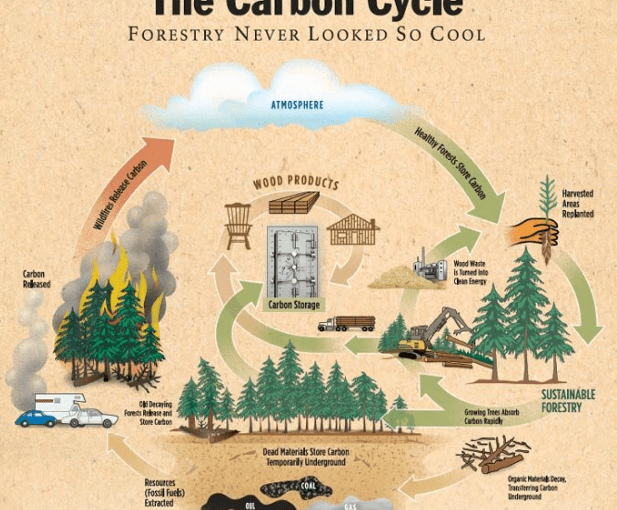
PHOTO The Carbon Cycle. Image Credit-Guada Bamboo

Flagship “Bamboo Villages” program to uplift lives of poor and IPs, generate forex value from $90 billion global market

August 18, 2023

Melody Mendoza Aguiba

The Marcos Administration is embarking on a flagship multi-billion peso “Bamboo  Villages” program that will uplift the livelihood of the poor and Indigenous People in ancestral lands while generating foreign exchange from bamboo’s $90 billion global market (by 2030).

   Newly-appointed Department of Agriculture Undersecretary (DA) Deogracias Victor B. Savellano has spearheaded “Buong Bansa Magtanim (BBM) ng kawayan “ to create livelihood in the countryside. 

   The program will use bamboo as a climate change mitigation tool even as President Ferdinand R. Marcos Jr (PBBM) himself cited  during the United Nations General Assembly that the climate challenge is a major policy goal of his administration.   

   Savellano has been leading consultations on the concept of Bamboo Villages which he has been pushing for as an inclusive, community-based approach to jobs creation and agricultural development.

   “With bamboo growing abundantly in the Philippines, we can tap a rich economic resource if we only have  a national program to develop it as an industry as what our neighbors have already invested in,” said Savellano.

   Among Asian bamboo programs that brought huge economic value are Indonesia’s 1,000 Bamboo Villages and Vietnam’s 100-hectare Bamboo Villages.

   Isidro I. Alcantara, a bank and mining executive, said Thailand just allocated $10 billion for the next 10 years to develop its bamboo industry.  Alcantara pioneered bamboo planting in a mining area in Marcventures in Surigao del Sur.

   China generates the biggest bamboo revenue at $35 billion yearly. 

   Savellano just led last week a consultation in Manolo Fortich, Bukidnon a proposed legislation allocating 5% of the budget of various government agencies for bamboo propagation.

   However, he asserted at a Senate hearing last August 9 that an institutionalized bamboo program will be needed to consolidate different government programs on bamboo that are now scattered across agencies.

   “We need to harmonize our programs that are now uncoordinated.  We need to obtain the cooperation of each individual and harness all economic resource to attract private sector investment in bamboo,” Savellano said.   

   Senator Mark Villar, who presided over the Senate hearing, said PBBM appears to find the concept of bamboo industrialization a bright light for the Philippine economy.

   “He is very excited about this,” Villar said.

   Bamboo bills filed in Congress, primarily Senate Bill 605 and House Bill 7941, have provided for a P100 million budget for the institutionalization of the Philippine Bamboo Industry Development Program.

   While P100 million yearly may be a heavy yearly budget for government, Senator Nancy Binay said the legislature should review the huge economic potential offered by bamboo as against costs.  This, as bamboo’s time has come given the global urgent call to reverse climate change.

   Former Agriculture Secretary Luis P. Lorenzo Jr., an investorat Flo rida-based Rizome Philippines which produces world-class engineered bamboo as alternative to hardwood lumber, said bamboo can be the biggest agriculture industry that the Marcos Administration can build.

  Bamboo can be the long term solution to insurgency.  Rizome’s bamboo plantations are now reintegrating rebels into mainstream economy by giving them livelihood.

   His company just entered into a Memorandum of Agreement for a bamboo project with the IP Manobos covering 2,500 hectares of ancestral domain land in North Cotabato.

   “Bamboo gives a very good return.  Our business is already a billion peso business  just with that.  It employs thousands of people. What’s good about it is we can create community-based first level processing (livelihood programs).  (People) can make slats, instead of we just buying a P70 peso pole. We can give them P400 per pole equivalent,” Lorenzo said.

     A single bamboo slat is now bought by Rizome’s Cagayan de Oro plant at P13 each.   As there is an average of 24 slats per pole, and seven poles per clump, a land producing 200 clumps per hectare can generate P436,800 gross income per year.

   “Given you have a P100,00 cost, you have a huge net income of (more than) P300,000 per hectare.  Our people just have to be taught.  They must be hardworking and should sharpen their blades everyday.”

   To support the development of the bamboo industry, Lorenzo said bureaucratic processes should be eliminated in plantation, harvesting permits. Plantation contracts of 25 years plus 25 years should be easy to obtain.

   “Honestly we’re getting invitations from Vietnam, Indonesia, India where it is much easier to do business than here.  We’re being offered lands for free.  No bureaucratic processes,” said Lorenzo.  “(Fortunately though), they don’t have good quality as our lumber because they cannot grow our  node to node distance which is very long.”

   With bamboo’s “strong like steel, tough like concrete, beautiful as hardwood,” amboo should be included as a certified material in the Building Code. 

   Bamboo has become a raw material for a wide range of products  including lumber as alternative to hardwood (beams, engineered wood, tiles), textiles, carbon composites for windmill turbine blades, large diameter water pipes and sewage mains, and bamboo pellets to replace coal in power generation.

   Alcantara, also former chairman of Philippine Nickel Industry Association, said during the Senate hearing that the mining industry can be a catalyst to bamboo’s development as an industry.  It can generate $3.5 billion in revenue per year, equivalent to the revenue from Philippines’ mining sector. This is given vast areas in mining tenements where only 25% have mineable ore. 

   The Philippines has 3.75 million hectares of idle land waiting to be developed, Alcantara said.  Yet, even if only 400,000 hectares are developed for bamboo equivalent to 10% of China’s 4.2 million hectares, Philippines can earn $3.5 billion yearly.  It can generate one million new direct jobs.   

   For wood products alone, the Philippines exported $1.81 billion in a recent year.   However, Philippines imported $1.29 billion in wood products.

   “If we substitute the imports, can you imagine the savings in foreign  exchange reserve? It’s like exporting also,” Alcantara said. “For handicraft, we have the best handcraft makers in the world.  Our craftsmen are being offered P60,000/month by other countries.  We’re even losing our craftsmen.”

   Department of Trade and Industry Regional Director  Leah P. Ocampo said during the same Senate hearing that bamboo market value will grow to $88.43 billion in 2030.  This is from $61.69 billion in 2022.

   “Asia Pacific led the largest revenue share of 78.8% in 2021.  It is expected to grow at over 4% compound annual growth rate,” Ocampo said.

   In the 2021 revenue of $59.3 billion, the furniture segment had the largest revenue share of 25.7%,  expanding yearly at 4.4%. 

   Ocampo said the bamboo shoots segment is also a growth area as edible vegetable is significantly growing due to the rising awareness  of healthy food.  Bamboo shoots contain amino acids, proteins, Vitamin A, niacin, and thiamine, among others.

   For Philippines’ bamboo product export, destinations are United States, Japan, Europe (United Kingdom, Germany, and France). 

   As of 2022, investments generated in the bamboo industry totalled P89.2 million, and domestic sales, P143 million.  The sector generated 10,898 jobs, 5,012 micro small and medium industries, and 92 community-based enterprises.

   As a climate friendly grass, bamboo sequesters 11 to 15  times the carbon dioxide compared to a tree.  It can be nurtured and ustainably harvested,  for 100 years.

   It can fight soil erosion.  Given bamboo’s plantation in 3 million hectares of denuded land in Mindanao alone, bamboo will play a significant role in Philippines’ reforestation, more popularly under National Greening Program. 

Ph should aspire to have UNWTO-named “Best Tourism Villages” to sustain rural economy

March 20, 2023

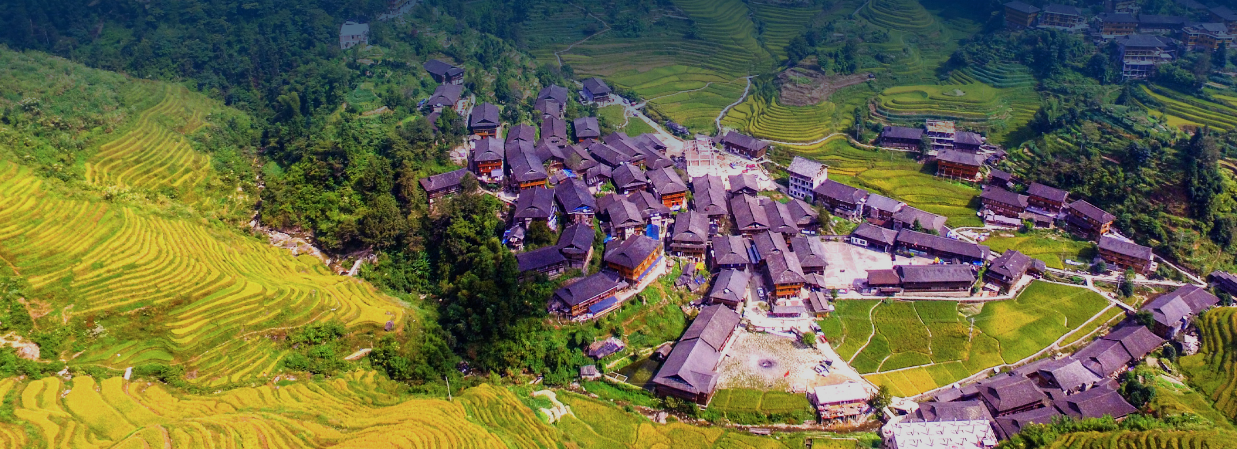
Best Tourism Villages Credit- UNWTO


The Philippines should aspire to have UN-World Trade Organization-named “Best Tourism Villages” that help sustain rural economy and cultural traditions and support livelihood in the outskirts.
   Antonio Lopez de Avila, UNWTO Tourism for Rural Development Programme coordinator, said at a tourism forum of the Southeast Asian Center for Graduate Study and Research in  Agriculture (SEARCA) that farm tourism will play a significant role in post-Covid rural development.
  As borders have started to open since countries imposed movement restrictions at the height of the pandemic, farm tourism will now play a big role in the recovery of economies.
   “We can use tourism as a powerful driver. People are discovering new routes.  They do what they have not done before like harvest crops,” he said.
   One way to encourage rural towns to invest in tourism development is to provide incentives for rural areas to strive to qualify for the Best Tourism Villages, a United Nations WTO program.
   The Alula Framework for Inclusive Community Development through Tourism has been set up by the WTO, G20 Tourism Working Group, and the G20 Saudi Presidency in a vision to improve the livelihood of many people.  The Alula Framework has a vision that livelihood generation can be achieved through education, investment, innovation, and technology in farm tourism sector.
   In the same SEARCA tourism forum titled “Unleashing Untapped Opportunities of Agrifood Tourism, Keneth de Gracia of the Department of Tourism (DOT) 4-A said the Philippines has already emerged as a top farm tourism destination.  
   This has arisen due largely to the ratification of Republic Act 10816 or an “Act Providing for the Development and Promotion of Farm Tourism in the Philippines.”
   Even more, farm tourism is becoming popular especially among the youth who are exposed to a new face of agriculture.  The  pandemic has brought about awareness on agriculture’s role in sustaining food production, nutrition, and health.  
   De Gracia said DOT has engaged in a technical cooperation with the United Nations Food and Agriculture Organization (UN FAO).  This will come up with a standard module for capacity development in farm tourism.  I will train people on  farm tourism sites in Calabarzon (Cavite, Laguna, Batangas Rizal, Quezon).
     Dr. Siti Fatimahwati Pehin Dato Musa, professor at Universiti Brunei Darusalam, also said at SEARCA’s agritourism forum that the current fast food culture has become a threat to food traditions.  This is why there is a hunger for agritourism and farm-to-table (FTT) activities.

Farm tourists learn foraging in Temburong Jungle

   SEARCA has engaged in discussions on agritourism even as SEARCA Director Glenn B. Gregorio said “agritourism is an innovative pathway to ISARD.”  
   ISARD or inclusive and sustainable agricultural and rural development is the mandate of SEARCA when it was founded as a treaty organisation in 1966.
   Through the farm tourism sector, new markets are created for agricultural products, said Pehin Dato Musa.  
   Traceability of food sources is strengthened, and transport of goods becomes shorter in distance and cheaper as communities get to be aware of farms’ presence.
   “FTT groups have been taking responsibility for promoting local artisans, local farmers, and local flavours through regional events such as taste workshops, wine and food tasting, and farmers’ markets.”

Best Tourism qualification

   To qualify for the “Best Tourism Villages,” a candidate site should have a population of a maximum of 15,000 inhabitants.  Its location should showcase traditional activities particularly agriculture, forestry, livestock, or fishing.  
   As not all can be Best Tourism Villages winners, UNWTO gives support to candidates through partnerships that help improve a site after an evaluation.
  Among the benefits of the UNWTO program are training, sharing of good practices, participation in international events, networking, mentoring, and financing.
   The Best Tourism Villages provides guidance to governments and the private sector on putting up tourism policies through education, investment, innovation and technology to “transform the livelihoods of millions, while preserving our environment and culture.”
   UNWTO advances the role of tourism as it preserves “landscapes, knowledge systems, biological and cultural diversity, values and activities” in rural areas.
   De Avila said UNWTO’s secretary general  Surab Pololikashvili stated that “tourism has proven to be a lifeline for many rural communities, but its true potential has yet to be realized.”
   According to the WTO, tourism accounts for 7% of world trade.  It is among the most resilient sectors of the economy and generates millions of jobs.

Farm-to-table
   Pehin Dato Musa said farm-to-table activities in Southeast Asia include cooking classes, events, tours, markets and school or organization activities.
   Tourists get to value their heritage. People realize it is much safer to tour locally where farms are.
   “Agritourism farms in California can operate despite Covid 19 regulations.  And 61% of revenue direct sales of agricultural products are delivered fresh to consumers.”
   One agritourism site in Brunei, Pehin Dato Musa cites, the Sumbiling Eco Village, is a protected rainforest.  Its natives practice organic farming and agroforestry– planting native trees and bamboo. The Iban people’s food heritage also offers unique culinary experience.  Tourists get the chance to look for edible or medicinal plants, stingless bee honey, and wild herbs in the deep forest as one activity.
   Farm tourism can develop infrastructure in rural areas. A big gap has been observed in the  absence of electricity in rural areas compared to urban areas.  Absence of electricity affects 638 million rural compared to 121 million urban people.  Such big difference is true too in sanitation services and drinking water and financial services. Melody Mendoza Aguiba

Featured Photo Credit: UNWTO


PBIDC urges replication of 20-hectare Karugo, 10-hectare Puray bamboo projects to support tribal livelihood for tribes, prevent MM flooding

February 15, 2022


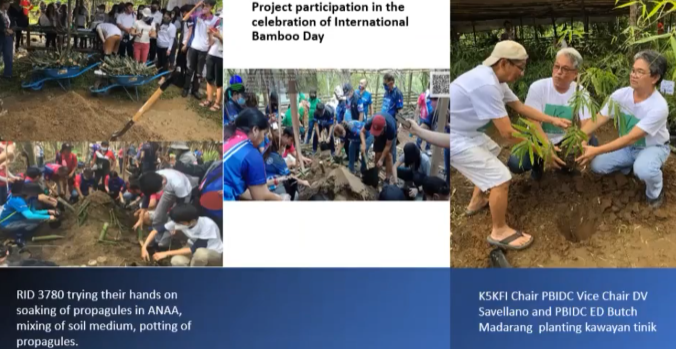
The Philippine Bamboo Industry Development Council (PBIDC) is proposing to replicate nationwide the 20-hectare Karugo and 10-hectare Puray bamboo projects in Marikina Watershed which give livelihood to tribes and help prevent Metro Manila flooding.

The Karugo and Puray bamboo projects in Montalban, Rizal are an ideal multi-agency collaboration that involves minimal budget, according to PBIDC Vice Chairman Deogracias Victor B. Savellano.


Yet it has harnessed and consolidated multiple resources that redounds to upland economic benefit and protects the environment.

“Our best examples (for bamboo propagation) are those in Puray and Karugo. It’s something that’s not difficult to do. It is a joint effort between government Rotary International, Indigenous People, and community. It’s a beautiful model that should be replicated all over the Philippines,” said Savellano.

Bamboo partnership between PBIDC, 5K, Rotary International 3780, Bamboo Professionals Inc., Puray IPs


Rotary raised a minimal P1.5 million in district grants for Karugo project.

The Kilusang 5K (Kawayan: Kalikasan, Kaunlaran, Kabuhayan, Kinabukasan) Foundation, founded by Savellano, has supported organization of Puray and Karugo projects. The bamboo propagules planted in 2022 in Karugo is estimated to multiply to 142,000 bamboo culms in five years and 228,000 culms in eight years.


Now that Trade Secretary Alfredo Pascual has reconvened PBIDC, Savellano said PBIDC is now coordinating all bamboo projects and agencies. Thus, such replication can implemented in every town in the country—as what has been done by Savellano’s former constituents in Ilocos Sur.

PBIDC has adopted the Montalban projects for its own collaborative, cost-effective model.

“We tapped the two community-based projects to establish nurseries and do plantation development,” said PBIDC Executive Director Butch Madarang.

“Using the convergence formula through consultation with different agencies, we’re able to engage everybody. We have an inclusive perspective. Our formula is to tap different agencies’ resources.”


Puray farmers earn P300 per day from potting for bamboo seedlings

Lead collaborator is the Department of Environment and Natural Resources (DENR) which identified the project site. Kilusang 5K tapped the Philippine Bamboo Foundation and Bamboo Professionals Inc to train on bamboo propagation the IPs belonging to the Samahan ng Kawayan sa Karugo Agri-Farmers Association (SAKKAFA) and Tribal Council Assn. of Puray Inc. (TCAPI).

Instead of planting hardwood that takes 10-20 years to harvest, bamboo was chosen as it is harvestable in three years, generating income to the community.

More so, bamboo plants are climate disaster fighters. Bamboo, at four years old, has been proven to absorb 500 kilos of carbon dioxide yearly. It generates 300 kilos more of oxygen per year compared to other trees. Bamboo plants hold more water than other trees, helping prevent erosion and flooding. It has high survival rate due to endemicity and maintenance care.

Puray Indigenous People who used to just cut bamboo plants relentlessly learn sustainable farming


The 10-hectare Puray project is now generating a P300 per day income for farmers who do potting for growing seedlings. While generating income from selling seedlings, the vision for the bamboo projects is to produce commercially viable products.


“We should venture first on basic products (before going to high-end sophisticated bamboo products like composites, fibers, engineered bamboo). For me, I will be happy enough if we’re able to produce bamboo chopsticks and barbecue sticks which we are importing even if we have many bamboo culms nationwide,” said Savellano.


The Montalban projects are really part of the bigger Upper Marikina Watershed Project (five municipalities/cities in the Sierra Madre mountains). It covers an estimated 26,000 hectares. It is envisioned to address persistent flooding in Marikina and Metro Manila as a whole.


The watershed also protects the Wawa Dam which is capable of producing water for 500,000 households.


The Marikina watershed, while declared a protected area, has been extensively plagued by illegal logging, highly-destructive quarrying, and illegal settlement. These have worsened state of flooding in Metro Manila. (Melody Mendoza Aguiba)

Govt boosts investment interest for bamboo with launching of CITE Marikina training center for PBIDC

January 21, 2022

The government is boosting investment interest for bamboo as it launches the Center Innovation and Technology for Enterprise (CITE) as a training center for the Philippine Bamboo Industry Development Council’s (PBIDC) capacity building and consultative programs.

To be launched in February 2023, the CITE facility of the Department of Trade and Industry (DTI) will be the home base for the sector.

It is the opportune time as bamboo is just starting to gain interest among private and public investors in light of the post Covid scenario and efforts to fight climate change, flooding, and natural disasters.

PBIDC Vice Chairman Deogracias Victor B. Savellano said bamboo is now being recognized as a new “tree of life” that gives livelihood to the poorest in the countryside. That includes even Indigenous People (IP)-occupied ancestral domains that dominate 30-to 40% of Philippines potential productive land.

“DTI Secretary (Alfredo) Pascual who has reconvened the PBIDC has thrown his support for our bamboo programs. Even non-government organizations have laid out their plans for the industry. The private sector is very serious about planting bamboo,” said Savellano.

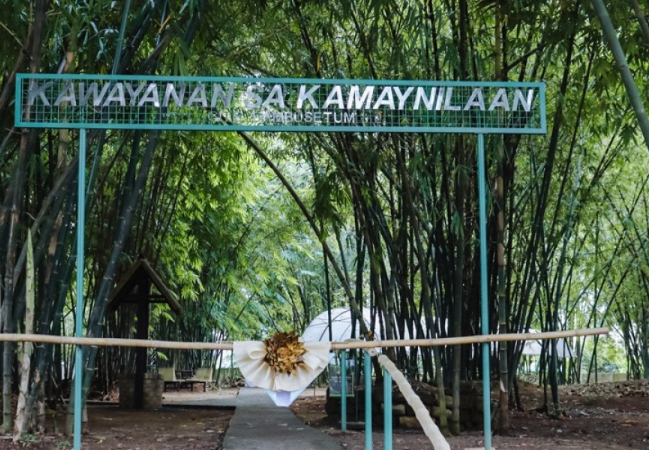
CITE Bambusetum in Marikina City

The CITE facility in Marikina City houses training machines, equipment, function rooms, a dormitory for in-house training, and offices. The CITE also has a Bambusetum in Marikina City that showcases different bamboo varieties and their uses. It has been offering training on bamboo propagule production and bamboo product processing.


“Nobody used to give attention to bamboo before. With PBIDC now reconvened, bamboo programs will have continuity,” said PBIDC Executive Director Butch Madarang.


As involvement of local governments units (LGU) is crucial to bamboo planting, Savellano said the PBIDC executive committee is enjoining the Department of Interior and Local Government (DILG) and League of Cities to be part of PBIDC. Technical Education and Skills Development Authority (TESDA and the Climate Change Commission should also be part of it.


“There is a big demand for bamboo. There’s an urgency in what we’re doing. We want to develop the bamboo industry under President Marcos’s term, and we now only have 5.5 years.” Savellano said. “(That’s why) we have to make our programs inclusive. It should involve everybod,y as many who want to support the industry,” he said.


“If we can’t do it now, when else can it be done? President Marcos already made a declaration during the United Nations General Assembly that fighting climate change will be a priority of his administration. He made a call on his birthday on Sept 13, 2022 during the Nationwide Bamboo and Tree Planting Program for us to uphold environmental protection.”


Other members of PBIDC are the heads of the Department of Agriculture, Department of Education, Department of Environment and Natural Resources, Department of Agriculture, Department of Science and Technology (DOST), Department of Labor and Employment (DOLE), among others. DTI heads the PBIDC.


The PBIDC bill under House Bill 9576 has been approved for third reading in the Lower House and transmitted to the Senate which had two hearings. But the national election has halted the proceedings. Nevertheless, the bill will be refiled in the 19th Congress.


While the bill has not yet been approved, PBIDC is putting up with tapping resources from different agencies that have a budget, albeit minimal, for different bamboo programs. DTI, for one, has programs for bamboo commercialization and processing, Department of Science and Technology (DOST) has bamboo researches.

“Since the budget and programs for 2023 are yet being planned, we are appealing to the different agencies to include bamboo in their programs. The DA, for example, has declared bamboo as a high value crop. Bamboo should be included in its High Value Crop program,” Savellano said.

PBIDC has been created under Executive Order 879. However, a budget has yet to be allocated for bamboo under the General Appropriations Act (GAA). PBIDC is not included in the 2023 GAA.

Even then, Savellano, who is founder of Kilusang 5K (Kawayan: Kalikasan, Kaunlaran, Kabuhayan, Kinabukasan) Foundation, has pushed for bamboo programs including nursery establishment.

Kilusang 5K carried out community-based bamboo reforestation, production and nursery establishment in the Marikina Watershed and at Sitio Karugo, San Rafael, Rodriguez.

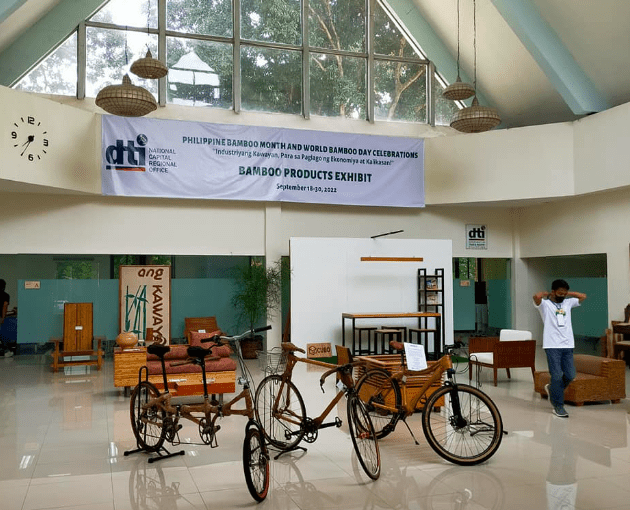
Bamboo-made furniture exhibited at CITE. Credit-Bamboo Network PH


Such bamboo production in Puray, Rodriguez was participated by indigenous people, the SaKKAFA non government organization, and the Council Assn of Puray Inc.
Training was supervised by technology experts from the Philippine Bamboo Foundation and Bamboo professionals. It was funded by the Rotary Foundation Grant of the Rotary International districts 3780 and 3830.

Kilusang 5K, along with Rotary and other stakeholders, decided to choose these locations as the deforestation in the Sierra Madre mountains has been known to cause flooding in Metro Manila.

“We are proud to have accomplished many things in the last two years with zero budget. Bamboo is an advocacy for us. We’re fighting for bamboo because you already have the clumps available. With the proper management and rehabilitation, you have a livelihood. It’s a doable program. It’s productive in 3-4 years from planting. ” he said.

“If we can’t develop our bamboo industry, tell me what else are we capable of doing?” he said.

High value-added engineered bamboo. Credit-Bamboo Network PH


EO 879 saw a $8 billion global market for bamboo. It will have tremendous economic multiplier effect was it is seen to replace plastic, metal and other wood as manufacturing input.


Madarang said PBIDC looks forward in the future to have budget allocation.
“We need it for the upkeep of the CITE facility. We need to support how roadmaps of agencies (like the one drafted by DA mainly for bamboo production and food) will cascade into regional offices,” said Madarang.


PBIDC in the last two years has been coordinating agencies’ programs for harmonization and non duplication. It includes the following:

  1. Localization of bamboo programs with now 48 active local councils.
  2. Bamboo Resources Inventory and Technology-Enabled Mapping in the Philippines (Britemap) to develop bamboo resources inventory system.
  3. Consultative meetings with Cordillera Administrative Region, Regions 1, 2, 4A, 5, 6, and 7-12.
  4. Series of bamboo summits from Luzon to Mindanao that tapped the Mindanao bamboo advocates.
  5. Series of bamboo smmits n mining in a tieup with the Philippine Mining Club, DENR-Mines and Geosciences Bureau.
  6. Declaration of Bamboo Month under House Resolution No. 197 and celebration of World Bamboo Day in order to promote the significance of bamboo planting and production.
  7. PBIDC participation in Smart Bamboo Database Management System of the Philippine Bamboo Society of Advocates, Bamboo Bootcamp, DENR-Forest Management Bureau training,
  8. Pasig River Rehabilitation involving bamboo planting in its tributaries.
  9. Support for DTI’s shared services facilities establishment.
  10. Memorandum of agreement with TESDA on training protocols
  11. Rehabilitation of existing bamboo clusters in the first district of Ilocus Sur under the TUPAD program. (Melody Mendoza Aguiba)

Phil. Bamboo Industry Development bill to establish Ph’s natural bamboo competitive edge in transport, construction, furniture, manufacturing

December 9, 2022

The Philippine Bamboo Industry Development Act (PBIDA) is seen to establish the country’s compettive edge in the natural bamboo market in transport, construction, furniture, and fabric sectors that can lead to industrial-manufacturing development.


Filed under House Bill 9576 which was approved for the third and final reading in August 2021, PBIDA is hoped to be certified as urgent by the administration of President Ferdinand R. Marcos Jr.

“House Bill 9576 should be approved under the admnistration of BBM (Bongbong Marcos). It will substantially help advance our industrial development. We already have the clumps in our inventory. We just need the support for production, training, processing,” said Deogracias Victor “DV” B. Savellano.

Savellano leads private sector advocates of bamboo as nature-friendly, climate smart industrial material through the 5K (Kawayan: Kalikasan, Kabuhayan, Kaunlaran, Kinabukasan).Foundation Inc.

HB 9576 will be refiled by Bohol Representative Edgardo M. Chatto. It will be endorsed in the Senate by the House of Representative.

The bill which envisions to seize part of a global market placed in 2010 at $8 billion will institutionalize the Philippine Bamboo Industry Development Council (PBIDC).
Created by Executive Order 879 in 2010, PBIDC saw the prospect of bamboo replacing plastic, metal, and other wood as manufacturing input.


While Savellano has earlier been appointed vice chairman of PBIDC, the council has not yet been convened since the Marcos Administration stepped in. A budget has neither been allocated for the council.


Aircraft uses bamboo

The bamboo industry holds huge economic potential for contributing to industrialization, being a highly-durable and ecologically-friendly raw material.

Comparable to or even better than other hardwood, bamboo has already been technologically developed into engineered wood, composites, laminated wood, or strand woven bamboo as a sophisticated lumber or construction material.

Filipinos have extensively exhibited their creative genius in using bamboo.

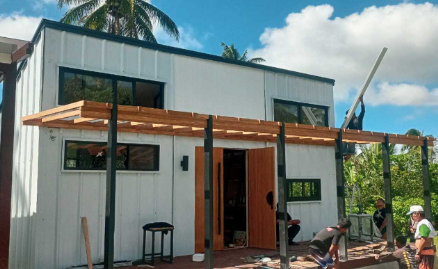
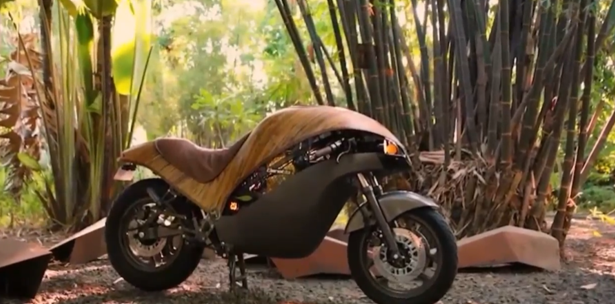
The Cubo modular house, designed by Earl Forlales, is not only a modern but one that is also an aesthetic and durable house made of natural, indigenous materials. In 2017, designer Christopher Paris Lacson crafted the Banatti motorcycle whose body is made of highly durable, elegant-looking, light-weight bamboo.

Lacson himself said Philippines has long been a pioneer of industrial bamboo design as cited by a local newspaper in the early 1950s. Filipino Antonio de Leon designed a single-engine, light experimental aircraft XL-14-MAYA. It used a type of woven bamboo called WOBEX, woven bamboo experimental.


Cubo modular house made of bamboo designed by Earl Forlales

Another product is the bamboo mobile, a type of jeepney spearheaded by the Department of Transportation of long ago. Its body is made of bamboo. Bambu Batu (House of Bamboo) cites many other modern, fashionable furniture and clothing products made of bamboo.

Bamboo also holds tremendous promise as green ethanol or fossil fuel substitute as a renewable energy.

Bamboo mobile introduced by the old Department of Transportation

PBIDC

The PBIDC, according to EO 879, should be be composed of the heads of the Department of Trade and Industry, Department of Environment and Natural Resources, Department of Agriculture, and Department of Science and Technology (DOST), among others.


Bamboo advocates are now petitioning government to allocate at least P100 million to jumpstart the development of bamboo as a manufacturing sector.
EO 879 mandates DENR, Mines and Geosciences Bureau, and Laguna Lake Development Authority to use bamboo in at least 20% in their annual reforestation areas.


Rene Madarang, appointed PBIDC executive director but also actively supports bamboo promotion through 5K Foundation, earlier created a Technical Working Group (TWG) to support PBIDC functions.

TWGs have been put up for three functions– production and propagation, industry and commerce, and training of workforce for propagation and processing.

Chrostopher Paris Lacson’s Banatti bamboo motorcycle

Economic contribution

The Philippines now has an estimated bamboo area of around 104,000 hectares. It generates a value of $60 million yearly. With 5.59 million hectares of arable land, the Philippines can expand bamboo area to 400,000 hectares– if only to level up to at least 10% of China’s bamboo area of 4.2 million hectares.
Such area can yield a whopping $3 billion (P150 billion). The industry can employ one million rural folks including indigenous people that can be organized into cooperatives.
Each 10-hectare area can generate a net income of P922,995 per bamboo worker per year, according to a study of the International Network for Bamboo and Rattan (INBAR).

Sustainable development

Bamboo is a sustainable material. It fights climate change in several ways, INBAR said.
First, its fast-growing trait enables it to sequester carbon more substantially than other plants. It releases 35% more oxygen than other trees. Bamboo plants sequester 12 metric tons of carbon per hectare annually.


“Durable products made from bamboo can also be potentially carbon-negative. Bamboo could also be a favorable substitute for hardwoods, even FSC (Forest Stewardship Council)-certified ones.”

Bamboo also replaces fossil fuels and reduces deforestation. Its solid biomass is used for cooking (charcoal and briquettes) and It can be converted into pellets for electricity and heating.

It is harvestable year-round, providing a stable rural income.

As it thrives in problem soils and steep slopes, it is an excellent land restoration crop.

“It is an effective windbreak, and its sturdy rhizomes and roots regulate water flows and prevent erosion. A case in Allahabad, India, tells of the rebuilding of rural livelihoods where 80,000 hectares of degraded land were brought back into productivity using bamboo as a pioneer species.”

It has been found scientifically in abandoned mines in the Philippines to be useful as bioremediation tool, absorbing toxic metals, fully restoring mined-out barren lands. (Melody Mendoza Aguiba)