P120M road and P72M RCDG bridge projects bring hope of easier market access for pineapple farmers of Ifugao

June 10, 2021

A P120 million road and a P72 million RCDG bridge projects of the Department of Environment and Natural Resources (DENR) are bringing hope of easier market access for pineapple farmers of barangays Alimit, Langayan, and Banao of Ifugao province. 

   This is precisely the objective of DENR’s Forestland Management Project (FMP) – to make a success of upland farmers as entrepreneurs, according to Marlon Atienza, project manager of DENR’s FMP.

   Consequently, the farmers become protectors of the watershed and the river basin of Ifugao— and abandon forest-degrading kaingin (slash and burn) practices. 

   “We are excited to see our project gradually but surely materialize on the ground.  This is what FMP means when we say ‘Agroforestry Support Facilities.’ The growers of these pineapples and other agroforestry products are strengthened,” said Atienza.   

   “Connectivity of their plantation to the market and other communities (is becoming possible).  The bridge will facilitate easy transport and marketing of the agroforestry goods and contribute to the increase in income of upland communities.”

   As the FMP is about to end by 2022, Atienza said DENR has requested FMP’s funder, the Japan International Cooperation Agency (JICA), for a one year extension.

   “We need to complete activities on maintenance and protection of established plantations, construction of agroforestry support facilities, and implementation of the sustainability action plan.The request was made in view of the effects of the Covid 19 pandemic,” said Atienza.

   FMP has been successful in achieving its objectives in its almost 10-year duration.

   It has strengthened the management of 149 People’s Organizations (PO). It established 71,300 hectares of tree and agroforestry plantations.
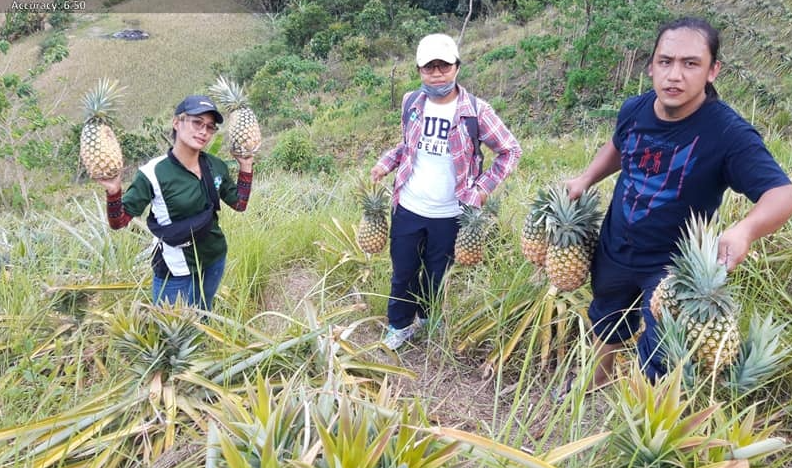
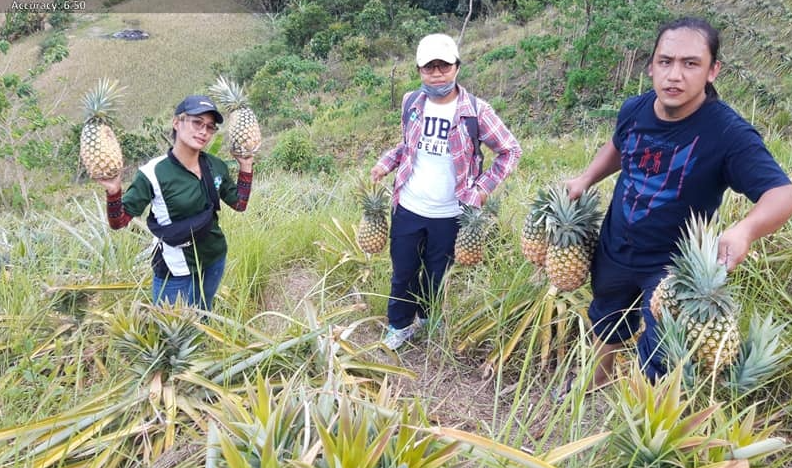
   Pineapple harvest by the Alimit Langayan Banao Farmers Organization (ALBAFO) in Ifugao

Contractors of the P72M Reinforced Concrete Deck Girder (RCDG) bridge just held in the last week of May a “concrete pouring” ceremony for the bridge.  It is a go signal for its construction.

    Another FMP project that will benefit the Peoples Organization (PO) of Alimit Langayan Banao Farmers Organization (ALBAFO) is the 3.867 kilometer Brgy. Montabiong Access Road.     

   Worth P48 million, it is now undergoing construction.     It will take 270 days to complete the access road.

   “This road concreting will strengthen the connectivity between the Alimit West and Lagawe subwatersheds,” said Atienza.

   The Brgy. Montabiong Access Road just also started construction with a groundbreaking ceremony last June 3, 2021.

   Aside from ALBAFO, the immediate beneficiary of this access road is the PO Iphodan Di Alah Ad Montabiong Inc. (IDAMI) and DENR-Ifugao Field Implementing Units.

   The FMP is a 10-year program up to 2022 aimed at strengthening forest management in three critical river basins— Upper Magat and Cagayan, Upper Pampanga, and Jalaur (Panay Island). 

Bridge to connect Ifugao’s fruits and vegetable produce to the market

   It is funded by JICA through a P4.708 billion loan component.

   A highly-valued accomplishment of FMP is the increase in forest cover and a decrease in soil erosion).  However, these benefits have yet to be quantified based on science practices.

    The pineapple-agroforestry  enterprise is funded too under FMP with a budget of P100,000.

   FMP’s poverty reduction benefits to the grassroots have been so pronounced as it involved 149 POs within the identified 24 sub-watershed areas.

   With farmer-training from FMP,  the upland dwellers have become more intensive growers of agroforestry products like timber (gmelina, mahogany and narra) and fruit trees (guyabano, cacao, mango).   

   They have expanded their farming and has reached new markets through FMP’s marketing assistance and promotion.

   The total project investment cost is estimated at Php 5,870.64 million of which P1,162.26 million is shouldered by the Philippine government. 

      FMP has carried out  reforestation through collaborative and comprehensive Community-Based Forest Management (CBFM) strategies. (Melody Mendoza Aguiba)
Govt, private agencies urged to “invest in nature” as this generates $350B per year in improved ecosystem services, eliminate future pandemics

June 8, 2021

Biodiversity financing strategist Biofin Philippines has urged government and private agencies to “invest in nature” as this will generate globally $350 billion per year  in improved ecosystem services and contribute to elimination of pandemics.

   As the International Day for Biological Diversity is celebrated this year, BIOFIN, a project of the Department of Environment and Natural Resources (DENR), prodded policy makers to contribute to financing the Philippines’ 13-year biodiversity plan.

   The Philippine Biodiversity Strategy and Action Plan (PBSAP), which started in 2015 and will last until year 2028, will cost P24 billion yearly.  A budget deficit of P19 billion yearly exists.

    “According to Campaign for Nature, Protecting the world’s land and ocean resources outweighs financial costs at least five-to-one. Globally, this can lead to $250 billion in increased yearly economic output, plus $350 billion in improved ecosystem services annually,” said Angelique Ogena of Biofin.

   The other critical reason for investing in nature is human health itself.  When watersheds and forests–the habitat of wild animals — are destroyed, direct interaction between human and the wildlife that carries diseases unknown to man becomes imminent.

   “The International Day for Biological Diversity puts us at the center of conservation efforts in the fight to save biodiversity amid the ongoing COVID-19 pandemic,” said Ogena.

   “Seventy-five percent of emerging infectious diseases in humans originates from zoonotic pathogens.  That is enough reason to revisit and reprioritize resources toward the improvement of natural resources management especially in protected areas to prevent future pandemics.”

   Biodiversity Finance Initiative (BIOFIN), co-implemented by the United Nations Development Program (UNDP) in the Philippines, seeks to raise awareness on the economic and ecological values of PAs (protected areas). 

    The campaign aims to  increase BIOFIN’s revenue by establishing partnerships with the private sector and other agencies that can have common mission to support PAs.

   BIOFIN is pushing for a proposed Presidential Proclamation to proclaim June 2021

to May 2022 as the “Year of the Protected Areas” and June of each year as “Month of Protected Areas”.

   Both are in in support of Republic Act 11038 or the Expanded National Integrated Protected Areas System Law (NIPAS).

   “Nature is a reliable provider of our daily basic needs such as clean water for drinking, air forbbreathing and other resources such as medicine, jobs, and climate change mitigation to create a more resilient nation,” said Ogena.

   “If we zoom in to the ecosystem and species levels, national parks are at the top tier when it comes to natural wealth and therefore the most in need of protection and sustainable management.”

   According the International Union for the Conservation of Nature, a global network of protected areas can store at least 15 percent of terrestrial carbon, boosting the value of conserving protected areas to new heights.

   Nature-positive solutions follow a wholistic approach, which is highlighted in an opinion piece written by the biodiversity finance legislative champion, Representative Josephine Ramirez-Sato.    

   Sato,  representative of the lone district of Occidental Mindoro, aims to “spur ideas to generate resources and jobs for conservation of nature.” 

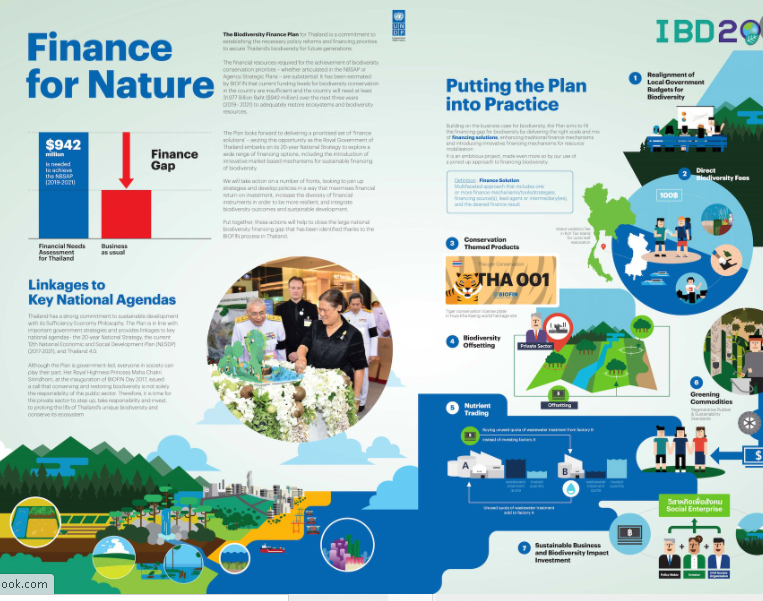
BIOFIN for Nature. Credit-BIOFIN Thailand

   “This will help in the allocation and implementation of the Inter-Agency Task Force on Emerging Infectious Diseases (IATF)’s P1.3 trillion stimulus and recovery package,” according to Sato.

   Part of the stimulus package equivalent to P650 billion has been allotted for the Enhanced Build, Build, Build Program. This includes construction of climate-smart and resilient infrastructure where biodiversity and ecosystem enhancement can be mainstreamed.

   “”The stimulus package is heavy on economic provisions and budget appropriations to enable the country to recover faster, but with proper environmental considerations” Cong. Ramirez-Sato said in her opinion piece.

   “Nature-positive solutions can create stable jobs and protect our planet,” she added.

   Sato suggests a seven-step approach to build back greener from the pandemic.  These are: 1) Include Protected Areas (PAs) and key biodiversity areas (KBAs) as key elements of nature-based solutions; 2) Invest more in PAs and KBAs; 3) Fast-track the passage of biodiversity conservation-related policies; 4) Embrace Agrobiodiversity; 5) Leverage partnerships and private sector engagement for PAs; 6) Strengthen human resources; and 7) maximize technology and citizen engagement.

  “Our actions now to address the pandemic should not amplify the risks of future outbreaks and crises. The UN World Health Organization predicts that ‘reducing the environmental and social factors people are exposed to, nearly a quarter of the global health burden could be prevented.’”

   Post-COVID19 recovery plans must be inclusive and sustainable, taking into prime

consideration biodiversity conservation and financing to prevent future pandemics. Moving forward to the ‘new normal,’ business as usual is no longer an option.

   Putting the environment at the core of what all agencies do should be the new paradigm of doing business so building back can be greener and better from this pandemic.

   While the economic losses caused by the COVID-19 pandemic continues to exist, both  public and private sectors should also pay attention in long-term solutions – one of which is investing in nature. Such investment will take quite some time before returns are realized in theform of an e quitable, environmentally-sound and sustainable growth. As a an old saying goes,“what soever man sows, he shall also reap.” (Angelique Ogena)

DENR pushes for policy strengthening against ozone depleting substance HCFC that causes global warming

June 6, 2021

            The government is pushing for the establishment of policies for the use of “low carbon, energy efficient” cold chain system to totally eliminate the use of hydrochlorofluorocarbons  (HCFC), an ozone depleting substance causing global warming.

            In a project costing $27.5 million, the “Global  Partnership for Improving the Food Cold Chain in the Philippines” (GPI-FCCP),  DENR is also carrying out a program putting up environment-friendly cold chain facilities.  

            These refrigeration systems for transporting goods for the food industry will no longer use ODS-HCFC.

            Stringent policies are important in providing a stable investment environment for investors in “green” cooling technologies, the DENR said.

            Cold chain covers every produce that needs cooling from the “field to the fork (transport, storage, transformation, packaging).  Policies will involve national standards for flammable refrigerants and revision of energy efficiency standards.

How ozone depleting substances affect the atmosphere; Source- DW

            A project assisted by international funder Global Environment Facility (GEF), the GPI-FCCP includes training of 200 key stakeholders on energy-efficiency and climate-friendly cold chain technologies. 

            There is also a high level training for 50 local engineers, system suppliers and end-users on the use of global innovative cold chain technology.

            Major implementers of the GPI-FCCP are the DENR and UNIDO (United Nations Industrial Development Organization).   A co-financier is Germany’s international cooperation agency GIZ (Gesselschaft fur Internationanale Zusammenarbeit).    

            According to the DENR, the cold chain project came about as part of the Philippines’ compliance to its commitment to the 1987 Montreal Protocol.  It is a global agreement to protect the stratospheric ozone layer by phasing out the production and consumption of ozone-depleting substances (ODS).

              The ozone is the earth’s protective layer, absorbing UV light which reduces human’s exposure to harmful (skin cancer and cataract-causing) ultraviolet radiation.

              ODS includes chlorofluorocarbons, halons, carbontetrachloride, methy chloroform, hydrobromofluorocarbons, hydrochlorofluorocarbons (HCFCs), methyl bromide, and bromochloromethane.

            Refrigeration technologies have come out as top concern to have energy efficiency and low Global Warming Potential (GWP).  It is because refrigerants extensively use  hydrochlorofluorocarbons  (HCFC) that have been found to be ozone-depleting.

            The Montreal Protocol compelled signatory countries to freeze consumption and production of the ODS hydrochloroflouocarbons (HCFCs).  Developing countries should have cut by 100% their HCFC production by 2030.

            Private sector engagement will be crucial in the Philippines’ effort in obtaining knowledge transfer of the most innovative, climate friendly, and energy efficient refrigeration technologies, the DENR said. (Melody Mendoza Aguiba)

Pilot project in Benguet, Pangasinan, Tarlac to urge farmers to wear personal protective equipment while spraying crop protection products

June 4, 2021

Bayer Crop Science will be implementing a pilot project in selected agricultural towns aimed at making personal protective equipment (PPE) available for farmers when applying crop protection products in their fields.

   The project, which will be implemented in vegetable-producing municipalities of Buguias

and La Trinidad in Benguet, and the rice areas of Bayambang, Pangasinan and Concepcion, Tarlac, aims to offer a Safety Kit. This package will be composed of 2 filter face masks, a pair of nitrile gloves, and goggles.

   While Filipino farmers seeking good yields ensure that their crops are protected from

insect pests and diseases, most farmers do not use the complete recommended PPE at

the time when spraying is necessary.

   Based on a survey conducted by Bayer, only 6 out of 10 farmers wear a face mask when preparing and applying crop protection products.

   Among those who do sport them, they use the surgical mask type, which is not recommended as it doesn’t protect the farmer from potential inhalation of the product due to dispersal and wind changes.

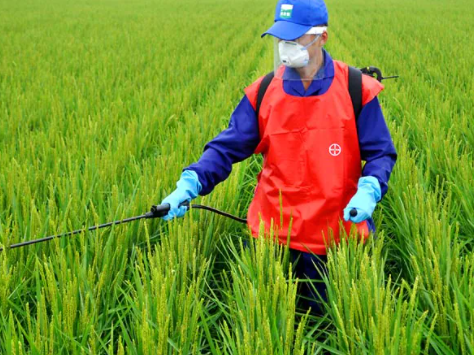
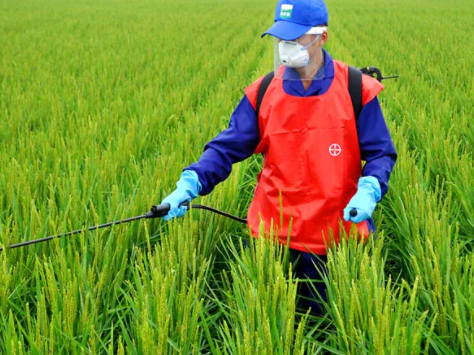
   Farmer dons complete Personal Protective Equipment for his health protection while spraying pesticides

“The right face mask when spraying crop protection products are those with a filter, ideally

FFP2 type,” said David Cristobal, Regulatory Stewardship and Compliance Lead for

Bayer Crop Science.

   “FFP2 masks have three layers of synthetic non-woven materials with the inclusion of filtration layers between, and they provide sufficient protection for farmers.”

   In addition to low and incorrect mask use in the survey, only 10% of farmers use googles

when spraying crop protection products, while 60% use surgical gloves, which is also not

the right material to shield the farmers’ hands.

    “As part of our stewardship efforts, we make it a point to train farmers on the proper

application of crop protection products, which includes wearing full PPE when spraying,”

said Iiinas Ivan Lao, Country Commercial Lead for Bayer Crop Science. “A complete PPE

set is comprised of boots, long sleeved shirts & trousers, nitrile gloves, filter mask, and

goggles.”

    While nearly all farmers said that PPE is important to protect themselves from any harm,

some reasons why they chose not to wear them include the cost, unavailability, and lack

of comfort.

   From the pilot project, Bayer will be selling the Safety Kit through selected distributors in

the 4 municipalities with the objective of gauging farmer adoption of the PPE and

generating insights from the initiative. The farmer also has the option to purchase

individual items instead of the entire kit.

   “We’re hoping that this project can solve some of the concerns of farmers on low and

wrong PPE usage, and that this will help sustain their health as they continue to provide

food for all of us,” said Lao. 

World Heritage Site Mt. Hamiguitan receives forest protection boost as communities engage in sustainable livelihood beekeeping

June 3, 2021

UNESCO World Heritage Site Mt Hamiguitan in Davao Oriental is receiving its needed forest protection boost as its communities have engaged in beekeeping of native “kiyot,” generating sustainable income while protecting the environment.

            With a more dependable livelihood and income, residents of the buffer zone of Mt. Hamiguitan Range Wildlife Sanctuary (MHRWS) are turning to become strong forest guards who help conserve forests and biodiversity of the protected site.

            The beekeeping livelihood program is a special project called Beekeeping as Bio-diversity-Friendly Community-Based Enterprise in Mt. Hamiguitan Range Wildlife Sanctuary and Expansion Areas of the Department of Environment and Natural Resources (DENR) to involve the community in forest conservation.  This is even as Mt. Hamiguitan is a wildlife sanctuary recognized by UNESCO to have a universal value. It is home to globally threatened flora and fauna eight of which are found only Mt. Hamiguitan itself.

            It is the sixth in the Philippines to be accorded recognition as a World Heritage Site.

            “Raising native bees will not only generate alternative source of livelihood, but it is also considered significant in improving the diversity and productivity of the surrounding vegetation of Mt. Hamiguitan through an improved pollination process offered by the bees,” said Clint Michael Cleofe, Provincial Environment & Natural Resources Office management specialist.

            Fortunately, the native bee variety in San Isidro town, the kiyot, is known to be stingless.  That apparently makes it easier to harvest the kiyot honey.

            The beekeeping livelihood program is supported by the local government of San Isidro municipality.  The University of Southeastern Philippines (USEP) Tagum campus also has a development plan for the beekeeping livelihood program.

              DENR’s assistance to the beekeeping livelihood project includes a Capacity Development Plan or training of people’s organizations (POs) on beekeeping and business management.

            Beekeeping materials and equipment and start-up kits are provided to the POs.  Assistance in product development and product marketing area also extended to the POs.

              As there is a high demand for bee products—honey and propolis– the project is expected to generate satisfactory income for the community.#

   There is a separate memorandum of agreement between DENR and the local government of the Governor Generoso municipality (also host community of MHRWS) for another livelihood program—sustainable almaciga resin.

   PO  to be benefited is the Lumad Almaciga Tappers of Governor Generoso (LATAGG).  Monthly household income generated from almaciga resin production is P6,000 to P8,000.  At the same time, LATAGG members become volunteer forest patrollers in Mt. Hamiguitan.

   While generally pronounced to have “good” state of protection, Mt. Hamiguitan is being strictly protected as it faces threats of conversion of land for agriculture.  There are also mining threats outside the site. 

   Potential risks from climate change and increasing tourism are now being addressed by DENR.

   Mt. Hamiguitan is known for its highly diverse mountain ecosystem that makes it home to a number of endemic species known only in Mindanao and particularly found only in Mt. Hamiguitan.

   “The combination of terrestrial and aquatic ecosystems within the boundaries of the property and the large number of species inhabiting each makes the MHRWS home to a total of 1,380 species with 341 Philippine endemics,” according to UNESCO (United Nations Educational, Scientific and Cultural Organization.

   That includes critically endangered species — the iconic Philippine Eagle (Pithecophaga jefferyi).  Also considered endangered are the Philippine Cockatoo (Cacatua haematuropygia), the trees Shorea polysperma, Shorea astylosa and the  orchid Paphiopedilum adductum.

   “Its high level of endemicity is well exemplified by the proportion of its amphibian (75% endemic) and reptile (84% endemic) species.  The fragile tropical ‘bonsai’ forest that crowns the MHRWS epitomizes nature’s bid to survive in adverse conditions,” UNESCO said.

   Scientists believe there may be more undiscovered unique flora and fauna in the mountain range.

   “In the lower elevations the agro-ecosystem and remnants of dipterocarp forests house some 246 plant species including significant numbers of endemics such as the globally threatened dipterocarps of the genus Shorea. The dipterocarp forest ecosystem is characterized by the presence of large trees and is home to 418 plant and 146 animal species, which include threatened species such as the Mindanao Bleeding-heart dove (Gallicolumba crinigera) and Philippine warty pig (Sus philippensis).”  (Melody Mendoza Aguiba)

Filipino-owned Frabelle Fishing Corp interested in putting up tuna canning plant in India

June 1, 2021

Filipino-owned global firm Frabelle Fishing Corp. (FFC) has expressed interest in putting up tuna canning facilities in India as an expansion of Filipino companies’ already existing overseas canning operations in Papua New Guinea,

   Speaking before the first virtual India Philippines Marine fisheries & Aquatic Business Conference (IPM-ABC), FFC President Francisco Tiu Laurel said India is a very prospective site for putting up canning facilities with its availability of tuna raw material.

   “It is quite interesting for me to note that India has a potential of 230,000 metric tons of tuna annually of which 40% is skipjack and the rest is big eye and yellowfin.  That’s something worth looking into by way of putting up the facility or at least buy more materials to feed existing Filipino-owned factories around the western and central Pacific,” said Tiu at the IPM-ABC.

   Filipino companies are unique in a way that these have the fleet to catch the  fish and the plant to process and can the fish. The biggest volume, 86%,  is canned in pouch, and 14%, is in tuna loins.

   “In the 1960s, boats were a lot smaller now.  Now we compete with world’s best with purse seine large fishing vessels,” he said during the IPM-ABC co-organized by the Philippine Chamber of Agriculture and Food (PCAFI).

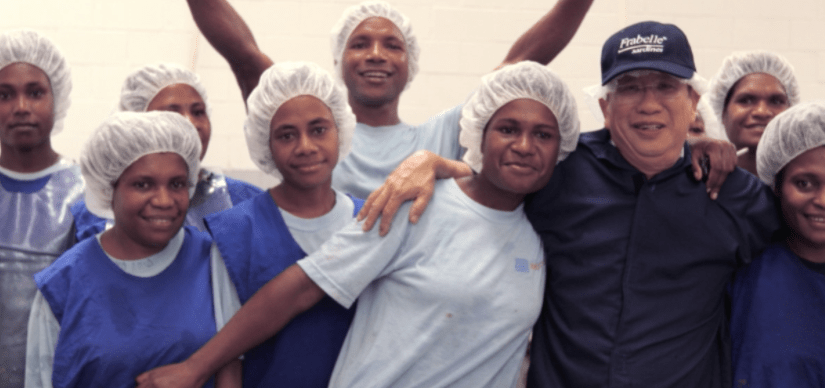
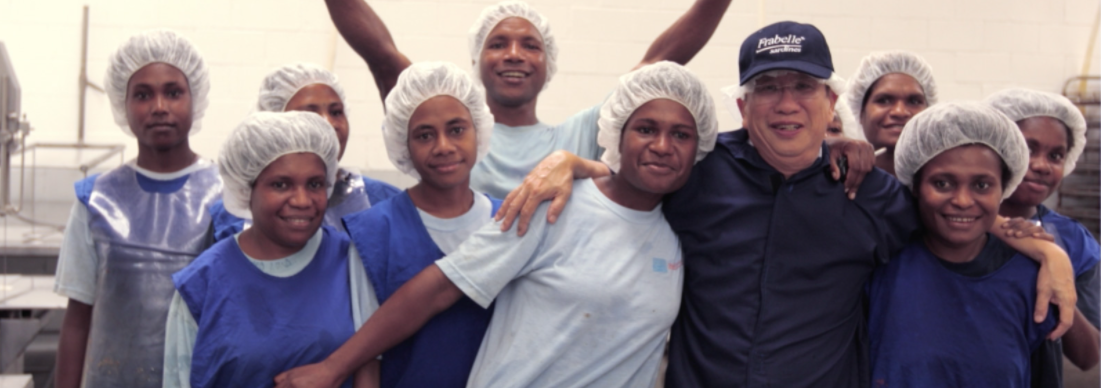
Filipino-owned Frabelle Fishing Corp. runs tuna processing-canning plants in Papua New Guinea Credit-Frabelle

   FFC is into deep-sea fishing, aquaculture, canning, food manufacturing, processing, food importation and trading, cold storage, shipyard operations, wharf development, real estate development, and power generation.

   Since Filipino-owned companies already operate canning facilities overseas, it can further just expand to India whose available tuna supply can be processed right where the fish is caught. Filipino-owned tuna companies have existing canning plants in Papua New Guinea, Vietnam, and Indonesia.

   Another expansion option, Tiu said, under this India-Philippines cooperation is for Filipino companies to expand their fleet and fish around India’s fishing ground.  That is if they are permitted.

   “We are willing to expand our tuna fleet where we are welcome to fish.That’s something quite encouraging to look at in India.  The Philippines will be willing to invest as long as they’re are allowed to fish– if that’s  possible,” said Tiu.

   Frabelle is a world-class fishing company.  It runs a fleet of over 100 vessels.The company employs 5,000 people.  Its markets for seafood are Asia, Europe, the Middle East, South Africa, and the United States.

    The Philippines exports the large chunk of 90% of its tuna production mainly to  the European Union, 60% (where it enjoys preferential duty); United States, 40%; and to the Middle East, Japan and Australia, a combined 26%. Only 8-11% is marketed locally.

   PCAFI President Danilo V. Fausto said expansion of the country’s fishery sector arising from the trade cooperation between India and the Philippines is expected to improve the lives of Filipino fishermen who depend on fishing for their livelihood.

   “The fisheries sector provides employment to over 1.6 million people, 85% of whom were from the municipal fisheries and 1% from commercial fisheries, while the aquaculture sector employed 14%,” said Fausto.

Frabelle has a fleet of more than 100 vessels producing fresh fish mainly from western and central Pacific. Credit-Fis-net

   “The Philippine fishing industry contributed around 2% of the country’s gross domestic product (GDP) and 15% of the total Philippine agriculture output “

   Indian fishery authorities who attended the IPM-ABC said there are huge opportunities for value addition in India’s fishery sector. 

   “Tuna has great investment opportunity in India.  We recognize the Philippines as a world leader in tuna processing. You come to India and directly invest,” said Cherian Cherian Kurian, managing director of India’s M/s HIC ABF Special Foods.

   “The Indian government announced a policy to exploit these resources.  Today we do canning in India, but volume is so low.”

   Tuna is the Philippines’ biggest seafood export with  value of $300 to $400 million yearly.

   With the successful virtual business conference co-organized too by the Indian Embassy in the Philippines, Indian Ambassador Shambhu S. Kumaran said both agencies will host other conferences that will benefit both countries’ agriculture subsectors. Among the next business conference may be on the dairy and livestock sectors.     (Melody Mendoza Aguiba)
DENR puts up water conservation policies in Mt Makiling Forest Reserve with sustainability threats from resorts operations

DENR puts up water conservation policies in Mt Makiling Forest Reserve with sustainability threats from resorts operations

May 30, 2021

The Department of Environment and Natural Resources (DENR) is putting up water conservation policies in the Mt. Makiling Forest Reserve (MMFR) as the water-intensive resorts in the protected area threaten water resource sustainability in Laguna.

            DENR is putting up water conservation policies in the local government units (LGU) of Los Banos and Calamba City to address the unseen threat in water resources that can arise from the influx of tourists visiting the increasing number of resorts.

Water-intensive resorts flourish in Laguna while threatening the aquifers of the Mt. Makiling watershed

            DENR is now employing Geographic Information Systems (GIS) to analyze the spatial distribution of resorts in Los Banos and Calamba City.  Its study also involves formulation of a mechanism by which tourists could be charged with a fee for using the environmental resources of Laguna.

            “The project employs economic methods to analyze the willingness-to-pay of visitors for improved water conservation practices by resorts and the conservation of MMFR to secure water services,” said            DENR.

            The government has been concerned that the number of resorts in Los Baños has increased over the last seven years from 42 to 171 in Los Banos. In Calamba City, the number of resorts has increased from 466 to 855 from 2014 to 2020.

            The watershed of Mount Makiling is important in supporting the domestic, agricultural, and industrial water requirements of Los Baños and Calamba City.

            Mt. Makiling is a dormant volcano.  This is the reason why its underground water gives rise to hot springs.  Thus, it encouraged the establishment of numerous resorts with the natural hot spring water in swimming pools and baths.

            While the resorts operations have generated higher income for operators and gave livelihood opportunities for other tourism-oriented (restaurants, food stalls, convenience stores), this has brought about negative side effects, such as that of the use of water resources by the industry.

               DENR’s project called “Economics, Policies and Institutions of Groundwater Use by Resorts in Los Baños and Calamba, Laguna” is hoped to ensure sustainable water operations despite continuing existence of the tourism businesses.             “Majority of visitor respondents have expressed their willingness to pay for the conservation of groundwater resource from Mount Makiling. They want to contribute to the conservation efforts.  They agreed that current practices are wasteful because groundwater is indeed limited,” said DENR. (Melody Mendoza Aguiba)

Philippines, India jointly eye $12 billion global seaweeds market

May 29, 2021

The Philippines and India are jointly eyeing a $12 billion global market or 32 million metric tons (MT) for seaweeds as a bilateral cooperation takes off complementarily between both developing countries.

   While China and Indonesia dominate by 80% the global market, the two countries are optimistic of commonly boosting production of seaweeds and its processed form, carrageenan, through business and technical cooperation.

   The growing bilateral relations in marine fisheries and aquaculture is brought about by eagerness of private companies from both countries to invest in each other’s sector as a result of a pioneering work of the Philippine Chamber of Agriculture and Food Inc. (PCAFI).

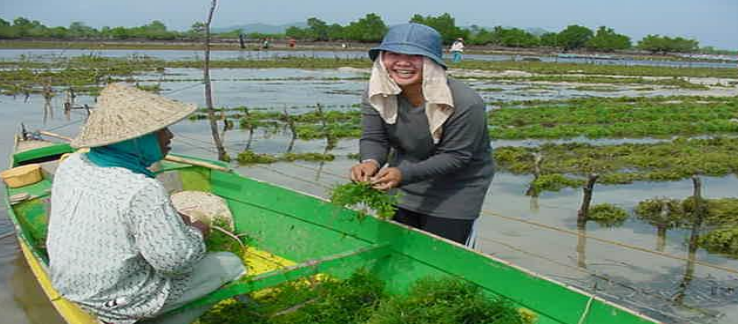
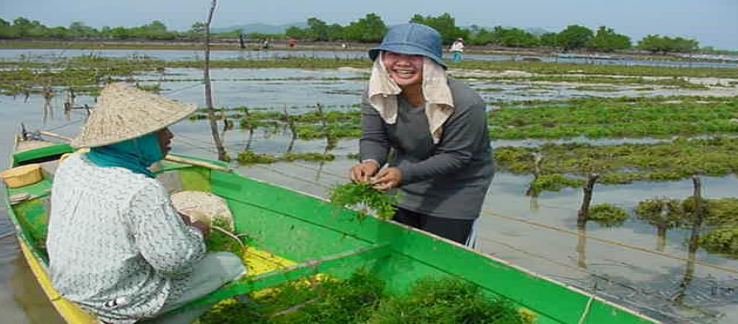
Seaweed culture farming in Zamboanga. Credit-NAST

   PCAFI President DAnilo V. Fausto the industry is “happy and delighted” that Indian Ambassador to Philippines Shambhu S. Kumaran brought up the idea of the India Philippines Virtual Business Conference on Marine Fisheries and Aquaculture (IPBC-MFA).  The first of such IPBC-MFA was held Thursday.

   “Indian fisheries sector produces over 7 million tons of fish and shellfish from capture fisheries and aquaculture, almost double of that produced by the Philippines, representing nearly 5% of the world’s total fish production,” said Fausto.

   Yet, Fausto said both countries can immensely benefit from exchange of resources, technology, know-how as Philippines also has much to offer.

   “Philippine aquaculture has strong potential for further expansion and development with our vast resources 338,393 hectares of swampland, 14,531 hectares of freshwater fishponds, and 239,323 hectares of brackish water fishponds,” Fausto said.

   “The Philippines sits at the heart of the coral triangle, the global center of marine biodiversity.  The Verde Island Passage boasts the highest concentration of marine species with its reefs as home to nearly 60% of the world’s known fishes and 300 species of corals.”

   During the business conference,   Dr. Munisamy Shanmugham M/s Aqua Agro Processing Manamaduria (Tamil Nadu)  vice president, said this is the time to invest in aquaculture, including seaweeds in India. Government, he said, has allotted budget of INR 640 crore ($88.34 million) to promote the industry and provides subsidy for seaweed cultivation.

   “There is huge demand for seaweed hydrocolloids in India, but currently 50-90% is met through imports,” said Shanmughan.

  There are new areas –Gulf of Mannar and Gulf of Kutch—that may be considered for seaweed cultivation to meet India’s demand.

   India just started to establish in 2010 its processing facilities for producing carrageenan, a value-added processed form of seaweed. Carrageenan acts as emulsifier, thickener, additive, and preservative in food and consumer products. It is an input in manufacturing dairy, gelatin, and meat products and other high value consumer products such as toothpaste and gels.

   The Philippines is a global leader in carrageenan and seaweeds and has put up its processing facilities way earlier than other countries. Its seaweeds and carrageenan exports totals to around $200 to $250 million yearly. It has strength in technology and know-how in carrageenan manufacturing. It was the first in the world to develop seaweed species Euchema and Kappaphycus for commercial cultivation for carrageenan.

Carrageenan, a thickener, enhancer, emulsifer, preservative. Credit-Medium

   Even with that, the Philippines still has huge expansion area of 140,000 hectares of potential seaweed farm for expansion, according to Alfredro Pedrosa III, Seaweed Industry Assn of the Philippines (SIAP), said in the same conference.

   “These are the resources that sustain our industry. We have available farm area of 200,000 hectares along coastlines.  Only 60,000 hectares are farmed.  We have 500,000 hectares of deep-sea available farmable area,” said Pedrosa.

   Opportunities for investments in the Philippines in seaweed industry are ripe, Pedrosa said, as domestic demand exceeds supply.

   The following factors also augur well for seaweed investments, he said:  ASEAN market integration, consumer preference for natural products such as seaweeds, and new climate change adaptation strategies and COVID pandemic recovery.

   The Philippines has continuing research and development (R&D) activities on other seaweed species.  Surprisingly, there is an abundance of 893 seaweed species in the Philippines, he said. But only a few are used for carrageenan of perhaps less than 10 species including Eucheuma, Gracilaria, Sargassum, and Kappaphycus.  Other seaweeds species to be cultured are Halymenia, Porpyra, and Ulva Lactuca. (Melody Mendoza Aguiba)

Philippines, India looks at enormous fishery trade opportunity starting with Philippines’ potential investment in tuna processing facilities in India

May 27. 2021

The Philippines and India are looking at enormous opportunity for trade cooperation on marine fishery and aquaculture starting off with Philippines’ potential investments in putting up tuna processing facilities in India or importing its needed tuna raw materials from India.

   India’s fishery industry players led by Indian Ambassador to the PHilippines Shambhu S. Kumaran have invited members of the Philippine Chamber of Agriculture and Fisheries Inc. (PCAFI) led by Chairman Philip L. Ong, also aquaculture feeds maker Santeh Feeds chairman, to look at investment and technology exchange in fisheries. 

   “It will be the start of a long process of linking to raise productivity.  We invite you to look at business opportunities in India,” said Kumaran during the India Philippines Marine Fisheries & Aquaculture virtual business conference.

PCAFI Chairman Philip L. Ong optimistic of investments, technology exchange in marine fisheries and aquaculture between India and Philippines

   Cherian Kurian, managing director of India’s M/s HIC ABF Special Foods, there is a huge opportunity for tuna value addition in India as it produces largely tuna ready for canning.  This is where Philippines’ global leadership in tuna processing and canning comes in. Tuna is one of the Philippines’ largest seafood export with a yearly value of $350-$400 million.

   Frabelle Fishing Corp President Francisco Tiu Laurel Jr. said tuna fishing in India is also a potential opportunity for local fish producers.

   “Tuna fleet is willing to expand when they’re woelcome to fish,” said Laurel.

   Local tuna processors-canners can put up canning facilities in India. 

   However,   Francisco Buencamino, Tuna Canners Assn of the Philippines executive director, said it may be advantageous rather to import India’s raw tuna production and process these locally.  This is because the Philippines has preferential duty privileges to the European Union in tuna export.

   Kurian said India’s oceanic tuna resource potential within its exclusive economic zone reaches to 2.13 million metric tons (MT) with yellowfin taking up 54% and skipjack 40% of total.   Kurian said India can start exporting tuna to the Philippines in bigger volume. This way, the Philippines can maximize its processing-canning capabilities.

   Another area of cooperation is shrimp as India may extend technology and research and development (R&D) to Philippines which suffers from difficulty handling shrimp diseases.

   India is the world’s largest shrimp producer and exporter particularly the vannamei species. It exports 90% of shrimp production, exporting almost 50% to the United STates.   Still, there is 9.7 million hectares of potential shrimp area in India.  Of this, 8.5 million hectares are waterlogged saline areas and 1.2 million hectares of brackishwater.

   Miguel Rene A. Dominguez, Alsons Agribusiness Unit vice president, said there is an opportunity to raise productivity in shrimp and mangrove crab production in the Philippines. India’s technology expertise in these technologies may potentially help raise Philippines’ shrimp and mangrove crab production.  End

   For the Philippines’s hatchery, there is a huge opportunity in Finfish, shrimp and crab.    “The Philippines has a rich reservoir of resources both physical and know-how for aquaculture development.” (Melody Mendoza Aguiba)

DENR carries out $150 million project for enhanced ecosystems through USAID bilateral assistance fund

May 27, 2021

The Department of Environment and Natural Resources (DENR) is carrying out a $150 million (P7.25 billion) project for enhanced ecosystems through a bilateral assistance fund from the United States Agency for International Development (USAID).

   As the United States government marks this year its 75th year of bilateral relations with the Philippines, it has further committed to a project to help the country in sustainable development.

   The bilateral assistance agreement was signed last February by the National Economic and Development Authority (NEDA) and USAID.

   “The agreement aims to protect ecosystems, promote the sustainable use of natural resources, and build the capacity of people, communities and institutions to withstand, cope and recover from shocks and stresses so that people and ecosystems thrive,” said Sean Callahan, Acting Mission Director of USAID. 

   Two of the projects covered by the bilateral agreement are SIBOL and Safe Water Project (SWP). SIBOL or Sustainable Interventions for Biodiversity, Oceans and Landscapes is a five-year, P1.1 billion ($22 million) project.

   The project supports DENR in improving natural resource governance, stimulating public and private sector investments in conservation, and reducing environmental crime, leading to greater ecosystem stability and inclusive green growth. The project also includes provision for communities’ access to clean water and sanitation services.

   SIBOL works with the Biodiversity Management Bureau, Forest Management Bureau, and DENR’s field offices in Central Luzon (Region 3), Southern Luzon (Region 4B) and the CARAGA Administrative Region (Region 13). 

   SIBOL’s implementation is led by RTI International, a U.S.-based non-profit organization.  It has three decades of experience providing technical assistance, institutional strengthening, programmatic support, and research in a variety of sectors in the Philippines.
   Meanwhile, SWP is a five-year worth P870 million ($18.4 million).  It works to improve water security for vulnerable and underserved communities. 

   Working with both the national and local governments, SWP supports initiatives to increase access to resilient water supply and sanitation services.  It aims to improve the sustainable management of water resources that enable long-term water provisioning.

   Also part of SWP’s mandate is to strengthen the governance and regulation of the water sector. 

   SWP’s implementation is coordinated with NEDA and with multiple sections of the DENR.  These include the Forest Management Bureau, DENR field offices in Southern Luzon (Region 4B), Western Visayas (Region 6), and SOCCSKSARGEN. It also works with the National Water Resources Board.  

   The project is being implemented by the DAI Global LLC which carries a long history of working in the Philippine water sector. 

   SWP is also coordinated with local organizations, Orient Integrated Development Consultants, Inc. (OIDCI), Lutheran World Relief, Inc. (LWR), CEST, Inc., Geosciences Foundation Inc., and the Manila Observatory.  

“The long history of the partnership between DENR and USAID has been fruitful.  We have achieved much in creating a more secure environment that sustains both ecological integrity and human development. It has led to the improved management of protected areas and strengthened environmental law enforcement. It has increased public awareness about the challenges of wildlife trafficking and improved water security through integrated watershed management, among others,” said Sean Callahan, Acting Mission Director of USAID. 

   “As USAID and the Philippines mark the 75th anniversary of the diplomatic relations this year, I am truly optimistic that these memorandum of understanding will help us achieve many more milestones together as we work toward our shared goal of inclusive and resilient growth for all Filipinos,” he added

   Environment Secretary Roy Cimatu looks forward to the partnership.

   “We always welcome effective collaboration to continue the advancement and sustainability of how we protect our ecosystem and natural resources,” he said.

   “USAID has always been a consistent and effective ally for the DENR for the past years. They have supported us for years in creating sustainable models which guided us in increasing and strengthening our policies for the management of our ecosystems. That is why we are looking forward to more meaningful years with USAID in advancing our shared goals of environmental sustainability and improving the lives of the Filipino communities.”    Since 2014, USAID has provided more than P5 billion ($100 million) in assistance to the Philippine government in conserving the country’s biodiversity and protecting its landscapes and seascapes.