The government is strengthening five seaports’ capability to seize illegally traded wildlife in light of unabated cases of wildlife smuggling that threatens biodiversity, consequently the nation’s economic resources.
The Department of Environment and Natural Resources (DENR)-attached Biodiversity Management Bureau (BMB) has entered in a memorandum of agreement (MOA) with the Philippine Ports Authority (PPA) to combat illegal wildlife trade (IWT) beginning with the country’s five major seaports.
The seaports in the south include the Lipata Port in Surigao del Norte, and Nasipit Port in Agusan del Norte. In Metro Manila, these are the ports of Manila — Manila North Harbor, Manila South Harbor , and Manila International Container Terminal.
Illegal wildlife trade renders to extinction endangered species. Credit-ADB
DENR-BMB and PPA have started evaluating emergency responses to wildlife smuggling of these five seaports. Data showed that over the last 10 years (2010 to 2020), there have been 17 cases of wildlife confiscations in ports overseen by the PPA.
The MOA involves partnership to combat IWT in all of the 337 PPA-registered seaports nationwide.
According to the United Nations Environment Programme (UNEP), IWT is estimated to have a value of $23 billion per year. This makes it the fourth “largest transnational crime” in the world after narcotics, human trafficking, and arms.
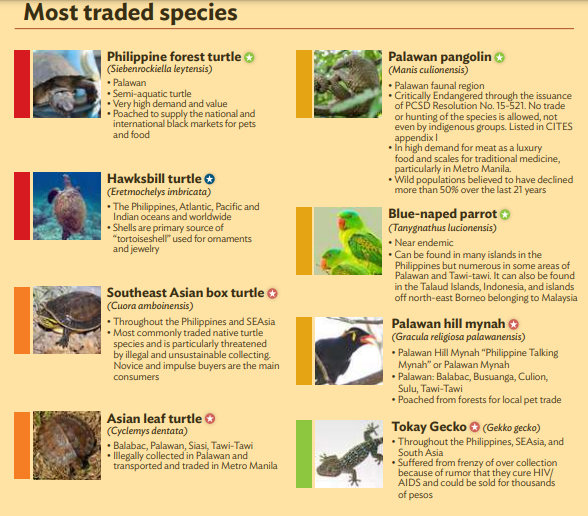
Philippines’ most illegally traded species. Credit-ADB
With the assistance of the Global Environment Facility (GEF-6) through the project
“Combating Environmental Organized Crime in the Philippines,” DENR-BMB is implementing a three-year project on capability building against IWT. It is co-implemented with the Asian Development Bank.
“It aims to combat environmental organized crime in the Philippines through legal and
institutional reforms, capacity building in the full law enforcement chain, and reduction of demand for illegal wildlife and wildlife parts and derivatives,” DENR said.
Earlier assessment of the five seaports indicated flaws that have to be addressed in order to fight wildlife trafficking. The evaluation found out that there is an absence of a “single window environment for Electronic Clearance System in the ports.
There has also been a lack of intelligence and intelligence access on a regional scale that may help the early detection and interception of wildlife contrabands entering the port. (Melody Mendoza Aguiba)
ADDITIONAL DETAILS
These problems also have to be addressed so that government will be able to stop or reduce cases of IWT:
1. Lack of risk profiling system complemented with wildlife crime risk indicators;
2. Absence of a K9 Unit able to detect wildlife, by-products, and derivatives
3. Absence of established standard operating procedures for inspection and seizure of wildlife and other illicit goods;
4. Absence of a protocol on post seizure investigation of cases;
5. ABsence of an information exchange system with local ports (for PPA) but under-maximized communication exchange with international institutions;
6. Absence of an established system to maintain employees’ integrity and professional standards and to deter corrupt practices; and,
7. Absence participation of industry operators, and need for greater cooperation and support from other supply chains.
June 19, 2021 – Applications are now open for the 2021 Youth Ag Summit (YAS), a global forum and biennially organized conference where young leaders collaborate to develop sustainable solutions for food security and global agriculture as they work toward becoming global instruments of change.
While this is the 5th biennial Youth Ag Summit, it will be the first virtual YAS event. This year’s cohort will also benefit from another exciting YAS first. As an official global partner with Bayer for this year’s forum, the UN Sustainable Development Solutions Network (SDSN), in partnership with technology company Babele, will also provide a virtual idea incubator called YAS University where delegates will continue to learn entrepreneurship and leadership skills, receive coaching from mentors, and improve their own “Thrive for Change” project concepts throughout a 10-week period following the November summit.
The summit’s overall theme, “Feeding a Hungry Planet,” is based on the United Nations’ prediction that the planet’s population will reach 9.7 billion people by 2050 and will be faced with food security challenges. The 100 delegates selected to participate in this year’s Youth Ag Summit will be tasked to work on developing solutions to this challenge using the Sustainable Development Goals (SDGs) of the United Nations as their framework.
2019 delegates of the Youth Ag Summit, Brasilia, Brazil
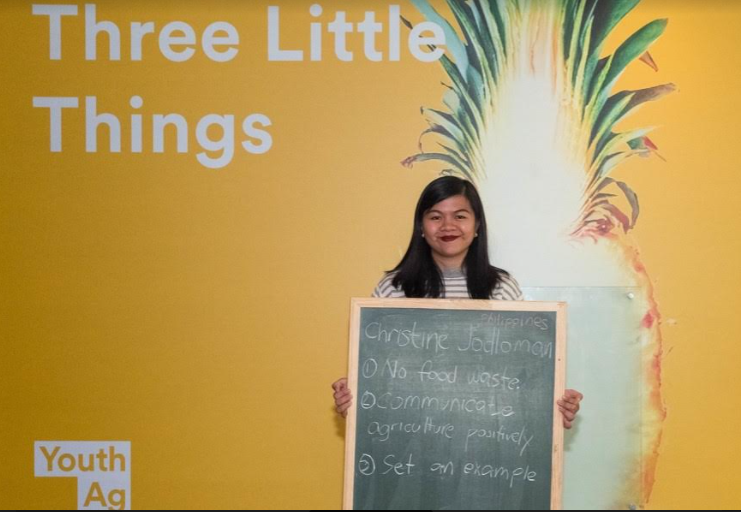
Christine Jodloman, Associate Director of AGREA Foundation and the sole Filipino delegate in the 2019 YAS held in Brazil, shares her experience. “My YAS experience has been amazing and humbling, as I was able to meet, connect, and get inspired by my fellow youth ag changemakers around the world.”
In the event, Jodloman was able to share her work and advcocacy on grassroots agripreneurship for rural farming communities. According to her, delegates from around the world were able to provide suggestions and improvements, which she has been integrating in their youth and women programs at AGREA. Within the organization, Jodloman also helps in their Move Food Initiative as a facilitator to farmer groups, wherein they were able to provide 190,000 kg of produce and help 30,000 farmers in 2020 at the onset of the pandemic.
“Agriculture is not just about growing food, but it also means growing the future,” added Jodloman. “We need a future with a thriving agricultural sector, where people and the planet are prioritized. I believe the youth are willing to be more involved in agriculture when it’s communicated in a positive way.”
“This is a great opportunity for the youth to be empowered and take the lead in sustaining Philippine agriculture,” said Iiinas Ivan Lao, Country Commercial Lead of Bayer Crop Science. “With the Youth Ag Summit, delegates can learn from each other and find out which ag successes in countries that can be adopted locally. This is also consistent with the Department of Agriculture’s push for agriculture promotion among the youth for food security in succeeding generations.”
Associate Director of AGREA Foundation and the sole Filipino delegate in the 2019 YAS held in Brazil
Application for the 2021 Youth Ag Summit is open to young people of any background aged 18-25. Potential delegates will be asked to share their motivation to join the summit, their previous advocacy experience and a 3-minute video pitch explaining their project idea on “How to feed a hungry planet.” Examples of projects pitched and developed from earlier summits include the opening of Sri Lanka’s Kadamandiya Food Bank and the establishment of a Madagascar health clinic where workers harvest essential grains in fields nearby to supplement their patient’s nutritional needs.
Applicants should be personally, professionally, and academically interested in agriculture, international development, environmental stewardship, food security, biotechnology, and/or farming.
To apply for the Youth Ag Summit 2021, please visit www.youthagsummit.com. To learn more, follow #AgvocatesWithoutBorders on Twitter and Youth Ag Summit (@youthagsummit) on the YAS Instagram channel. Application closes on June 30, 2021. The Youth Ag Summit will be held on November 16-17, 2021.
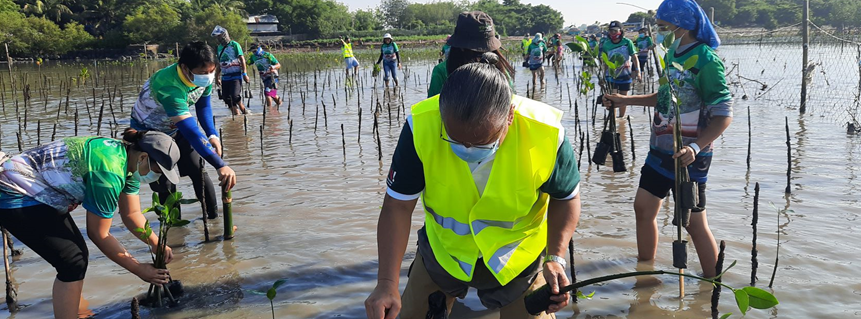
A degraded mangrove coastal area in Barangay Buayan, General Santos City has been adopted as a “Rhizophora” farm by Bayer Crop Science in an aim to help sustain biodiversity, protect the community from storm surges, and generate livelihood and income.
Called “Adopt a Coastal Special Protection Area,” the project was initiated by the Department of Environment and Natural Resources (DENR) in the city.
“It will generate income for the community from the seedlings that they’re able to grow. We will encourage them to maintain the transplanted seedlings in a portion of the coastal area,” said Richard Bangoy, Bayer Crop Science regional field technical lead for Philippines and Indonesia.
An initial 200 seedlings of the mangrove variety Rhizophora mucronata have so far been planted in the mangrove area by Bayer.
The Rhizophora varieties have been identified by the City Environment and Natural Resources (CENRO) office of General Santos as Rhizophora has been naturally occurring in the area for a long time. It has been the long-known adaptable mangrove variety that better survives diseases and climate changes..
Rhizophora mucronata has multiple uses, multiplying potential sources of income for the Barangay Buayan community.
Aside from helping prevent coastal erosion, its timber is used for firewood and in the construction of buildings, as poles and pilings, and in making fish traps.
The fruits can be cooked and eaten or the juice extracted to make wine, and the young shoots can be consumed as a vegetable. The bark is used in tanning and a dye can be extracted from both bark and leaves. Various parts of the plant are used in folk medicine.
The degraded coastal area in Barangay Buayan has made the community vulnerable to harsh impacts of climate change — storms and tsunamis.
“General Santos City’s environment and natural resources have been under threat from various environmental issues and problems from deforestation and conversion of forestlands, degradation of its rivers and coastal waters and resources from erosion, pollution and anthropogenic activities, climate change, among others,” said Bangoy.
Protecting the community from serious disasters (such as what happened to Leyte communities during the very destructive Yolanda storm) is a major objective in rehabilitating the coastal area.
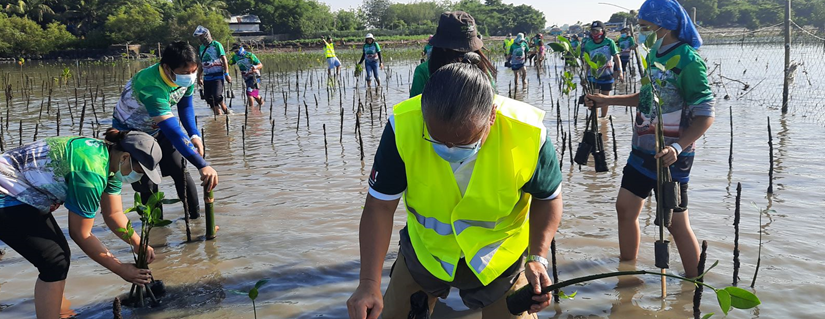
Bayer employees give back to the environment and the community of Brgy Buayan, General Santos City through mangrove planting
“Mangroves are the first line of defense for coastal communities. They stabilize shorelines by slowing erosion and provide natural barriers protecting coastal communities.”
The communities in Barangay Buayan have contributed to putting up the nursery for Rhizophora. They are the ones picking up seeds or seedlings and first grow these seedlings up to a height of one foot to 1.5 foot before transplanting to more vulnerable coastal areas exposed to the tide. They also water the transplanted plants.
Over the longer term, the mangrove area may potentially generate livelihood from growing crabs or a local delicacy called “Tamilok.” Tamilok is a kind of edible earthworm prepared into a dish like kinilaw or kilawin – a dish cooked in vinegar.
Bangoy also hopes that sustaining the environmental beauty in the coastal area of Barangay Buayan would help transform it into a tourist site near General Santos City airport.
In the last eight years, Bayer has been supporting different environmental projects including a bamboo planting along the riverbanks of Barangay Tinagakan, General Santos City. Bayer has a corn research and breeding station in the city and these efforts are a way of giving back to the local community there. (Melody Mendoza Aguiba)
The Philippines has posted an “embarrassingly high” poverty incidence among farmers of 31.6% and a whopping trade deficit of $5.9 billion that makes it the only net food deficit country in the ASEAN5.
Private sector leaders led by the Philippine Chamber of Agriculture and Food Inc. (PCAFI) deplored that the Philippines has been left behind by ASEAN5 (Association of Southeast Asian Nations) countries. That is despite its being equally endowed in natural resources and even in numerous labor.
Dr. Emil Q. Javier, chairman of the Coalition for Agricultural Modernization of the Philippines (CAM), an ally organization of PCAFI, said in a press briefing Thursday that Philippines’ food export just totaled to only $5.1 billion, a figure far exceeded by imports.
“All is not well in Philippine agriculture. We have food exports of only $5.1 billion but trade deficit of $5.9 billion, (That makes Philippines’) dubious distinction of being the only net food deficit country among ASEAN 5,” he said. The other progressive ASEAN countries are Thailand, Malaysia, Vietnam, Indonesia, and Singapore.
A “nearsighted” focus of government leaders on what can be accomplished during their short, political 6-year term has made Philippines the laggard among progressing neighbors, according to PCAFI President Danilo V. Fausto.
He urged the government to plan on a long-term basis, not on a reactive basis on just what happens in the global economy.
“Government leaders come and go based on their term. But we in the private sector are invested in. Our children and our children’s children depend on agriculture for business and livelihood. My appeal is for the government to consider agriculture not as charity but as a sustainable venture,” said Fausto.
Dr. Emil Q. Javier, national scientist & former Department of Science and Technology secretary; Danilo V. Fausto, PCAFI president & DVF Dairy Inc. entrepreneurial founder
As entrepreneurial founder of “Gatas ng Kalabaw” bottled carabao milk and other high-value dairy goods, Fausto said he has been in the dairy industry for 30 years.
Javier is optimistic though that the Philippines indeed has a modern farm sector ( of progressive farmers and corporate farms) with high productivity, profitable and competitive with imports. Having been a consultant for multinational pineapple processor Del Monte, Javier has known world-class operations of Filipino food producers.
“We can do better. It is the small farmers and fisherfolk (SFF) who constitute the majority that are dragging our averages down,” he said.
Fausto and Javier lamented that of the high 26% national poverty incidence as of 2018, the brunt of suffering goes to the farmers and people in the countryside. Poverty incidence among farmers tops at 31.6%; fisherfolks, 26.2% percent; and individuals residing in rural areas at 24.5%.
Javier is emphatic that government should adopt strategies that will make small farmers become “bigger” as they are organized into groups or clusters.
He said clustering is important because it will be the key to lifting SFF from poverty.
When clustered, small farmers can enter the global supply chain where margins are bigger.
They can negotiate for higher prices in big supermarkets, even multinational ones. They can also haggle to buy cheaper inputs when they buy fertilizers or seeds in bulk. Economies of scale can be achieved, bringing down cost, when services (like transportation, irrigation, post harvest facilities, storage facilities) are delivered in bulk.
“Farm consolidation will enable farmers to mechanize field operations to reduce costs; facilitate acquisition of inputs as well as credit; embark on value-adding (processing) at the community level; diversification into crops and other livelihood,” said Javier.
A former Department of Science and Technology (DOST) secretary and a recently awarded National Scientist, Javier stressed contract growing will be the key to making small farmers bigger.
“There should be promotion of contract growing as a business model. It involves buyer-driven value chains that are working in broilers, swine, banana, pineapple, papaya, tobacco, okra (industries),” he said.
He said contract growing provides incentives to agribusiness integrators (mills, food processors, exporters, supermarkets) to expand into other commodities.
Government should facilitate in “social mobilization of farmers” and helping in enforcement of contracts in a contract growing system.
Himself a contract grower (of hybrid rice and other agricultural produce), Javier said agriculture leaders especially in government (Department of Agriculture, Department of Agrarian Reform, and Local government units) should not give up their efforts to organize farmers.
“By organizing farmer associations e.g. coops, irrigators associations (IAS) agrarian reform beneficiaries organizations (ARBOs), the small farmers are in a better position to be partners/players in the value chains.”
“We should persevere (not give up!) in mobilizing, organizing farmers into cooperatives, IAS and ARBOs.”
PCAFI and CAMP has supported a strong LGU-led development of the agriculture sector.
Javier said the Province-led Agriculture and Fisheries Extension Service (PAFES), initiated by DA, should be strengthened as a national policy.
That is a mandate already firmly established by the Local Government Code of 1991 (RA 7160).
But capability building in LGUs is necessary to make this happen.
“Unfortunately, the municipal agriculture offices (MAOs) proved to be suboptimal operating units to deliver rural extension services for various reasons, the principal of which is lack of personnel, expertise, and operating funds (especially in third and sixth class municipalities)
“It is better to shift the locus of rural development planning, coordination and direction at the provincial level,” he said. (Melody Mendoza Aguiba)
The private sector has asked President Duterte to issue an executive order (EO) institutionalizing a provincial-led agricultural governmance especially as local government units (LGs) will soon be awash with cash. LGUs will have an additional P234.39 billion budget beginning in 2020 from the new Mandanas-Garcia ruling.
The Philippine Chamber of Agriculture and Food Inc (PCAFI) and the Coalition for Agricultural Modernization of the Philippines (CAMP) have expressed support for a national policy putting the burden of agricultural governance to LGUs.
The EO must be issued, rather than just putting all responsibility for the farm sector’s administration to Department of Agriculture (DA) alone as what is the prevailing system.
Dr. Emil Q. Javier, CAMP chairman, said in a press briefing that DA is in the right track in having set up a pilot program for this agriculture governance in the province. .
However, instead of just a DA administrative order (AO), an EO will be a stronger national policy that will accelerate use of funds for food security and agriculture. It will compel LGUs to put a major focus on agriculture and food security.
“The tactical program in agriculture should be coursed to provincial offices to encourage provincial government (to focus on agriculture.) We should organize extension officers in SUCs (state universities and colleges),” said Javier.
“(DA) Secretary (William Dar ) already adopted the proposal and has a pilot program for provincial agriculture office. But there should be more agriculture offices in the provinces. It’s a good opportunity to call attention of the president by way of issuing an EO.”
PCAFI President Danilo V. Fausto such EO should already be issued by Duterte considering that budget for 2022 is now being prepared.
PCAFI President Danilo V. Fausto, CAMP Chairman Emil Q. Javier
The EO is just in the right timing for the national government’s implementation of the Mandanas-Garcia Ruling of the Supreme Court. The ruling ordered that LGUs should get a share of all national taxes, not only those collected by the Bureau of Internal Revenue, but all national tax collections.
With this ruling LGUs are seen to raise their budget by 26.61% equivalent to P234.39 billion.
PCAFI asserts that since the national government’s budget for DA will be reduced, it is just proper for LGUs to allocate 10% of their internal revenue allotment (IRA) for food security.
“It is the interest and responsibility of LGUs to invest in food security,” said Fausto
LGUs will have a total budget reaching to P1.083 trillion, given the new ruling’s implementation.
“To create fiscal space, it is expected that some of the projects of the national agencies will be un-funded. With the policy of the current administration giving low priority to agriculture, we can project that the unfair allocation of the national budget to DA will further aggravate,” said Fausto.
PCAFI has been asking for reform in budgeting for the agriculture sector. It has been pressing for an allocation of at least 10% budget for agriculture out of the country’s estimated gross domestic product (GDP) – since agriculture contributes 10% of GDP.
World Bank placed at US$ 367.36 Billion (₱17.82 Triilion @48.50) the country’s GDP as of 2020.
The Philippine Statistics Authority placed total agricultural production for 2020 at ₱1.78 trillion representing roughly 10 percent of the GDP.
“Out of the total national budget of ₱4.506 trillion, the share of agriculture is a measly 1.5 percent or ₱66.4 Billion, despite contributing 10 percent to total GDP, showing clear disparity in budget allocation and the lack of priority given by the administration to food production leading to food sufficiency and food security,” said Fausto.
As of March 2021, the agriculture sector employs 24.6 percent of Filipinos coming both from the labor force and not in the labor force equivalent to 18.5 million Filipinos, with those in the labor force representing 48.77 million workers and not in labor force of 26.26 million totaling 75 million Filipinos.
“But, according to a paper written by Dr. Ciel Habito, if one considers agro-processing and agricultural inputs, manufacturing and trading (i.e. agribusiness sectors) along with basic agricultural production, about 40 percent of GDP and two-thirds of jobs in the economy arise from agriculture,” said Fausto.
From the 2021 ₱66.4 Billion budget of the DA, livestock and poultry which contributes 28-31 percent of the total agriculture production, got ₱3.21 Billion or 3.68 percent of the total DA budget.
On the other hand, the rice program that contributes 22 percent to the agriculture production got a budget of ₱35.27 Billion, representing 40.45 percent of the DA budget. If we are to include the budget for irrigation which is ₱31.0 Billion, the rice program is getting ₱65 Billion from the national budget since almost 100 percent of water irrigation goes to the rice program. In 2020, rice contributed ₱390.2 Billion. (Melody Mendoza Aguiba)
A multilateral cold chain project is looking for private sector investors in a “low carbon” cold chain system that involves a Covid 19 vaccination storage facility and a “hub” of facilities that will boost Philippines’ food-pharmaceutical safety and food security.
A project totally costing $27.5 million, the “Global Partnership for Improving the Food Cold Chain in the Philippines” (GPI-FCCP) is putting up cold chain facilities critical to the country’s food industry.
Cold chain has also now become critical to the health of the country’s population in the advent of Covid 19 pandemic .
A project led by international funder Global Environment Facility (GEF), the GPI-FCCP primarily involves establishment of policies advocating use of low carbon and energy-efficient refrigeration facilities for the food system.
Stringent policies are important in providing a stable investment environment for investors in “green” cooling technologies.
Cold chain covers every produce that needs cooling from the “field to the fork (transport, storage, transformation, packaging).
Policies will involve national standards for flammable refrigerants and revision of energy efficiency standards.
A total of 200 key stakeholders is targeted to be trained on energy-efficiency and climate-friendly cold chain technologies.
There is also a high level training for 50 local engineers, system suppliers and end-users on the use of global innovative cold chain technology.
Major implementors of the GPI-FCCP are the Department of Environment and Natural Resources (DENR) and UNIDO (United Nations Industrial Development Organization) .
A co-financier is Germany’s international cooperation agency GIZ (Gesselschaft fur Internationanale Zusammenarbeit).
GIZ now looks for private sector companies as part of distributing Covid 19 vaccines in the Philippines.
“Vaccine cold chains have become a new and urgent priority in the Philippines. The project also provides an opportunity to help develop integrated cold-chain strategies that build on the existing food cold chain system – ensuring better health and a reliable food supply in the Philippines,” reported the DENR.
Cold chain “hub”
The global cold chain project is also putting up the Cold Chain Innovation Hub (CCIH). It will be the project’s “central ecosystem of technical resources, training, knowledge sharing and stakeholder collaboration. “
The CCIH will guarantee that ”knowledge within the field of energy efficiency, low-Global Warming Potential (GWP) refrigeration technologies, and monitoring of the cold chain will be kept in the Philippines,” according to the GEF. That is even after project closure in 2022.
The Cold Chain; Source- DGrid Energy
Montreal Protocol
The cold chain project came about as part of the Philippines’ commitment to the 1987 Montreal Protocol. It is a global agreement to protect the stratospheric ozone layer by phasing out the production and consumption of ozone-depleting substances (ODS).
The ozone is the earth’s protective layer, absorbing UV light which reduces human’s exposure to harmful (skin cancer and cataract-causing) ultraviolet radiation.
ODS includes chlorofluorocarbons, halons, carbontetrachloride, methy chloroform, hydrobromofluorocarbons, hydrochlorofluorocarbons (HCFCs), methyl bromide, and bromochloromethane.
Refrigeration technologies have come out as top concern to have energy efficiency and low Global Warming Potential (GWP). It is because refrigerants extensively use hydrochlorofluorocarbons (HCFC) that have been found to be ozone-depleting.
The Montreal Protocol compelled signatory countries to freeze consumption and production of the ODS hydrochloroflouocarbons (HCFCs). Developing countries should have cut by 100% their HCFC production by 2030.
Very potent greenhouse gases, HCFCs are used as “refrigerants, solvents, blowing agents for plastic foam manufacture, and fire extinguishers.”
Private sector engagement will be crucial in the Philippines’ effort in obtaining knowledge transfer of the most innovative, climate friendly, and energy efficient refrigeration technologies.
How ozone depleting substances affect the atmosphere; Source- DW
Financiers
Financiers of the GPI-FCCP include Asian Development Bank, $10 million loan; DENR, $190,000; UNIDO, $199,500; Land Bank, $7 million; Development Bank of the Philippines, $5 million; Shecco, $3 million in supplies; and GIZ, $100,000.
The vaccine initiative will be financed by the German Federal Ministry for Economic Cooperation and Development (BMZ). BMZ supports private sector initiatives that “mitigate the economic as well as the health-related impact of the corona pandemic” of countries like the Philippines
BMZ disclosed that projects related to the Covid 19 vaccine cold chain requirements will receive up to €2,000,000 (US$2,430,710) of funding. This has a government cost counterpart of 50%.
Emission reduction targets
The GPI-FCCP targets to cut emission of carbon dioxide (CO2) by up to 5,722 metric tons (MT) directly. It also aims to cut CO2 emission indirectly by up to 479,815 MT.
The project will also have a forecast of Philippines’ growth in energy demand and its climate impact.
Emission of carbon due to refrigerants is estimated to contribute to 20% of total carbon emission. Moreover, energy consumption accounts for the highest 80% in carbon emissions.
“Worldwide it is estimated that 40% of all foods require refrigeration, and 15% of electricity consumed is used for refrigeration . With the rising concern over climate change, global warming as well as the insecurity in development and fluctuations in energy costs , there is increasing pressure to make significant reductions in carbon emissions and energy use,” GEF said.
Food exports
Adequate cold chain facilities are critical to the Philippines with its growing population. Its current capacity of 300,000 MT in cold chain threatens the quality of food it feeds to its people. With inadequacy, Philippines will also have difficulty sustaining its export/import potential.
The GEF report indicated the cold chain project will support the country’s increasing agricultural exports that reached $1.03 billion as of 2016.
The country’s cold storage sector was earlier projected to have reached a market value of $1.4 billion by 2020.
“The sector is highly fragmented, with more than 100 players active in the market. What’s currently lacking is end-to-end, integrated cold chain management to consistently allow all players on the network to connect,” according to the GEF report.
Poor practices in cold chain operations in countries like the Philippines has led to the “waste of electricity to feed the cold chain, release of powerful greenhouse gases, and post harvest losses.”
It is estimated that post harvest losses account for 30% of total production. The absence of a good cold chain is a major reason for this, among others.
“Lack of proper maintenance and knowledge very often translates into an inadequate management of the life cycle of refrigerant gases. More refrigerant leakage means less efficient equipment and higher emission of high GWP (global warming potential) gases into the atmosphere,” according to a Global Environment Facility (GEF) report.
Network of experts
The CCIH is so far eyed to be run by any of the following training institutions—De La Salle University Laguna, TESDA Green Technology Center or the University of the pHIlippines Los Banos Post Harvest Horticulture Training and Research Center.
The CCIH will maintain the network of experts in the project. It will run cold chain technology exhibition and training center. (Melody Mendoza Aguiba)
The tariff cut that now prevails under Executive Order (EO) 128 is totally useless as pork price is seen to remain expensive, and pork import has already skyrocketed by 150.7% to 110.419 million kilos in the first quarter of 2021 even without the tariff cut.
The United Broilers and Raisers Association (UBRA) said in a position paper filed with the Senate that inflation will not really soften just because of a tariff cut on pork imports.
“The stated purpose of EO 128 to bring down pork prices to affordable levels and dampen inflation will not happen,“ according to UBRA President Lawyer Jose Elias “Bong” Inciong.
Data from the Bureau of animal Industry (BAI) showed that even if a tariff cut has not yet been implemented, there was already a substantial increase of 150.70% or 66.376 million kilos in pork imports early this year.
This is from an import volume of 44.031 million kilos from January to March 2020 to 110.419 million kilos in the same period of 2021.
For prime cuts like bellies and pork cuts, the increase in pork imports has also been significant at 254% or from 10.719 million kilos in January to March 2020 to 38.024 million in the same period of 2021.
It is notable that the period accounted for started even prior to the onset of the effects of the Covid 19 pandemic lockdowns.
“Covid was not yet a major problem during the first quarter of 2020. These increases in importation occurred without any cuts in tariff.”
The Department of Agriculture (DA) itself set a Suggested Retail Price (SRP) for imported pork that is not really significantly cheaper than prevailing prices. The SRP for kasim is P270 per kilo, and for liempo, P350 per kilo.
“If this is the expected retail price after reducing the tariff for pork, then there is no improvement in the situation of our consumers. Since there will be no significant change in retail prices, why forego badly needed revenues by reducing tariffs on imported pork?” said Inciong.
United Broilers and Raisers Assn President Lawyer Jose Elias “Bong” Inciong
UBRA asserted government should rather let tariff rate at 30% in-quota and 40% out-quota.
The farmers’ group lamented that the current pork crisis is not only a result of the local hog industry’s contraction of African swine fever (ASF).
Rather, it is the natural consequence of the Philippine government’s intentional plan in the last 25 years to depend on importation and neglect its own Filipino farmers’ welfare.
“The executive branch was never serious about developing Philippine agriculture and fisheries.”
It is unfortunate that government really intended trade liberalization to keep retail prices of critical goods such as pork low.
When it joined World Trade Organization just before turn-of-the-century in 2000, government merely hoped free trade will compel local producers to be competitive.
However, this is a plan bound to fail.
“Retail prices have remained expensive for consumers because of a disconnect with farm gate prices and even with imports. Worse, many consumers lost their jobs and livelihoods and became OFWs (Overseas Filipino Workers.)”
While other countries took advantage of beneficial provisions of WTO’s free market offer, the Philippine government just opened up its industries to exposure to cheap imports.
But it neglected its own farm sector by failing to implement WTO’s provisions for domestic support, trade remedies, and Sanitary and Phytosanitary measures.
“The Philippines, unlike other government interpreted this (market access) to mean only import liberalization,” he said.
“Domestic support is about production and consumer subsidies and by extension, even export subsidies. This is an area where the Philippines has performed very poorly through the failure to implement laws like the AFMA (Agriculture and Fisheries Modernization Act).”
Neither did government implement trade remedies (anti-dumping, countervailing, safeguards measures) to protect local farmers against unfair trade.
“The government waits for the industries to suffer damage before acting,” he said.
A blatant government negligence is in its failure to put up the National Information Network (NIN) specifically mandated under AFMA’s Sections 38-45.
By such failure to establish a data system in trade and related information, government has failed to invoke trade remedies. This while other governments built their own data to establish evidences long before an unfair trade problem arises.
Even when it comes to SPS which should have protected the local pork industry from entry of ASF and other diseases, it failed.
Unfortunately, even up to now since the advent of trade liberalization more than 20 years ago, the Philippines does not yet have the first border inspection facility at the ports.
“The absence of a first border inspection area at customs is one of the most damning indication of the disinterest of government in agriculture. It is the reason ASF got inside our country.” (Melody Mendoza Aguiba)
Life science company Bayer has launched a second vegetable farm to benefit relocated communities in Calauan, Laguna. This is part of the company’s bid to augment food and livelihood requirements for families where needed.
Situated beside Southville 7 in Barangay Dayap, the 2,200-square meter farm is intended to support the regular feeding program in the community and contribute to providing an income source for community residents turned farmers.
“We’re excited to have this second opportunity to reach out to communities and promote agriculture for both food and livelihood,” said Vinit Jindal, managing director of Bayer Philippines. “Our colleagues are passionate about bringing our Bayer vision to life—Health for All, Hunger for None, and this is just one of the many ways on how our contribution can make a positive impact in society.”
Prior to the Bayer Kubo project in Calauan, the first urban farm was inaugurated in Taguig in January 2020 before the COVID-19 pandemic hit the country.
“When we first launched the Bayer Kubo project in Taguig, we had hoped to bring in medical expertise who could impart knowledge on healthcare topics as part of our capabilities,” said Bryan Rivera, head of communications and public affairs, science & sustainability of Bayer Philippines. “As the pandemic led to restricted people movement, we had to postpone these activities. However, the urban farm became a blessing for residents as this allowed them to make good use of their time through growing food right in their backyard.”
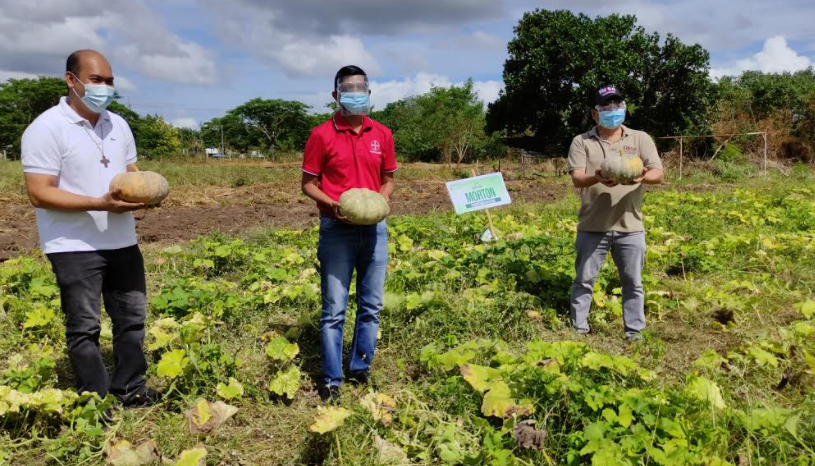
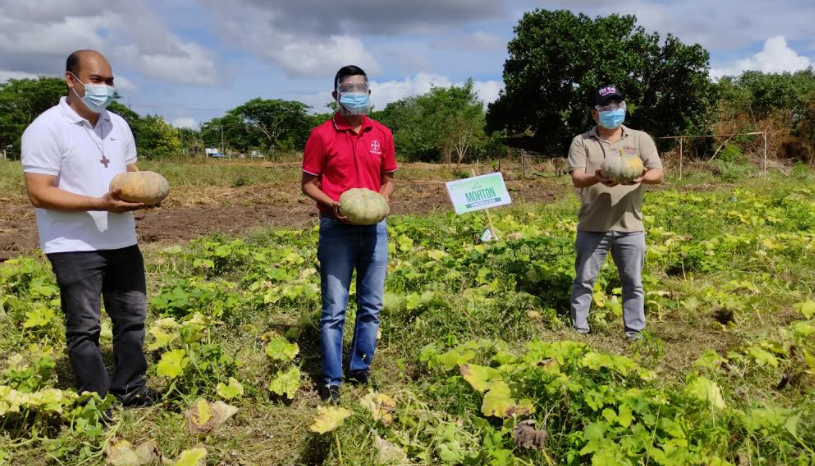
The crops initially grown in the Calauan vegetable farm include sweet corn, squash, tomatoes, and bottle gourd. The site also has a seedling nursery and a kubo that serves as a venue for training activities related to recommended farming practices.
Bayer Philippines Managing Director Vinit Jindal (center) leads harvest of squash at Bayer’s community vegetable farm in Caluan, Laguna
For the two projects, Bayer partnered with Rise Against Hunger Philippines as the latter has been active in distributing food through its food bank network, especially during the COVID-19 crisis.
“The community residents here in Barangay Dayap are eager to take care of the farm as they know it would bring them a source of income while supporting the regular feeding program of Rise Against Hunger,” said Jomar Fleras, executive director of Rise Against Hunger Philippines.
“In our agreement, part of the produce will go to the feeding program, the farmer volunteers, and managed by Don Bosco Technical and Vocational Education Training (TVET) Center in Calauan.”
Rise Against Hunger is an international hunger relief organization that distributes food and life-changing aid to the world’s most vulnerable, mobilizing the necessary resources to end hunger by 2030.
Father Jeffrey L. Mangubat, administrator and technical director of Don Bosco TVET Center in Calauan, was grateful for having the project established within their training facility.
Bayer Kubo becomes a center a training center not only for farming but health concerns regarding the Covid 19 pandemic, and even family planning for the Calauan, Laguna community
“We see this as a gateway to encourage the community to look for ways to become self-sustaining by getting involved in farming, whether big or small. We believe that this is not the last initiative of Bayer and Rise Against Hunger as we uplift the lives of families through the Bayer Kubo project and future engagement activities,” he said. (Bryan Rivera)
An education think tank has pushed for a legislation institutionalizing online or “blended” education as evidences show internet-based learning is creating renewed zealousness for learning among young students across all levels.
The Covid 19 pandemic just compelled many schools to resort to online methods of teaching upon the pandemic’s advent early last year.
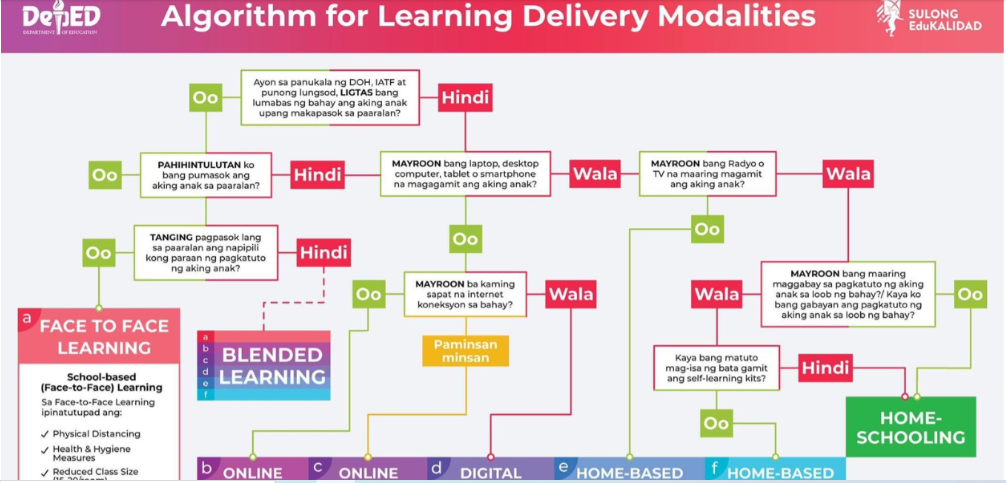
This means online learning becomes part of the blended learning mode. “Blended” also involves the traditional face-to-face system and the use of radio and television, according to the Department of Education.
Repeated studies of education expert Philippine Normal University (PNU) has been proving that online education is inevitably becoming pertinent in twentieth-century education.
Researches over the last 10 years compiled by Dr. Edna Luz Raymundo-Abulon of PNU even indicate that technology, as part of other education strategies, can spell the difference in Philippines’ reversing the “brain drain” phenomenon.
Apparently, the brain drain phenomenon — where Filipino teachers choose rather to work abroad than teach here– is caused not only by the low wage at home, but also the lack of opportunities to growth.
New methods in teaching through technology may turn out to be the hope toward brain gain— winning back home lost teaching workforce.
The PNU research is a compilation of 89 published researches in recognized refereed scientific journals and 38 research reported to the Educational Policy Research and Development Center (EPRDC).
Blended Learning. Source: Let’s Learn English
The researches were authored by PNU teaching professionals and conducted from 2010 to 2020.
The report supports PNU’s mandate under Republic Act 9647 which designated PNU as the country’s National Center for Teacher Education (NCTE). It made PNU a center on innovations and alternative systems and their utilization and application to teacher training and development.
PNU teacher-researchers are among those that instruct the country’s learners in grade school, high school, college (HEIs), and teaching leaders and administrators. PNU has also trained many teachers in more difficult subjects under STEAM (Science, Technology, Engineering, Agriculture, and Mathematics).
The use of technology in (via blended modality) in higher education has been proven to be effective. This was especially true for teaching Learning Management Systems—a software for administering of educational or training programs (Balagtas et al. 2018).
Even for learners in basic education, technology has been known to be enhancing learning. A study on MyOpenMath, an online learning management system in grade school, was found to help young pupils not only learn Math efficiently.
More so, the study of Sarmiento and Prudente discovered that a practical function of MyOpenMath is it prevents copying of homework among students. That ensures pupils’ authentic Math learning.
To explore students’ thoughts regarding blended learning, students’ perception has been solicited in another PNU study (Mancao and Morales, Abulon, Ermita & David). The study showed that blended learning—integrating online lectures with classroom lectures — is an “efficient and effective” way to teach or learn college courses.
But while college students have positively welcomed the use of internet and gadgets (laptop, netbook, mobile phone) as part of education, the problem oftentimes is the lack of readiness in using these.
Cost of gadgets and internet connection remain to be a major hindrance to online learning. Moreover, the presence of qualified teachers adept in software and hardware is another problem.
This is where a legislative policy may come in. That is to ensure that gaps in blended learning is collectively addressed by the Department of Education, Department of Information Communications Technology and relevant agencies.
As the government has a thrust to enhance education on STEAM ((science, technology, engineering, agri-fisheries, and mathematics), the PNU report stressed that new pedagogies (teaching methods) including the use of technology must be introduced.
“Proper assistance must be given by universities in implementing new pedagogies. For instance, with blended learning, standard templates, class schedules, and online rules must be developed (Mancao et al., 2015).”
“In any new or innovative strategy to be implemented, it must first be determined that there are enough resources, instructors must be properly trained, and students must be involved in ensuring that these pedagogies are properly applied.”
Blended learning is actually being suggested as a solution to addressing the problem of large classes across all levels in the Philippines. Ideal class size may just be 20-30 students per class. But it is not uncommon to find classes of 40 and above even in grade school.
“Studies looked at approaches that can be used in order to address limitations like large classes. One such study examined the effective teaching strategies that can be applied in large classes (Reyes & Dumanhug, 2015). Another study looked at an innovative approach that can integrate technology in teaching—blended learning,” reported Abulon.
The fact remains the gaps in technology use in schools have to be addressed.
One basic facility that has to be enhanced in higher learning (college and graduate) is the online library. PNU itself promotes a web-based research management system as part of developing a university research portal.
At PNU, the web-based research portal developed has provided a fast, systematic, and organized research management system that keeps record and tracks all research activities in the university.
In higher education (college and graduate schools), there should be policies to ensure that the curriculum is relevant to present needs of the society.
“Archaic ways which no longer serve their purpose must not be retained (e.g., Anito & Morales, 2019).”
DepEd’s Blended Learning Mode
“Higher education could greatly benefit from technology, such as in the delivery of training using a blended modality (Balagtas et al., 2018).”
Moreover, a PNU research found out online learning is not only effective. Important, it can also be fun and enjoyable as one class in a Teacher Education Institution (TEI) showed. A TEI is a school focused on training teachers.
“The use of low-cost tablets wherein online and offline course-related activities were implemented to an intact class in a TEI was piloted for a semester. It found out that learning became enjoyable with the tablet because of the many useful apps that could optimize learning (Cacho et.al, 2017).”
The use of smartphones (in-class and after-class) was also explored in a class of pre-service teachers (Cacho 2017).
“The study highlighted the functionalities of the apps in android phones commonly used by the students in relation to better access to relevant information. There is cohesiveness during collaborative learning activities.” (Melody Mendoza Aguiba)














 Growth Features