PCAFI President Danilo V. Fausto, DA Sec. William D. Dar, PMFI President Roger Navarro (2nd from right to left)
The private sector has pressed the Philippine Ports Authority (PPA) to approve the location of the First Border Control (FBC) facility in to arrest massive spread of African swine fever (ASF)-infected meat and livestock that wreaks havoc on farmers’ livelihood.
The Chamber of Agriculture and Food Inc.(PCAFI) and member group Philippine Maize Federation Inc. (PMFI) have re-asserted their petition after the Department of Agriculture (DA) promised to put up the FBC facility in July last year.
“ASF as we know comes from outside of our country. We are very strict and compliant with all protocols in our movements from within our soil. Yet we failed in the First Border on what is coming into our country,” said PMFI President Roger Navarro.
Navarro said reports indicate the delay in the FBC construction is due to the delay in the approval of the location where the facility should be put up.
“We are told there are obstacles to implement the First Border Control facility due to pending approval from the Philippine Ports Authority to give the area. So we are calling on PPA and the Department of Transportation and Communication (DOTC) to cooperate and help,” said Navarro.
Danilo V. Fausto, PCAFI president, said government seemed to have allowed wayward spread of ASF with the delay in the FBC construction and the absence of systematic and organized hog vaccination program.
PCAFI urges government to implement all-out all measures to spread ASF through massive vaccination.
DA and Bureau of Animal Industry (BAI) should get vaccine from Vietnam to stop ASF similar to how vaccination program for Covid 19 is being accelerated.
Fausto said the Central Luzon State University (CLSU) has developed rapid test kits for the early detection of ASF in hogs.
“This use of CLSU’s rapid test kits must be coming in too late after ASF’s discovery in 2019, but it’s better late than never,” he said.
Navarro said even if it is not its direct concern, PPA-DOTC should be pressed on the critical importance of the FBC.
“While we are experiencing the devastation of ASF from the consumers, piggery owners down to the lowly corn farmers, authorities that need to help seems to be asleep and does not care. DOTC should wake up. This is the time we need you on rescue mode and be partakers to save our country and farmers,” said Navarro.
PCAFI has also been petitioning before Congress long term development plans for the hog, poultry, and livestock sectors, not just short-term solutions to crises like ASF.
It is unfair that poultry and livestock gets only an average of 3% from the budget of DA while it contributes an estimated 35% in total agricultural production revenue. On the other hand, palay gets the whopping 40% of budget despite contributing only 22% in production revenue.
Moreover, livestock and poultry actually accounts for a significant 2.5% of the Philippines’ total Gross Domestic Product (GDP) revenue generation. That makes it a critical mover in national development.
Agriculture sector gets barely 2% of the total national budget, while contributing 9-10% of the GDP. With P4.5trillion 2021 budget, DA should get at least P405B in the national budget, livestock and poultry with at least P112.5B from the national budget.
Poultry and livestock plays a highly significant role in the economy as its condition has multiple effect in many other sectors.
“The feed industry is a P510 billion industry. Assuming two-thirds (67%) of feeds go to livestock and poultry, that represents P340 billion,” said Fausto.
Fausto also said DA does not really need to raise imports of meat and poultry given adequate distribution nationwide of the supply.
The supply is enough to fill the local demand. The need is to channel poultry and meat production, particularly from Visayas and Mindanao where these are produced, to where these are needed—Metro Manila and other cities. Melody Mendoza Aguiba
Rather than a temporary food aid of P5,000 per farmer, farmers have pressed government to put up mechanical dryers for rice and corn which will have lasting benefit of raising the produce’s price per kilo and stretching their shelf life, enabling them to hedge on the stocks for a longer period.
While not directly opposing the P5,000 food aid program approved under a Senate resolution, the Philippine Maize Federation (PMFI) asked government for a more beneficial investment—that of putting up rice and corn mechanical dryers.
“We are not comfortable with the decision of government to impart the excess tariff collected from rice imports to farmers at P5,000 each. We view this as if government is promoting our farmers’ state of mendicancy,” said PMFI President Roger Navarro
PMFI, many of whose members also plant rice and representing other farmers belonging to Philippine Chamber of Agriculture and Food Inc (PCAFI), said Filipino farmers deserve more “dignity and respect.”
Being a powerful investment tool, the money from excess rice tariff and whatever is approved by Congress under Bayanhan 2 should be used to empower farmers, according to PMFI.
“More funds should be invested for long range and sustainable projects that farmers badly need which are the post harvest and storage facilities,” said Navarro.
With higher quality dried corn and rice, farmers will be able to store their produce for a longer period of around one year. That enables them to trade on their rice and corn, hold them in storage and sell them when prices are higher compared to right when just harvested.
The farmers particularly refer to mechanical dryers that enable them to meet the National Food Authority’s (NFA) quality for buying palay. Paddy rice must have a moisture content of 14% so NFA may buy it at a higher price by at least P1 per kilo compared to those not properly dried. For corn, ideal moisture content is 15.5%.
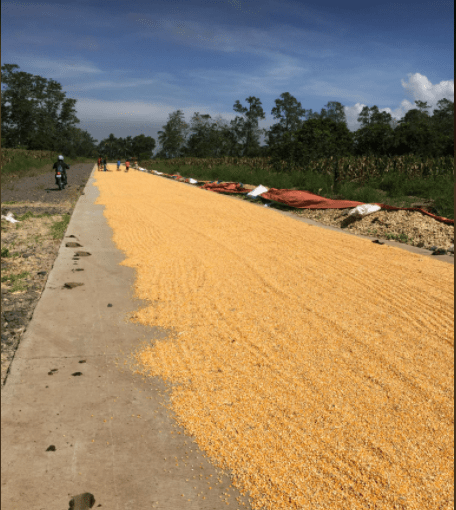
While there is a substitute to mechanical dryers—concrete pavements or roads—these oftentimes render the product unclean with stones and other dirt. Worse, these cannot be used when it is raining.
“We can still see farmers drying their produce on the highways. We must resolve this problem first and foremost. This is a basic fundamental infrastructure intervention support that government should do. Or it will fail in its mandate and can therefore be charged for dereliction of duty,” said Navarro.
PMFI also asserted government should implement the Magna Carta for Small Farmers or Republic act 7607.
“Government failed to implement price support mechanism both for rice and corn which NFA used to do before the Rice Tarrification Law.”
The agriculture sector has been disappointed by government’s failure to implement the Agriculture and Fisheries Modernization Act (AFMA) and its provisions.
In their letter to Department of Agriculture Secretary William D. Dar, 58 farmers’ organizations led by Lawyer Jose Elias Inciong of the United Broilers and Raisers Association and Danilo Fausto of DVF Dairy Inc. (also PCAFI president) cited what has not been implemented under AFMA:
Provision of responsive business information and trading services that link farmers to market
Creation of a national marketing umbrella to generate highest income to farmers
National Information Network (NIN) to be set up one year from AFMA’s enactment in 1997.
The NIN should provide industry data, similar to that being produced extensively by the United States DA (USDA). USDA extensively studies and reports even Philippines’ industry data.
“The NIN shall provide information and marketing services related to agriculture and fisheries which shall include the following: supply; demand; price and price trends; product standards for both fresh and processed agricultural and fisheries products; directory of, cooperatives, traders, key market centers, processors and business institutions.”
The NIN should also provide research information and technology generated from research institutions; international, regional and local market forecasts; and resource accounting data.
“The NIN shall likewise be accessible to the private sector engaged in agriculture and fisheries enterprises,“ according to Section 45.
The farmers’ groups said that DA’s budget for 2001-2004, 2011-2017, and 2018-2023 have not been consulted with the agriculture sector at all despite AFMA’s provision for this to be implemented.
Agriculture Secretary William D. Dar was asked by a 58-signatory farmers’ groups to hold consultation with farmers and not come up with its own plans which has rendered failure in implementing two-decade-old Agriculture and Fisheries Modernization Act (AFMA).
In a letter received on November 4 by DA, Dar was also asked by the 58 farmer-leaders to explain why the Department of Agriculture (DA) refuses to implement trade remedies allowed by the World Trade Organization (WTO) and local laws addressing import surges and price depressions.
DA’s failure to consult farmers is precisely the reason why there is “misallocation and misuse” of DA funds.
“The absence of consultations is at the heart of misallocations and misuse of funds by DA,” said the United Broilers Raisers Assn, Philippine Chamber of Agriculture and Food, Samahang Industriya ng Agrikultura (SINAG), and more than 50 other farmer-leaders.
“DA’s plans, given the results, are certainly not for the stakeholders. The law mandates that stakeholders be consulted in the formulation and implementation of AFMA.”
Consultation should include budget requests which should be subject to transparency.
The farmers’ groups lamented the non-implementation of Sections 38 to 45 of AFMA. These are among the provisions DA failed to implement:
Provision of responsive business information and trading services that link farmers to market
Creation of a national marketing umbrella to generate highest income to farmers
National Information Network (NIN) to be set up one year from AFMA’s enactment in 1997.
The NIN should provide industry data, similar to that being produced extensively by the United States DA (USDA). USDA extensively studies and reports even Philippines’ industry data.
“The NIN shall provide information and marketing services related to agriculture and fisheries which shall include the following: supply; demand; price and price trends; product standards for both fresh and processed agricultural and fisheries products; directory of, cooperatives, traders, key market centers, processors and business institutions.”
The NIN should also provide research information and technology generated from research institutions; international, regional and local market forecasts; and resource accounting data.
“The NIN shall likewise be accessible to the private sector engaged in agriculture and fisheries enterprises,“ according to Section 45.
On Dar’s battlecry that DA has to engage in “New Thinking,” DA should now look into why other countries (Thailand, Vietnam, Malaysia) thrived despite their World Trade Organization (WTO) membership, the farmer-leaders said.
On the other hand, Philippine agriculture reels into further poverty as imports flood the market and kill farmers’ livelihood.
The farmers’ groups said that DA’s plans in 2001-2004, 2011-2017, and 2018-2023 have not been consulted with the agriculture sector.
“We have only come to know these AFMA programs upon discovery of counsel as part of due diligence in preparation of a case,” the 58 farmers’ group confessed.
DA’s plans all the years were made simply as “paper compliance” with the requirement of the Department of Budget and Management.
In professional budget management, the farmer-leaders said budgets should have “clear performance targets and quantifiable and verifiable impact indicators and conduct of up-to-date monitoring.”
Absence of data is another reason why there is disconnect between farmgate and retail prices. This happens for instance in rice where farmgate price is now down to P10 per kilo. But consumers still pay for a high P38 to P45 per kilo in wet markets.
“How can DA effectively plan without a data and information system? What will be the basis for its plans? How can stakeholders plan investments base on the realities of the supply and demand in an industry?”
The farmer-leaders lamented that AFMA’s other major provisions have not been implemented:
Strategic Agriculture and Fisheries Development Zone
Agro-industry Modernization and Credit Financing Program
Irrigation and Agriculture and Fisheries INfrastructure Support SERvices
Trade and Fiscal Incentives
DA also did not receive at all the P20 billion initial AFMA allocation and P17 billion yearly at least for 6 years since AFMA’s enactment.
“You have spoken of rebooting the industry. The first step is to follow the law and implement AFMA,” said the 56 farmer-groups to Dar in a letter. “That is the only way to effectively gain the trust and respect of stakeholders.” Melody Mendoza Aguiba
A former vice president of banana-exporting multinational Unifrutti has pleaded for help for poorer corn farmers who are being “killed” by illegal smugglers and importers even as price plunged to an all-time high P9 per kilo.
Rodolfo Pancrudo, farmer-owner of Pancrudo Farm in Manolo Fortich, Bukidnon, has asked
government not to allow the killing of corn farmers.
This may be the ultimate plight of farmers since they do not enjoy corn support price, supposedly expected before from the National Food Administration (NFA). Nor do they have post harvest facilities by which to dry and store their corn.
Mechanical dryers and storage facilities should enable them to hold their sale of corn and wait until prices become more profitable.
“Traders haggle for the lowest price and tell farmers, ‘Your corn is of low quality.’ That’s why farmers are forced to sell their corn even at only P9 per kilo because they need money. Otherwise the harvest will just go to waste since there are no post harvest facilities,”said Pancrudo.
While he is more fortunate because he is a retiree of Unifrutti, one of the world’s largest producer-exporters of fresh produce, more farmers are poor.
“I am just more fortunate since I am more of an entrepreneur. I have an integrated farm. It’s a kind of sustainable farming. But I see farmers having a very difficult life. They are in a hand-to-mouth existence,” he said.
Pancrudo Farm also has a piggery. The farm uses hogs’ dung to feed a biogas facility and uses it for fertilizer. It also grows papaya as Pancrudo is a sub-contractor of also multinational Del Monte.
“I hope other corn farmers may also become entrepreneurs. But most of them are not learned. When I retired from my company (Unifrutti), I went into farming just to practice my being an agriculture engineer. But many farmers run to me for these problems. I have to speak for them.”
Farmer-entrepreneur Rodolfo ‘Opong’ Pancrudo
The Philippine Chamber of Agriculture and Food Inc. (PCAFI) with its president, Danilo V. Fausto, has been seeking an audience from the Department of Agriculture (DA) regarding the plight of farmers in light of the Covid 19 food crisis. PCAFI asked for least an increase in tariff of farm commodities—mainly rice – so as to support local farmers.
For corn, DA should at least prohibit imported corn to coincide with the harvest.
However, PCAFI member and Philippine Maize Federation Inc. (PMFI) President Roger V. Navarro feared DA’s inaction on the plummeting corn price forebodes a collapse of the sector. Worse, DA appears to be attempting to hide the problem of farmers experiencing low corn price.
“To my mind, this is not a good indication. (DA’s trying to cover up the truth) tries to tell the people to keep quiet as it intentionally tries to hide the problem and the reality,” said Navarro.
“We cannot hide the trutht that we have a problem in agriculture. In effect DA is building a high wall. But the crack on the wall runs down that it may suddenly collapse—shattered and badly broken. I don’t want to see that happen.”
PMFI has also asked government to investigate possible corn smuggling. Bureau of Plant Industry (BPI) Director George Y. Culaste reportedly claimed that no permit has been issued for incoming importations of corn.
“This leads us to assume that this coming corn is smuggled,” Navarro said.
Expected to arrive soon are the following corn shipments: 6,000 metric tons (MT) for General Santos arrival; 20,000 MT, Cagayan de Oro; 50,000 MT, Bicol; and 30,000 MT, Iloilo.
“We reported this to DA Secretary (William) Dar, and we are awaiting his action. These corn shipments will strike the fatal blow to the corn farmers who painstakingly harvested a huge 3.5 million tons, wet season crop,” Navarro said.
Pancrudo said farmers will hardly be able to make money from gross earnings of just around P30,000 per hectare. This is against production cost of P35,000 to P40,000 per hectare.
Support for fertilizers and good seed varieties is also an important intervention Filipino farmers do not get, unlike farmers in neighboring countries as Thailand.
“There will come a time Filipinos will no longer have (locally-produced) food. All will be imported,” said Pancrudo. “Even a small amount of support for fertilizer will already be a (significant) help in raising yield. But there is no such support.”
Navarro invoked the implementation of prevailing laws that should help farmers during this Covid 19 crisis.
These nationally sanctioned policies will not require much budget:
.These are Republic Act (RA) 8800, the Safeguard Measures Act; RA 7607, Empowering Smallholder Farmers in their Economic Endeavors,” and RA 8435 or Agriculture and Fisheries Modernization Act.
“From the recent articulation of Congressman (Rodante) Marcoleta, he was saying DA should look outside the box, away from traditional structured intervention mindset that makes agriculture development restrictive,” said Navarro.
“There are non-funding interventions that need to be reformed or made new. RA 7607 upholds farmers’ rights to price support especially for corn. RA 8435 mandates banks to give loans to farmers. The best policy is derived from good consultation.”
The perennial problem of lack of storage and drying facilities will forever hinder farmers’ becoming more profitable – unless these are invested in.
“We need storage to (stretch shelf life of) surplus harvest that cannot be absorbed by the demand from industries. Without this infrastructure support, we will be the same year in and year out.”
“DA is trying to rally farmers to increase production, but when harvest comes, DA can’t help them.”
Private stakeholders anticipate President Rodrigo Duterte’s new promise to the farm sector in his July 27 State of the Nation Address (SONA) in light of closures of micro small and medium enterprises (MSME) and poverty-worsening impact of COVID 19 to 4.1 million rural poor.
The Philippine Chamber of Agriculture and Food Inc. (PCAFI) and the Agri Fisheries Alliance (AFA) said they hope Duterte will consider alternative means of rescuing the entire agriculture value chain from the pandemic’s impact.
That is even as agriculture’s economic significance has been undervalued for decades despite its huge potential as a gateway for industrialization and economic recovery.
“Most of the MSMEs that are closing down due to the pandemic are in the countryside, adversely affecting farmers,” said PCAFI President Danilo V. Fausto.
PCAFI stresses that now that government’s financial resource is in dearth, it seeks support that does not necessarily require any budget but is extremely crucial just to tide the sector over.
“There are immediate executive actions that could be undertaken by the current administration that do not require budget. But it can immediately bring respite to the ailing agricultural sector. These are remedial steps that don’t go against our WTO (World Trade Organization) agreement,” Fausto said.
This refers to trade remedies sanctioned by WTO and government rules, particularly Safeguard Measures Act (2000), Anti-Dumping Act of 1999, and Countervailing Act of 1999. Philippines itself ratified such laws to uphold its farmers’ welfare amid trade liberalization.
“In the WTO agreement, there are winners and losers. Other countries have supported, protected, and subsidized their losing sectors. This is not true with the Philippines. The losing sector was advised to swim on their own and left to drown as local farmers and fishers cannot compete with the highly-subsidized imported agricultural products,” said Fausto.
“Imported products help more the farmers of importing countries to the detriment of our local farmers and fishers.”
Department of Agriculture has just rejected the poultry sector’s petition to stop issuance of import permit for chicken imports that caused chicken price to collapse to P30 per kilo during the COVID 19 lockdown.
PCAFI led by Danilo V. Fausto, president (bottom row, fifth from left).
Fausto said there are 26 instances of countries regulating their imports during this pandemic as reported to the WTO. But the Philippines has not acted on even one import regulation.
“Other countries have prohibited importation of chicken from Brazil citing as a reason that their dressing plants and manufacturers have COVID-19. The same could be made as an excuse to suspend importation of meat coming from the United States, New Zealand and Australia,” Fausto said.
Even if possible protest may arise from these countries if Philippines suspends chicken importation, this will have huge benefits to saving the poultry sector.
“A few months of suspension while negotiation is on-going could give enough elbow room for local producers to breathe, stay alive, and recover from the losses from the pandemic.”
AFA stressed Duterte must now prioritize agriculture amid the pandemic as it is a primary hope for economic recovery with its tremendous potential for growth.
“Agriculture contributes 33% to our GDP. It has an additional 10% contribution in food manufacturing and 15% in agriculture-allied services,” said AFA National Coordinator Ernesto Ordonez.
“The great majority of our poor is found in agriculture where our rural poverty is 25%, double Indonesia’s 13% and triple Thailand’s 8%. But our average agriculture growth rate over the last 9 years has been a disappointing 1.4%, compared to industry’s 6.6%.”
Ordonez said agriculture has always been a low priority in previous SONAs.
“During this critical pandemic time, agriculture must now be given its proper priority. We hope President Rodrigo Duterte’s 2020 SONA will reverse this downward trend.”
AFA is composed of five coalitions: Alyansa Agrikultura (AA) representing farmers and fisherfolk; PCAFI; Coalition for Agriculture Modernization in the Philippines (CAMP) representing science and academe; Pambansang Kilusan ng Kababaihan sa Kanayunan (PKKK) representing rural women; and Agri Fisheries 2025 (AF2025) representing multi sectors.
AFA President Arsenio Tanchuling said that though construction and agriculture have been identified as the most important sectors to address during this pandemic. But agriculture gets a very small percentage of resources as compared to construction.
CAMP Chairman Emil Javier decries the 28-year delay in the release of the coco levy funds.
PKKK president Luz Bador said, “Specially during this crisis, rural women’s role should be appropriately recognized. They should get as much access as men to livelihood and support services.”
PCAFI lamented that DA does not solve rampant smuggling, either technical, undervaluation or misdeclaration, of agricultural products imported from other countries like frozen chicken parts, pork, rice and even corn, cannot be stopped.
“DA’s solution is to appeal to businessmen-importers not to commit smuggling rather than undertake concrete and immediate measures to catch these smugglers with the assistance of other law enforcement agencies and penalize them with the full force of the law,” said Fausto.
PCAFI said the worst impact of COVID 19 crisis will be on farmers who were recorded as of 2018 to be in the highest subsistence level.
Farmers consist 11.5% of the Philippine population. Those in the highest subsistence incidence also include fishers, 8.3% and individuals residing in rural areas, 8%.
The already food-poor people as of 2018 totals to 4.1 million rural residents, 3.2 million children, and 2.7 million women.
PCAFI noted that the nominal wage rate in agriculture was P276.03 per day as of 2018. But adjusted for purchasing power due to inflation, this is equivalent to a real wage of just P191.69 per day. End
“Agriculture constitutes the foundation and basis for food and nutrition security and provide raw materials for industrialization. These are important factors that allow progress to take place in a society.” Melody Mendoza Aguiba
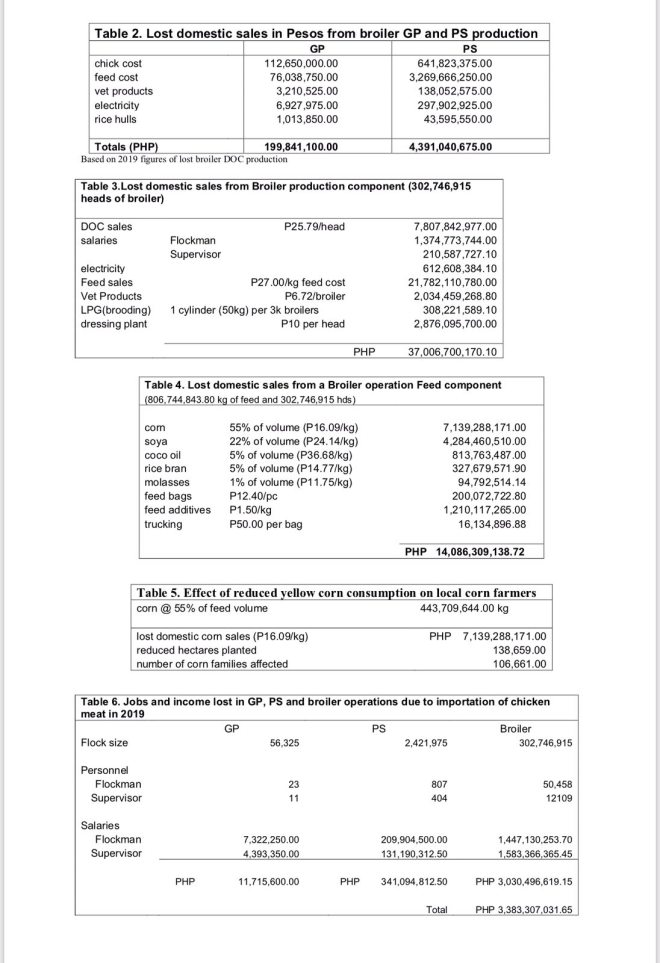
The Philippine government’s strong import policy has displaced Filipino farmers’ potential broiler sales of a whopping P37 billion for eight years, P14.086 billion in broiler feed, P15.18 billion in “ihaw ihaw” sales, P4.2 billion in logistics, P8 billion in dressing plant operations, and P3.38 billion in jobs loss.
In an open letter desperate for public support, the United Broilers and Raisers Association (UBRA) and the Philippine Chamber of Agriculture and Food Inc. (PCAFI) said they have been compelled to present evidence-based quantifiable data amid recent Department of Agriculture (DA) response to its pleadings against imports.
“We are saddened that on May 28, 2020, the DA through the Bureau of Animal Industry (BAI), the agency responsible for our sector, seems to be complacent about our industry’s plight. In a meeting with PCAF, they said that the volume of imports is smaller than the volume of production,” said Lawyer Jose M. Elias Inciong, UBRA president.
Also signatories to the letter are PCAFI President Danilo V. Fausto and a growing number of nearly 50 other private agriculture association leaders. PCAF stands for Philippine Council of Agriculture and Fisheries, a public-private group hosted by DA.
“The message being sent is that we do not have a problem. The stakeholders believe the opposite is true.”
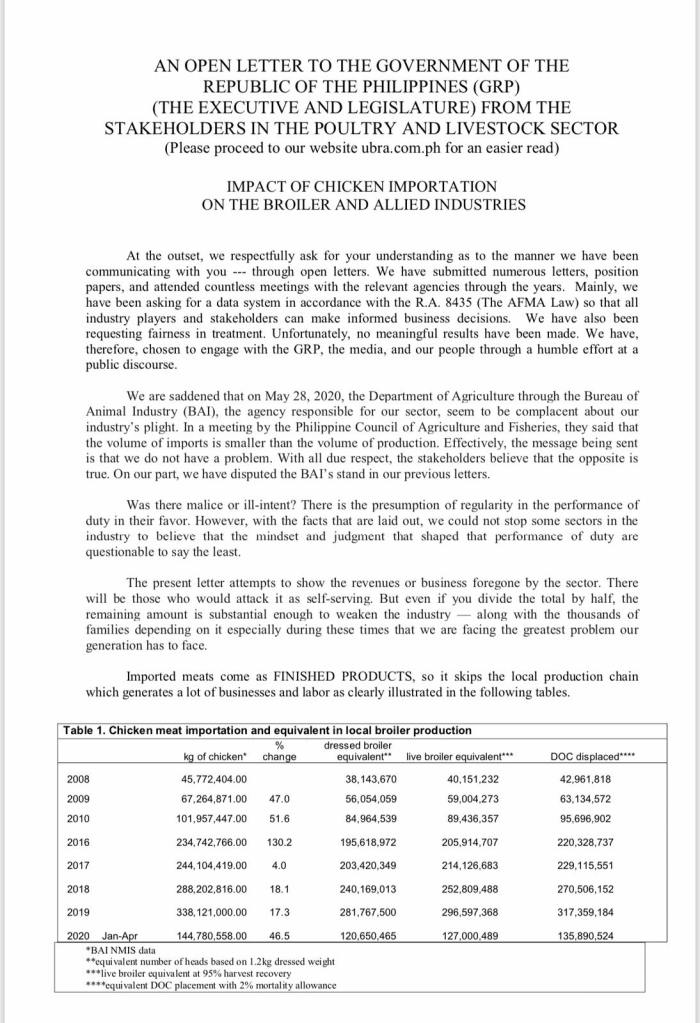
Sacrificed jobs are huge as “imported meats come as finished products, so it skips the local production chain which generates a lot of businesses and labor.”
These are the import volume in chicken meat and broiler equivalent: 45.77 million kilos, 2008; 67.26 million kilos, 2009; 101.96 million kilos, 2010; 234.74 million kilos, 2016; 244.104 million, 2017; 288.2 million kilos, 2018; 338.12 million kilos, 2019; and 144.78 million kilos, 2020 (January to April).
Lost sales from broiler production is broken down into P21.78 billion, feed sales; P7.8 billion, day old chick; P2.88 billion, dressing plant at P10 per head; P2.034 billion, veterinary products; P1.58 billion, salaries; P612.6 million electricity; P308 million, LPG (brooding).
Here are feed components of lost domestic sales from broiler operation: P7.139 billion, corn: P4.284 billion, soya; P1.2 billion, feed additives; P813.76 million, coconut oil; P327.68 million, rice bran; P200 million, feed bags; P94.79 million, molasses; and P16 million, trucking.
Lost domestic sales for corn, P7.139 billion affecting 106,661 Filipino families. Reduced number of hectares of corn land is equivalent to 138,659.
Other authorities, mainly DA officials themselves, continue to question UBRA’s claim on the significance of import volume in order to obliterate the Filipino poultry sector.
“But even if you divide the total by half, the remaining amount is substantial enough to weaken the industry—along with the thousands of families depending on it especially during these times that we are facing the greatest problem our generation has to face.”
Lost income from sales of ihaw ihaw stalls is accounted for by isaw, P5.75 billion; chicken feet or adidas, P2.88 billion; head and neck, P4.31 billion; and betamax or dugo, P2.88 billion.
Reduced dressing operations of 287.61 million heads totaled to a loss of P2.88 billion and by product, P5.18 billion.
Logistics revenue lost consists of hauling, P2.847 billion; delivery, P806.74 million; egg vans to hatchery, P302.75 million; and chick vans, P71.9 million.
Jobs lost represents broiler flock size of 302.742 million affecting 50,458 flockman and 12,109 supervisors with salaries of P1.447 billion for fllockman and P1.583 billion for supervisor.
Another UBRA-PCAFI petition as sanctioned by Republic Act 8435 or the Agriculture and Fisheries Modernization Act (AFMA) is a data system that will enable stakeholders to make informed decisions. Melody Mendoza Aguiba
The private sector lamented government’s lack of fund to finance a P2.8 trillion proposed stimulus package that worsens COVID 19 crisis’s economic impact, sending yearend GDP to a negative growth of 4-6%, further adversely affecting 4.1 million food-poor rural people.
After having hit a negative 0.2% GDP (gross domestic product) in the first quarter, the economy is projected to further decline by a negative GDP growth of 8-10% in the second quarter, 4-6% in the third quarter, and 2-4% in the fourth quarter – putting the economy into a state of recession
“My rough estimate is we will have a negative 4-6% percent GDP growth for the whole year of 2020. Assuming a negative 5% growth due to COVID 19 plus the 7% lost (original GDP growth projection without COVID 19), we will have lost 12% less in GDP,” said PCAFI President Danilo V. Fausto in a webinar hosted by the Procurement and Supply Institute of Asia (PASIA).
Such GDP loss is equivalent to P2 to P2.2 trillion based on the Philippine Statistics Authority’s (PSA) $356.8 billion GDP as of 2019 at P50 to P51 to a dollar conversion, said Fausto, an economist and entrepreneurial founder of DVF Dairy Inc.
Unfortunately, the worst impact will be on those recorded even as of 2018 to be of the highest subsistence level –farmers consisting of 11.5% of the Philippine population. Those in the highest subsistence incidence also include fishers, 8.3% and individuals residing in rural areas, 8%.
The already food-poor people as of 2018 totals to 4.1 million rural residents, 3.2 million children and 2.7 million women.
PCAFI noted that the nominal wage rate in agriculture was P276.03 per day as of 2018. But adjusted for purchasing power due to inflation, this is equivalent to a real wage of just P191.69 per day.
In response to COVID 19’s economic impact, Congress proposed a P2.8 trillion stimulus package consisting of the P1.3 trillion Accelerated Recovery and Investment Stimulus for the Economy of the Philippines (ARISE) and P1.5 trillion for Economic Reduction and Economic Stimulus (CURES).
“Apparently, this cannot be funded since economic managers can only allow a maximum of 9% on the deficit this year, and the current deficit of P1.613 trillion is already equivalent to 8.4% of GDP,” said Fausto.
Fishery wastage observed at fish ports of Bulan in Sorsogon, Masbate Pass, Masbate Bay, Ticao Pass, Burias Pass, and Sibuyan Sea due to COVID 19 lockdown
Nevertheless, PCAFI looks forward to sustained positive impact of some reforms in agriculture implemented particularly the easing of credit access for small farmers by the Land Bank of the Philippines (LBP).
This easier credit access enabled LBP to raise agriculture lending to P236.31 billion in 2019 compared to only P183.4 million in 2017.
Fausto noted LBP’s reforms including simplification of loan application form to one document from 3 documents that are now easier to be filled up through tick boxes.
LBP also cut requirements to only the filing of loan application form and barangay clearance. It shortened loan processing from 10 days to 1 day. It has expanded loan workforce, recruiting more than 1,000 credit specialists deployed throughout towns to directly help farmers.
Still, many banks failed to comply with the Agri-Agra law that mandates banks to allocate 15% of loan portfolio to agriculture and 10% for agrarian reform-related projects.
This deprives the agriculture sector of P734 billion in mandated accessible loan.
Even government’s guarantee program is very limited, making the figure a minuscule 5% compared to the P180 billion guarantee for the real estate sector under the Home Guarantee Corp.
Here are concerns in agriculture that should be addressed in order to raise production and uplift livelihood levels of farmers:
Address farm size fragmentation by managing small farms into larger operating units to overcome liability of “smallness” from land preparation to sourcing of inputs, product processing and transport, and marketing.
Achieve economies of scale through strengthening of farmers’ associations and irrigators’ associations, expanding contract growing, and raising success of agrarian reform.
“With contract growing, the corporate integrator programs the production schedule, be assured of his raw materials, and the farmer gets to sell all the produce he was contracted for at a fair market price,” Fausto said.
Address lack of productivity by enhancing linkages of primary producers to markets that will solve these problems.
“Supermarkets, fast food outlets, and convenience stores are taking business away from the traditional wet markets, carinderias, and sari sari stores,” said Fausto.
These similar problems should be resolved– seasonality of farm produce (the bulk comes to the market at the same time, sending price to collapse); lack of prior marketing arrangements between farmers and buyers; lack of agronomic practices (for flowering, harvesting) to make harvest year-round; and poor schedule of seeding, fertilization and irrigation in order to meet market timing needs.
Fisheries sector also faces huge development deficiencies.
“We have 220 million hectares of territorial waters including our exclusive economic zone (EEZ), 750,000 hectares of inland waters (lakes, rivers, reservoirs), and a coastline of 17,460 kilometers,” said Fausto.
The Department of Agriculture (DA) proposed a P280 billion budget for 2021, a 333% jump from the P64.7 billion in 2020.
It includes budget for Plant Plant Plant, rice buffering by the National Food Authority, upscaling of Kadiwa ni Ani at Kita, distribution of seeds and fertilizer, enhancing livestock and poultry subsectors and of small ruminant, increased white corn production for snack and supplemental food, expansion of coconut production, coconut replanting, development of fisheries ( aquaponics, aquaculture, fish cages), and urban farming and gulayan in schools and barangay.
I also includes a cash for work program and P20 billion for food logistics and food market even as supply and logistics disruption occurred due to the COVID 19 crisis and lockdown.
However, even the proposed budget appears to be just a “wish list.”
The agriculture sector has been plagued by food movement and transportation problems resulting in huge losses from throwing away of rotting vegetables from Benguet and other provinces and of wasted fish production from fish ports of Bulan in Sorsogon, Masbate Pass, Masbate Bay, Ticao Pass, Burias Pass, and Sibuyan Sea.
The logistics problem has even been worsened by inability to transport animal and meat products from Visayas and Mindanao to Luzon due to the African swine fever (ASF) quarantine restrictions. (Melody Mendoza Aguiba)
The private sector has elevated to President Duterte, Senate and Lower House a pleading against the Department of Agriculture’s (DA) “alacrity” to give in to massive imports to “feign empty concern for consumers” and abject refusal to find World Trade Organization (WTO)-sanctioned “trade remedies.”
With an expanding number of agriculture sector advocates for reforms, the United Broilers and Raisers Association (UBRA), along with 25 signatories, advanced their open letter to Malacanang and the legislature. This amid DA’s silence to eight radical reforms that will uplift not only consumers’ welfare, but also Filipino farmers’.
It is counterintuitive that DA uses consumer protection to rationalize surging imports.
Illogically, it fails to address the flagrant disconnect between price of chicken in supermarkets and wet markets and the farmgate price received as compensation of farmers.
As chicken farmgate price reeled down to P30 per kilo during the lockdown, price of chicken reaching consumers remained high at P150 to P170 per kilo during the Covid 19 ECQ (enhanced community quarantine). It indicates traders and importers are the ones taking advantage of windfall profit from price difference. It is neither consumers, nor farmers.
Unfortunately, this case applies even to other agricultural commodities such as rice.
“This behavior (alacrity to import) is always couched in a supposed concern for consumers. The DA, however, has never effectively addressed the disconnect between farmgate prices and retail prices. Thus, it is an empty concern,” said UBRA in its letter to President Duterte.
UBRA testifies to this alacrity to import via a recorded video on a meeting with DA-Bureau of Animal Industry (BAI) on May 27, 2020 (link attached).
With the Covid 19 crisis, revenue sources the Philippines depends upon—Overseas Filipino Workers (OFW) and business process outsourcing (BPO)—are proving to be unstable.
It is thus urgent to prioritize agriculture.
“For decades, OFW remittances, BPO revenues, and tourism have propped up our economy at great sacrifice by the young men and women, especially millennials, who work in these fields. These are now challenged not only by Covid 19 but also by trends that may undermine its sustainability,” according to UBRA.
“Other countries are seeking to provide work for their own people. BPOs are threatened by digitalization which includes artificial intelligence, and robotics. Tourism’s horizon is murky in the near and medium term. A resilient economy with a population our size needs agriculture and manufacturing.”
Desperate about the neglect of agriculture for many years, the UBRA officials led by Gregorio A. San Diego Jr, chairman, and Lawyer Elias Jose M. Inciong, president, said DA never had a “long term commitment” to the sector.
It has never at all implemented the Agriculture and Fisheries Modernization Act (AFMA, RA 8435 of 1997).
“The institution supposed to lead the sector to success, the DA, has only resorted to what Mckinsey & Company calls ‘short termism,’” said San Diego and Inciong.
“Unlike other countries which have had success in agriculture as members of the WTO, the DA has consistently used our trade commitments as an excuse to stand aside and let stakeholders be damaged by imports from countries with heavily subsidized agricultural systems.”
In a sigh of hopelessness, the poultry raisers asked, “How come DA has never shown interest in finding out how other countries managed to protect their agricultural sector for the long term? Every administration has committed to develop the sector but the results have been dismal.”
Knowing Filipino farmers are poor, government must act speedily in implementing trade remedies once world market points to dumping of cheap, bulkier volume of imports that render more farmers impoverished. Instead, it speedily resorts to importation.
Trade remedies such as special safeguards measure (SSG) are sanctioned by WTO and the Safeguard Measures Act (RA8800) to “protect domestic industries …from increased imports which cause or threaten to cause serious injury to domestic industries.”
“The DA, must be able to intervene especially in extreme cases of oversupply brought about by Covid 19 pandemic or (when there is) abnormally low international commodity prices,” said UBRA.
“The government acts with alacrity when supply is tight by resorting to importation. In times of oversupply, should not the government act just as fast by stopping importation or reducing supply by some other mechanism?”
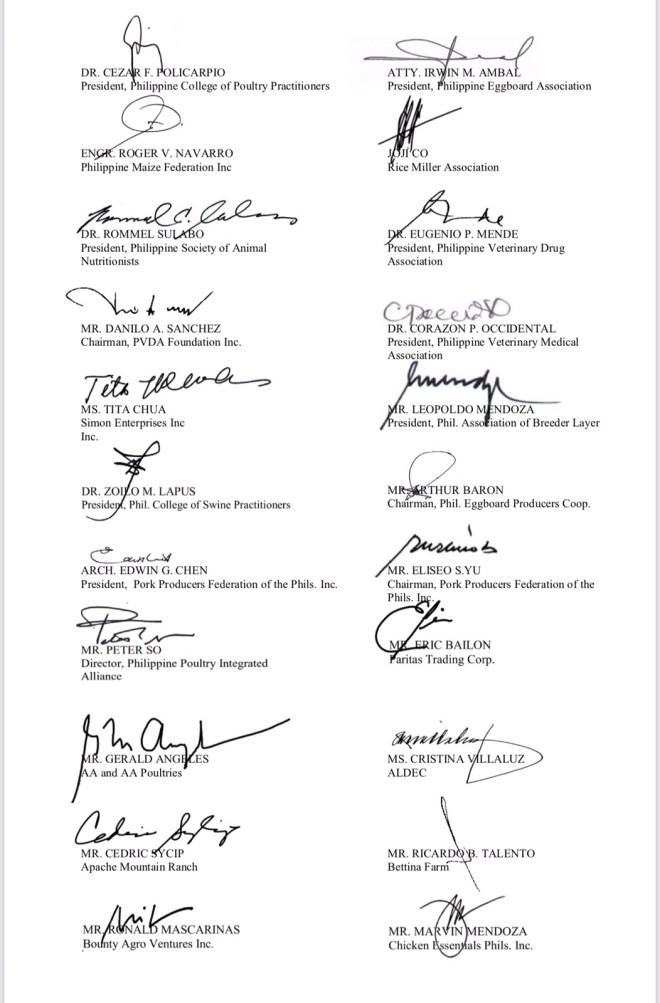
Signatories to the letter to Malacanang include Phil. Chamber of Agriculture and Food Inc (Danilo V. Fausto); Nat’l. Federation of Hog Farmers (Chester Warren Y. Tan); Phil. Assn of Feedmillers Inc. (Stephanie Nicole S. Garcia); Phil Maize Federation Inc. (Roger V. Navarro); Phil. College of Poultry Practitioners (Dr.Cesar F. POlicarpio); Phil. Veterinary Drug Assn (Dr. Eugenio P. Mende); Phil Eggboard Assn (Atty. Irwin M. Ambal); PVDA Found Inc. (Danilo A. Sanchez); and Phil. Veterinary Medical Assn (Dr. Corazon P. Occidental).
The rest are Simon Enterprises INc. (Tita Chua); Phil. Assn of Breeder Layer Inc (Leopoldo Mendoza); Phil. Eggboard Producers Coop (Arthur Baron); PROPORK (Edwin G. Chen); Phil. Poultry Integrated Alliance (Peter So); Paritas Trading Corp. (Eric Bailon); ALDEC (Cristina Villaluz); Apache Mountain Ranch (Cedric Sycip); Bettina Farm (Ricardo B. Talento); Bounty Agro Ventures Inc. (Ronald Mascarinas); Chicumi Farms (Ricardo C. Clarin Jr); and Chicken EssentialsPhils Inc (Marvin Mendoza).
Here are their eight-point “Call for Reforms by the Stakeholders in the Poultry and Livestock Sectors to the Executive and Legislature:”
1. The urgent need for decentralization of functions. There should be check and balance. Everything is lodged with the BAI. Department of Trade and Industry (DTI) should be involved in the issuance of Sanitary and Phytosanitary Import Clearance (SPS IC). Agencies like the Department of Science and Technology and the Philippine Statistics Authority should do gathering, analysis, and publication of data so that stakeholders can make informed business decisions. Presently, everyone is blind, especially the government, in terms of both local and international data.
2. Reformattting of the SPS IC to simplify and facilitate collection of tariffs and duties and their reporting.
3. Address under-evaluation through WTO-allowed methods and the regular comparison and publication of the composition and volume of exports by country of origin as against the data of BAI and Bureau of Customs. This minimizes misdeclaration of products.
4. Conduct studies on trade remedies not only for poultry and livestock but for the entire agri-fisheries sector. What did other countries do which encouraged a commitment for the long term from government and stakeholders?
5. Establish confidence in the trading system of chicken meat by addressing the alleged abuses in Customs Bonded Warehouse (CBW) 0% tariff privileges. The BAI and NMIS (National Meat Inspection System) have not presented any data on this for years. UBRA has just asked DTI this data.
6.Construct cold-chain-ready quarantine facilities at the Customs border so that inspection can be done before the payment of tariffs and duties. The current so-called 2nd Border Control does not work. The system is below international standards and has allowed the entry of diseases such as ASF (African swine flu), bird flu, and the smuggling of prohibited pork and poultry products from China.
7. Support the corn sector to enable poultry and livestock sectors’ access to affordable yellow corn for feeds when there are no corn harvests.
8. Address the disconnect between farmgate and retail prices either through a more effective enforcement of the Price Act and a program of consumer subsidies similar to the program provided in the series of Farm Bills in the United States.
“The reform agenda is necessary to avoid a drastic and involuntary cut in production caused by heavy losses. There will be a domino impact on the feed milling industry, corn farmers, rice farmers by way of their rice bran, producers of coco oil, molasses, fish meal, suppliers of soya bean meal, mineral sources, and veterinary products.”
The same malevolent effect will be on the “agri-processing of the value chain such as cutting and marination all the way to agriservices like food service outlets, groceries, cold storage, transportation, warehousing, packaging, and financing.” (Melody Mendoza Aguiba)
Poultry raisers denounced anew government claims that “deboned” meat is not “locally available” and dismissed misleading data that imports dropped in 2020 as Bureau of Animal Industry (BAI) data showed it shot up 32% to 371%, including fully-finished whole chicken.
The slowdown in import arrivals claimed by the Department of Agriculture (DA) in its website statement “Drop in poultry imports bodes well for local industry” is misleading.
It was artificial as it was caused only by logistics problems due to the COVID 19 lockdown, showing a drop in imports volume from January to May.
But newly-released actual BAI data showed cumulative imports from January to May 2020 of chicken cuts skyrocketed by a whopping 140.57% to 22,941 million kilos from only 9.536 million kilos in January to May in 2019.
A perplexing data is the importation from the same period of whole chicken at 545,406 kilos, a staggering 371.43% increase from last year.
Imports of chicken leg quarters was at 43.445 million kilos for the first five months, a 45.21% increase.
Total imported chicken products ballooned to 178.334 million kilos, an increase of 50.34% from 118.616 million kilos in the same period last year.
Imports of offals grew to 1.061 million kilos or by 32.97%. Only fats and rind skin recorded decline in imports from January to May at 1.513 million kilos for fats, down by 11.68%. Rind and skin dropped by 52.19% to 398,404 million kilos.
Mechanically deboned meat (MDM) imports climbed to 108.428 million kilos, up by 45.21%.
Controversial “deboned” meat
The importation of deboned meat is a major bone of contention as UBRA said in a fresh open letter to DA Secretary William D. Dar dated June 15, 2020 that this is available locally.
Dar said earlier that DA and its attached BAI only allows importation of manufacturing inputs—mainly deboned meat– for products needed by meat processors.
But first, UBRA said in the letter that such chicken importation supposedly as “manufacturing input” has dragged down development of the poultry processing industry in the Philippines. The letter was signed by Lawyer Elias Jose Inciong, president, and Gregorio San Diego, chairman.
UBRA officials Gregorio San Diego, Elias Jose Inciong. Credit—DZMM, Tindig Balitaan sa Rembrandt
Already, a major company has facilities to supply part of MDM requirements with assurance of quality.
But instead of supporting MDM local production so as to develop the MDM industry and raise utilization of local chicken, DA-BAI has apparently supported imports.
“The importation agenda and mindset prevented such a development. There has been a significant increasing trend in both the total imports and the key composite items in the last five years.”
It is a blatant attempt to distort the truth that DA and BAI refuse to accept that imports have threatened the industry and jobs of local farmers and poultry raisers. That even as farmgate price of chicken collapsed to P30 per kilo during the COVID 19 lockdown.
“BAI attempts to minimize the threat of imports by saying that 70% is MDM, fats, offals, and rind/skin used by industrial processors.”
Shutdown
Worse, chicken imports in the past have already caused a shutdown of several broiler producers.
Broiler producers Purefoods, RFM-Swift, General Milling, and Robina already closed due to losses. Only San Miguel Corp. and Bounty Fresh have remained.
“Vitarich is back after suffering the ravages of importation and is now our member,” UBRA said.
“This is the reason why we cannot accept the reasoning of DA especially BAI that imports are not threat much less a cause of the sufferings of the industry. UBRA was born out of the struggle to survive such wrongheaded thinking.”
Inaction
Evidence of passive response and inaction of DA and BAI on serious concerns of poultry growers is so glaring.
In an urgent situation as the COVID 19 crisis that sent poultry farmgate price to collapse down to P30 per kilo, it took DA and BAI to respond after three weeks just to call a meeting. Its letter was on May 8; the meeting was on May 28.
UBRA denied that a “miscommunication” between UBRA and BAI happened as a video of the meeting last May 28.
“We never said that BAI gave an order to stop production. This is either a wicked spin by DA to muddle the public discourse or you were addressing other parties who have expressed their own sentiments.
UBRA stressed DA and BAI’s pronouncements clearly sent a message to poultry producers to limit production.
“We do not know how DA understands its recommendation to us that there should be “industry regulation on the level of production by each region or enterprise to prevent oversupply.”
“As chicken farmers, we understand this to mean as limiting our production to give way to imports as you feel helpless to stop it.”
Sacrificial lamb, technical smuggling
The poultry sector has been sacrificed in the country’s attempt to protect the rice sector through Quantitative Restriction or QR (restricts volume of rice imports). Tariff of MDM was offered (to WTO) to be cut to 5% for Philippines to retain the rice QR.
Unfortunately, MDM is used in misdeclaration of products.
Inciong and San Diego said Senate Committee Chairman Cynthia Villar supported UBRA’s plea for a suspension of imports upon finding out MDM is a tool in technical smuggling.
“Non-MDM items with tariffs of 40% were smuggled as were declared as MDM. The committee also found that there was no assurance that MDM was being used properly. The Food and Drug Administration said that the inclusion rate should only be 20%. The National Meat Inspection Service stated that it was alright to use 40%. The processors answered that they were using it up to 80%.”
UBRA wrote Villar a letter on May 17. The Senate office received evidence on technical smuggling from the Samahan ng Industriya ng Agrikultura .
Farmgate, retail price disconnect
It is unfortunate that both DA and the Department of Trade and Industry (DTI) know the disconnect between retail prices and farmgate price of products.
But they turn a blind eye in the knowledge that traders, not the farmers or consumers, enjoy the windfall profit, from low farmgate prices as these are not passed on to consumers.
“Importers are happier if wholesale and retail prices are high because they will have more margins to pocket.”
Diseases
UBRA also dismissed the position of BAI that they can only stop issuance of import permit if there are sanitary and phytosanitary (SPS) questions or threat of disease from animal imports that may infect local industry.
The truth is “African Swine Fever is not a homegrown disease but an imported one. It is a major failure of BAI.”
It was even Manila Mayor Isko Moreno that led the interdiction of the entry of illegal poultry and pork products from CHIna. It was not DA-BAI despite its mandate on meat quarantine.
“These all happened because of the absence of quarantine facilities at the customs border. Stakeholders have lobbied long for its construction not BAI,” they said.
Traders’ price manipulation
Importers have gain control over prices. Because of dumping of cheap imports, local producers are compelled to reduce and stop operations.
When that happens, shortage occurs, and importers take advantage of the opportunity to raise prices.
“This is what happened in the 2003 after the Great Glut of 2002. Aside from the financial damage, imports have been the source of diseases which have decimated livelihoods in the across the countryside.”
Importers’ manipulation
The government, in its absence of devotion to local farm producers, has been made to believe by importers that they are indispensable in satisfying consumers’ demand for cheap poultry meat.
It refuses to recognize the truth that the huge volume of import is the reason why farmgate price of poultry collapsed during the COVID 19 lockdown down to P30 per kilo.
“Importers have the habit of cherry-picking high retail prices through the years to prove that they are necessary and indispensable. Look at what will happen to the consumers without us? They are blatantly silent on the very low farmgate prices which they cause that damage stakeholders throughout the value chain. From corn farmers to the wet markets.”
Passive
DA’s passive stance on protecting local farmers have relegated DA and agriculture as a less important industry in the Philippines.
“The issues we have raised are about fundamental policies and mindset. It goes beyond the poultry sector. It is probably the reason why DA is not a priority in the national budget. The absence of plans and what the Jesuits call modo de proceder, a way of proceeding, that engenders confidence in the system is the cause why we have been left behind by our peers.”
UBRA said that Philippines does not even have to resign from the World Trade Organization (WTO) to promote its local industry.
“Other countries have managed to develop under its rules. It’s just that the mindset and priorities of their agricultural authorities are not as screwed up as ours.”
“The WTO commitments have become an excuse to feign helplessness and, worse, to push for the agenda of the importers. This attitude is scandalous in its particular unfairness towards the broiler industry.”
Other agenda
These are other concerns reiterated by UBRA in its June 15 letter to DA:
UBRA affirmed the recommendation of Senate President Pro Tempore Ralph Recto that there is a surplus in poultry.
“All of the three projections point to a surplus. If such is the case, why encourage imports? Kung 136 percent hanggang 183 percent ang chicken sufficiency forecast, bakit mag-aangkat pa?” Recto said.
UBRA said Recto’s question “crystallizes the plight of the broiler industry.”
“The pervading mindset at the DA is that it is helpless in the face of our WTO free trade commitments. It has become the perpetual excuse to do nothing and just leave farmers and producers to be slaughtered by commodities from countries with heavily subsidized agricultural systems.”
UBRA has invoked a decision of the late Senator Edgardo Angara, when he was DA secretary in 2000-2001, to suspend poultry imports upon knowing of dumping of these products.
It was a time the poultry industry was at a “brink of collapse and had suffered enormous losses because of unfair competition from imports and smuggling.”
“This was at the height of the ideological power of free trade as embodied by the WTO. An importer took him to court but the case did not prosper. This is the reason why our members still vote for Senator Angara, the son, even though some of us are not always in agreement with him. We remember his late father.”
Yet, present DA officials ignore these issues on huge trade subsidies and support of the US and other governments to their farmers.
“Philippine agriculture has failed to flourish because the government has turned a blind eye to the subsidies and non-tariff barriers of developed countries. The United States has had several Farm Bills to support both producers and consumers. It is one of the reasons the Doha Development Round of the WTO failed.”
Trade support is “anchored on the fundamental interests of the farmers and producers.”
With full government budgetary and credit support, it has enabled “our peers in ASEAN to have successful agricultural sectors.”
“Unfortunately for the Philippine broiler industry, after Senator Angara’s very brief tenure as Secretary, the importation agenda again dominated the policy landscape.” Melody Mendoza Aguiba
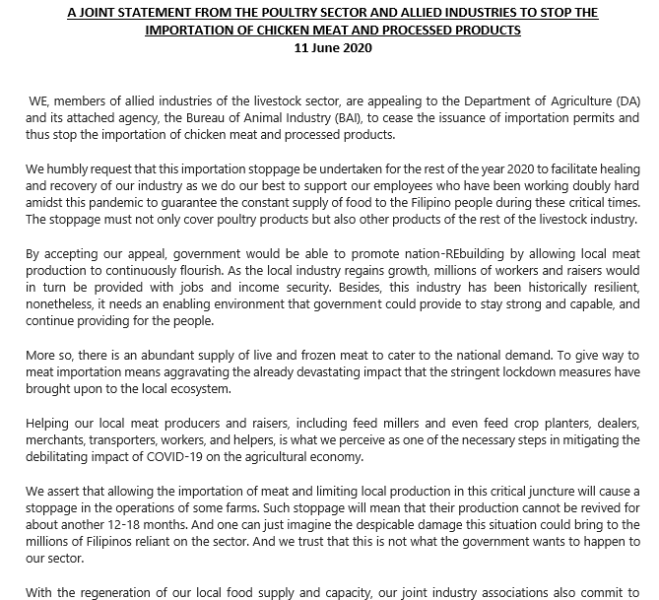
The Department of Agriculture (DA) was flooded Thursday by more petitions to stop chicken and pork importation, pleading this is the help farmers need most amid the “debilitating” COVID 19 crisis that threatens to render millions of Filipino jobless.
In a joint statement, eight agriculture and related organizations appealed for DA and the Bureau of Animal Industry (BAI) to stop issuing import permits for chicken meat, pork, and processed products until the end of the year to allow poultry producers to survive.
Imports are causing a “ despicable” damage to “millions of Filipinos.
“Allowing the importation of meat and limiting local production in this critical juncture will cause a stoppage in the operations of some farms. Their production cannot be revived for another 12-18 months. One can just imagine the despicable damage this could bring to millions of Filipinos reliant on the sector. We trust that this is not what the government wants,” according to the eight organizations.
Signatory in the joint statement are Philippine Association of Feed Millers Inc. (Stephanie Nicole S. Garcia); Pork Producers Federation of the Philippines (Arch Edwin G. Chen); Philippine Maize Federation Inc. (Engr. Roger Navarro); Philippine Chamber of Agriculture and Food Inc. (Danilo V. Fausto); United Broilers and Raisers Association (Lawyer Elias Jose Inciong); National Federation of Hog Farmers Inc. (Chester Warren Y. Tan); Philippine Eggboard Association Inc. (Irwin M. Ambal); and Philippine Veterinary Medical Association (Corazon P. Occidental).
“Helping our local meat producers and raisers, including feed millers and even feed crop planters, dealers, merchants, transporters, workers, and helpers, is the necessary steps in mitigating the debilitating impact of COVID-19 on the agricultural economy,” they said.
The groups’ appeal comes after DA Secretary William D. Dar’s pronouncement Thursday that neither DA, nor its attached Bureau of Animal Industry” did not ask the poultry sector to “stop production.”
Rather, Dar said in a press briefing Thursday that government is only allowing importation of deboned poultry products that cannot be produced by local farmers. Such processed products are imported as manufacturing input of meat processors, DA said.
However, the poultry raisers said “there is an abundant supply of live and frozen meat” to cater to the national demand.
“To give way to meat importation means aggravating the already devastating impact that the stringent lockdown measures have brought upon to the local ecosystem.”
Even the hog raisers asked for a similar cessation in importation of other livestock products.
“We humbly request that this importation stoppage be undertaken for the rest of 2020 to facilitate healing of our industry. We will do our best to support our employees who have been working doubly hard to guarantee the constant supply of food to the Filipino people amidst this pandemic. The stoppage must not only cover poultry products but also other products of the rest of the livestock industry,” the agriculture producers said.
“Government would be able to promote nation rebuilding by allowing local meat production to continuously flourish. As the local industry regains growth, millions of workers and raisers would be provided with jobs and income security. This industry has been historically resilient. (But) it needs an enabling environment to stay strong and capable, and continue providing for the people.”
Gregorio San Diego and Lawyer Elias Jose Inciong of UBRA said in an open letter to Dar that they were surprised that a BAI official has asked them to limit production “to give space” to imports.
The groups committed to DA to produce what is needed by Filipino consumers— that at a “fair” price to help other businesses flourish.
“With the regeneration of our local food supply and capacity, our joint industry associations commit to government that we will be able to supply and secure the food cycle of the whole country, as what we have done even during the ECQ period.” “We are also committing fair market prices products to help our fellow business owners and consumers recover with us and fight this global pandemic. A true Bayanihan is uplifting too the Filipino industries to thrive and flourish in this critical time. Let us all heal and recover together by caring for the Philippine agricultural economy.” Melody Mendoza Aguiba











 Growth Features
