Poultry sector opposes DA’s ‘bizaare’ import policy which is against Pres. Duterte’s food production augmentation policy

June 2020

The poultry sector has opposed  Department of Agriculture-Bureau of Animal Industry’s recommendation for more poultry imports as this “bizaare” policy is against upholding Filipino farmers’ welfare and is in contrast to President Rodrigo Duterte’s stance to boost local food production.

   It is strange that BAI is asking Filipino poultry producers to limit their production in order to “give way” to foreign producers.

   In an open letter to Department of Agriculture (DA) Secretary William D. Dar, the United Broilers and Raisers’ Association (UBRA), supported by the Philippine Chamber of Agriculture and Food Inc (PCAFI), has dismissed the claim of BAI that poultry imports are too “minimal” to hurt Filipino producers. 

   BAI is an attached agency of DA.

   “Imports are not a ‘mere threat.’ But it has caused actual damage in the last 25 years. The volume of imports need not be overwhelming to cause damage.  It only takes a relatively minimal volume to move farmgate prices from profit to loss as agricultural products are commodities,” said UBRA.

   The open letter was signed by UBRA Chairman Gregorio San Diego and Lawyer Elias Jose M. Inciong, UBRA president.  San Diego and Inciong stressed the letter is for “information on the challenges involved in the reform of the (DA-BAI) system.”

   Private farm sector group PCAFI lamented that DA hardly listened to the voice of Filipino poultry raisers.

   “PCAFI fully supports the complaint sent to Secretary Dar which is apparently not taken with serious attention and without considering the plight of the poultry industry. Food production is the main focus of the economic managers to recover from COVID-19.  But the people of DA  recommendi the opposite in favor of foreign producers,” said PCAFI President Danilo V. Fausto.

   Even more ironic, DA is supporting foreign farmers that are fully supported by their governments.

   “Prices of imports are low because these come from countries with subsidized agricultural system.”

      The Foreign Agricultural Service of the United States DA placed Philippines’ poultry imports at an increasing rate from 320,000 metric tons (MT) in 2018 to 345,000 MT  in 2019, and 390,000 MT in 2020.

   UBRA and PCAFI officials were invited to a virtual meeting last June 4 by DA-BAI regarding meat supply with high expectation that their pleading for suspension of poultry imports will be supported.

   They petitioned last May 4  for the immediate suspension of imports of poultry meat and poultry products.

   Unfortunately, the virtual meeting turned to be extremely frustrating as BAI asked the local poultry raisers to “self regulateand limit local production.”

   “In the kindest possible terms, this is one of the most bizaare thinking that ever emanated from DA. The incongruence is glaring.  At a time when the secretary of DA, together with the economic managers, is encouraging local production, BAI is telling a key industry to limit  production in order to give space to imports,” said San Diego and Inciong.

   Oddly, while BAI intends to deprive local poultry raisers of a better market right in the Philippines, it suggests to Filipino poultry to rather explore “exports.”

   “It is disappointing, to say the least, that BAI is pretending to be unaware of the competitive international market dominated by the United States, Brazil, and Thailand.”

   BAI, together with the National Meat Inspection System (NMIS), has gained prominence in accrediting importers and foreign meat establishments as suppliers with alacrity.”

   BAI never at all presented any serious plan to support exports. 

   “For exports to happen, an ecosystem must be established with the cooperation of government, academe, and private sector.”

   The private farm associations believe DA should have more competent animal industry officials who have the compassion and empathy for the plight of Filipino poultry raisers.

   “If the grievance lodged by UBRA is not immediately acted upon, I think Secretary Dar should find somebody else who can implement his vision and action plan for Philippine agriculture and follow the direction of President Rodrigo Duterte’s economic managers,” said Fausto.

   These are the other reforms asserted by UBRA-PCAFI:

  1. Urgent need for decentralization of functions at DA-BAI
  2. Reformatting of systems to simplify collection of tariffs and duties and simplify its reporting
  3. Address undervaluation through methods allowed by the World Trade Organization (WTO) on the regular comparison and publication of the composition and volume of exports.  This will compare data of BAI and Bureau of Customs.  This minimizes misdeclaration of products.
  4. Conduct studies on trade remedies not only for poultry and livestock sector but the entire agriculture sector
  5. Establish confidence in the trading of chicken meat by addressing alleged abuses in the implementation of Customs Bonded Warehouse 0% tariff privileges.  BAI and NMIS have not presented data on this for many years.
  6. Implement the Cold Chain-Ready Quarantine Facilities at Customs Border so that inspection can be done before the payment of tariffs and duties.  The  so called Second Border is a failure as it is a sham. The system is below international standards and has caused entry of diseases such as African swine flu, bird flu, and the smuggling of prohibited products like poultry products of China.
  7. Support for the corn sector and access to affordable yellow corn and feeds when there are no corn harvests. This is also to support poultry and livestock sectors that depends largely on feed for competitiveness.
  8. Address disconnect between farmgate and retail price through strict enforcement of the Price Act and a consumer subsidy program similar to that in the United States Farm Bill.

   “The need for reforms in DA and BAI is acute.  These reforms have never been more urgent than in the time of COVID 19.  These will assure stakeholders in the agriculture and fisheries sector that they will at last be given the chance to succeed and make a difference in the lives of people,” said San Diego and Inciong. Melody Mendoza Aguiba
P32 B economic stimulus package asked to be allocated for “productivity” and value added farm goods as livestock and fishery, logistics to enable recovery from Covid 19

May 5, 2019

The private sector has asked government to focus allocation of the P32 billion stimulus package for “productivity” and value-added farm goods such as livestock and fishery,  not just on rice and corn, to enable economic resurgence amid the Covid 19 crisis.

   In a letter to Congress’s ESRP (Economic Stimulus Response Package) chairperson, Rep. Joey Salceda and Agriculture Sec. William D. Dar,  the Philippine Chamber of Agriculture and Food Inc. (PCAFI) acknowledged the significant value of the P32 billion ESRP.

   Nevertheless, with the budget’s limitation compared to the gargantuan need in agriculture , PCAFI asserted the budget should primarily zero in on productivity even in livestock, fishery, export-oriented fruits and vegetables that bring higher income.

   “Focus should be on productivity, in time for the increasing demand and consumption towards the 3rd and 4th quarter of 2020, as a result of the grand stimulus package in order for the Philippine economy to recover,” said PCAFI President Danilo V. Fausto.

   “While the P 32.0 Billion proposed supplemental budget will be of tremendous help to enable the agriculture stakeholders to recover from the COVID-19 pandemic that brought havoc to the industry, we feel it is inadequate and might leave the exclusions of concerns not properly addressed.”

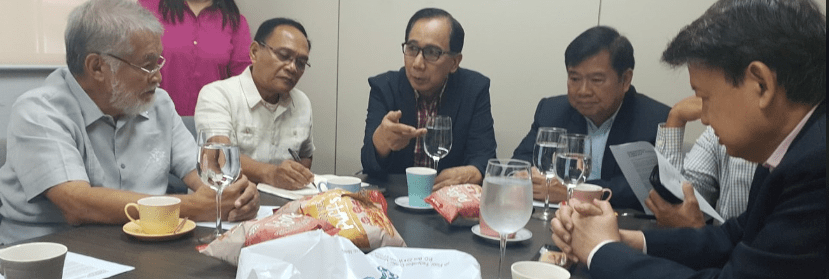
PCAFI led by Danilo V. Fausto (second from right) meets with Department of Agriculture Secretary William D. Dar (third from right)

   It is important to allocate budget for logistics to move fish and agriculture goods, not only in Luzon, but in Mindanao.

   “A lot of these products are wasted due to suspension of airline operation, difficulty in the land transport of perishable fruits, vegetables, fish, meat (specifically pork) and including fingerlings. Since these products are highly perishable, they need enhancement for cold chain support (refrigerated trucks),” said Fausto.

   Budget for artificial insemination (AI) in reproducing livestock and for controlling ASF (African swine flu) is also important.

   “There is an obvious slant towards rice and corn. Aside from rice, livestock, fishery and aqua need help. The ASF task force are running out of kits and lack veterinarians to monitor the livestock industry. There is a need to provide support on a consistent manner not only when disease outbreaks occur.”

   PCAFI also asked government to channel a P1.5 billion budget to more “value added” dairy, poultry, hogs, fisheries, and feed crops. 

   This P1.5 billion budget is originally proposed for urban agriculture and  protective personal equipment (P500 million each);  corn for food project (P300 million; and information, education and communications (P200 million).

   “We would like to recommend that portions thereof be transferred to dairy, poultry, hogs, fisheries, and feed crops. These sectors have been hit hard by the ECQ (enhanced community quarantine) with the closure or limited working hours of food outlets and will continue to suffer losses even under a GCQ (general community quarantine,” said Fausto.

   To maximize productivity that will generate higher income for farmers and enable them to contribute to higher GDP (gross domestic product), these are proposed by PCAFI under government’s “Ahon Lahat, Pagkaing Sapat (ALPAS) Kontra sa COVID-19“:

  • Programs that will encourage meat processors to use local supply, requiring minimum inclusion of local producers
  • Inclusion of stimulus budget for agricultural producers, processors and suppliers of raw materials for high value fruits, vegetables and other commodities for export and local markets
  • Programs to make corn (for animal feed) more competitive even during rainy season to ensure consistent supply and quality to the poultry or livestock sectors
  • Production of feed grade animal feeds including copra and coconut oil, palm oil, and production of fish oil and fish meal as an alternative to the imported soybean meal for protein content of feeds
  • Establishment of more laboratories to be accredited at strategic locations due to GCQ (General Community Quarantine) reason

   “Credit guarantees should be focused towards the agriculture sector where banks shied away due to the risk inherent to food production. Guarantees should also be provided for suppliers of inputs who provide credit to farmer producers especially the small and medium livestock owners majority of which are asking for a reprieve on their payables due to huge losses,” Fausto said

Equal attention should be provided in budgeting for the following.

  • Improvement of irrigation system
  • Fertilizers to sustain and increase crop and vegetable production
  • Start-up planning and showcasing of “Balik Probinsya” resettlement and inclusive agribusiness under government and private sector partnership
  • To encourage investment in rice production, the Philippine Crop Insurance Corporation should provide insurance “unconditionally” to palay producers guaranteeing the return of capital (at say P 45,000.00 per hectare) in case of natural calamities

   “Price support and subsidy should be provided to rice farmers guaranteeing minimum purchase price of palay at P17 per kilo.”

   This was reportedly the original breakdown for the P32 budget under which rice continues to take up the biggest chunk of the budget:

P 8.5 billion – rice resiliency project

P 7  billion – palay procurement fund of the National Food Authority

P 3 billion – expanded SURE Aid and recovery  (loan to farmers at zero interest)

P 3 billion – expanded agriculture insurance

P3 billion – social amelioration for farmers and farm workers

P 1 billion – upscaling of KADIWA ni Ani at Kita

P1 billion – integrated livestock and corn resiliency project

P1 billion – expanded small ruminants and poultry project; i)

P1billion– coconut-based diversification

P 1  billion- fisheries resiliency project

P 1 billion–revitalized gulayan

P 500 million – urban agriculture

P500 million– acquisition of protective personal equipment

P 300 million – corn for food project

P 200 M – information, education and communications project

   The letter was also sent to ESRP Cluster co-chairpersons, Rep. Sharon S. Garin and Rep. Stella Luz A. Quimbo, and Agriculture and Food chairperson Wilfrido Mark M. Enverga. (Melody Mendoza Aguiba)

Emergency trading centers in barangays urged to be put up by govt to to ensure consumers healthful food amid Covid 19

March 30, 2020

As vegetables and other farm produce are left wasted due amid Covid 19 lockdown, the private sector urged government to put up “emergency” trading centers down to the barangay to ensure consumers supply of healthful food.

   The Philippine Chamber of Agriculture and Food (PCAFI) said the establishment of emergency testing centers is “urgent” as vegetables in Benguet are getting wasted away as many roads in barangays have been blocked due to Covid 19.

   Food producers should also be allowed to take the lead in this supply system so as to widen participation in the distribution of needed goods—ensuring food security. 

   “Emergency trading centers  in barangays and subdivisions nearest to consumers will give people access to the food they need while enhanced community quarantine is in effect. Mobile and rolling stores should be immediately dispatched. The agribusiness sector, unhampered, must take the lead,” said PCAFI President Danilo V. Fausto.

PCAFI led by Danilo V. Fausto, president, together with Department of Agriculture Secretary William D. Dar

The trading centers will supply more nutrients to Filipino consumers than just what is available in canned goods which are what is being distributed by barangays.

   The emergency trading centers will also spare farmers from further impoverished situation amid Covid 19. The same trading centers will also be used as place for sorting, packaging, marketing, and delivery of farm produce whenever found in food-producing areas.

   “Marketing, distribution and delivery efforts should be augmented with the help of government, the LGUs, and even by the military to ensure that food reaches the consumers and market of the farmers’ produced is assured.”

   Amid the consequential crisis from the pandemic,   PCAFI also stressed the nation should not forget existing quarantine measures against the African swine fever (ASF), among others, as this may be neglected.

    “Complications on quarantine protocol: ASF for swine, Avian Flu for poultry and Fall army worm for corn could be left unattended due to the pandemic on COVID-19.

   “Some local government units (LGUs) are defiant to the executive orders and laws that were promulgated to ensure safety and availability of food for their constituents. LGUs should be forced, with the help of the police and military to let go of their excess food produced in their area in order to ensure their availability to other parts of the country.”

   These are other concerns PCAFI urged to be implemented:

  1. The value chain should be left unhampered. Production and agribusiness should be protected and supported and their operations encouraged to normalize and allow free flow of goods and services to feed the people
  2.  Value chain requires the needed manpower in the supermarkets like drivers and helpers, merchandisers. They should not be blocked at the checkpoints. Factories producing the packaging materials should be allowed to operate.
  3. Production inputs like chicks, piglets, fingerlings, seeds, feeds, fertilizer and irrigation should be made available and its delivery to the farmer producers assured this coming production and planting season. Failure to do this, there will be no new planting and production for the next season and will result in shortage of food for the next semester and Christmas season.
  4. The food flow should start from the community or barangay to feed the people in the particular barangay. Any excess from the production in the barangay, it should be exported to the other barangays, municipalities, city or province, and make the farm produce available to areas where there are none.
  5. Ready market should be provided to the current farm harvest and income should be guaranteed for the farmer producers. If markets and income will not be assured, farmers will stop producing for the next cropping season (both for rice, vegetables, meat, poultry and fish).
  6. Farm produce should be able to reach the consumers. In the absence of traders to bridge the gap between the producers and consumers, the government should intervene to provide logistical requirements, delivery system and marketing support for the producers. Melody Mendoza Aguiba

Private sector fears threat of massive buyout of farm land due to REIT revisions

March 16, 2020

The private sector has expressed fear over imminent threat of massive buyout of farm land arising from the revisions in the Real Estate Investment Trust Act (REIT) that could leave more farmers jobless.

   Despite envisioned intensified economic development to be brought by the revised REIT Act of 2009, the Philippine Chamber of Agriculture and Food Inc. (PCAFI) has expressed fear over imminent destruction of agricultural lands.  These can be the cheapest land up for sale for developers.

   “The REIT is a mode of floating in the stock market shares of properties. The (revised) law is now reducing public ownership of a REIT to 33 percent (enabling increased control of private companies).  Therefore all developers – Ayala, Megaworld, Vistaland, Robinson’s Land—everybody is now up to develop more lands,” said PCAFI President Danilo V. Fausto.

   “You will see massive acquisition of land— (possibly even including big farm lands) in Central Luzon.  Where will they get the land? From farmers losing in rice.”

Private agriculture sector leaders led by PCAFI President Danilo V. Fausto (second from left) push for agro-industrial development with Trade Secretary Ramon Lopez (leftmost) as audience.

   Incidentally, the Rice Tariffication Act (RTA) implemented last year appears to be supporting REIT as it has rendered many rice Filipino farmers bankrupt.

   “What is happening is there will be malls inside a vast track of land. In the next century, there will no more be land for food,” he said.

   The revised REIT IRR took effect last February 7. The law, as of 2011, was imposing upon REITs to offer shares to public a minimum of 40 percent of the outstanding capital stock for the first year.  This minimum public ownership (MPO) should be raised to 67 percent within three years from listing.

   However, this high MPO discouraged land developers as they would barely have control over the venture with a measly 33 percent.

   But the revision now encourages massive real estate development. However, this makes a despicable picture for farms.

   Therefore, PCAFI is pressing government to offer a compromise by raising investments in farm development.

   Fausto said government should give agriculture a similar support since it is the backbone of the economy and is a source of raw materials for industrial development.

   Particularly, government should pour money into guarantee for farm production in order to encourage banks and investors to lend to agriculture.  

   “The government should also develop farm lands (along with real estate lands). You look at the housing sector.  It receives P180 billion in guarantee.  But how much is the guarantee for agriculture? Only P5 billion. So, I’m asking them (policymakers), ‘Can you eat concrete walls?’”

   While government is investing huge amount for Build Build Build including farm-to-market roads, this will just lead to massive conversion of farm lands into residential-and commercial lands without the support for farm production.

   “Farm-to-market roads accelerate delivery of produce to market.  But if you do not have goods to deliver, you will just accelerate sale of farm lands to real estate developers,” said Fausto.

   “The REIT  is a massive accumulation of capital to develop lands. We can’t stop that anymore.  But why don’t we have a balance? Let’s develop lands, but also develop agriculture production so you can feed people in call centers,” he said.

   PCAFI is also pushing for the immediate passage of the Land Use Act which will prevent massive conversion of agricultural lands into residential-commercial areas.  

   Conversion is feared even of irrigated areas where government already put in huge investments.

   Unfortunately,even irrigated areas are subject to threat of  conversion into residential-commercial areas just by the passage of an ordinance by local government officials.

   Fausto said the Land Use Act will solidify the presence of investors in agriculture.

   “Our investors will have stability with Land Use Act. They’re putting in millions and billions in investments.  But at the end of the day, their land may be converted because we don’t have a proper land use law.  Lands that are perfectly productive should remain producing food for our country,” said Fausto.

   Without the Land Use Act, farm companies that invest huge amount for poultry or livestock farms and processing facilities may suffer losses from land conversion ordinances recklessly issued by influential government officials.  Melody Mendoza Aguiba

Legal regime for rice sector, special safeguards duty, pushed as import suspension is “illegal”

The private sector has stood pat in its support for a “legal” regime in rice sector via issuance of special safeguard duty (SSG) on imports despite import suspension’s temporary relief from influx of imported rice.

   The Philippine Chamber of Agriculture and Food Inc (PCAFI) asserted the SSG measure, with the benefit of being sanctioned by Republic Act 11203, the Rice Tarrification Act, still needs to be implemented by January or February 2020.

   This is to ensure imports will not coincide with harvest by dry season  in March to April 2020, the peak harvest of the 2-season crop.  It will help support farmgate price of palay (unhusked rice) to at least P17 per kilo.

   “It takes 30 to 60 days to implement the law.  So it should be issued January-February.  A suspension is against the prevailing law on ‘no QR’ (quantative restriction),” said PCAFI President Danilo V. Fausto,” a dairy entrepreneur who also plants rice.

   As the SSG is ideally issued just for that dry harvest window, the SSG may also be immediately lifted once harvest is finished.

   The benefit of SSG, aside from being sanctioned by section 10 of RA 11203, is it automatically puts a cap on imports as price of imported rice becomes at parity with local prices, making Filipino farmers’ rice competitive.

   PCAFI has maintained the needed duty on imported rice is 70%. At rice’s world market price of $360 per metric ton, imported rice’s landed cost stands at P17 per kilo which makes it hit a P32-P34 per kilo retail price, just matching domestic produce, when added with 70% duty and traders’ margin.

   With imported price just matching domestic rice produce, traders will opt to rather defer importation as imports lose price advantage of the locals.

   While worried about its inflationary effect, PCAFI brushed aside such fear of inflation amid SSG implementation.

   Even if domestic rice price inches up a little due to a little higher rice price for consumers, inflation may just hit just 1.3%.  This is much within government’s targeted 2-4% limit.  Yet this will do a huge help of rescue for Filipino farmers, said Fausto.

   Section 10 of RA 11203 states  “In order to protect the Philippine rice industry from sudden or extreme price fluctuations, a special safeguard duty on rice shall be imposed in accordance with R.A. No. 8800, otherwise known as the ‘Safeguard Measures Act’ and its implementing rules and regulations.” (Melody Mendoza Aguiba)

Govt to face court suits for abandoning safeguards amid Hitlerian reasoning it’s to benefit 108 million Filipinos vs “only” 10 million farmers

October 20, 2019

The private sector has warned government of possible lawsuits for “illegally” refusing to enforce the “mandated” safeguards against rice imports in Nazi-like reasoning that it is a choice between “105 million Filipinos versus 10 million farmers.”

   The Philippine Chamber of Agriculture & Food (PCAFI) said the Department of Agriculture (DA) and government’s economic managers are committing an “illegal act” for deliberate abandonment of its poorest sector despite claims of “inclusive” development.

   It is explicitly indicated in Section 10 Republic Act 11203 (Rice Tarrification Law ) Section 10 that “in order to protect the Philippine rice industry from extreme price fluctuations, a special safeguard duty—SSG– on rice shall be imposed.”

   As such it is incumbent upon government to enforce the safeguards legal mandate.

   “Although it is not their (DA and economic managers) intention, but the argument that we should choose 105 million Filipinos as against 10 million farmers (psa.gov.ph, 2018)  is like Hitler justifying the killing of six million German Jews to save the German Aryan nation.

   “They have yet to effectively implement the Rice Competitiveness Enhancement Fund, but they led them to slaughter,” said Lawyer Elias Jose M. Inciong, PCAFI director.

   PCAFI President Danilo V. Fausto said granting farmers an additional P3 billion cash assistance in place of implementing SSG on rice imports is tantamount to “violating the law” itself.

   This may subject government authorities to court suits.

“That is a clear analogy that like the German Nazi and Hitler, you are willing to slaughter 10 million farmers to save 105 million consumers. But farmers are also consumers. That’s why inflation is just at 0.9 percent because farmers don’t have the money to buy. Demand is low,” said Fausto.

   The DA and economic managers are misleading the public by claiming implementing SSG is inflationary.

   “This is a diversionary tactic to protect those who benefited from this law which are importers. The ones favored by this law are not consumers, much more not farmers, but importers.  They’re trying to divert us from the fact that so far the importers are the beneficiaries of the law,” said Inciong.

   It is utterly unfair that government is insulting its own farmers by giving a cash consolation of P3 billion (as earlier announced by DA) in place of the safeguards mandate. 

   “The government really looks down on farmers.  It is in bad faith to even argue that safeguards are inflationary.  They’re in bad faith for refusing to implement the law,” said Inciong.

   “The law mandates Section 10 of RA 11203, meaning the executive has no choice but to impose it.  The meaning of impose is to establish the mechanism,” said Inciong, a lawyer and also president of the United Broiler Raisers Association some of whose farmer-members are planting rice.

  Government should start having a new perspective on farmers.

   “Farmers don’t plant to save the agriculture industry.  They plant to sustain their livelihood, to have income.  The government should now see farmers not as welfare beneficiaries, but as a business sector that needs to profit,” Fausto said.

   Inciong said government’s task under the law is simply to come up with a mechanism implementing the SSG based on either price or volume triggers. 

   If, for instance, the trigger price is set at P35 per kilo and the landed price of imported rice hits below P35, an SSG should automatically be implemented. The lower it is from the trigger price, the bigger the duties to be imposed.

   “The only thing DA has to do is to issue an order requesting the Commissioner of Customs through the Department of Finance. It is in bad faith to say it is inflationary because they can suspend the SSG anytime.  That claim has no credence,” said Inciong.

   Unfortunately, DA is apparently refusing to even come up with this mechanism.

   “The way the law was crafted and in practice, when you say impose, you establish the mechanism. The mechanism is to find out what is the trigger– when to apply the special safeguard, either price or volume trigger”

   So far, the indicative volume trigger of rice imports must have already been hit as “we only need 1.9 million tons of imports, but our importation has already hit 3 million tons according to (DA Secretary William) Dar himself,” said Fausto.(Melody Mendoza Aguiba)

Sugar supply stabilization, not import liberalization, sought by food/agriculture processors, 105,000 MT allocation asked

October 14, 2019

Food and agriculture processors have asked for a sugar import allocation of an estimated 105,000 metric tons (MT) annually to stabilize their manufacturing input and raise their global competitiveness with heftily lower cost.

   The Philippine Chamber of Agriculture & Food Inc (PCAFI) and member  Philippine Food Processors &  Exporters Organization (Philfoodex) is asking Agriculture Secretary William D. Dar to grant a maximum of 10% sugar import allocation.

   This is out of the country’s annual sugar production placed at 2.1 million MT.  However, even just half of this amount, or 105,000 MT will be good enough to significantly raise food processors’ global competitiveness.

   It will cut sugar cost for food manufacturing from P55-P60 per kilo locally to P28-P30 per kilo in other South East Asian countries, particularly Thailand.

   PCAFI President Danilo V Fausto said this petition of PCAFI and PHilfoodex for an import allocation will be accompanied by an implementation mechanism to ensure it does not adversely affect local sugar farmers’ plight.

   “We’ll issue a petition to be submitted to Secretary Dar and President (Rodrigo) Duterte. We will also propose an implementation mechanism that will ensure this allocation will not go to the retail market but rather help our food producers become competitive,” said Fausto.

   Philfoodex President Roberto C. Amores said not even the entire 10% of production will be asked by processors.

   Initially, only 50% of each company’s sugar requirement based on its production program is proposed to be granted to the company.

   “We’re not talking about even 10% of the 2.1 million.  We’re not requesting for liberalization. We’re requesting for import allocation for stabilization for the cause of processors,” Amores said.

   “As a processor, you will submit your requirements based on your production program and sales. And you will be given only 50% of your requirement (not 100%).”

   This initial allocation per processor will establish credibility of the processor. 

   The processor should  guarantee that the sugar import will be used solely as input for its food manufacturing, not for retail to the domestic market (adversely affecting sugar farmers’ income).

   Dr. Rolandy Dy, Center for Food & Agribusiness (University of Asia & the Pacific) chief and PCAFI member, said the sugar import allocation for local food processors is necessary.

   “We’re not competitive.  Never mind (if we’re not competitive in) softdrinks which is not exportable because softdrinks are heavy. The problem is we’re not competitive in products like biscuits, candies,” said Dy.

   Filipino food processors can hardly compete with ASEAN biscuit manufacturers.

   “I’m talking about those 4,500 food processors who are paying P55 versus P28. When Apollo biscuits from Malaysia (or Indonesia) arrive here, it’s only P10. Pero pag gumawa si Mang Pandoy ng Apollo biscuits nya, P15 ang puhunan nya,” said Amores.

   (If Filipino businessman Mang Pandoy produces his own Apollo biscuit, his cost is at P15).

   Some groups have opposed such allocation due to past experiences when some imports for manufacturing input have been diverted to the domestic market. 

   This concerns not only sugar, but other imports such as carabeef (carabao meat from India).

   But a proven effective mechanism to control such diversion is to make the food manufacturers themselves to police their ranks, PCAFI said.

   Fausto said members of PCAFI, Philfoodex, and the Philippine Chamber of Commerce and Industries (PCCI) may be tasked to monitor if the import allocation is being diverted to the market.

   Amores stressed food processors’ import need is not for liberalization.

   “I would like to correct the impression that this is liberalization. The sugar industry in Negros has been writing all over the news that the private sector led by me is espousing liberalization. It’s not,” he said.

   “We all know that since our sugar sector is not competitive, we can’t be self-sufficient in sugar as sugar area is declining.  But we have to admit some traders are riding on this issue in the guise of protecting farmers.”

   Also, it is initially proposed that the state-owned Philippine International Trading Corp (PITC) be the one to do the importation.

   Philfoodex lamented that while the Sugar Regulatory Administration (SRA) had once approved sugar importation for 170,000 MT, this volume has not benefited food processors.

   Since SRA issued a memorandum allowing this volume to be designated as “reserve,” some of this sugar found their way into the domestic market since reserve sugar is allowed to be released domestically.

   “But we have not benefitted from this allocation,” said Amores. (Melody Mendoza Aguiba)

70% rice tariff, urgent rice safeguards implementation asked

October 2, 2019         

A rice tariff of at least 70%, as sanctioned by the Rice Tariffication Law’s (RTL) safeguards provision, was pressed to be urgently implemented by government to arrest further imports hitting beyond all-time high records, saving Filipino farmers.

   The safeguards will also save government from needing to spend huge funds for conditional cash transfer or farmers’ loan, now placed by Department of Agriculture (DA) at P15 billion, just to spare Filipino farmers from serious economic damage.

   The private sector, representing thousands of Filipino farmers under its wings in the supply chain, has pegged desired rice tariff to at least 70% in order to beef up global competitiveness of  Filipino produce.

   At the same time, the Philippine Chamber of Agriculture& Food Inc. (PCAFI) asserted that it strongly supports the RTL, contrary to what may be perceived by some groups.

   “We are supporting the law. Therefore let’s implement the law. We want the law, that’s why we want it implemented,” said PCAFI President Danilo V. Fausto.

    PCAFI warned the continuous influx of cheap imported rice may threaten the country’s national security, prompting hungry farmers in the rural areas to resort to joining communist rebels.

   “We have to assess the situation because any further damage may affect our national security.”

   Unlike the position of some groups adversely affected by the RTL, Fausto said PCAFI wants RTL upheld through immediate implementation of its explicit provisions.

   “We’re not asking for a repeal of the law or an amendment of the law.  And if the law says, section 10 of Republic Act there are safeguards, let’s implement it.”

   A tariff rate of at least 70 percent should be reasonable enough to give the Filipino farmers at least the “temporary” yet extra edge against imports.

   “Our palay price is now at around P12 per kilo. But NFA should buy it at P17 (to aid farmers).  At that buying price, it will sell in the retail market at P34 per kilo, when milled.  Then domestic rice will even out with the imported at P34,” said Fausto.

   With price of both domestic and imported rice at same level, “why would you bother importing?”

   Ernesto Ordonez, PCAFI trustee and Agri Fisheries Alliance (AFA) chairman, said the imposition of safeguards from the current 35% level is urgent even as there are trade notification rules involved.

   AFA is composed of five sectors: farmers and fisherfolk, (Alyansa Agrikultura-AA), agribusiness, PCAFI, science and technology (Coalition for Agriculture Modernization in the Philippines – CAMP), rural women (Pambansang Kilusan ng Kababaihan sa Kanayunan – PKKK), and multisectors (Agrifisheries 2025 – AF2025). 

   “We do not want a repeat of the mistake during the 1990’s when we agreed to the too rapid tariff reduction without giving the farmers the necessary support services and the WTO-approved safeguard measures,” said Ordonez.

   Ordonez cited the Department of Agriculture September 9 national survey where imported rice with the 35% tariff caused farmgate wet palay prices in Regions 2, 3, 11 averaged P12.10 a kilo, barely above the P12 production cost.

   CAMP President Emil Javier favored measures like cash transfers and assistance in credit, technology, and marketing.

   AFA stated it rejects calls for a return to government rice import monopoly and supports food security instead of food self-sufficiency.

   “In areas where rice production is not competitive, the government must provide assistance for transition to higher value crops,” said Ordonez.

   The tariff protection under safeguards will just be a temporary, a transitory, policy, PCAFI asserted.

   “DA should immediately implement it as promised it should be by October 1.  Anyway, that will just  temporary, while we’re trying to give our farmers time to upgrade their competitiveness.”

   Now at 2.4 to 2.5 million MT (MT), imports must immediately be curbed.  The Foreign Agricultural Service (USDA)  placed projected import for the year to hit 2.6 million MT.

   Fausto said even a P34 against P34 per kilo Filipino against import price will be enough.

   Imported rice is currently being traded at around P17 per kilo.  With trader’s overhead, it rises to P20 per kilo, and finally to P27, P28 per kilo in the retail market (with logistics costs). 

  “But imported rice should be at least equal the local market price.  That will make them lose over domestic rice.  Now, NFA should ensure farmers dictate the buying price of palay at P17 per kilo for dry and P13, P14 per kilo for wet.”

   PCAFI Trustee Elias Inciong is questioned why some groups may be opposing the safeguards implementation even if they are representing sectors that are not rice-related as compared to suffering rice farmers.

   “They don’t want higher tariff?  Why?  Because it will affect consumers? (or their businesses?)”

   But PCAFI, some of whose members themselves plant rice in poverty stricken, rural areas, want more protection for precious but few Filipino farmers that remain sustaining to raise the country’s food security.

   Under Republic Act 880, the Safeguard Measures Act, safeguards may be imposed in the following conditions (Rule 2.2a-c) all of which conditions are reported to have been happening after the RTL implementation:

  • significant idling of productive facilities in the domestic industry including the closure of plants (rice mills) or underutilization of production capacity
  • inability of a significant number of firms to carry out domestic production at a profit
  • significant unemployment or underemployment within the domestic industry.

Suspension of pork imports asked until “genuine” quarantine system that ensures tariff/duties collection is in place

September 21, 2019                                                                        

The Philippine Chamber of Agriculture and Food Inc. (PCAFI) supports the call of the Samahan ng Industriya sa Agrikultura (SIK) for government to suspend importation of pork until a genuine quarantine system is in place at Customs borders.

   That policy will not only ensure animal protection from infection of the dreaded African swine fever (ASF). It will also ensure that proper tariffs and duties are paid.

   The government—the Bureau of Customs (BOC)—currently does not have the full capability to carry out strict biosecurity system that will guarantee that no imported meat products infected with ASF will enter the country.

   These BOC deficiencies include the absence of  refrigerated facilities where the meat products may be adequately inspected for quarantine systems by the Bureau of Animal Industry (BAI) and the system for proper collection of tariffs and duties.

   These deficiencies derail implementation of proper  animal and food safety along with proper revenue collection from meat imports.

   “The current ‘make-do’ second border system inside the cold storage facility of the importer is meaningless in terms of proper collection of tariffs and duties, quarantine and food safety,” said PCAFI President Danilo V. Fausto.

   Such government practice of allowing meat imports to be directly transported to warehouse of importers before these are evaluated for quarantine procedures and charged with tariffs and duties have long been questioned by agriculture stakeholders.

   “The Bureau of Customs has no refrigerated facilities within the  Port of Manila which has prevented the Bureau of Animal Industry (BAI) from implementing quarantine protocols,” Fausto said.

   Poultry and livestock industry stakeholders have long recommended that all meat imports should just go through a single port with the necessary facilities for a full quarantine process.

   The agriculture stakeholders have asserted government’s role in implementing biosecurity systems against ASF will be crucial. 

   Likewise, all local government units (LGUs) should consistently impose on all backyard hog raisers to obtain business permit for their operations even as some LGUs do not even know that hog backyard raisers exist in their jurisdiction. 

   LGUs will have a critical role in this biosecurity system considering that nearly 70 percent of all hog production in the Philippines comes from backyard raisers. 

   “LGUs should be held liable on the control of African swine fever within their area,” said Fausto.

   At the same time, even sari-sari store operators should be monitored for keeping business permits through which a system may be implemented on controlling consumption of meat that may be affected by the disease. 

Stricter biosecurity measure on pigs urged by PCAFI after hog disposal in Marikina river

Stricter biosecurity measure on pigs urged by PCAFI after hog disposal in Marikina river

September 13, 2019

The private sector has urged government to implement stricter biosecurity measures against the spread of Asian swine fever (ASF) on hogs but also assured consumers that humans cannot be infected by the disease.

   The Philippine Chamber of Agriculture and Food (PCAFI) urged the Department of Agriculture (DA) and local government units (LGU) to intensify implementation of protocol in disposing of dead hogs.  This as some of the dead hogs suspected of having been infected by ASF have been found floating in the Marikina River.   

   “Offenders should be prosecuted as this is apparently a violation of certain memorandum act of DA regarding the disposal of dead hogs,” said PCAFI President Danilo V. Fausto.  “Stricter implementation of biosecurity procedures should be observed.”

   At the same time, Fausto said there should also be more information program declaring the scare against hog consumption since ASF does not adversely affect human health.

   “People should not be afraid of ASF,” said Fausto.

   Edwin Chen, president of PCAFI member Pork Producers Federation of the Phils (Propork), said hog raisers, particularly those from small backyards, should be advised to observe proper disposal of dead hogs.

   “If the farm is in the backyard, the hogs (affected by the disease) should be culled first then buried immediately outside the farm at a depth (that may not be disturbed by other animals.) Depending on the number, it should be within a certain depth, maybe two meters if there are only a few.”

   “In commercial farms or in a locality, DA people have a designated areas for burying these. The site should not be near a waterway or a creek.”

   DA spokesman Noel Reyes said government will be prosecuting offenders on the handling of dead hogs based on the Animal Welfare Act and the Solid Waste Management Law.

   There are several other ways of controlling spread of ASF, according to authorities. The Disease and Welfare guide of the Pigsite.com advises the following:

  • Prevention of feeding of contaminated feed and contaminated food waste used to supplement hog feed
  • Control of the animals from the bites of soft bodied ticks, lies and flies
  • Prevention of inoculation of the pigs with contaminated syringes and use of contaminated surgical equipment
  • Prevention of introduction of infected pigs with uninfected ones. (Melody M. Aguiba)
  •